The Short Answer: What Are the Main Electric Vehicle Components?
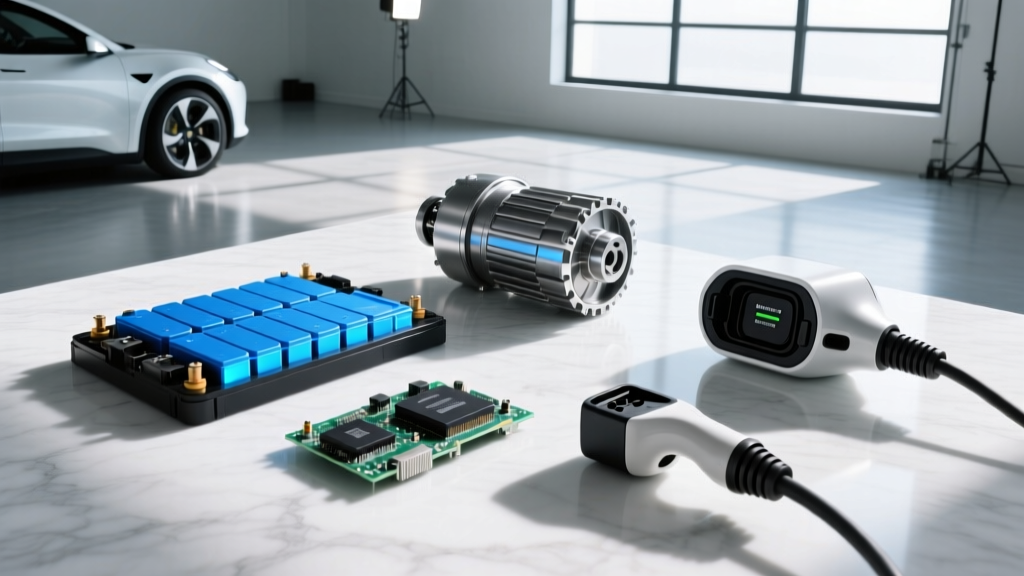
Every battery-electric vehicle (BEV) relies on five core components: a traction battery pack (measured in kWh of usable energy), one or more electric motors (measured in horsepower or kW output), a power inverter (converts DC battery power to AC motor power), an onboard charger (converts AC grid power to DC for the battery, rated in kW), and a thermal management system (liquid cooling/heating to protect the battery and optimize charging). Unlike a gas car with hundreds of moving parts in its engine and transmission, a BEV's drivetrain has roughly 20 moving components — which is why EV maintenance costs average $0.061 per mile versus $0.101 for gas vehicles according to the EPA. Understanding these components directly determines what range you'll actually get, how fast you can charge, and what you'll pay over five years of ownership.
The Traction Battery: Chemistry, Capacity, and Real-World Range
The battery pack is the single most expensive electric vehicle component, typically accounting for 30–40% of a new EV's MSRP. In 2026, most mainstream BEVs use one of two lithium-ion chemistries:
| Attribute | LFP (Lithium Iron Phosphate) | NMC/NCA (Nickel Manganese Cobalt / Nickel Cobalt Aluminum) |
|---|---|---|
| Energy Density | Lower (~160 Wh/kg cell-level) | Higher (~250–300 Wh/kg cell-level) |
| Typical Usable Capacity | 50–77 kWh (e.g., Tesla Model 3 RWD: 57.5 kWh) | 72–100+ kWh (e.g., Hyundai Ioniq 5: 77.4 kWh; Rivian R1S: 106 kWh) |
| Cycle Life | 3,000–5,000+ cycles to 80% SoH | 1,000–2,000 cycles to 80% SoH |
| Cold-Weather Performance | Greater range loss (~30–40% at 20°F) | Moderate range loss (~20–30% at 20°F) |
| Recommended Daily Charge Limit | 100% (LFP tolerates full SoC well) | 80% for daily use; 100% only for trips |
| Cost Advantage | No cobalt/nickel — lower raw-material cost | Higher material cost but more range per pound |
EPA Sticker vs. Real-World Range: Why Chemistry Matters
The EPA range figure on the window sticker assumes a mix of city and highway driving at moderate temperatures. In practice, a 2026 Hyundai Ioniq 5 SEL (NMC, 77.4 kWh usable, EPA 310 miles) will deliver roughly 250–270 miles on a sustained 75-mph highway trip and as low as 210–230 miles at 20°F with cabin heat. An LFP-equipped Tesla Model 3 RWD (EPA 272 miles) may see 170–190 miles in deep cold due to LFP's higher cold-weather sensitivity. Always budget 20–30% below the EPA number for highway road-trip planning.
Battery degradation is real but slower than most first-time buyers fear. Data aggregated from fleet telematics shows that most NMC packs retain 90–93% State of Health (SoH) after 100,000 miles, while LFP packs often exceed 95% SoH at the same mileage. Federal law mandates that EV battery warranties cover at least 8 years / 100,000 miles with a capacity-retention threshold (typically 70% of original capacity). Hyundai, Kia, and Genesis extend this to 10 years / 100,000 miles.
Electric Motors and the Power Inverter
Where a gas engine needs a multi-speed transmission, most EVs use a single-speed reduction gear paired with one or two electric motors. The two dominant motor types in 2026 BEVs are:
- Permanent Magnet Synchronous Motor (PMSM): Higher efficiency (~95–97%), used in most Tesla, Hyundai, and BMW models. Relies on rare-earth magnets (neodymium).
- AC Induction Motor: Slightly lower peak efficiency but no rare-earth materials, excellent at high RPM. Often used as the front motor in dual-motor AWD setups (e.g., Tesla Model Y Long Range front unit) because it can freewheel with zero drag when not needed.
The power inverter sits between the battery and the motor, converting the battery's DC output to the AC waveform the motor needs. Modern silicon-carbide (SiC) inverters — now standard in vehicles like the Hyundai Ioniq 5, Lucid Air, and Tesla Model 3 Highland — operate at higher voltages (800V architectures) and switch faster, reducing energy loss by 2–4% compared to older silicon IGBT inverters. That efficiency gain translates directly into roughly 5–10 additional miles of EPA range on a 300-mile pack.
Onboard Charger and DC Fast Charging: The kW Numbers That Matter
The onboard charger is the electric vehicle component that governs how fast you can charge at home on a Level 2 AC circuit. Most 2026 BEVs include an 11.5 kW onboard charger (48 amps on a 60-amp circuit), adding roughly 35–44 miles of range per hour. Some budget trims — like the base Nissan LEAF — still ship with a 6.6 kW unit.
| Level | Power (kW) | Typical Miles Added per Hour | Component Involved |
|---|---|---|---|
| Level 1 (120V household) | 1.0–1.4 kW | 3–5 mi/hr | Onboard charger |
| Level 2 (240V home/public) | 7.2–11.5 kW | 25–44 mi/hr | Onboard charger |
| DC Fast Charge (public) | 50–350 kW | 150–1,200+ mi/hr (peak) | Bypasses onboard charger; DC direct to battery via BMS |
For DC fast charging, the onboard charger is bypassed entirely — the station delivers DC power straight to the battery, managed by the vehicle's Battery Management System (BMS). Peak charge rates in 2026 vary widely:
- Hyundai Ioniq 5 (800V architecture): Peak 240 kW, 10–80% in ~18 minutes on a 350 kW charger.
- Tesla Model 3 Long Range: Peak ~250 kW, 10–80% in ~22 minutes on a V3 Supercharger.
- Chevrolet Equinox EV: Peak ~150 kW, 10–80% in ~28 minutes.
Critical real-world caveat: peak kW is not sustained kW. A vehicle advertising 240 kW peak will typically hold that rate only between 10–40% State of Charge, then taper progressively. Above 80% SoC, charging slows dramatically to protect cell longevity — often dropping below 50 kW. This is why most road-trip charging strategies target 10–80% stops rather than full charges.
Thermal Management: The Component Most Buyers Overlook
Liquid thermal management — a network of coolant loops, heat pumps, and resistive heaters — is the electric vehicle component that most separates a good EV from a frustrating one in extreme climates.
Heat pumps (standard on the Hyundai Ioniq 5, Tesla Model Y, BMW i4, and most 2026 BEVs above $40,000) scavenge ambient heat and waste heat from the motor to warm the cabin, using roughly 50% less energy than a resistive PTC heater in temperatures between 25–50°F. This preserves an estimated 15–25 miles of range on a cold-weather commute.
Battery preconditioning — where the thermal system warms the pack before a DC fast-charging stop — is equally critical. Without preconditioning, a cold battery may accept only 50–70 kW at a 350 kW station. Tesla's navigation-routed preconditioning and Hyundai's similar system can raise charge speeds by 40–60% in cold weather. If you live in a climate where winter temperatures regularly drop below 35°F, prioritize a BEV with both a heat pump and automatic preconditioning.
Cost Breakdown: EV Components vs. Gas-Car Drivetrain Over 5 Years
| Cost Category | Ioniq 5 SEL (BEV) | RAV4 LE AWD (Gas) | Notes |
|---|---|---|---|
| Base MSRP | $45,350 | $32,875 | Before incentives |
| Federal Tax Credit (§30D) | –$7,500 (if eligible) | $0 | Income/MSRP/sourcing rules apply; see IRS §30D |
| Effective Purchase Price | ~$37,850 | $32,875 | Before state rebates, dealer fees |
| Fuel / Electricity (75k mi) | ~$3,375 (home L2 at $0.14/kWh avg) | ~$9,000 (28 MPG combined at $3.36/gal) | Public DC charging costs more (~$0.35–0.50/kWh) |
| Maintenance (75k mi) | ~$1,200 (cabin filter, tire rotation, wiper fluid) | ~$3,750 (oil changes, filters, spark plugs, brake pads) | EV regen braking saves pad wear |
| Insurance (5-yr avg) | ~$9,500 | ~$7,200 | EV premiums run 15–25% higher on average |
| Estimated Depreciation | ~$18,000 | ~$14,500 | EV depreciation has moderated but still trails Toyota retention |
| 5-Year Total | ~$70,925 | ~$67,325 | BEV breaks even around year 6–7 with home charging |
The numbers make clear that home charging access is the single biggest variable in EV ownership economics. At $0.14/kWh residential rates, the Ioniq 5 costs about 4.5 cents per mile to fuel. Relying exclusively on public DC fast charging at $0.42/kWh pushes that to roughly 13.5 cents per mile — nearly matching the RAV4's gas cost. If you cannot install a Level 2 home charger or lack workplace charging, a PHEV like the Toyota RAV4 Prime (42 miles electric-only, 38 MPG combined on gas) may be a more practical bridge.
Common Misconceptions About EV Components
| Myth | Fact |
|---|---|
| "EV batteries need replacing every 5–7 years like a phone." | Modern liquid-cooled packs are warrantied for 8–10 years / 100,000 miles. Fleet data shows median degradation of ~7–10% at 100k miles. Full replacements are rare and typically covered under warranty within the term. |
| "Electric motors wear out like gas engines." | EV motors have one moving part (the rotor) and no combustion stress. They routinely outlast 300,000 miles. The reduction gear fluid may need a change at ~100k miles (~$150–250). |
| "All EVs charge at the same speed." | Peak DC charge rates range from 50 kW (older Nissan LEAF) to 350 kW (Lucid Air, Porsche Taycan). An 800V architecture with SiC inverters can cut 10–80% times nearly in half versus a 400V system. |
| "Regenerative braking eliminates brake maintenance entirely." | Regen dramatically reduces pad wear — many EV owners report original pads at 80,000+ miles — but brake calipers can seize from underuse. Periodic brake inspections and occasional rotor cleaning are still recommended. |
| "Bigger battery = always better." | A 100 kWh pack adds 300–500 lbs, reducing efficiency (mi/kWh). If your daily drive is under 60 miles and you have home charging, a 60–75 kWh pack saves money, weight, and charging time. |
Decision Framework: Which EV Components Should You Prioritize?
If-This-Then-That: Matching Components to Your Driving Life
- If your daily round-trip commute is under 50 miles and you have a garage: Prioritize a smaller LFP battery (55–65 kWh) with an 11.5 kW onboard charger. You'll charge to 100% overnight at home and rarely need DC fast charging. Examples: Tesla Model 3 RWD, base Volvo EX30.
- If you road-trip 3+ times per year over 200 miles: Prioritize peak DC charge rate (≥200 kW) and an 800V architecture. NMC chemistry gives better cold-weather highway range. Examples: Hyundai Ioniq 5, Kia EV6, Porsche Macan EV.
- If you live where winters drop below 25°F regularly: A heat pump is non-negotiable — it saves 15–25 miles of range per cold commute. Battery preconditioning for DC charging is equally important. Examples: Tesla Model Y, Hyundai Ioniq 5, BMW iX.
- If you lack home charging and rely on public infrastructure: Choose an EV with NACS (Tesla connector) access or a CCS adapter to maximize station compatibility. Prioritize vehicles with ≥250 kW peak charge rates to minimize time at public chargers. Consider whether a PHEV better fits your situation.
- If you tow or haul regularly: Expect 40–50% range reduction at highway speeds with a loaded trailer. A larger NMC pack (90+ kWh) and dual-motor AWD are essential. Examples: Ford F-150 Lightning Extended Range, Rivian R1T Dual-Motor Max Pack.
Frequently Asked Questions
How much does it cost to replace an EV battery out of warranty?
Out-of-warranty traction battery replacements in 2026 range from roughly $8,000–$12,000 for a 60 kWh LFP pack (e.g., Tesla Model 3 RWD) to $15,000–$22,000 for a 100+ kWh NMC pack (e.g., GMC Hummer EV, Rivian R1T Max). However, individual module replacement — swapping only degraded sections — is increasingly available and costs $2,000–$5,000. Most owners never face full-pack replacement within the vehicle's useful life.
Do electric vehicle components require scheduled maintenance like a gas car?
EVs eliminate oil changes, spark plugs, timing belts, fuel filters, and exhaust system repairs. Remaining scheduled maintenance includes: cabin air filter ($30–$60 every 20–30k miles), tire rotation ($25–$50 every 7,500 miles — EVs wear tires ~20% faster due to instant torque and heavier weight), brake fluid check, coolant loop service (~every 5 years or 80k miles), and windshield washer fluid. Total annual maintenance averages $200–$400 versus $800–$1,200 for a comparable gas vehicle.
Does the §30D federal tax credit apply to every EV in 2026?
No. Under current IRS §30D rules, eligibility depends on: buyer income caps ($150k single / $300k joint modified AGI), vehicle MSRP caps ($55,000 for sedans / $80,000 for SUVs and trucks), battery component manufacturing in North America, and critical-mineral sourcing from the U.S. or free-trade-agreement partners. The credit can be transferred to the dealer at point of sale as an immediate price reduction. Always verify a specific VIN's eligibility on the IRS clean vehicle report before purchase — sourcing requirements tighten annually.
What is the difference between kW and kWh in EV specs?
This is the most common confusion for new EV buyers. kWh (kilowatt-hours) measures energy capacity — think of it as the size of the fuel tank. A 77.4 kWh battery holds 77.4 kWh of usable energy. kW (kilowatts) measures power — the rate at which energy flows. A 240 kW DC fast charger can deliver energy at a rate of 240 kilowatts at peak, but the rate tapers as the battery fills. Similarly, motor output in kW tells you how much power is available for acceleration (1 kW ≈ 1.34 horsepower).
Should I worry about the onboard charger speed?
Only if you regularly need a full charge at home overnight from a very low State of Charge. An 11.5 kW onboard charger will refill a 77 kWh pack from 10–100% in about 7 hours — adequate for overnight charging on a 60-amp circuit. If your EV ships with a 6.6 kW charger (some budget trims), that same refill takes over 11 hours. For most owners who plug in nightly and only need to replenish 30–50% per session, even 6.6 kW is sufficient.