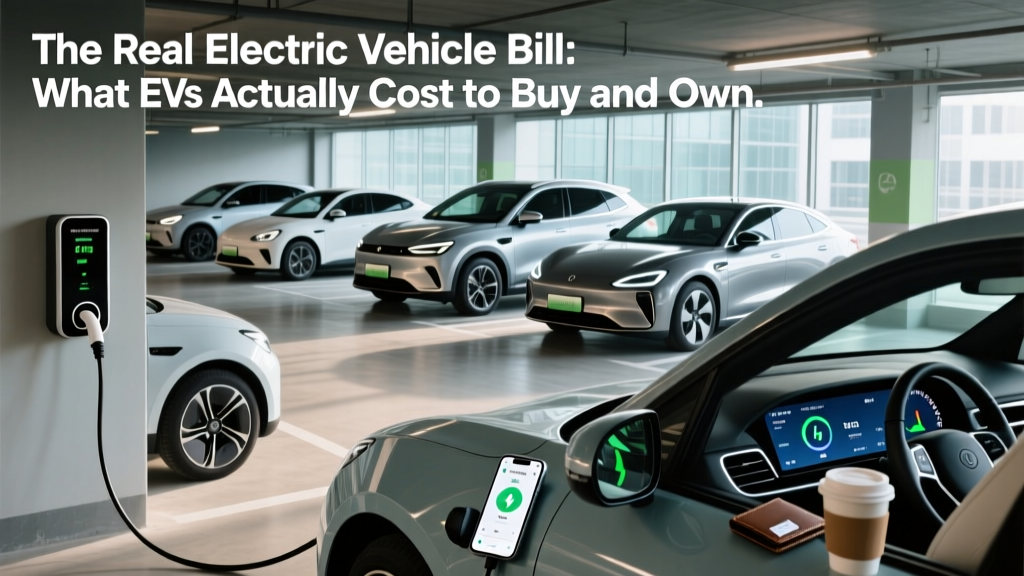
You're considering an electric vehicle, but the sticker price is only the first line item. The real electric vehicle bill includes charging costs, insurance premiums, maintenance savings, depreciation, and tax credits that can shave thousands off your purchase. Most buyers focus on MSRP and miss the total picture — and that's where costly surprises hide.
The Quick Answer
A mid-range EV like the 2026 Hyundai Ioniq 5 (starting at $42,600) costs roughly $0.04–$0.06 per mile to charge at home on a national-average electricity rate of $0.17/kWh, versus $0.12–$0.15 per mile for a comparable gas car at $3.40/gallon. Over five years and 75,000 miles, that's $6,000–$8,250 in fuel savings. But EV insurance runs 15–25% higher, home charger installation adds $800–$2,500, and depreciation varies wildly by model. The true electric vehicle bill depends on your driving patterns, electricity rate, and whether you qualify for the federal §30D tax credit.
Breaking Down the Electric Vehicle Bill: Purchase Price and Incentives
The upfront cost of an EV remains higher than a comparable gas car, but the gap has narrowed significantly. Here's what you're actually paying at the dealership in 2026:
| Vehicle | Base MSRP | Federal §30D Credit | Effective Price | EPA Range |
|---|---|---|---|---|
| 2026 Chevrolet Equinox EV 2LT | $33,600 | Up to $7,500 | ~$26,100 | 319 mi |
| 2026 Hyundai Ioniq 5 SE | $42,600 | Up to $7,500 | ~$35,100 | 318 mi |
| 2026 Tesla Model Y Long Range | $44,990 | Up to $7,500 | ~$37,490 | 320 mi |
| 2026 Toyota RAV4 (gas, XLE AWD) | $32,575 | $0 | $32,575 | N/A (28 MPG combined) |
The §30D federal tax credit can be applied at the point of sale as of 2024 onward, meaning the dealer reduces your purchase price directly. But eligibility is not universal. According to IRS guidelines, you must meet income caps ($150,000 single / $300,000 joint modified AGI), the vehicle must be under MSRP caps ($55,000 for sedans, $80,000 for SUVs/trucks), and the battery must meet critical-mineral and component-sourcing thresholds that tighten annually. Many popular models qualify for the full $7,500; some qualify for $3,750 or nothing depending on the battery's supply chain. Always verify eligibility at fueleconomy.gov before signing paperwork.
Charging Costs vs. Gas: The Biggest Line Item Difference
Fuel is where the electric vehicle bill diverges most dramatically from a gas car. The math depends on two variables: your electricity rate (cents per kWh) and your vehicle's efficiency (kWh per 100 miles).
| Cost Factor | EV (Home Charging) | EV (Public DC Fast) | Gas Car (28 MPG) |
|---|---|---|---|
| Energy/Fuel Rate | $0.17/kWh (national avg) | $0.35–$0.55/kWh | $3.40/gallon |
| Efficiency | 28 kWh/100 mi | 28 kWh/100 mi | 3.57 gal/100 mi |
| Cost Per Mile | $0.048 | $0.10–$0.15 | $0.121 |
| Cost for 15,000 mi/year | $714 | $1,500–$2,310 | $1,821 |
| 5-Year Fuel/Energy Cost | $3,570 | $7,500–$11,550 | $9,105 |
The takeaway is stark: home charging is where the savings live. If you charge primarily at home on a standard residential rate, you'll spend roughly $1,100 less per year than a gas car. But if you rely entirely on public DC fast charging — which can cost $0.40–$0.55/kWh at networks like Electrify America or EVgo — your energy costs can actually exceed gasoline.
This is the single biggest factor first-time buyers underestimate. A 2026 Hyundai Ioniq 5 with its 84 kWh (usable) battery charges from 10–80% in roughly 18 minutes at its peak 240 kW rate. That convenience is incredible on road trips, but paying $0.48/kWh for that session costs about $28 for ~225 miles of range — comparable to filling a gas tank.
Charging Cost Decision Framework
Choose an EV if: You have access to home charging (garage, driveway, or workplace Level 2), your daily commute is under 80 miles, and your electricity rate is below $0.25/kWh. Your per-mile energy cost will be 50–65% less than gas.
Consider a PHEV instead if: You lack reliable home charging, regularly drive over 300 miles between charging opportunities, or live in an apartment without charging infrastructure. A plug-in hybrid like the 2026 Toyota RAV4 Prime (42 mi electric-only, 38 MPG combined after battery depletion) gives you partial EV savings without range dependency.
Stick with gas/hybrid if: You live in a charging desert (rural areas with sparse DC fast-charger coverage), rely on street parking with no charging access, or your electricity rate exceeds $0.30/kWh with no off-peak discount option.
Maintenance, Insurance, and the Hidden Line Items
The electric vehicle bill extends beyond fuel. Here's where EVs win and where they cost more:
Maintenance savings are real. EVs have no engine oil, no spark plugs, no timing belts, no exhaust systems, and regenerative braking drastically extends brake pad life (often 100,000+ miles before replacement). According to fueleconomy.gov, annual maintenance for an EV averages $0.061 per mile versus $0.101 per mile for a gas car. Over 75,000 miles, that's roughly $3,000 in maintenance savings.
Insurance costs more. EV insurance premiums run 15–25% higher than equivalent gas vehicles, driven by higher repair costs (specialized body shops, battery replacement concerns, and advanced sensor calibration after collisions). For a 2026 Tesla Model Y, expect annual premiums of $1,800–$2,400 depending on your state and driving record, versus $1,400–$1,900 for a gas-powered Toyota RAV4. Over five years, that's an additional $1,500–$3,000 on the electric vehicle bill.
Tires wear faster. EVs are heavier (the Ioniq 5 weighs 4,431 lbs vs. a gas Tucson at 3,474 lbs) and deliver instant torque, accelerating tire wear by 15–20%. Budget for tire replacement every 30,000–40,000 miles instead of 50,000+. A set of four EV-rated tires (like Michelin Pilot Sport EV or Hankton iON) runs $800–$1,400 installed.
Depreciation is the wildcard. EV depreciation has been volatile. Tesla price cuts in 2023–2024 cratered used values across the EV market. As of 2026, mainstream EVs like the Equinox EV and Ioniq 5 are holding value better, but luxury EVs and discontinued models (Rivian R1T early builds, some Polestar variants) depreciate faster than gas equivalents. Plan for 45–55% depreciation over five years on mainstream models; some luxury EVs lose 60%+.
Five-Year Total Cost: EV vs. Gas vs. Hybrid
Let's put the full electric vehicle bill in context with a five-year, 75,000-mile ownership scenario comparing a 2026 Hyundai Ioniq 5 SE (EV), a 2026 Toyota RAV4 XLE AWD (gas), and a 2026 Toyota RAV4 Prime (PHEV). We assume home charging for the EV and PHEV, national average electricity and gas prices, and the Ioniq 5 qualifying for the full $7,500 §30D credit.
| Cost Category | Ioniq 5 SE (EV) | RAV4 XLE AWD (Gas) | RAV4 Prime (PHEV) |
|---|---|---|---|
| Purchase Price (after incentives) | $35,100 | $32,575 | $39,900 |
| Fuel/Energy (5 years) | $3,570 | $9,105 | $5,200 |
| Maintenance (5 years) | $4,575 | $7,575 | $6,200 |
| Insurance (5 years) | $10,500 | $8,500 | $9,250 |
| Home Charger Install | $1,500 | $0 | $1,500 |
| Estimated Resale Value (5 yr) | −$17,550 | −$19,545 | −$21,945 |
| Net 5-Year Cost | $37,695 | $38,210 | $39,105 |
The Ioniq 5 edges out the gas RAV4 by roughly $500 over five years when the full tax credit applies. Without the credit, the EV costs about $7,000 more. The PHEV sits in between — offering partial electric savings with zero range anxiety but a higher purchase price and no federal credit (the RAV4 Prime does not qualify for §30D due to battery sourcing rules as of 2026).
The math shifts dramatically based on your local electricity rate. At $0.10/kWh (common in the Pacific Northwest and parts of the Southeast), the Ioniq 5's energy cost drops to $2,100 over five years, widening the savings gap to $2,000+. At $0.30/kWh (California peak rates without time-of-use optimization), energy costs jump to $6,300 and the advantage nearly disappears.
Real-World Ownership Factors That Change the Bill
Spreadsheets assume ideal conditions. Here's what actually moves the numbers in daily life:
Cold-weather range loss. In sub-freezing temperatures, expect 20–35% range reduction. An Ioniq 5 rated at 318 miles EPA may deliver 210–250 miles in a Minnesota January. If your commute is 80+ miles round-trip in cold weather, you'll charge more frequently, increasing public charging costs and time spent at stations.
Highway efficiency drop. EVs are most efficient at city speeds where regenerative braking recaptures energy. At sustained 75–80 mph highway driving, efficiency drops 10–15% below the EPA combined rating. The Ioniq 5's 114 MPGe combined translates to roughly 98 MPGe on the interstate — still excellent, but plan road-trip charging stops accordingly.
Home charger installation variables. A basic Level 2 (240V, 48-amp) home charger like the ChargePoint Home Flex costs $550–$700 for the unit. Professional installation runs $500–$1,800 if your electrical panel has capacity. If you need a panel upgrade from 100A to 200A service, add $1,500–$3,000. Total home charging setup: $1,050–$2,500 for most homes, up to $5,500 if a panel upgrade is required.
Time-of-use electricity rates. Many utilities offer off-peak rates 40–60% cheaper than peak. Charging overnight at $0.08/kWh instead of $0.17/kWh cuts your annual energy cost from $714 to $336 for 15,000 miles of driving. If your utility offers this, it's the single easiest way to reduce your electric vehicle bill.
Common Misconceptions About EV Costs
| Myth | Fact |
|---|---|
| "EV batteries need replacing every 5 years and cost $20,000" | Federal law mandates 8-year/100,000-mile battery warranties. Real-world data shows modern NMC and LFP batteries lose 8–15% capacity over 150,000 miles. Full replacement is rare and typically covered under warranty within the coverage period. |
| "Charging an EV costs the same as gas" | At national-average home electricity rates ($0.17/kWh), fueling an EV costs 55–65% less per mile than gas. Only exclusive public DC fast charging at premium rates ($0.50+/kWh) approaches gas pricing. |
| "The $7,500 tax credit applies to every EV" | The §30D credit has MSRP caps, buyer income limits, and battery-sourcing requirements that disqualify many vehicles and buyers. Some models qualify for $3,750 or $0. Always verify at fueleconomy.gov before purchasing. |
| "EVs don't save money because electricity isn't free" | Nobody claims electricity is free. The savings come from electricity being cheaper per mile than gasoline in most US markets, combined with lower maintenance costs. The total bill depends on your specific rate and usage. |
| "You need a special charger at home to own an EV" | Every EV includes a Level 1 (120V) charging cable that adds 3–5 miles of range per hour. For drivers covering under 40 miles daily, Level 1 alone may suffice. A Level 2 charger (adding 25–35 miles/hour) is a convenience upgrade, not a requirement. |
First-Time EV Buyer Checklist
Before signing, work through these items to ensure your electric vehicle bill matches your expectations:
- Verify your home electrical capacity. Check if you have a 240V outlet (like a dryer outlet) near your parking spot. If so, a $200 adapter may be all you need. If not, get a quote from a licensed electrician for a Level 2 circuit before buying.
- Check your commute against real-world range. Take the EPA range, subtract 25% for highway driving and cold weather, and ensure the result covers your longest typical drive with a 50-mile buffer.
- Confirm §30D eligibility. Check fueleconomy.gov for the specific trim and model year, verify your income is under the cap, and confirm the dealer supports point-of-sale credit transfer.
- Get insurance quotes before purchasing. Call your insurer with the exact trim and VIN. EV premiums vary widely — some carriers charge 10% more, others 30%+. Shop at least three quotes.
- Map your charging options. Use apps like PlugShare or A Better Routeplanner to identify DC fast chargers along your common routes. If you regularly drive through areas with sparse coverage, factor in the inconvenience cost.
- Understand the charge curve. A 240 kW peak charge rate doesn't mean sustained speed. Most EVs charge at peak rate only between 10–50% SoC, then taper significantly. A "25-minute charge" usually means 10–80%, not 0–100%.
Frequently Asked Questions
Is an EV actually cheaper to own than a gas car?
It depends on the full equation. With the $7,500 federal tax credit, home charging at average rates, and a mainstream model, a five-year ownership cost is roughly comparable to or slightly cheaper than a gas equivalent. Without the credit or with exclusive public charging, an EV typically costs more. The breakeven point is usually 3–5 years for most buyers with home charging access.
How much does it cost to charge an EV at home per month?
For 1,250 miles of monthly driving (15,000/year) in a vehicle averaging 28 kWh/100 mi at $0.17/kWh, expect roughly $60/month in added electricity cost. With time-of-use rates and overnight charging, that can drop to $30–$40/month.
What happens if I can't charge at home?
Public-only charging is viable but more expensive and less convenient. Budget $125–$190/month for DC fast charging at commercial rates ($0.35–$0.55/kWh). Look for workplace charging (often free or subsidized) and apartment complexes installing Level 2 chargers. If neither is available, a PHEV may be a better fit.
Do EVs cost more to insure?
Yes, typically 15–25% more than gas equivalents due to higher repair costs and vehicle prices. However, some insurers now offer EV-specific discounts. Always compare quotes — the gap varies significantly by carrier, state, and driving record.
Will I need to replace the EV battery, and what does it cost?
Battery replacement before 150,000 miles is uncommon for modern chemistries. Federal warranty requirements cover 8 years/100,000 miles with a minimum 70% capacity retention threshold. Out-of-warranty replacement costs range from $8,000–$18,000 depending on battery size and chemistry, but prices continue to decline as battery technology matures.