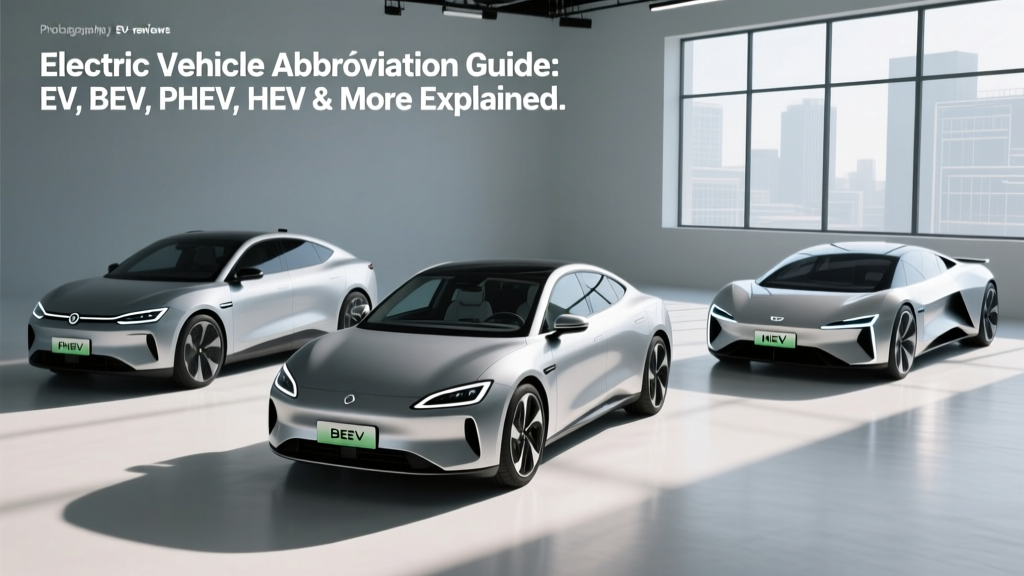
The Quick Answer: What Does Every Electric Vehicle Abbreviation Mean?
EV stands for Electric Vehicle, but it's a broad umbrella term covering any vehicle propelled in part or fully by an electric motor. The specific abbreviation tells you exactly how the vehicle gets its electricity:
- BEV (Battery Electric Vehicle): 100% electric, no gas engine. Examples: Tesla Model Y, Hyundai Ioniq 5, Ford F-150 Lightning.
- PHEV (Plug-in Hybrid Electric Vehicle): Has both a battery you can plug in (typically 25–45 miles of electric-only range) and a gas engine. Examples: Toyota RAV4 Prime, Jeep Wrangler 4xe.
- HEV (Hybrid Electric Vehicle): Self-charging hybrid — you never plug it in. Small battery recovers energy from braking. Example: Toyota Prius.
- EREV (Extended-Range Electric Vehicle): Electric motor drives the wheels; a gas engine acts only as a generator to recharge the battery. Example: BMW i3 REx (discontinued), upcoming Ram 1500 REV.
If you're shopping, the first decision is which abbreviation matches your driving pattern, charging access, and budget. Here's how to tell them apart — and what each one actually costs to own.
EV vs BEV vs PHEV vs HEV: The Core Powertrain Differences
The term "EV" is used loosely in marketing and media, but technically it encompasses all four powertrain types above. When someone says "I'm buying an EV," they usually mean a BEV — a fully battery-electric car with no tailpipe. But the distinction matters enormously for your wallet, your daily routine, and your road-trip planning.
| Abbreviation | Full Name | Plug-In? | Gas Engine? | Electric-Only Range | Typical Battery | Example (2026) |
|---|---|---|---|---|---|---|
| BEV | Battery Electric Vehicle | Yes | No | 200–400+ mi (EPA) | 60–130 kWh | Tesla Model Y Long Range (320 mi EPA) |
| PHEV | Plug-in Hybrid Electric Vehicle | Yes | Yes | 25–50 mi (EPA) | 10–25 kWh | Toyota RAV4 Prime (42 mi EPA electric) |
| HEV | Hybrid Electric Vehicle | No | Yes | ~1 mi or less | 1–2 kWh | Toyota Prius (57 MPG combined) |
| EREV | Extended-Range Electric Vehicle | Yes | Yes (generator only) | 100–350 mi (EPA) | 50–90 kWh | Ram 1500 REV (est. 350 mi electric) |
The key takeaway: BEVs eliminate gasoline entirely but require reliable charging access. PHEVs give you electric commuting with gas-engine backup for long trips. HEVs improve fuel economy without any change in habit. EREVs drive electric all the time but carry a gas generator for range extension — a niche but growing category.
kW vs kWh: The Most Misused EV Abbreviations
If you take nothing else from this guide, internalize this distinction — it's the single biggest source of confusion for new EV buyers:
- kW (kilowatt) = power, the rate of energy flow. Think of it like water pressure in a hose. A 250 kW DC fast charger delivers energy quickly. A motor producing 300 kW delivers strong acceleration.
- kWh (kilowatt-hour) = energy, the total amount stored or consumed. Think of it like the size of the water tank. An 82 kWh battery holds enough energy to drive roughly 250–300 miles depending on vehicle efficiency.
When a manufacturer advertises "charges at 350 kW," that's the peak power rate — not a sustained rate. Real-world DC fast charging follows a charge curve: the battery pulls maximum kW at low state of charge (SoC), then tapers as it fills to protect cell health. A vehicle rated at 250 kW peak might only sustain that rate from 10% to 35% SoC, then drop to 150 kW, then 75 kW, then 25 kW above 80%. This is why we report 10–80% charge times rather than peak kW alone — it's the practical number that matters on a road trip.
Other electrical abbreviations you'll encounter:
- AC (Alternating Current): Used by Level 1 and Level 2 charging (home and destination). The car's onboard charger converts AC to DC for the battery.
- DC (Direct Current): Used by DC fast chargers. Bypasses the onboard charger for much higher power delivery.
- V2L / V2H / V2G: Vehicle-to-Load (power devices from your car), Vehicle-to-Home (backup power during outages), Vehicle-to-Grid (sell energy back to the utility). Available on select models like the Hyundai Ioniq 5 and Ford F-150 Lightning.
MPGe, SoC, SoH, and Other Efficiency Abbreviations
MPGe (Miles Per Gallon equivalent) is the EPA's attempt to translate electric efficiency into a number gas-car buyers recognize. One gallon of gasoline contains roughly 33.7 kWh of energy, so MPGe tells you how far the vehicle travels on that equivalent amount of electricity. A 2026 Tesla Model 3 Long Range achieves about 134 MPGe combined. Higher is better, but most EV analysts prefer kWh/100 mi (kilowatt-hours per 100 miles) because it directly tells you your energy cost. Lower kWh/100 mi means better efficiency — similar to how liters-per-100km is more intuitive than MPG for comparing consumption.
State-of-charge abbreviations:
- SoC (State of Charge): How full the battery is right now, like a fuel gauge reading. "I left at 90% SoC and arrived at 20%."
- SoH (State of Health): The battery's overall capacity compared to when it was new. A 2-year-old EV with 94% SoH has lost 6% of its original capacity — normal and expected. Most manufacturers warranty the battery at 70% SoH retention over 8 years/100,000 miles.
Real Cost Breakdown: BEV vs PHEV vs Gas in 2026
Abbreviations only matter if they help you make a financial decision. Here's a five-year cost comparison for a midsize SUV buyer driving 15,000 miles per year, comparing a BEV (Tesla Model Y Long Range), a PHEV (Toyota RAV4 Prime), and a gas-only baseline (Toyota RAV4 LE). Electricity priced at $0.16/kWh national average; gasoline at $3.40/gallon.
| Cost Category | BEV: Tesla Model Y LR | PHEV: RAV4 Prime | Gas: RAV4 LE |
|---|---|---|---|
| Base MSRP (2026 est.) | $44,990 | $46,000 | $32,000 |
| Federal Tax Credit (§30D)* | −$3,750 to $7,500 | −$3,750 to $7,500 | $0 |
| Fuel/Energy (5 yrs) | $3,900 | $5,200 | $10,600 |
| Maintenance (5 yrs) | $1,200 | $2,800 | $3,500 |
| Insurance (5 yrs avg) | $11,500 | $9,800 | $8,500 |
| Estimated 5-Yr Depreciation | $18,000 | $16,500 | $12,000 |
| Total 5-Yr Cost | ~$41,340–$47,840 | ~$48,300–$51,800 | ~$54,600 |
*IRS §30D credit eligibility depends on MSRP caps ($55,000 for SUVs), buyer income limits ($150K single / $300K joint), battery component sourcing, and critical mineral requirements. Credit can be transferred at point of sale to reduce purchase price. Verify eligibility with a tax professional.
Key observations: The BEV wins on fuel and maintenance savings — no oil changes, no spark plugs, fewer brake replacements due to regenerative braking. But BEV insurance premiums run 15–30% higher on average due to repair costs and specialized parts. The PHEV splits the difference: you save on fuel for daily electric commuting but still pay for gas-engine maintenance. The gas vehicle has the lowest upfront price but the highest operating cost over time.
Charging Abbreviations: NACS, CCS, Level 1, Level 2, and DCFC
If you're buying a BEV or PHEV, you need to know how you'll charge it. Here are the connector and charging-level abbreviations:
- Level 1 (120V AC): Standard household outlet. Delivers ~1.4 kW — adds about 3–5 miles of range per hour. Fine for PHEVs with small batteries; painfully slow for BEVs.
- Level 2 (240V AC): Home wall connector or public destination charger. Delivers 7.2–19.2 kW depending on circuit and vehicle's onboard charger. Adds 25–55 miles per hour. A full overnight charge for any BEV.
- DCFC (DC Fast Charging): Public highway chargers delivering 50–350 kW. Adds 100–300+ miles in 15–30 minutes depending on the vehicle's charge curve and battery size.
- NACS (North American Charging Standard): Tesla's connector, now adopted by Ford, GM, Rivian, Hyundai, and most major automakers for 2025+ models. Smaller, lighter plug with access to the Supercharger network.
- CCS (Combined Charging System): The legacy standard still found on older VWs, BMWs, and some public chargers. Being phased out in favor of NACS in North America.
- CHAdeMO: Legacy Japanese DC fast-charge connector (Nissan Leaf). Effectively discontinued for new vehicles.
For home charging, a Level 2 installation on a 60-amp circuit (delivering 48 amps / 11.5 kW to the vehicle) typically costs $800–$2,200 including the charger unit, electrician labor, and permits — more if your electrical panel needs an upgrade from 100A to 200A service. That panel upgrade alone can add $1,500–$4,000.
ADAS Abbreviations and Automation Levels
Modern EVs are loaded with driver-assistance systems, each with its own branding. Here's what they mean — and critically, what they don't mean:
SAE Automation Levels: The Abbreviations That Matter Most
The SAE J3016 standard defines six levels of driving automation:
- Level 0: No automation. Warnings only (beeps, alerts).
- Level 1: Single-axis assist — either steering OR speed (adaptive cruise OR lane-keep).
- Level 2: Combined steering AND speed assist. The driver must remain fully engaged. This is where Tesla Autopilot, FSD (Supervised), GM Super Cruise, Ford BlueCruise, and Toyota Safety Sense all sit.
- Level 3: Conditional automation — the car handles driving in limited scenarios; the driver must be ready to take over. Very rare in the US (Mercedes Drive Pilot in limited areas).
- Level 4: High automation — no driver needed in defined conditions. This is Waymo and Zoox robotaxi territory.
- Level 5: Full automation everywhere. Does not exist in production.
Common abbreviations for ADAS features:
- ACC (Adaptive Cruise Control): Maintains set speed and following distance.
- LKA / LKC (Lane Keep Assist / Lane Keep Control): Steers to stay in lane markings.
- AEB (Automatic Emergency Braking): Detects imminent collisions and brakes.
- BSD (Blind Spot Detection): Alerts to vehicles in blind spots.
- FSD (Full Self-Driving): Despite the name, Tesla's FSD (Supervised) is a Level 2 system requiring constant driver attention. It is not autonomous driving.
Critical reminder: No consumer vehicle sold in 2026 is self-driving. Every driver-assist system on the market — regardless of the abbreviation or marketing name — requires you to keep your hands on or near the wheel, eyes on the road, and be prepared to take over instantly. Misusing these systems has resulted in documented fatalities. Treat them as helpful co-pilots, not replacements.
Battery Chemistry Abbreviations: LFP vs NMC
Your EV's battery chemistry determines its range, longevity, charging behavior, and cost. Two abbreviations dominate:
| Attribute | LFP (Lithium Iron Phosphate) | NMC (Nickel Manganese Cobalt) |
|---|---|---|
| Energy Density | Lower (~160 Wh/kg) — heavier for same range | Higher (~250 Wh/kg) — more range per pound |
| Cycle Life | 3,000–5,000+ cycles — longer lifespan | 1,500–2,500 cycles — good but shorter |
| Charging to 100% | Recommended regularly — no degradation concern | Better kept at 80% daily; 100% for trips only |
| Cold Performance | Weaker in freezing temps — greater range loss | Better cold-weather performance |
| Cost | Cheaper — no cobalt or nickel | More expensive — commodity-dependent |
| Found In | Tesla Model 3/Y RWD, base Ford Mustang Mach-E | Most long-range and AWD trims |
If you see "LFP" in a spec sheet, expect slightly less range but a battery that's more tolerant of daily full charges and likely to outlast the car itself. If you see "NMC," expect more range per kilogram but a battery that prefers partial daily charges for maximum longevity.
Decision Framework: Which EV Abbreviation Fits You?
Choose BEV if:
- You have reliable home Level 2 charging (or can install it)
- Your daily driving is under 250 miles round-trip
- You want the lowest per-mile energy cost (~$0.04–$0.06/mi at home)
- You're willing to plan DC fast-charge stops on road trips (15–25 min per stop)
- You want near-zero routine maintenance
Choose PHEV if:
- You have home charging but also take frequent 400+ mile road trips
- You want electric-only commuting (25–45 mi covers most daily drives) without range anxiety
- You live in an area with sparse DC fast-charging infrastructure
- You aren't ready to commit to fully electric but want meaningful fuel savings
Choose HEV if:
- You have no access to home or workplace charging
- You want better fuel economy (50+ MPG) with zero behavior change
- Your budget doesn't accommodate a plug-in vehicle's higher upfront cost
Choose EREV if:
- You want to drive electrically 100% of the time (electric motor drives the wheels) but need gas backup for long hauls
- You value the smooth, instant-torque EV driving experience with no charging-planning burden
EV Abbreviation FAQ
Is "EV" the same as "BEV"?
Colloquially, many people use "EV" to mean a fully electric car (BEV). But technically, EV is the umbrella term covering BEVs, PHEVs, and sometimes HEVs. When reading manufacturer specs or tax-credit rules, check whether "EV" refers to all electrified vehicles or battery-electric only — it varies by context.
What does MPGe mean, and should I care?
MPGe converts electric energy consumption into a gasoline-equivalent number for comparison. A BEV rated at 120 MPGe uses roughly the same energy as a gas car getting 120 MPG. It's useful for cross-shopping, but kWh/100 mi is more practical for calculating your actual electricity cost. At $0.16/kWh, a vehicle consuming 28 kWh/100 mi costs about $4.48 per 100 miles to fuel.
What's the difference between kW and kWh again?
kW is the speed of energy delivery (like MPH). kWh is the amount of energy (like gallons). A 77 kWh battery holds 77 kilowatt-hours of energy. A 150 kW charger can theoretically deliver 150 kilowatts of power at peak — filling that 77 kWh battery in roughly 30 minutes if the rate were sustained (it isn't, due to charge-curve tapering).
What does "NACS" mean for my charging options?
NACS (North American Charging Standard) is Tesla's charging connector, now adopted industry-wide. If you buy a 2025+ model-year EV from Ford, GM, Hyundai, Rivian, or others, it will have a native NACS port and direct access to Tesla Superchargers — over 20,000 stalls in North America. Older CCS-equipped vehicles can use a NACS adapter (often included by the automaker) to access Superchargers.
Does the §30D tax credit apply to all EVs?
No. The federal §30D credit has multiple eligibility requirements: the vehicle must be under the MSRP cap ($55,000 for sedans, $80,000 for SUVs/pickups), the buyer must be under income limits ($150K single, $300K joint AGI), and the battery must meet critical-mineral and component-sourcing thresholds that tighten annually. Many popular EVs qualify for only $3,750 (partial credit) or nothing at all depending on the model year. Always verify on the IRS website or with a tax professional before purchasing.
What does SoH mean, and when should I worry?
SoH (State of Health) measures your battery's remaining capacity vs. new. Most EVs lose 5–10% capacity in the first two years, then degrade more slowly. You should pay attention if SoH drops below 80% within the warranty period (typically 8 years/100,000 miles) — that may qualify you for a warranty replacement. Most modern EVs reach 200,000+ miles before SoH falls to 80%.
What's a "charge curve" and why does it matter?
A charge curve describes how a battery's charging speed (in kW) changes as it fills. Peak kW only occurs at low SoC (typically 10–30%). The rate then tapers to protect the cells from heat damage. A "250 kW" charger doesn't deliver 250 kW for the entire session — it might average 120–150 kW over a 10–80% session. This is why 10–80% charge time (e.g., "18 minutes") is a more useful spec than peak kW alone.