The Quick Answer on Electric Travel Trailers
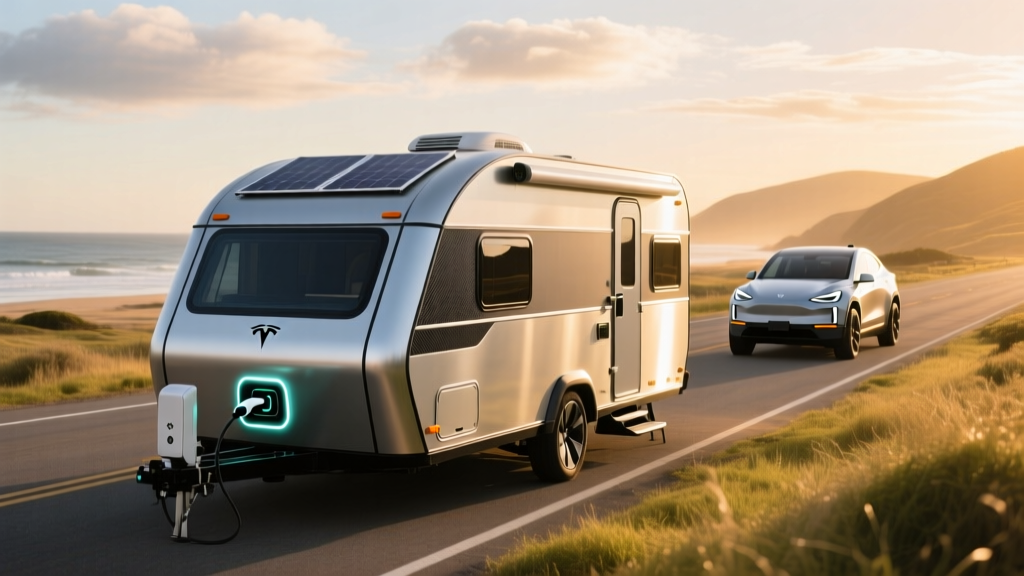
Electric travel trailers are towable RVs with built-in battery packs (typically 40–80 kWh) and electric motors on their axles that assist the tow vehicle, reducing range loss by 30–50% compared to conventional trailers. As of 2026, production models from Lightship (the L1) and concept/pre-production units from brands like Airstream (eStream) remain the primary options, with prices ranging from roughly $65,000 to $120,000+. They do not qualify for the IRS §30D federal EV tax credit, which applies to on-road motor vehicles, not towed trailers.
If you own an EV like a Ford F-150 Lightning, Rivian R1S, or Tesla Cybertruck and want to tow a travel trailer, the range penalty is severe: a conventional 5,000-lb trailer can cut your EV's highway range by 40–60%. Electric travel trailers aim to solve this by propelling themselves in sync with the tow vehicle, effectively acting as a rolling battery and motor assist.
What Is an Electric Travel Trailer — and How Does It Differ from a Gas RV Setup?
An electric travel trailer integrates three components that traditional trailers lack:
- Traction battery pack (LFP chemistry is standard for safety and cycle life): 40–80 kWh usable capacity.
- Electric axle motors: 1–2 motors producing combined output of roughly 50–150 kW, providing propulsion assist during highway towing.
- Self-propulsion capability: Some models can maneuver themselves at low speeds (campsite parking) without the tow vehicle attached — essentially a Level 1/Level 2 automated feature for hitching and positioning.
Compare this to a conventional setup: a gas-powered Ford F-150 towing a 5,000-lb Airstream Bambi loses roughly 40–50% of its fuel economy (from ~22 MPG combined down to 11–13 MPG). An EV tow vehicle suffers an even steeper efficiency drop because aerodynamic drag and rolling resistance hit batteries harder at highway speeds. The electric trailer's motors offset that drag by pushing their own weight.
| Metric | Gas Truck + Conventional Trailer | EV Truck + Electric Trailer |
|---|---|---|
| Combined range (loaded) | ~300–350 miles | ~200–280 miles (EV alone) + trailer battery assist |
| Fuel/energy cost per mile | $0.22–$0.30 (gas at $3.50/gal) | $0.08–$0.14 (home charging at $0.13/kWh) |
| Refuel/recharge stops per 500 mi | 1–2 (gas stations) | 2–3 (DC fast chargers, 30–45 min each) |
| Campsite power hookup needed? | Yes (30A/50A shore power) | No — trailer battery powers AC, fridge, lights for 3–7 days |
| Trailer self-parking | No | Yes (on select models) |
2026 Electric Travel Trailer Models: Specs and Pricing
The market is still early. Here's what's announced or in limited production as of the 2026 model year:
| Model | Battery (kWh) | Motor Assist (kW) | Range Impact Reduction | Off-Grid Duration | MSRP (est.) | Status |
|---|---|---|---|---|---|---|
| Lightship L1 | 80 kWh (LFP) | ~120 kW dual axle | Up to 50% less range loss | ~7 days (moderate use) | $95,000–$120,000 | Limited production |
| Airstream eStream (concept) | ~45 kWh (LFP) | ~60 kW single axle | ~30% less range loss | ~3–4 days | TBD (est. $75,000+) | Pre-production/concept |
| Grounded G1 (announced) | ~60 kWh | ~80 kW | ~35% less range loss | ~5 days | ~$65,000–$80,000 | Announced, not yet shipping |
Critical note on availability: The Lightship L1 is the closest to a purchasable product, with initial deliveries beginning in late 2025 and ramping through 2026. The Airstream eStream and other concepts remain in development. If a manufacturer lists a trailer as "announced" or "reservation-only," treat specs as preliminary.
Real-World Costs: Purchase, Charging, and the Tax Credit Reality
| Cost Category | Electric Travel Trailer | Conventional Travel Trailer |
|---|---|---|
| Purchase price (mid-range model) | $80,000–$120,000 | $25,000–$55,000 |
| Federal §30D tax credit | $0 — not eligible | $0 — not eligible |
| Annual energy/fuel for 6,000 mi towing | ~$700–$1,100 (home + DCFC mix) | ~$1,400–$1,900 (gas at $3.50/gal) |
| Campsite hookup fees per night | $0 (boondocking capable) | $35–$85 (full-hookup sites) |
| Maintenance (annual avg.) | ~$100–$200 (no generator, axle motors minimal) | ~$300–$600 (generator service, brakes, bearings) |
| Insurance (annual avg.) | $1,200–$2,000 (higher replacement cost) | $600–$1,200 |
| 5-year total cost (6,000 mi/yr) | ~$95,000–$140,000 | ~$45,000–$80,000 |
The economics are straightforward: electric travel trailers cost roughly 2–3x more upfront than comparable conventional trailers. The per-mile energy savings are real — roughly $0.12/mile vs $0.25/mile when towing — but they won't close a $50,000+ purchase gap over a typical 10-year ownership period unless you camp off-grid frequently and avoid paid hookup sites.
Tax credit clarification: The IRS §30D New Clean Vehicle Credit applies to self-propelled vehicles (cars, trucks, SUVs) with four wheels and a GVWR under 14,000 lbs. A towed trailer, even one with its own motors and battery, does not meet the definition. Your EV tow vehicle may qualify for §30D (up to $7,500, subject to IRS income and MSRP caps), but the trailer itself does not. Some states may offer separate incentives for energy-storage products — check your state energy office.
Range Impact: What Happens to Your EV When Towing
EPA range vs. towing reality: A Ford F-150 Lightning Extended Range carries a 310-mile EPA sticker. When towing a 5,500-lb conventional trailer at 65 mph on flat terrain, expect 140–170 miles of real range — a 45–55% reduction. In cold weather (below 35°F), add another 10–15% loss, dropping to as low as 120 miles between charges.
An electric travel trailer's motor assist recovers roughly 30–50% of that penalty, potentially restoring range to 200–240 miles depending on trailer battery state-of-charge, terrain, and speed. However, once the trailer's battery depletes (typically after 80–120 miles of assist), it becomes dead weight — and your EV range drops to conventional-trailer levels.
This creates a unique trip-planning dynamic: you get excellent range for the first leg of your journey, but on long towing days (300+ miles), you'll need to recharge both the truck and the trailer. Currently, no public DC fast-charging stations offer dedicated RV pull-through lanes with trailer charging connectors. You'll need to unhook the trailer or use a long CCS/NACS cable to reach the trailer's charge port — a real logistical friction point that the industry is only beginning to address.
Common Misconceptions About Electric Travel Trailers
| Myth | Fact |
|---|---|
| "Electric trailers qualify for the $7,500 EV tax credit." | No. IRS §30D applies only to self-propelled motor vehicles. Trailers are excluded regardless of battery size. |
| "The trailer recharges itself while driving." | Partially true. Regenerative braking on descents recovers some energy (5–15% on mountain routes), but net consumption is always negative on flat terrain. The trailer's battery depletes while assisting. |
| "I can charge the trailer at any EV station." | Most DCFC stalls are designed for passenger cars with short cables and tight pull-in spots. You'll likely need a CCS or NACS extension cable (25–40 ft, ~$200–$400) and a pull-through site, which are rare. |
| "Electric trailers eliminate range anxiety entirely." | They reduce the range penalty by 30–50%, but you're still planning charging stops every 150–250 miles on long highway days — and adding 30–45 minutes per stop for both truck and trailer. |
| "Any EV can tow an electric trailer." | The trailer's assist system must communicate with the tow vehicle via a proprietary or standardized controller. As of 2026, Lightship lists compatibility with the F-150 Lightning, Rivian R1T/R1S, and Tesla Cybertruck. Verify before purchasing. |
Decision Framework: Is an Electric Travel Trailer Right for You?
Choose an electric travel trailer if:
- You already own (or plan to buy) an EV truck/SUV with 7,000+ lb towing capacity.
- You camp off-grid frequently and value 5–7 days of boondocking without a generator.
- Your typical towing trips are under 200 miles one-way, or you're willing to plan multi-stop charging days.
- You want to eliminate campsite hookup fees ($35–$85/night savings adds up for 30+ nights/year).
- The $80,000–$120,000 purchase price fits your budget without requiring the savings to justify itself.
Stick with a conventional trailer if:
- Your budget is under $60,000 for a trailer.
- You primarily camp at RV parks with full hookups (shore power, water, sewer).
- You tow more than 300 miles regularly and don't want to manage dual charging logistics.
- You tow with a gas or diesel truck and don't plan to switch to an EV tow vehicle.
- You want immediate availability — most electric trailers require reservations and 6–18 month wait times.
Frequently Asked Questions
Can I charge an electric travel trailer from my home Level 2 charger?
Yes. Most electric trailers include a standard J1772 or NACS inlet for Level 2 charging at 7.2–11.5 kW. An 80 kWh trailer battery will take roughly 7–11 hours to charge from 10–100% on a 48A Level 2 circuit. You'll need a dedicated 60A circuit installed by a licensed electrician ($800–$2,500 depending on panel proximity) — plan for this during site preparation.
What happens if the trailer battery runs out mid-trip?
The trailer's motors disengage, and it reverts to a conventional unpowered trailer. Your EV's range will immediately drop to conventional towing levels. The trailer's house systems (lights, fridge, climate) typically draw from a separate buffer or a secondary 12V/48V system, so living amenities remain functional even if the traction pack is depleted.
Do electric travel trailers have their own brakes?
Yes. Electric trailers use regenerative braking from their axle motors as the primary deceleration force, supplemented by traditional electric-over-hydraulic friction brakes. This reduces wear on both the trailer's friction brakes and the tow vehicle's brakes. Expect friction brake service intervals of 50,000+ miles, compared to 15,000–25,000 miles on conventional trailers.
Are electric travel trailers heavier than conventional ones?
Yes, typically by 800–1,500 lbs due to the battery pack. A Lightship L1, for example, has a GVWR of approximately 7,500 lbs. This matters for tow ratings: verify your EV's max towing capacity and payload (hitch weight). The Ford F-150 Lightning Extended Range is rated for 7,700 lbs; the Rivian R1T Dual-Motor for 11,000 lbs. Always stay within the lower of the truck's rating or the trailer's GVWR.
What battery chemistry do electric trailers use, and is it safe?
Most announced models use LFP (lithium iron phosphate) chemistry, which is the correct choice for this application. LFP offers superior thermal stability (no thermal runaway risk at normal operating temperatures), 3,000–5,000+ cycle life, and lower energy density than NMC — but energy density matters less in a trailer where weight limits are set by tow ratings, not packaging constraints. According to NHTSA guidance on lithium batteries in vehicles, LFP is among the safest lithium chemistries for consumer applications.
Can I use solar panels to charge the trailer battery?
Most electric trailers include roof-mounted solar arrays (400–1,200 watts) that maintain the house battery and trickle-charge the traction pack. However, even a 1,200W array produces roughly 5–6 kWh per day in good sun — enough to extend boondocking by a day or two, but not enough to meaningfully recharge an 80 kWh traction pack. Think of solar as range maintenance, not range replacement.
Electric travel trailers represent a genuine solution to the EV towing problem, but they remain a premium, early-adopter product in 2026. The technology works — motor-assisted towing demonstrably reduces range loss — but the economics require either deep commitment to off-grid camping or acceptance that the upfront cost won't pay for itself through fuel savings alone. For buyers who meet the use-case criteria and can absorb the price, models like the Lightship L1 offer a meaningfully better towing and camping experience than the gas-generator status quo.