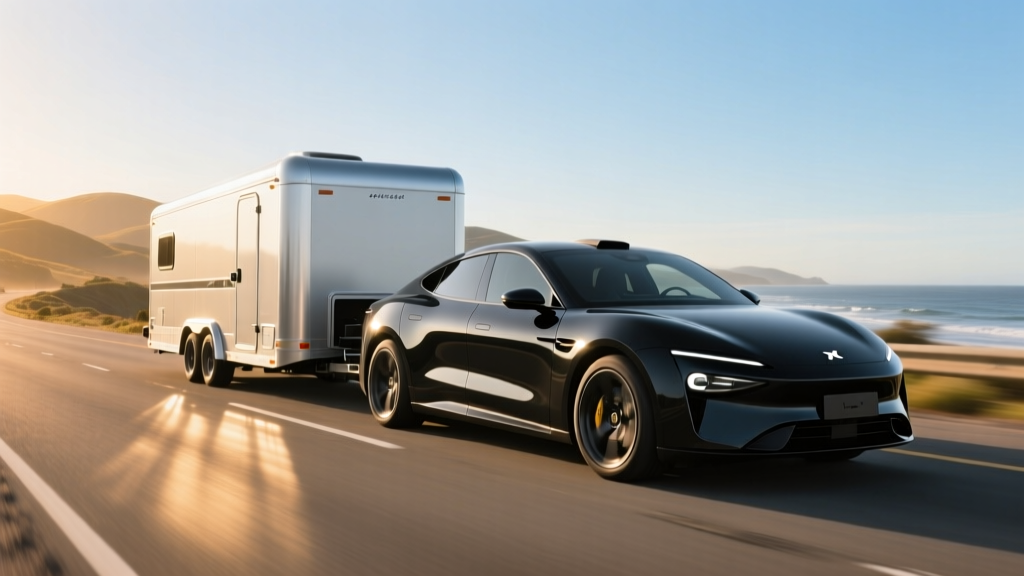
Quick Answer: Electric trailers are self-propelled trailers with integrated battery packs and electric motors that assist the tow vehicle, reducing the range penalty of towing with an EV. While conventional towing can slash an EV's EPA range by 30–50%, electric trailers from companies like Lightship, Pebble, and Canoo aim to recover much of that loss by powering their own wheels. However, as of 2026, most electric travel trailers are either in limited production or pre-order stages, with prices ranging from roughly $65,000 to over $125,000. For most EV owners, the practical question is whether the trailer's integrated battery and propulsion system justifies the premium over a conventional lightweight trailer — and whether their tow vehicle can handle the added gross combined weight.
The Real Problem: Why Towing Kills EV Range
Before evaluating electric trailers, it's essential to understand why towing with any EV is fundamentally different from towing with a gas truck. A 2025 Ford F-150 Lightning with the Extended Range battery (131 kWh usable, EPA 320 miles unladen) typically sees its range drop to between 160 and 200 miles when pulling a 5,000-pound conventional travel trailer at highway speeds. That's a 38–50% reduction, driven by aerodynamic drag (the trailer's flat frontal area pushes the combined drag coefficient dramatically higher) and rolling resistance from the trailer's axles.
Gas trucks experience a similar percentage drop in MPG when towing — an F-150 EcoBoost might fall from 22 MPG combined to 10–12 MPG towing — but the advantage is that gas stations are ubiquitous and refueling takes five minutes. With an EV, that 170-mile real-world towing range means stopping at a DC fast charger every 90 minutes of highway driving (accounting for a safety buffer and the reality that chargers aren't always spaced ideally along rural routes). And charging an F-150 Lightning from 10–80% at a 150 kW CCS stall takes roughly 38 minutes, per Ford's published specs.
| Metric | F-150 Lightning (Extended Range) | F-150 3.5L EcoBoost 4x4 |
|---|---|---|
| EPA Range / MPG (unladen) | 320 miles (EPA) | 22 MPG combined |
| Estimated range towing | 160–200 miles | ~250 miles (10–12 MPG, 36-gal tank) |
| Refuel/recharge time | ~38 min (10–80% at 150 kW) | ~5 min (full tank) |
| Stops per 500-mile trip | 2–3 DC fast charges | 1–2 fuel stops |
| Energy/fuel cost per 500 mi | ~$55–$90 (public DCFC) | ~$140–$170 ($3.50/gal avg) |
The cost advantage of electric towing is real when charging at home ($0.13–$0.18/kWh national average), but on the road at public DC fast chargers priced at $0.35–$0.55/kWh, the savings narrow considerably — and may even reverse versus a fuel-efficient diesel truck. Data from fueleconomy.gov confirms that efficiency under load is where EVs suffer most, since electric motors are already highly efficient at baseline; there's less "waste" to recoup compared to an internal combustion engine.
How Electric Trailers Work: Propulsion, Batteries, and Range Recovery
An electric trailer integrates three key systems that a conventional trailer lacks:
- Battery pack: Typically 40–80 kWh of lithium-ion (usually NMC chemistry for energy density) mounted low in the trailer chassis for stability. Some concepts, like the Lightship L1, advertise up to 80 kWh.
- Electric drive axle: One or two electric motors on the trailer's axle(s) that provide propulsive force, reducing the load on the tow vehicle's motors.
- Regenerative braking: The trailer's motors act as generators during deceleration, recovering energy that would otherwise be lost to the trailer's friction brakes.
The net effect: instead of the tow vehicle's battery powering both itself and dragging a dead-weight trailer, the electric trailer "pushes itself" for portions of the trip. Manufacturers claim this can reduce range loss to as little as 10–15% versus unladen driving — a dramatic improvement over the 30–50% loss with conventional trailers.
However, there's a physics ceiling. Moving a combined vehicle weight of 10,000–14,000 pounds at 65 mph requires substantial energy regardless of how that energy is distributed. A trailer with an 80 kWh battery adding propulsion still adds mass (batteries are heavy — roughly 800–1,200 lbs for that capacity in NMC). The range recovery is real, but it's not magic. Expect real-world towing range with an electric trailer to land somewhere between 240 and 280 miles for a long-range F-150 Lightning or Rivian R1T, depending on terrain, speed, and temperature.
2026 Electric Trailer Landscape: Who's Selling, Who's Pre-Order
As of early 2026, the electric trailer market is still nascent. Here's where the major players stand:
| Brand / Model | Battery (kWh) | Claimed Range Assist | Base Price (MSRP) | Availability |
|---|---|---|---|---|
| Lightship L1 | 80 kWh (est.) | "Near-zero range loss" | ~$125,000 | Limited production / reservations |
| Pebble Flow | 45 kWh (est.) | Up to 50 mi self-propel | ~$75,000–$100,000 | Pre-order, initial deliveries 2025–2026 |
| Canoo Lifestyle Vehicle (concept) | TBD | TBD | TBD | Announced / concept stage |
| Lightship L1 (base trim) | 60 kWh (est.) | Reduced range penalty | ~$90,000 | Reservations open |
Key caveat: these specifications are preliminary or based on manufacturer claims. Independent third-party towing tests with instrumented range measurements are scarce as of this writing. Buyers should treat claimed range-recovery figures with the same skepticism applied to early EV range estimates — real-world results depend heavily on driving conditions.
Cost Breakdown: Electric Trailer vs Conventional Trailer Ownership
The premium for an electric trailer is substantial. Let's compare a 5-year ownership scenario:
| Cost Category | Electric Trailer (~$100K) | Conventional Trailer (~$35K) |
|---|---|---|
| Purchase price | $100,000 | $35,000 |
| Additional range cost (towing 4 weekends/yr, 1,000 mi total) | ~$180/yr (home charging) = $900 | ~$600/yr (extra DCFC stops) = $3,000 |
| Trailer maintenance (5 yr) | ~$1,500 (fewer brake replacements due to regen) | ~$2,500 (brake jobs, bearing service) |
| Battery degradation reserve | ~$0 (under warranty, but future replacement could be $15K–$25K post-warranty) | $0 |
| Insurance (annual avg) | ~$1,800/yr = $9,000 | ~$900/yr = $4,500 |
| 5-Year Total | ~$111,400 | ~$45,000 |
The electric trailer saves roughly $2,100 over five years in energy and maintenance costs, but the $65,000 purchase premium means the payback period is effectively never — purely on economics. The value proposition is entirely about convenience (fewer charging stops, less range anxiety on long trips) and the ability to reach remote campsites without planning DCFC routes.
It's also worth noting that the IRS §30D clean vehicle credit does not currently apply to trailers — it applies to the tow vehicle if it qualifies as a new clean vehicle meeting MSRP caps ($80,000 for SUVs/trucks), income limits ($300K MFJ / $150K single), and battery-sourcing requirements. Check irs.gov for current-year eligibility, as rules evolve.
Real-World Ownership Considerations
Home Charging Infrastructure
An electric trailer with a 60–80 kWh battery needs significant energy to recharge. At a standard Level 2 home charger (11.5 kW / 48A, which requires a 60A dedicated circuit), fully recharging a depleted 80 kWh trailer battery takes approximately 7–8 hours. If your home electrical panel is already supporting a 48A EV charger for your tow vehicle, adding a second high-power circuit may require a panel upgrade — typically $1,500–$3,500 depending on your existing service (100A panels often need upgrading to 200A).
If you lack home charging entirely (apartment dwellers, street parking), the electric trailer's value proposition collapses. You'd be relying on public DCFC infrastructure to charge both your tow vehicle and trailer, and most public charging stations aren't designed to accommodate a towed trailer — you'd need to unhitch or find pull-through sites, which are rare.
Cold-Weather Towing
Battery chemistry matters here. NMC batteries (used in most electric trailer concepts for energy density) lose 20–30% of usable capacity in sub-freezing temperatures. A trailer rated for 80 kWh usable in mild weather might deliver only 56–64 kWh at 20°F. Combined with the tow vehicle's own cold-weather range reduction (typically 15–25% for NMC packs without heat-pump preconditioning), winter towing with an electric trailer still requires careful route planning.
Tow Vehicle Compatibility
Electric trailers are heavy. An 80 kWh battery pack alone adds roughly 1,000 lbs to the trailer's dry weight. A fully loaded electric travel trailer could push gross trailer weight to 7,500–9,000 lbs. Verify your EV's maximum tow rating:
- Ford F-150 Lightning: 7,700–10,000 lbs (depending on battery/config)
- Rivian R1T: 11,000 lbs
- Tesla Cybertruck: 11,000 lbs (AWD)
- Chevrolet Silverado EV: 10,000 lbs (Work Truck)
- Hyundai Ioniq 5: 1,650–2,300 lbs (not viable for full-size electric trailers)
Always check your vehicle's Gross Combined Weight Rating (GCWR) — exceeding it is unsafe and voids your powertrain warranty.
Common Misconceptions About Electric Trailers
| Myth | Fact |
|---|---|
| "Electric trailers eliminate range loss entirely" | They reduce it significantly (to ~10–20%), but moving mass at highway speed always costs energy. Physics applies. |
| "I can charge the trailer from my EV's battery" | Some concepts allow limited V2L (vehicle-to-load) for campsite power, but charging a 60+ kWh trailer battery from a 131 kWh truck battery would halve your truck's range. Trailers are designed to charge independently. |
| "Electric trailers qualify for the $7,500 tax credit" | The §30D credit applies to qualified clean motor vehicles — not trailers. Your tow vehicle may qualify separately. |
| "Any EV can tow an electric trailer" | Tow ratings matter. Compact/midsize EVs (Ioniq 5, Model Y) typically max out at 1,650–3,500 lbs — insufficient for a full-size electric travel trailer. |
| "The trailer recharges itself going downhill" | Regenerative braking recovers some energy on descents, but not enough to fully offset the climb. Net energy is still consumed over a round trip. |
Decision Framework: Should You Buy an Electric Trailer?
Choose an electric trailer if:
- You own a full-size electric truck (F-150 Lightning, R1T, Silverado EV, Cybertruck) with 10,000+ lb tow rating
- You have reliable Level 2 home charging with capacity for a second circuit (or a 200A+ panel)
- You tow 1,000+ miles per year and the reduced charging stops meaningfully improve your trips
- You camp off-grid and value the trailer's battery as a power source (some models offer 10+ kW of campsite power output, replacing a generator)
- Budget allows $75,000–$125,000+ for a trailer without expecting financial payback
Stick with a conventional lightweight trailer if:
- Your tow vehicle is a midsize EV or crossover with under 5,000 lb tow capacity
- You lack home charging or have a 100A electrical panel with no upgrade path
- You tow fewer than 500 miles per year (the range penalty is manageable with route planning)
- Budget is a primary concern — a $35K conventional trailer plus careful DCFC planning delivers 90% of the experience at one-third the cost
- You want proven reliability and widely available service/parts
Consider a hybrid (PHEV) truck + conventional trailer if:
- You want electric-only commuting during the week but unrestricted towing range on weekends
- The Ford F-150 PowerBoost Hybrid or Toyota Tacoma i-FORCE MAX offers competitive tow ratings (10,000+ lbs for the F-150 hybrid) with no range penalty from towing — you simply burn more fuel, and gas stations are everywhere
What First-Time EV Buyers Should Know About Towing
If you're buying an EV specifically to tow, prioritize these specs over marketing claims:
- Maximum tow rating — not payload, not GCWR alone, but the specific tow rating for your exact configuration (battery size, axle ratio, cab style all matter)
- Usable battery kWh — bigger is better for towing; a 131 kWh pack gives you a much larger buffer than a 98 kWh pack
- DC fast-charge rate (peak kW) — a truck that charges at 250+ kW (like the Silverado EV on 800V architecture) gets you back on the road faster between towing segments
- Trailer brake controller compatibility — your EV must have an integrated or aftermarket trailer brake controller; electric trailers may handle this differently, so confirm integration
- Route charging infrastructure — check your most common towing routes on apps like PlugShare or A Better Routeplanner for DCFC availability and pull-through accessibility
For safety data on your tow vehicle, consult NHTSA crash ratings and IIHS testing — towing stability control and trailer sway mitigation are critical features that vary by manufacturer.
Frequently Asked Questions
Can I tow an electric trailer with a Tesla Model Y or Model X?
The Model Y has a 3,500-lb tow rating (when equipped with the factory tow package), and the Model X is rated for 5,000 lbs. Most full-size electric travel trailers will exceed these limits when loaded. The Model X could potentially tow a smaller, lighter electric trailer concept, but verify the specific trailer's gross weight against your vehicle's rating before purchasing.
Do electric trailers need their own insurance?
Yes. Any trailer over a certain weight (varies by state, often 3,000+ lbs GVWR) requires separate registration and insurance. Expect to pay $1,200–$2,400 annually for an electric trailer policy, given the high replacement value of the battery pack. Some insurers may not yet have actuarial data on electric trailers, which can result in higher premiums.
How long will an electric trailer's battery last?
Manufacturers typically warrant trailer battery packs for 8 years / 100,000 miles (similar to EV traction batteries), with a capacity retention threshold of 70%. NMC chemistry degrades with charge cycles and calendar age. If you tow 1,000 miles per year, the battery should comfortably last 10+ years before falling below 80% state of health. Post-warranty replacement costs are estimated at $15,000–$25,000 depending on pack size — a significant long-term ownership cost to factor in.
Can I use an electric trailer as a home backup battery?
Some electric trailer concepts advertise V2H (vehicle-to-home) or high-wattage campsite power output (10–20 kW). In theory, a trailer with an 80 kWh battery could power an average home (30 kWh/day usage) for 2–3 days during an outage. However, V2H requires a compatible bidirectional inverter and electrical panel integration — similar to the Ford F-150 Lightning's PowerUp system. Confirm V2H capability and required equipment before relying on this feature.
Is it more efficient to tow with an EV or a gas truck?
In terms of raw energy cost per mile, electric towing wins when charging at home ($0.04–$0.06 per mile towing, versus $0.25–$0.35 per mile for a gas truck at $3.50/gal). But on public DC fast chargers at $0.45/kWh, electric towing costs roughly $0.14–$0.18 per mile — still cheaper than gas, but the gap narrows significantly. The real trade-off is convenience: gas trucks refuel in 5 minutes anywhere; EVs require 30–40 minute charging stops every 150–200 miles while towing.