Quick Answer: Is an Electric Track Loader Right for You?
An electric track loader (CTL) replaces a diesel engine with a battery-electric powertrain, delivering comparable lift capacities (typically 1,800–3,500 lbs operating capacity) with zero tailpipe emissions, drastically lower fuel and maintenance costs, and significantly reduced noise. In 2026, models like the Volvo ECR25 Electric and emerging compact electric CTLs from brands such as Bobcat and Caterpillar are entering the market. Expect battery capacities in the 40–90 kWh range, 4–8 hours of continuous operation per charge, and Level 2 AC charging (7–22 kW) taking 4–10 hours for a full cycle. Base pricing typically starts around $75,000–$130,000, roughly 30–60% above equivalent diesel CTLs, but total cost of ownership (TCO) can break even in 2–4 years depending on duty cycle and local electricity rates.
Bottom line: If you work in noise-restricted urban zones, indoor demolition, emissions-regulated job sites, or have depot-based operations with overnight charging, an electric track loader is a compelling choice. If you run 12+ hour remote shifts with no grid access, diesel still wins.
What Is an Electric Track Loader?
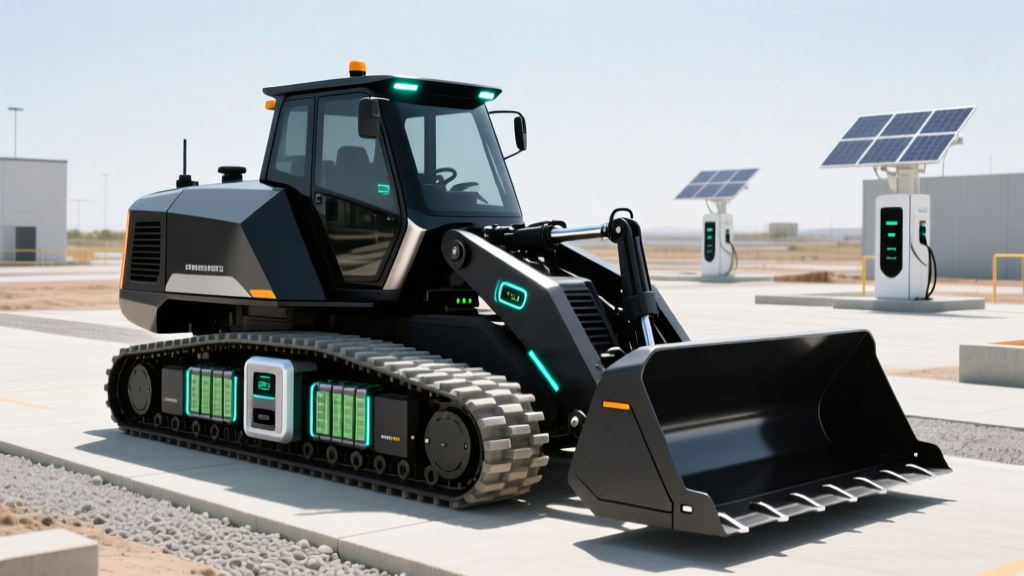
An electric track loader is a compact construction machine that uses rubber tracks for mobility and a battery-electric drivetrain (electric motors driving the hydraulic pumps and travel motors) instead of a diesel engine. The form factor mirrors a conventional compact track loader — a rigid frame with a lift arm and attachment interface — but swaps the internal combustion engine for a lithium-ion battery pack (typically NMC chemistry for energy density) and one or more electric motors.
Key distinctions from a diesel CTL:
- Powertrain: Electric motors (20–75 HP equivalent) driving hydraulic pumps for lift/tilt functions and separate motors for travel.
- Energy storage: 40–90 kWh lithium-ion battery pack (NMC or LFP depending on manufacturer).
- Charging: AC Level 2 (J1772 or industrial connector) at 7–22 kW; some models support DC fast charging at 25–50 kW.
- Emissions: Zero tailpipe — critical for indoor work, enclosed spaces, and municipalities with clean-air mandates.
As of early 2026, the electric CTL market is still emerging. Volvo CE, Bobcat, and a handful of startups have announced or begun shipping electric compact loaders, though availability varies by region. For authoritative specs, always check the Volvo CE US site or your dealer network.
Electric Track Loader vs. Diesel CTL: The Numbers
The decision to go electric hinges on duty cycle, site conditions, and cost structure. Here's how a representative 2026 electric CTL stacks up against a comparable diesel model in the 74–75 HP class:
| Specification | Electric CTL (Representative) | Diesel CTL (Representative) |
|---|---|---|
| Rated Operating Capacity | 2,100–2,800 lbs | 2,100–3,200 lbs |
| Power (equivalent) | 40–75 HP (electric motor) | 74 HP (diesel engine) |
| Energy/Fuel Capacity | 60–90 kWh battery | 24–30 gal diesel tank |
| Operating Time (continuous) | 4–8 hours (load-dependent) | 8–12 hours |
| Refuel / Recharge Time | 4–10 hrs (Level 2); 1–2 hrs (DC fast) | 5–10 minutes |
| Weight | 8,500–11,000 lbs | 8,000–10,500 lbs |
| Noise Level (operator) | ~65–72 dB(A) | ~82–88 dB(A) |
| Tailpipe Emissions | Zero | Tier 4 Final diesel |
| Base Price (2026 est.) | $85,000–$130,000 | $55,000–$80,000 |
Key takeaway: Electric CTLs currently trade run-time and refuel speed for emissions-free operation, dramatically lower noise, and reduced operating costs. The battery is the limiting factor — if your typical shift is 6–8 hours of mixed loading and travel, a 60–90 kWh pack is usually sufficient. Heavy continuous digging or hydraulic hammer use will drain the battery faster.
Real-World Operating Costs: Electric vs. Diesel
The upfront premium of an electric track loader is significant, but the operating cost gap closes quickly for fleet owners and owner-operators who use the machine daily. Here's a 5-year TCO comparison assuming 1,500 operating hours per year:
| Cost Category (5-Year / 7,500 hrs) | Electric CTL | Diesel CTL |
|---|---|---|
| Purchase Price | $105,000 | $67,000 |
| Fuel / Energy | $4,500 (at $0.12/kWh, 25 kWh/hr avg) | $33,750 (at $4.50/gal, 2.0 gal/hr avg) |
| Engine Maintenance (oil, filters, DEF, coolant) | $0 | $7,500 |
| Hydraulic & Undercarriage Maintenance | $5,000 | $5,000 |
| Insurance (est.) | $6,000 | $5,500 |
| Total 5-Year Cost | $120,500 | $118,750 |
| Cost Per Operating Hour | $16.07 | $15.83 |
At parity by year 5 — and the electric machine pulls ahead in years 6–10 as diesel maintenance costs climb and battery degradation remains minimal (most industrial packs are warrantied for 5 years / 5,000+ cycles with 80% capacity retention). If your electricity rate is below $0.10/kWh or you can charge on a commercial time-of-use plan, the electric CTL becomes cheaper by year 3.
Important caveat: These figures assume depot-based overnight charging. If you need a portable generator or DC fast charger on-site, add $15,000–$40,000 in equipment costs and higher per-kWh energy prices ($0.25–$0.45/kWh from a diesel generator).
Charging Infrastructure: What You Actually Need
Unlike a consumer EV, an electric track loader typically charges at a depot, yard, or job-site trailer. Here's what that looks like in practice:
Level 2 AC Charging (Standard)
- Power: 7.2 kW (single-phase, 32A) to 22 kW (three-phase, 32A)
- Charge time (0–100%): 4–10 hours for a 60–90 kWh pack
- Infrastructure: Requires a 240V/480V circuit with a 40–100A breaker. A licensed electrician will typically charge $3,000–$12,000 for panel upgrades, conduit, and a hardwired industrial EVSE.
- Best for: Overnight charging at a home base or equipment yard
DC Fast Charging (Optional on Some Models)
- Power: 25–50 kW (CCS2 or proprietary connector)
- Charge time (10–80%): ~45–90 minutes
- Infrastructure: Requires 480V three-phase service and a DC charger unit ($20,000–$60,000+)
- Best for: Multi-shift operations, mid-day top-ups on large job sites
Real-world note: Battery thermal management matters. In cold climates (below 20°F), expect 15–25% reduced operating range and slower charge acceptance unless the machine has an active battery heating system. In hot climates (above 95°F sustained), charging may throttle above 70% SoC to protect cell longevity.
Common Misconceptions About Electric Track Loaders
| Myth | Fact |
|---|---|
| "Electric loaders don't have enough power for real work." | Electric motors deliver peak torque at 0 RPM. A 50 HP electric motor can match or exceed the breakout force of a 74 HP diesel in short bursts. Continuous hydraulic flow depends on pump sizing, not just motor HP. |
| "The battery won't last a full shift." | A 90 kWh pack at 20–25 kWh/hr average draw delivers 3.5–4.5 hours of heavy use or 6–8 hours of mixed/light duty. Most depot-based operations charge overnight and top up during lunch. |
| "Battery replacement will bankrupt you." | Industrial LFP and NMC packs are rated for 3,000–5,000+ full cycles. At one cycle per day, that's 8–14 years before reaching 80% capacity. Replacement costs (2026 est.) are $15,000–$30,000 for a 60–90 kWh pack, and declining. |
| "You need a special charging station on every job site." | If you can access a 240V outlet (welder receptacle, RV hookup, or temporary construction panel), you can Level 2 charge at 7–15 kW. A portable EVSE ($500–$2,000) makes this flexible. |
| "Federal tax credits don't apply to construction equipment." | The §30D credit applies to on-road vehicles, not off-road equipment. However, the §45W Commercial Clean Vehicle Credit and various state/local air-quality grants (e.g., CARB in California) may offset 15–40% of the purchase price. Consult a tax professional for eligibility. |
Decision Framework: Should You Buy an Electric Track Loader?
Choose an Electric CTL If:
- You work in noise-restricted environments (hospitals, schools, residential neighborhoods, nighttime work) — the 10–20 dB(A) reduction is transformative.
- You operate indoors or in enclosed spaces (warehouses, parking structures, demolition inside buildings) — zero exhaust eliminates ventilation requirements.
- Your municipality or client requires zero-emissions equipment on publicly funded projects (increasingly common in CA, NY, WA, and federal contracts).
- You have depot-based operations with reliable 240V+ power and can charge overnight.
- Your typical shift is under 8 hours of mixed use, or you can schedule a mid-day top-up.
- You plan to keep the machine 5+ years, allowing TCO parity and long-term fuel savings to offset the purchase premium.
Stick with Diesel (for Now) If:
- You run 10–12+ hour continuous shifts in remote locations with no grid power access.
- Your work is hydraulic-intensive (continuous hammer, auger, or mulcher use) that would drain a battery in 2–3 hours.
- You need immediate refueling (5 minutes) and can't accommodate any charging downtime.
- Your budget is constrained and you need a machine today — electric CTL availability is still limited in many regions as of 2026.
- You operate in extreme cold (sustained below 0°F) where battery performance drops significantly and diesel remains more predictable.
What a First-Time Electric Equipment Buyer Should Know
If you're transitioning from diesel to electric construction equipment, keep these practical points in mind:
- kW vs. kWh: This is the most common confusion. kW (kilowatts) is power — how fast the machine can do work or how fast it charges. kWh (kilowatt-hours) is energy — the size of the battery "tank." A 60 kWh battery running at 20 kW draw lasts ~3 hours.
- Charge curves matter: Just like EVs, industrial batteries charge fastest between 10–60% SoC and taper significantly above 80%. Plan your charging around the 10–80% window for efficiency.
- Regenerative capability: Some electric CTLs recover energy during travel deceleration and load lowering, extending runtime by 5–15% in stop-and-go loading cycles.
- Warranty specifics: Look for battery warranties covering 5 years or 5,000+ hours with a guaranteed 70–80% capacity retention threshold. Hydraulic and structural warranties should match diesel equivalents (typically 2–3 years).
- Incentives exist but vary: Beyond federal credits, check with your local air quality management district, utility company (many offer commercial EV charging rebates), and state environmental agency. California's CARB programs, for example, have funded up to $50,000+ per unit for off-road electrification.
- Dealer support is critical: Electric construction equipment requires different service skills. Confirm your local dealer has trained technicians and parts inventory for the electric drivetrain before purchasing.
Frequently Asked Questions
How long does an electric track loader battery last before replacement?
Most industrial lithium-ion packs (NMC or LFP) are rated for 3,000–5,000 full charge cycles before degrading to 80% of original capacity. At one full cycle per workday (roughly 250 days/year), that translates to 12–20 years of service. In practice, most operators don't fully cycle the battery daily, extending calendar life further. Replacement cost in 2026 is estimated at $15,000–$30,000 depending on pack size.
Can I charge an electric track loader from a standard job-site generator?
Technically yes, but it's inefficient and expensive. A 20 kW diesel generator can Level 2 charge a machine, but you're burning diesel to make electricity at roughly 30–35% efficiency, costing $0.35–$0.50/kWh equivalent — more expensive than grid power and defeating the emissions benefit. It's best reserved for emergency top-ups, not daily charging.
Do electric track loaders qualify for the federal $7,500 EV tax credit?
No. The IRS §30D New Clean Vehicle Credit applies to on-road passenger vehicles, not off-road construction equipment. However, the §45W Commercial Clean Vehicle Credit and various state incentive programs (especially in California, New York, and Colorado) may apply. Always verify with a tax professional and your state's environmental agency.
How does cold weather affect electric track loader performance?
In temperatures below 20°F, expect 15–25% reduced runtime due to increased battery internal resistance and energy consumed by battery heating systems. Charge times also increase. Machines with active thermal management (liquid heating/cooling) handle cold significantly better than those without. If you operate in sustained sub-zero conditions, discuss cold-weather battery specifications with your dealer.
Is an electric track loader quieter enough to matter on a job site?
Absolutely. The 10–20 dB(A) reduction is perceptually massive — a diesel CTL at 85 dB(A) sounds roughly 4–10× louder to human ears than an electric model at 68 dB(A). This matters for nighttime work, residential areas, hospital zones, school campuses, and indoor environments. Several municipalities now mandate low-noise equipment for certain permits, and electric CTLs meet those requirements easily.