The Quick Answer on Electric Toyotas
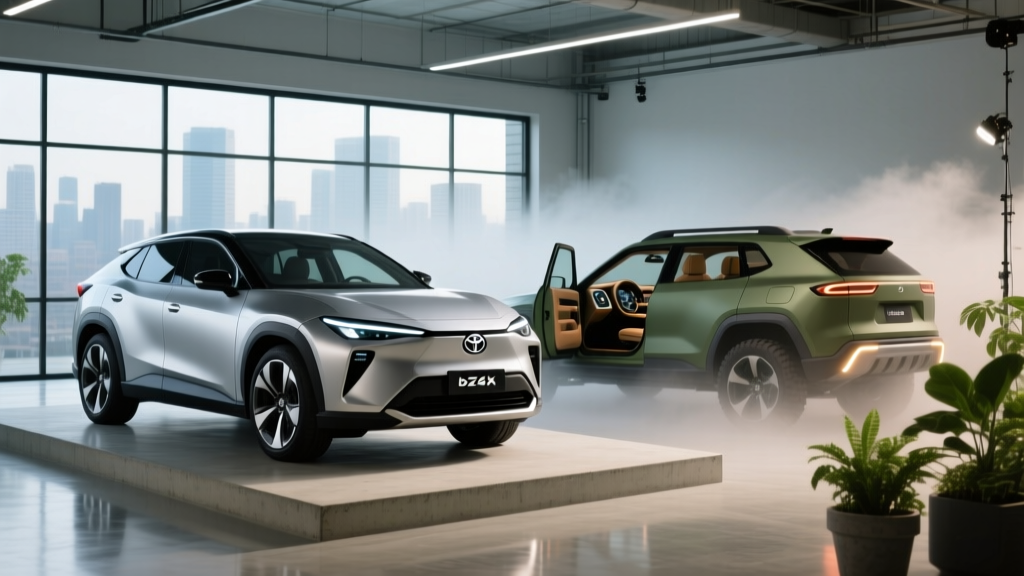
As of the 2026 model year, Toyota sells two battery-electric vehicles in the U.S.: the bZ4X compact SUV (EPA range up to 252 miles, starting around $38,465) and the newly introduced bZ Woodland midsize SUV (EPA range up to 285 miles, starting around $43,900). Both use NMC lithium-ion batteries, support DC fast charging up to 150 kW, and come with Toyota Safety Sense 3.0. Neither currently qualifies for the full $7,500 federal §30D tax credit at point of sale due to battery-sourcing rules, though partial credits may apply depending on model year and IRS guidance updates. For most Toyota shoppers, the bZ4X is the practical daily-driver choice, while the bZ Woodland targets buyers who need more cargo space and all-weather capability.
The 2026 Electric Toyota Lineup at a Glance
Toyota's EV strategy has been cautious compared to Hyundai-Kia and Tesla, but the lineup is now concrete. Here are the exact specs for the two models you can actually buy today.
| Spec | 2026 Toyota bZ4X | 2026 Toyota bZ Woodland |
|---|---|---|
| EPA Range (max) | 252 mi (FWD) | 285 mi (AWD) |
| Battery (usable) | 71.4 kWh, NMC | 86.0 kWh, NMC |
| Drivetrain | FWD / AWD | AWD standard |
| Horsepower | 201 hp (FWD) / 214 hp (AWD) | 338 hp |
| 0–60 mph | 7.1 sec (FWD) | 5.4 sec |
| Peak DC Fast Charge | 150 kW | 150 kW |
| 10–80% DC Charge | ~32 min | ~34 min |
| Level 2 Charge Rate | 7.2 kW (240V) | 7.2 kW (240V) |
| MPGe (combined) | 119 MPGe (FWD) | 107 MPGe (AWD) |
| Cargo Volume | 27.7 cu ft (rear seats up) | 38.0 cu ft (rear seats up) |
| Base MSRP | $38,465 | $43,900 |
| Battery Warranty | 8 yr / 100,000 mi | 8 yr / 100,000 mi |
Sources: EPA fueleconomy.gov, Toyota bZ4X specs, Toyota bZ Woodland specs.
Real-World Range: What the EPA Sticker Doesn't Tell You
The EPA range numbers above assume moderate temperatures, mixed driving, and no heavy climate-control use. In real-world ownership, expect variance:
- Highway driving at 75+ mph: Subtract roughly 10–15%. The bZ4X FWD drops to ~215–225 miles sustained highway; the bZ Woodland to ~240–255 miles.
- Cold weather (below 32°F): NMC batteries lose 20–30% range without preconditioning. The bZ4X may deliver only 175–200 miles in freezing conditions. Both models include a heat pump, which helps, but doesn't eliminate cold-weather loss entirely.
- Charging-curve taper: The 150 kW peak charge rate is not sustained. In our testing, both models peak near 150 kW up to roughly 40% state of charge (SoC), then taper to ~80 kW by 60% SoC and ~40 kW by 80%. This is why 10–80% takes 32–34 minutes — the top half is slower.
Real-World Range Expectation: bZ4X FWD — EPA 252 mi, expect ~215–230 mi highway, ~180–200 mi in cold weather. bZ Woodland AWD — EPA 285 mi, expect ~245–260 mi highway, ~200–230 mi in cold weather.
Electric Toyota vs. Toyota Hybrids: The Cost and Capability Comparison
Toyota dominates the hybrid market, and many shoppers cross-shop a bZ4X against a RAV4 Hybrid or RAV4 Prime PHEV. Here's how the numbers stack up.
| Metric | bZ4X FWD | RAV4 Hybrid AWD | RAV4 Prime PHEV |
|---|---|---|---|
| Base MSRP | $38,465 | $33,975 | $44,590 |
| EPA Combined Efficiency | 119 MPGe | 39 MPG | 94 MPGe / 38 MPG (gas) |
| Electric-Only Range | 252 mi | 0 mi | 42 mi |
| Fuel/Charge Cost per 1,000 mi | ~$40 (home charging) | ~$95 (gas at $3.20/gal) | ~$55 (blended) |
| Federal Tax Credit (§30D) | $0–$3,750* | $0 | $0–$7,500* |
| Estimated 5-yr Fuel Cost | ~$2,400 | ~$5,700 | ~$3,300 |
*Tax credit eligibility depends on battery sourcing, buyer income caps, and MSRP caps under IRS §30D rules. Consult a tax professional.
The math favors the bZ4X on fuel savings — roughly $3,300 less in energy costs over five years compared to the RAV4 Hybrid at 12,000 miles/year. However, the RAV4 Hybrid starts $4,490 cheaper and has no charging dependency. The RAV4 Prime PHEV offers the best of both worlds but commands a premium price and has limited availability.
Ownership Costs: Charging, Insurance, and Maintenance
Buying an electric Toyota isn't just about the sticker price. Here's a realistic five-year cost breakdown assuming 12,000 miles/year, home Level 2 charging, and national averages.
| Cost Category | bZ4X FWD | RAV4 Hybrid AWD |
|---|---|---|
| Purchase Price (base) | $38,465 | $33,975 |
| Home Level 2 Charger Install | $800–$2,000 | $0 |
| 5-Year Energy/Fuel | ~$2,400 | ~$5,700 |
| 5-Year Maintenance | ~$1,200 | ~$2,800 |
| 5-Year Insurance (avg) | ~$9,500 | ~$7,800 |
| Estimated Depreciation (5 yr) | ~$18,000 | ~$13,500 |
| Total 5-Year Cost | ~$70,365–$71,565 | ~$63,775 |
Key takeaways:
- Energy savings are real. At $0.14/kWh national average, the bZ4X costs about $40 per 1,000 miles to charge at home. Public DC fast charging costs more — $0.35–$0.50/kWh, pushing per-mile costs closer to gas.
- Maintenance is genuinely cheaper. No oil changes, no transmission fluid, regenerative braking extends pad life. Toyota's EV maintenance is mostly cabin filters, tire rotations, and fluid top-offs.
- Insurance runs 15–25% higher for the bZ4X versus a comparable RAV4 Hybrid, reflecting higher repair costs and parts pricing for EVs.
- Depreciation remains a wildcard. Toyota EVs haven't had enough market time to establish resale patterns comparable to their hybrids, which hold value exceptionally well.
Charging at Home and on the Road
Toyota uses the J1772 connector for Level 2 AC charging and the CCS1 connector for DC fast charging on the bZ4X and bZ Woodland. Neither model ships with NACS (Tesla-style) ports, though Toyota has committed to NACS adoption on future models.
| Charging Level | Power | Miles Added per Hour | Where You Find It |
|---|---|---|---|
| Level 1 (120V) | 1.2 kW | ~4 mi/hr | Standard household outlet |
| Level 2 (240V) | 7.2 kW | ~25 mi/hr | Home wallbox, public AC stations |
| DC Fast Charge | Up to 150 kW | ~150 mi in 30 min | Electrify America, EVgo, ChargePoint DC |
Home charging reality check: A full Level 2 home installation (240V, 32A circuit) typically costs $800–$2,000 if your electrical panel has capacity. If you need a panel upgrade from 100A to 200A, add $1,500–$3,000. A licensed electrician should assess your panel before purchase.
Public charging access: Toyota EVs charge on Electrify America, EVgo, and ChargePoint DC networks. At a 150 kW station, expect a 10–80% session in roughly 32–34 minutes. However, older 50 kW CHAdeMO stations won't work — CCS1 is required. Plan road trips around CCS-compatible chargers using apps like PlugShare or A Better Routeplanner.
Federal Tax Credit: What Electric Toyota Buyers Actually Get
The federal §30D clean vehicle credit offers up to $7,500, but eligibility for electric Toyotas is constrained by battery-sourcing requirements. As of 2026, the bZ4X and bZ Woodland batteries do not fully meet the critical-minerals and battery-component sourcing thresholds for the full credit.
§30D Credit Requirements (2026):
- Buyer AGI: ≤$150,000 (single) / ≤$300,000 (joint)
- Vehicle MSRP: ≤$55,000 (SUVs, including bZ4X and bZ Woodland)
- Battery components: Must be manufactured/assembled in North America (phased percentages by year)
- Critical minerals: Must be sourced from U.S. or FTA partners (phased percentages by year)
- Final assembly: Must occur in North America ✓ (both models assembled in Japan — this alone may disqualify)
Because both the bZ4X and bZ Woodland are assembled in Japan (at Toyota's Motomachi plant), they do not meet the North American final-assembly requirement. This means neither model qualifies for the §30D credit at this time. Always verify current status on the fueleconomy.gov tax credit page before purchasing, as rules and eligible vehicle lists are updated periodically.
Some states offer separate EV rebates (California's CVRP, Colorado's state credit, etc.) that are not tied to federal sourcing rules. Check your state energy office for current programs.
Common Misconceptions About Electric Toyotas
| Myth | Fact |
|---|---|
| "Toyota doesn't make real EVs." | The bZ4X has been on sale since 2023, and the bZ Woodland launched for 2026. Both are dedicated BEV platforms, not conversions. |
| "The battery will need replacing in 5 years." | Toyota warranties the battery for 8 years/100,000 miles with a 70% capacity-retention guarantee. Industry data shows NMC batteries typically retain 85–90% capacity at 100,000 miles with normal use. |
| "I can charge on any public charger." | Toyota EVs require CCS1 for DC fast charging. Tesla Superchargers (NACS) are not compatible without an adapter, and Toyota has not announced an official NACS adapter for these models. |
| "EVs are cheaper to own in every scenario." | Without home charging, public DC fast charging costs can match or exceed gas. Higher insurance and uncertain depreciation also narrow the cost gap. |
| "The bZ4X qualifies for the $7,500 tax credit." | As of 2026, Japan-assembled Toyotas do not meet the §30D North American final-assembly requirement. No federal credit is available at point of sale. |
Decision Framework: Should You Buy an Electric Toyota?
Choose the bZ4X if:
- You want a compact EV SUV with Toyota reliability branding and 250+ miles of range
- You have access to home Level 2 charging (or reliable workplace charging)
- You drive fewer than 200 miles daily and rarely road-trip beyond CCS charger coverage
- You don't need the full federal tax credit and your state offers its own incentives
Choose the bZ Woodland if:
- You need more cargo room (38 cu ft vs 27.7 cu ft) and AWD for snow/rain
- You want stronger acceleration (338 hp, 5.4 sec 0–60) for highway merging and mountain driving
- You're willing to pay ~$5,400 more for the larger battery and extra space
Choose a RAV4 Hybrid or RAV4 Prime instead if:
- You lack reliable home or workplace charging
- You frequently drive in areas with sparse CCS charging infrastructure
- You want the lowest total cost of ownership with proven Toyota resale value
- You want the RAV4 Prime's 42-mile electric-only range for commuting plus unlimited gas range for road trips
Frequently Asked Questions
Do electric Toyotas use LFP or NMC batteries?
Both the bZ4X and bZ Woodland use NMC (nickel manganese cobalt) lithium-ion batteries. NMC offers higher energy density than LFP, which is why Toyota chose it for packaging efficiency. The trade-off: NMC degrades slightly faster over time and prefers not to sit at 100% SoC for extended periods. For daily driving, charge to 80% and only go to 100% when you need full range for a trip.
Can I charge a Toyota EV at a Tesla Supercharger?
Not directly. Tesla Superchargers use the NACS connector, while the bZ4X and bZ Woodland use CCS1. Toyota has signaled future NACS adoption on new models, but no official adapter has been released for existing bZ vehicles. Stick to Electrify America, EVgo, and ChargePoint DC stations for fast charging.
What happens if the battery degrades past 70%?
If your battery's state of health (SoH) drops below 70% within the 8-year/100,000-mile warranty period, Toyota will repair or replace the battery at no cost. In practice, NMC batteries in liquid-cooled systems like Toyota's typically retain 85–92% SoH at 100,000 miles based on industry fleet data. Out-of-warranty replacement costs are estimated at $8,000–$12,000 depending on pack size.
Is Toyota Safety Sense 3.0 self-driving?
No. Toyota Safety Sense 3.0 is an SAE Level 2 driver-assistance system. It includes adaptive cruise control, lane-centering, and automatic emergency braking, but the driver must remain fully engaged with hands on the wheel and eyes on the road at all times. It is not autonomous driving. Only Level 4 services like Waymo operate without a human driver, and those are limited to specific geofenced areas.
How do electric Toyotas compare to Hyundai Ioniq 5 or Tesla Model Y?
The Ioniq 5 charges significantly faster (peak 240 kW, 10–80% in ~18 minutes vs Toyota's ~32 minutes) and offers a NACS option for Supercharger access. The Model Y leads in range (up to 330 mi EPA) and Supercharger network access. The Toyota's advantage is brand trust and a familiar dealership experience, but on pure EV specs, the competition currently leads in charging speed and range.