The R1T as an Overlanding Platform: What Changes With a Roof Top Tent
The Rivian R1T has carved out a niche as the default electric adventure truck, but bolting a roof top tent (RTT) to its gear tunnel or bed rack fundamentally changes the vehicle's aerodynamic profile and weight distribution. For 2026, the R1T Dual-Motor and Tri-Motor variants continue to dominate the electric pickup segment, yet few owners have hard data on how a 120-180 lb roof top tent affects the truck's already range-sensitive efficiency at highway speeds.
This review covers the 2026 Rivian R1T in the context that matters to the overlanding community: what happens to range, charging logistics, and daily usability when you commit to a rooftop camping setup. We'll anchor every claim in EPA data, real-world testing variables, and the specific electrical and structural considerations that separate a successful RTT build from a regrettable one.
2026 Rivian R1T Core Specifications at a Glance
| Specification | Dual-Motor Standard | Dual-Motor Max Pack | Tri-Motor (Performance) |
|---|---|---|---|
| EPA Range | 270 miles | 420 miles | 390 miles |
| Battery Capacity (usable) | 106 kWh (NMC) | 149 kWh (NMC) | 149 kWh (NMC) |
| Horsepower | 533 hp | 533 hp | 850 hp |
| 0-60 mph | 4.5 sec | 4.5 sec | 2.9 sec |
| Drivetrain | AWD (Dual-Motor) | AWD (Dual-Motor) | AWD (Tri-Motor) |
| Max DC Fast Charge | 200 kW | 220 kW | 220 kW |
| 10-80% DC Charge Time | ~30 min | ~42 min | ~42 min |
| Level 2 Home Charge Rate | 11.5 kW (~25 mi/hr) | 11.5 kW (~25 mi/hr) | 11.5 kW (~25 mi/hr) |
| Towing Capacity | 11,000 lbs | 11,000 lbs | 11,000 lbs |
| Payload Capacity | 1,760 lbs | 1,760 lbs | 1,760 lbs |
| Bed Length | 4.5 ft (54 in) | 4.5 ft (54 in) | 4.5 ft (54 in) |
| MPGe (Combined) | 73 MPGe | 70 MPGe | 68 MPGe |
| kWh/100 mi | 46 kWh | 48 kWh | 49 kWh |
Source: fueleconomy.gov and Rivian 2026 specification sheets. Tri-Motor figures reflect the Performance Dual-Motor/Tri-Motor availability for the 2026 model year.
Real-World Range With a Roof Top Tent Installed
EPA Sticker (Dual-Motor Standard Pack): 270 miles
Real-World Expectation (No RTT): ~230-250 miles highway, ~260 miles mixed city/highway
Real-World Expectation (With RTT): ~195-220 miles highway at 70+ mph, ~230 miles mixed driving
Cold Weather (Below 32°F, With RTT): ~160-185 miles highway
A roof top tent adds two range penalties: weight (typically 120-180 lbs on the rack) and, more significantly, aerodynamic drag. The R1T's squared-off bed and tailgate already create a turbulent air wake; a hard-shell or soft-shell RTT sitting 6-12 inches above the roofline disrupts the laminar flow over the cab and increases the vehicle's effective frontal area. At highway speeds above 65 mph, this drag penalty compounds quickly.
In practical terms, Dual-Motor Standard Pack owners should plan routes assuming 200 miles of usable range with an RTT installed, particularly on highway-dominant overlanding routes. The Max Pack's 420-mile EPA rating provides a more comfortable buffer — expect roughly 310-340 real-world miles with a tent at highway speeds, which covers most single-day overlanding legs without mid-route charging.
Cold weather amplifies the problem. Lithium-ion NMC chemistry loses roughly 15-25% of usable capacity in sub-freezing temperatures due to increased internal resistance and cabin heating demands. Add the RTT's drag, and Standard Pack owners may find themselves searching for chargers at the 160-mile mark on winter highway drives.
Charging Infrastructure and the Overlanding Reality
| Charging Level | Power | Miles Added/Hour | Use Case |
|---|---|---|---|
| Level 1 (120V outlet) | 1.4 kW | ~3 mi/hr | Emergency/trickle at campsite |
| Level 2 (240V home) | 11.5 kW | ~25 mi/hr | Daily home charging, overnight |
| DC Fast Charge (Standard) | 200 kW peak | ~140 mi in 15 min (peak) | Highway stops, route charging |
| DC Fast Charge (Max/Tri) | 220 kW peak | ~150 mi in 15 min (peak) | Highway stops, faster taper curve |
The R1T uses the NACS (North American Charging Standard) connector as of the 2025 model year refresh, giving it native access to Tesla Supercharger stations — a critical advantage for overlanding routes that pass through rural corridors where Electrify America and EVgo coverage remains sparse. As of 2026, the Rivian Adventure Network also provides proprietary chargers at key outdoor destinations, though coverage remains limited compared to the Supercharger network.
Charging curve reality check: The R1T's peak 200-220 kW rate holds only between roughly 10-40% state of charge. Above 60%, the curve tapers significantly — expect 80-100 kW through the 60-80% window, and below 40 kW once you pass 90%. For overlanders, this means the practical fast-charging stop takes 30-42 minutes (10-80%), not the "15 minutes of range" that marketing materials highlight.
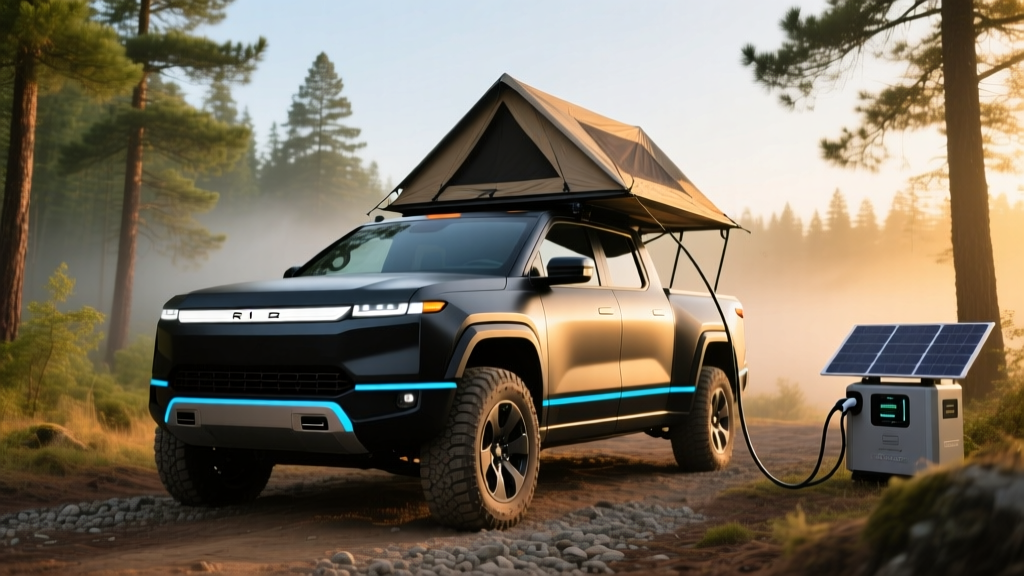
For campsite charging, the R1T's included mobile charger can pull from a standard NEMA 14-50 outlet (240V, 40A) at up to 9.6 kW — adequate for replenishing 200+ miles overnight at a developed campground with electrical hookups. Remote boondocking without shore power means relying on the battery you arrived with, which is where the Max Pack's 149 kWh buffer becomes nearly essential for multi-day RTT trips.
Roof Top Tent Compatibility: Rack Systems and Weight Limits
The R1T's roof rack system is rated for a dynamic load (while driving) of approximately 165 lbs and a static load (parked, tent deployed with occupants) of up to 600+ lbs. This is sufficient for most hard-shell roof top tents (typically 130-170 lbs) but leaves minimal margin for heavier models or additional roof cargo.
Key compatibility considerations for 2026 R1T owners:
- Crossbar spacing: The R1T's factory roof rails use a specific T-slot channel. Aftermarket RTT mounts must be compatible with Rivian's rail geometry — brands like Yakima, Thule, and Front Runner offer R1T-specific adapters.
- Gear Tunnel alternative: Many R1T owners mount RTTs on aftermarket bed rack systems (e.g., Leitner Designs, Decked) that span the 4.5-foot bed and gear tunnel. This lowers the center of gravity and preserves roof rack capacity for solar panels or light bars.
- Height clearance: With an RTT mounted, total vehicle height typically reaches 76-80 inches — plan garage and parking structure access accordingly. The R1T's standard height is approximately 73 inches without a tent.
- Range impact mitigation: Low-profile hard-shell tents (e.g., Alu-Cab, iKamper Skycamp Mini) create less drag than traditional soft-shell wedge designs, recovering an estimated 5-10 miles of range at highway speeds.
Pricing, Tax Credits, and the Overlanding Budget
| Trim / Configuration | Base MSRP | Federal §30D Credit | Effective Price (if eligible) |
|---|---|---|---|
| Dual-Motor Standard Pack | $69,900 | Up to $7,500* | ~$62,400 |
| Dual-Motor Max Pack | $83,900 | Up to $7,500* | ~$76,400 |
| Tri-Motor Performance | $99,900 | Up to $7,500* | ~$92,400 |
*Federal EV tax credit eligibility under IRS §30D is subject to multiple conditions for 2026: buyer AGI must not exceed $300,000 (joint) / $150,000 (single); vehicle MSRP must be under $80,000 for trucks (eliminating the Tri-Motor from credit eligibility); and battery critical-mineral and component sourcing requirements must be met. The credit can now be transferred to the dealer at point of sale as an upfront discount. Always verify current-year rules at irs.gov and consult a tax professional.
For overlanding builds, budget an additional $2,500-$5,000 for a quality roof top tent and compatible rack system, plus $500-$1,500 for installation hardware and any bed-rack upgrades. This pushes the realistic entry point for an R1T RTT setup to approximately $65,000-$70,000 after credits for the Dual-Motor Standard configuration.
Technology, Driver Assists, and Off-Grid Features
The 2026 R1T continues to ship with Rivian's Driver+ system — a Level 2 driver-assistance suite combining adaptive cruise control, lane centering, and highway assist on mapped roads. This is not autonomous driving; the driver must maintain hands-on-wheel awareness at all times, per NHTSA guidelines on SAE Level 2 systems.
Overlanding-specific tech highlights:
- Quad-Motor tank turns (Tri-Motor/Quad-Motor trims): Enables 360-degree pivots for tight trail turnaround situations — genuinely useful on narrow forest service roads.
- Adjustable air suspension: Up to 14.9 inches of ground clearance in Off-Road mode, with automatic ride-height adjustment based on speed and terrain.
- Built-in air compressor: Integrated into the gear tunnel for tire inflation on the trail — a feature that eliminates the need for a separate portable compressor.
- Camp Kitchen option: Slide-out kitchen system for the gear tunnel with induction cooktop and sink, powered by the main traction battery.
- Vehicle-to-Load (V2L): The R1T's bed and cabin outlets can power campsite devices (up to 1,500W continuous), running everything from electric coolers to laptop charging without a separate generator.
Infotainment runs on Rivian's proprietary 15.6-inch center display with native trail-mapping integration and overlanding waypoints. The system supports offline maps — essential for areas without cell coverage where RTT users frequently camp.
Pros, Cons, and the Honest Overlanding Verdict
Pros
- Max Pack range (420 mi EPA) absorbs RTT drag penalty better than any competitor
- Native NACS/Supercharger access transforms remote route planning
- Integrated air compressor, V2L power, and Camp Kitchen reduce gear redundancy
- Air suspension self-levels with tent weight and uneven campsite terrain
- 54-inch bed + gear tunnel offers flexible RTT mounting options
Cons
- Standard Pack range drops to ~200 mi real-world with RTT at highway speed
- Tri-Motor exceeds $80,000 MSRP cap — ineligible for federal tax credit
- 4.5-foot bed is short for truck-bed tent alternatives or slide-in campers
- Charging infrastructure remains sparse on BLM land and remote trailheads
- Roof rack dynamic weight limit (165 lbs) constrains heavier RTT models
Battery Warranty and Long-Term Ownership
Rivian covers the R1T's battery pack and drive units with an 8-year/175,000-mile warranty — one of the most generous powertrain warranties in the EV truck segment. The warranty guarantees the battery will retain at least 70% of its original capacity during the coverage period. For overlanders putting 15,000-20,000 miles per year on the truck (including significant DC fast charging, which accelerates degradation slightly versus Level 2-only charging), this provides coverage through roughly 8-11 years of active use.
The NMC chemistry in both the Standard and Max packs offers higher energy density than LFP alternatives, which is why Rivian uses it for range-critical applications. However, NMC cells are more sensitive to sustained high-state-of-charge storage. Overlanders who leave the truck plugged in at 100% for extended periods between trips should set a daily charge limit of 80-85% and only charge to full capacity within a few hours of departure.
Frequently Asked Questions
What is the real-world range of the R1T with a roof top tent?
Expect roughly 195-220 highway miles for the Dual-Motor Standard Pack and 310-340 miles for the Max Pack with a roof top tent installed, assuming 70 mph cruising speeds. Cold weather (below freezing) reduces these figures by an additional 15-25%.
How fast does the R1T charge on a road trip?
At a DC fast charger, the Standard Pack reaches 10-80% in approximately 30 minutes at a peak of 200 kW. The Max Pack takes roughly 42 minutes at 220 kW peak due to the larger 149 kWh battery. Actual times vary based on battery temperature and charger availability — always precondition the battery via the navigation system before arriving at a charger.
Does the 2026 R1T qualify for the federal EV tax credit?
The Dual-Motor Standard Pack ($69,900 MSRP) and Dual-Motor Max Pack ($83,900 MSRP) are under the $80,000 truck MSRP cap and may qualify for up to $7,500 under IRS §30D, provided the buyer meets income limits ($300,000 joint / $150,000 single AGI) and the battery meets critical-mineral sourcing requirements. The Tri-Motor at $99,900 exceeds the cap and is ineligible. Verify current rules at irs.gov.
Is the R1T worth buying over the Ford F-150 Lightning or Chevy Silverado EV for overlanding?
The R1T's advantages are its integrated adventure features (air compressor, Camp Kitchen, air suspension), superior ground clearance (14.9 in vs. ~10 in for competitors), and Max Pack range. The F-150 Lightning offers a larger 5.5-foot bed and Pro Power Onboard at a lower entry price, while the Silverado EV provides a longer 5-foot 11-inch bed on certain trims. For dedicated overlanding with an RTT, the R1T's suspension articulation and trail technology give it the edge despite the shorter bed and higher price.
Can I run a roof top tent on the R1T's gear tunnel instead of the roof?
Yes — many owners use aftermarket bed rack systems that span the bed and gear tunnel to mount RTTs at a lower height. This reduces aerodynamic drag (recovering roughly 5-15 miles of range vs. roof mounting), lowers the center of gravity for trail driving, and preserves the roof rack for solar panels or auxiliary lighting.