Quick Answer: The Electric Toyota Hilux
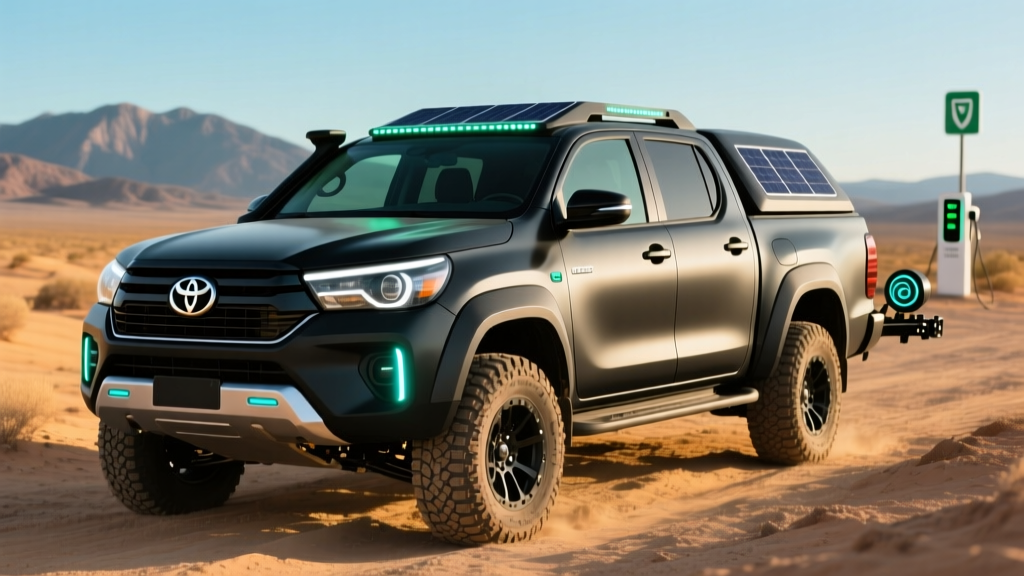
The electric Toyota Hilux is currently available only in select international markets (primarily Thailand and parts of Europe) as the Hilux Revo BEV concept and limited production model. As of early 2026, Toyota has not announced US availability for an electric Hilux, and the midsize Tacoma serves as its North American equivalent. Where sold, the electric Hilux offers an estimated ~200–220 miles of range, a battery capacity around 70–80 kWh, and towing capacity near 3,500 kg (~7,700 lbs). US buyers interested in an electric Toyota truck should watch the Tacoma lineup for electrification announcements.
What Is the Electric Toyota Hilux?
The Toyota Hilux has been one of the world's most popular pickup trucks for decades, dominating markets across Southeast Asia, Africa, Australia, and Europe. In response to tightening emissions regulations and commercial fleet electrification mandates, Toyota unveiled the Hilux Revo BEV concept and subsequently began limited production of an all-electric variant for specific markets.
The electric Hilux targets a specific buyer profile: commercial fleets, government agencies, and private owners in regions with strong EV incentives and charging infrastructure. Thailand, where the Hilux is assembled, has pushed aggressive EV adoption policies, making it the logical launchpad.
Key Specifications (International Markets)
| Spec | Estimated Value |
|---|---|
| Battery Capacity | ~70–80 kWh (usable), likely NMC chemistry |
| EPA-Equivalent Range | ~200–220 mi (WLTP-rated markets report higher) |
| Motor Output | ~150–180 kW (~200–240 hp) |
| Torque | ~350–400 lb-ft |
| 0–60 mph | ~8.5–9.5 seconds (estimated) |
| Max Towing | ~7,700 lbs (3,500 kg) |
| Payload | ~2,200 lbs (1,000 kg) |
| DC Fast Charge (peak) | ~100–130 kW |
| 10–80% DC Charge | ~35–45 minutes |
| Level 2 Charge Rate | ~7–11 kW (single-phase markets) |
| Drivetrain | 4WD (dual motor expected on higher trims) |
| Starting Price (intl.) | ~$45,000–$55,000 USD equivalent (varies by market) |
Note: These figures are compiled from Toyota's international press materials and market-specific filings. US-spec models, if they arrive, would carry different EPA ratings.
Will the Electric Hilux Come to the United States?
This is the question most American truck buyers are asking, and the honest answer is: not anytime soon, and possibly never under the Hilux nameplate.
Toyota's US truck strategy centers on the Tacoma (midsize) and Tundra (full-size). The Hilux, while mechanically related to the Tacoma historically, has diverged significantly over the past two generations. Toyota has not sold the Hilux in the US since the early 1990s, and reintroducing it would create internal competition with the Tacoma.
What is plausible: Toyota could bring an electric Tacoma to the US market, potentially sharing the EV platform developed for the international Hilux. Toyota's bZ (Beyond Zero) EV lineup has expanded steadily, and a truck application is a logical next step. However, as of early 2026, Toyota has only confirmed the bZ4X SUV and upcoming bZ compact SUV for North America — no electric truck announcement has been made.
Electric Hilux vs. Gas Hilux: The Ownership Math
For buyers in markets where the electric Hilux is sold, the cost comparison with the diesel/gas variant is the central decision factor. Here's how the numbers stack up over a 5-year / 75,000-mile ownership period:
| Cost Category | Electric Hilux (est.) | Gas/Diesel Hilux (est.) |
|---|---|---|
| Purchase Price | $50,000 | $35,000 |
| Fuel/Energy (75k mi) | $3,750 (home charging @ $0.15/kWh) | $9,375 (25 MPG avg @ $3.75/gal) |
| Maintenance (5 yr) | $1,200 | $3,500 |
| Insurance (5 yr avg) | $7,500 | $6,250 |
| Estimated Incentives | -$5,000 to -$8,000 (market-dependent) | $0 |
| 5-Year Total | ~$57,450–$60,450 | ~$54,125 |
The takeaway: The electric Hilux costs more upfront, but the fuel and maintenance savings close the gap substantially within 5 years. The breakeven point typically lands around year 4–5 depending on local electricity rates, annual mileage, and available incentives. Fleet buyers running high annual miles (20,000+ per year) hit breakeven faster.
Real-World Range and What Affects It
The sticker range of ~200–220 miles tells only part of the story. Electric pickup trucks, like all EVs, lose range under specific conditions — and truck buyers often drive in exactly those conditions.
Range Expectations: Real-World Scenarios
- Mild weather, city/mixed driving: ~190–210 mi (close to sticker)
- Highway at 70 mph sustained: ~155–175 mi (aerodynamic drag is the enemy of pickups)
- Cold weather (below 32°F): ~140–165 mi (battery chemistry + cabin heating draw)
- Towing at max capacity: ~100–130 mi (the brutal physics of pulling 7,700 lbs)
- Bed loaded at max payload: ~165–185 mi
The electric Hilux's boxy profile and high ground clearance create significant aerodynamic drag, which becomes the dominant energy consumer above 55 mph. This is why highway range drops sharply compared to city driving — the opposite of a gas truck, which gets better mileage on the highway.
Charging-curve reality: The peak DC fast-charge rate of ~100–130 kW is not sustained for the entire session. Expect the truck to pull peak power only between roughly 10% and 50% State of Charge (SoC), after which the rate tapers to protect the battery. A 10–80% session takes 35–45 minutes at a capable DC fast charger — plan road trips accordingly.
Charging the Electric Hilux: What You Need
Home charging is the backbone of EV truck ownership. Here's what that looks like:
Home Charging (Level 2)
A Level 2 home charger operating at 240V and ~32–48 amps (7.7–11.5 kW) will fully recharge the Hilux's ~75 kWh battery in 7–10 hours — overnight, in other words. Installation costs vary widely:
- Basic install (charger near panel, no panel upgrade): $500–$1,200
- Standard install (50-ft run, new 60A circuit): $1,200–$2,500
- Panel upgrade required (200A service): $2,500–$5,000+
Always get a quote from a licensed electrician — your home's existing electrical panel capacity determines the final cost.
Public DC Fast Charging
On the road, the Hilux uses CCS2 connectors in most international markets (Type 2/CCS in Europe, GB/T in some Asian markets). If a US version ever arrives, it would almost certainly use NACS (the Tesla-standard connector now adopted by most automakers). At a 150+ kW DC fast charger, you'll add roughly 100–120 miles of range in 30 minutes during the peak portion of the charge curve.
Common Misconceptions About Electric Pickups
| Myth | Fact |
|---|---|
| "Electric trucks can't tow anything useful." | The electric Hilux tows up to ~7,700 lbs — competitive with many gas midsize trucks. The limitation is range while towing (~100–130 mi), not capability. |
| "The battery will need replacing in a few years." | Modern NMC and LFP batteries are designed for 1,500–3,000+ charge cycles before reaching 80% capacity. Toyota typically warranties EV batteries for 8 years / 100,000 miles (market-dependent), and real-world degradation data shows most packs retain 90%+ capacity at 100,000 miles. |
| "EVs don't work in cold climates." | Range drops 15–30% in freezing temperatures — a real limitation. But preconditioning (warming the battery while plugged in) recovers some of that loss, and the truck still starts instantly in any cold. Norwegian EV adoption (one of the world's coldest EV markets) proves this daily. |
| "Charging takes too long for work use." | For daily work commutes under 150 miles, overnight home charging means you start every morning with a full battery. Public DC charging adds ~100 miles in 30 minutes for longer trips. Fleet operators often find that scheduled charging during lunch breaks or job-site downtime covers their needs. |
| "The electric Hilux qualifies for the US $7,500 tax credit." | Since the electric Hilux is not sold in the US, the IRS §30D federal tax credit does not apply. If Toyota brings an electric Tacoma to the US, credit eligibility would depend on MSRP caps, buyer income limits, battery sourcing requirements, and point-of-sale rules — always check current IRS guidance. |
Who Should Consider the Electric Hilux (or Wait for an Electric Tacoma)?
Decision Framework
Choose the electric Hilux (if available in your market) if:
- You drive under 150 miles per day and have access to home Level 2 charging
- You're a fleet operator with predictable routes and depot charging capability
- Your region offers strong EV purchase incentives that offset the price premium
- You value instant torque for off-road or worksite use (electric motors deliver full torque from 0 RPM)
- You want lower per-mile operating costs over a 5+ year ownership period
Stick with gas/diesel or wait for an electric Tacoma if:
- You regularly tow heavy loads over long distances (towing crushes EV range)
- You lack reliable home or depot charging access
- You live in a region with sparse public DC fast-charging infrastructure
- You need maximum range flexibility for remote/off-grid work
- You're a US buyer — the Hilux simply isn't available, and importing one isn't legal for road use
Consider a PHEV truck (when available) if:
- You want electric commuting range (30–50 mi) but gas-engine flexibility for towing and long trips
- You're not ready to commit to full EV charging logistics
What US Buyers Can Do Right Now
If you're an American truck buyer watching the electric Hilux from afar, here are your realistic options:
- Watch the Tacoma lineup. Toyota's midsize truck is the spiritual US equivalent. An electric or hybrid Tacoma variant is the most likely path to an electrified Toyota truck on American soil.
- Consider current electric trucks. The Ford F-150 Lightning, Rivian R1T, and Chevrolet Silverado EV are available now with established US charging networks and tax-credit eligibility.
- Monitor Toyota's bZ announcements. Toyota's global EV strategy is accelerating, and a truck reveal for the North American market could come at any major auto show.
- Don't plan around the Hilux. Without a US announcement, building your purchase timeline around this truck risks indefinite waiting.
Frequently Asked Questions
What is the electric Toyota Hilux called?
The production electric variant is marketed as the Hilux Revo BEV in Thailand and simply as the electric Hilux in other markets. It is part of Toyota's broader BEV (Battery Electric Vehicle) push, though it is not branded under the "bZ" naming convention used for dedicated EV platforms like the bZ4X.
How much does the electric Hilux cost?
In markets where it's sold, pricing starts at approximately $45,000–$55,000 USD equivalent, depending on trim, battery size, and local taxes. This represents a significant premium over the gas/diesel Hilux, which starts around $25,000–$35,000 in the same markets. Local EV incentives can offset $3,000–$10,000 of that gap.
Can I import an electric Hilux to the US?
Not for road use. Under NHTSA regulations, vehicles not originally certified to US Federal Motor Vehicle Safety Standards (FMVSS) cannot be legally imported for on-road driving unless they are 25+ years old. The electric Hilux is far too new to qualify. Show-and-display import exemptions are extremely limited and unlikely to apply.
Does the electric Hilux have 4WD?
Yes, higher-trim electric Hilux models are expected to feature dual-motor 4WD, consistent with the truck's off-road heritage. Base models in some markets may be offered in 2WD (rear-wheel drive) for fleet buyers prioritizing efficiency and lower cost.
What battery chemistry does the electric Hilux use?
Toyota has not published full chemistry details for all markets, but the Hilux Revo BEV is expected to use NMC (nickel-manganese-cobalt) cells, which offer higher energy density than LFP (lithium iron phosphate) — important for fitting adequate range into a truck platform. NMC batteries offer excellent range but are slightly more sensitive to sustained 100% charging; daily charging to 80% is recommended for longevity.
Will Toyota make an electric Tacoma?
Toyota has not officially confirmed an electric Tacoma as of early 2026. However, the company has committed to expanding its BEV lineup significantly, and a midsize electric truck for North America is widely anticipated by industry analysts. Any future electric Tacoma would need to compete with the Ford Maverick hybrid/electric variants and the forthcoming electric midsize trucks from Stellantis and others.
How does the electric Hilux compare to the Ford F-150 Lightning?
These are different vehicle classes. The Hilux is a midsize, globally-oriented truck (~200 mi range, ~7,700 lbs towing, ~$50K). The F-150 Lightning is a full-size American truck (230–320 mi EPA range, up to 10,000 lbs towing, $50K–$90K+). The Lightning offers more range, power, and towing, but at a higher price point and larger physical footprint. They serve different markets and use cases.
Sources consulted: Toyota global press materials, NHTSA import regulations, IRS §30D clean vehicle credit rules, and market-specific filings. Specifications for the electric Hilux are based on available international data and may differ from final production figures in any given market. Always verify current specs with your local Toyota dealer.