Quick Answer: The electric three wheel car market in 2026 is niche but viable for urban commuters. The most recognized street-legal option is the Arcimoto FUV (Fun Utility Vehicle) — a tandem two-seat, three-wheeled EV with an EPA-estimated range of ~102 miles, a 17.1 kWh LFP battery, and a base price around $21,900. However, availability remains limited, and most three-wheel EVs are classified as autocycles or Neighborhood Electric Vehicles (NEVs), which restricts highway use and federal tax credit eligibility. If you need a practical daily commuter under 35 mph, a three-wheel EV can work. If you need highway capability, cargo space, or reliable dealer support, a conventional four-wheel EV or PHEV is a far safer purchase.
What Exactly Qualifies as an Electric Three Wheel Car?
The term "electric three wheel car" covers a surprisingly fragmented category. In the U.S., three-wheeled electric vehicles fall into distinct legal classifications that determine where you can drive them, what license you need, and whether they qualify for federal incentives.
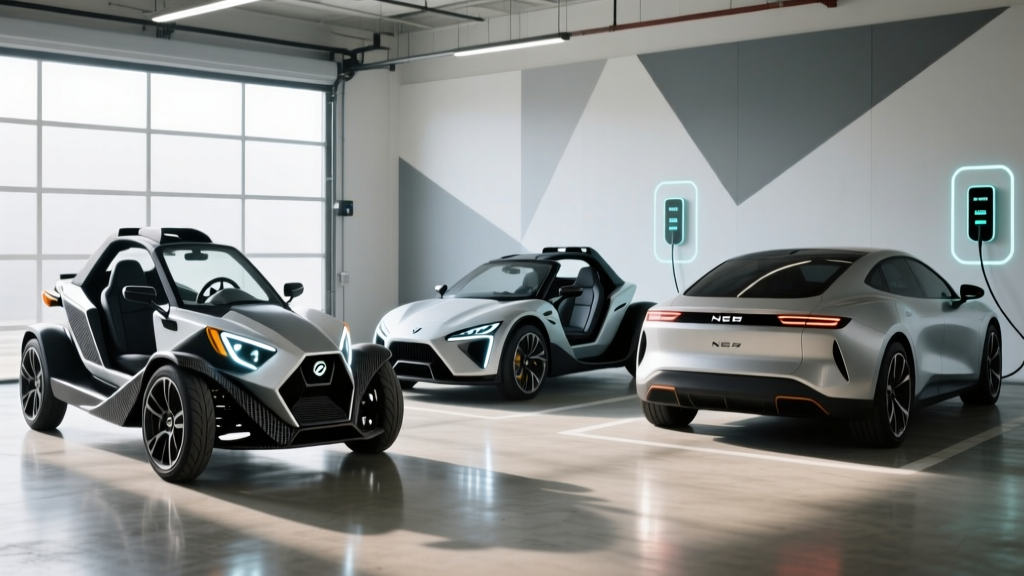
Autocycles — like the Arcimoto FUV — are the closest thing to a true three-wheel car. They have automotive-style controls (steering wheel, pedals), three wheels, and are street-legal on most roads including highways in many states. They must meet Federal Motor Vehicle Safety Standards (FMVSS) for motorcycles or low-speed vehicles depending on weight and speed capability.
Neighborhood Electric Vehicles (NEVs) — also called Low-Speed Vehicles (LSVs) — are federally limited to a top speed of 25 mph and can only be driven on roads with speed limits of 35 mph or lower (state laws vary). Many Chinese-market three-wheel EVs imported to the U.S. fall here. They are not highway-legal and often lack basic crash protection.
Electric trikes and enclosed scooters — vehicles like the ElectraMeccanica Solo (now discontinued) or various enclosed electric trikes blur the line. Some were street-legal as autocycles; others were never truly road-legal outside of private property or specific local ordinances.
The practical takeaway: before you fall in love with a three-wheel EV you saw online, verify its NHTSA classification and your state's registration requirements. A vehicle that's street-legal in Oregon may not be registrable in Texas.
The Leading Contender: Arcimoto FUV Specs and Reality
Arcimoto, based in Eugene, Oregon, has been the most visible manufacturer in the U.S. three-wheel EV space. The FUV (Fun Utility Vehicle) is a tandem-seat, fully enclosed autocycle with automotive-style controls. Here's what the numbers actually look like for the most recent production models:
| Spec | Value |
|---|---|
| Battery Capacity | 17.1 kWh (LFP chemistry) |
| EPA-Estimated Range | ~102 miles (city cycle); ~66 miles (highway at 70 mph) |
| Top Speed | 75 mph |
| Motor Power | 57 kW (77 hp) peak |
| 0–60 mph | ~7.5 seconds |
| Level 1 Charging (120V) | ~1.4 kW; 0–100% in ~12 hours |
| Level 2 Charging (240V) | ~3.3 kW; 0–100% in ~5 hours |
| DC Fast Charging | Not available |
| Curb Weight | ~1,300 lbs |
| Cargo Volume | ~12 cu ft (rear compartment) |
| Base MSRP | ~$21,900 (before incentives) |
Real-World Range Reality: The EPA's 102-mile figure is based on a low-speed city cycle. At sustained highway speeds of 65–70 mph, expect roughly 60–70 miles. In cold weather (below 40°F), LFP batteries lose less capacity than NMC chemistries, but the FUV's small battery and minimal thermal management mean you should plan for 50–60 miles of usable range in winter conditions. This vehicle is a local commuter, not a road-trip machine.
Charging is exclusively Level 1 and Level 2 — there is no DC fast-charging capability. For a daily commuter covering 20–30 miles round trip, overnight Level 1 charging from a standard 120V outlet is sufficient. But if your daily drive exceeds 50 miles, the lack of fast charging becomes a hard limitation.
How Does a Three-Wheel EV Compare to a Gas Car or Conventional EV?
Most shoppers considering an electric three wheel car are weighing it against either a fuel-efficient gas car or a conventional four-wheel EV. The comparison is rarely flattering for the three-wheeler unless your use case is extremely specific.
| Metric | Arcimoto FUV (3-Wheel EV) | Honda Civic (Gas) | Chevrolet Equinox EV (4-Wheel) |
|---|---|---|---|
| Base MSRP | $21,900 | $24,950 | $33,400 |
| EPA Range / Tank Range | 102 mi (city) / 66 mi (hwy) | ~420 mi (12.4 gal tank) | 319 mi |
| Energy/Fuel Cost per Mile | ~$0.04 (at $0.14/kWh) | ~$0.12 (at $3.40/gal, 32 MPG) | ~$0.04 (at $0.14/kWh) |
| Highway Capable | Yes (75 mph top speed) | Yes | Yes |
| Seating | 2 (tandem) | 5 | 5 |
| Cargo | ~12 cu ft | 14.8 cu ft (trunk) | 26.4 cu ft (rear seats up) |
| Crash Test Rating | Not rated by NHTSA/IIHS | IIHS Top Safety Pick | NHTSA 5-star |
| DC Fast Charging | No | N/A | Yes (up to 150 kW) |
| Federal Tax Credit (§30D) | Unlikely to qualify* | N/A | Up to $7,500 (if eligible) |
*The §30D federal tax credit requires vehicles to meet specific battery sourcing, critical minerals, MSRP caps, and buyer income thresholds. Three-wheel autocycles often fall into classification gray areas that make §30D eligibility uncertain. Always verify with a tax professional and check the IRS clean vehicle credit page for current rules.
The data makes the trade-off clear: the FUV costs less upfront than a Civic and far less per mile to fuel, but you sacrifice highway range, passenger capacity, cargo flexibility, verified crash safety, and fast-charging capability. A conventional EV like the Equinox EV or Hyundai Kona Electric delivers 250+ miles of range, full safety ratings, DC fast charging, and five seats — for roughly $10,000–$15,000 more before incentives.
Real Ownership Costs: What a Three-Wheel EV Actually Costs You
The appeal of a three-wheel EV is low operating cost. Let's break down a realistic five-year ownership scenario for the Arcimoto FUV compared to a gas subcompact, assuming 8,000 miles driven per year (appropriate for a local commuter).
| Cost Category | Arcimoto FUV | Honda Civic (Gas) |
|---|---|---|
| Purchase Price | $21,900 | $24,950 |
| Federal Tax Credit | $0 (likely ineligible) | $0 |
| Fuel/Energy (5 years) | $1,600 (at $0.14/kWh) | $4,800 (at $3.40/gal, 32 MPG) |
| Maintenance (5 years) | ~$600 (tire rotation, cabin filter, brake fluid check) | ~$2,500 (oil changes, filters, brakes, spark plugs) |
| Insurance (5 years) | ~$5,500 (specialty/niche vehicle premiums) | ~$4,500 (standard subcompact rates) |
| Estimated Depreciation | ~$11,000 (50%, niche resale market) | ~$9,000 (36%, strong resale) |
| Total 5-Year Cost | ~$40,600 | ~$45,750 |
| Cost per Mile | ~$1.02 | ~$1.14 |
The FUV saves roughly $5,000 over five years, primarily through fuel and maintenance savings. But that margin is thin — and it's entirely erased if insurance premiums run higher than estimated (common for niche vehicles with limited actuarial data), if the battery needs out-of-warranty service, or if resale value drops further due to low demand in the used market.
Home charging access is critical. The FUV's Level 1 charging means you can plug into any standard 120V outlet overnight. But if you lack access to any plug at home or work — apartment dwellers, street parkers — the 66-mile highway range becomes a daily constraint with no public fast-charging fallback. This vehicle demands home charging access to be practical.
Federal Tax Credits and Incentives: What Applies to Three-Wheel EVs?
This is where three-wheel EV buyers face the most confusion. The IRS §30D Clean Vehicle Credit — which provides up to $7,500 for qualifying new EVs — was designed around four-wheeled passenger vehicles. Here's the current eligibility checklist for 2026:
- Vehicle classification: Must be a four-wheeled vehicle with a GVWR under 14,000 lbs (three-wheel autocycles generally do not meet this requirement)
- Battery capacity: Minimum 7 kWh (the FUV's 17.1 kWh battery qualifies on this point)
- MSRP caps: $80,000 for SUVs/pickups/vans; $55,000 for sedans and other vehicles
- Buyer income limits: AGI ≤ $300,000 (joint), $225,000 (head of household), $150,000 (single)
- Battery sourcing: Critical minerals and battery components must meet escalating domestic/free-trade-partner sourcing thresholds
- Assembly: Final assembly must occur in North America
- Point-of-sale transfer: Eligible buyers can transfer the credit to the dealer at purchase for an immediate price reduction
Because most three-wheel EVs are classified as motorcycles or autocycles rather than four-wheeled motor vehicles, they typically do not qualify for §30D. Some buyers have explored the Used Clean Vehicle Credit (§25E, up to $4,000 or 30% of sale price) if purchasing a pre-owned model, but the same four-wheel requirement generally applies.
State and local incentives vary widely. Oregon (Arcimoto's home state), California, and a few other states have offered rebates that include autocycles or electric motorcycles. Always check your state's energy office or DMV for current programs — and confirm eligibility before counting on any incentive in your purchase math.
Common Misconceptions About Electric Three-Wheel Cars
| Myth | Fact |
|---|---|
| "Three-wheel EVs qualify for the $7,500 federal tax credit." | Most do not. §30D requires four wheels and specific vehicle classifications. Verify with a tax professional. |
| "They're just as safe as a regular car." | Three-wheel autocycles are not crash-tested by NHTSA or IIHS under standard passenger-vehicle protocols. They lack the mass, crumple zones, and airbag complement of a four-wheel EV. |
| "102 miles of range is enough for anyone's commute." | The 102-mile EPA figure is a low-speed city estimate. Highway driving at 65+ mph cuts range to ~60–70 miles. Cold weather reduces it further. |
| "You can charge them at any public EV station." | Most three-wheel EVs use a standard J1772 connector for Level 2, but they cannot use DC fast chargers (CCS, NACS, CHAdeMO). You're limited to Level 1 and Level 2 speeds. |
| "They're legal to drive everywhere with a regular license." | Registration and licensing requirements vary by state. Some states require a motorcycle endorsement for autocycles. Always check your state DMV. |
| "The battery will need expensive replacement within a few years." | LFP batteries generally offer strong cycle life (2,000+ cycles to 80% capacity). Arcimoto provides a battery warranty, but long-term replacement costs and parts availability for niche manufacturers carry more uncertainty than mainstream brands. |
Is a Three-Wheel EV Right for You? A Decision Framework
Choose a three-wheel electric car if:
- Your daily round-trip commute is under 40 miles, mostly on surface streets (under 55 mph)
- You have reliable home charging access (at minimum a standard 120V outlet in a garage or driveway)
- You live in a mild climate where winter range loss won't push you below your daily driving needs
- You're a single driver or occasional two-person household who doesn't need rear seating
- You understand the vehicle will not have NHTSA/IIHS crash ratings and accept that trade-off
- You're comfortable with limited dealer networks, niche parts availability, and uncertain resale value
Choose a conventional four-wheel EV or PHEV instead if:
- You regularly drive on highways or need more than 70 miles of real-world range
- You carry passengers or need more than ~12 cu ft of cargo space
- You want NHTSA/IIHS crash test validation and modern ADAS features (automatic emergency braking, lane-keeping, blind-spot monitoring)
- You need DC fast-charging capability for road trips or lack home charging
- You want to maximize your chances of qualifying for the §30D federal tax credit
- You prefer a mainstream brand with broad dealer support and predictable resale value
- You live in a region with harsh winters where small-battery EVs lose significant range
For buyers in the "choose conventional" camp, strong alternatives include the Chevrolet Equinox EV (319 miles EPA, ~$33,400, DC fast charging), the Hyundai Kona Electric (261 miles EPA, ~$32,975), or the Toyota Prius Prime PHEV (44 miles electric-only + 50 MPG combined gas) if charging access is uncertain. All four are NHTSA-tested, qualify for potential tax credits, and carry dramatically lower ownership risk.
What First-Time Buyers of Niche EVs Should Know
If you're committed to a three-wheel electric vehicle, go in with eyes open on these practical points:
Insurance will cost more and be harder to place. Niche vehicles with limited production runs and no actuarial history often require specialty insurers. Get quotes before purchasing — don't assume your current carrier will write a policy.
Service and parts are a real concern. Arcimoto operates a limited service network. If you're not near Eugene, Oregon, or one of their few service partners, you may be shipping components or waiting weeks for repairs. Compare this to a Chevrolet or Hyundai dealer within 10 miles of most American zip codes.
Resale value is unpredictable. Three-wheel EVs have a tiny buyer pool. When you're ready to sell, expect a longer listing period and a wider range of offers. Depreciation on niche vehicles is typically steeper than on mainstream EVs.
Verify your state's registration rules before ordering. Some states classify autocycles as motorcycles (requiring a motorcycle endorsement), some as autocycles (a distinct category), and a few don't have clear frameworks. Call your DMV. Do not rely on manufacturer assurances alone.
Test-drive in conditions that match your commute. A 15-minute test drive on a flat suburban road tells you nothing about how the vehicle handles a 70-mph highway merge in rain, a 5,000-foot mountain pass, or a 20°F January morning. If the manufacturer or dealer offers extended test drives, take them.
Frequently Asked Questions
Are electric three-wheel cars street-legal in all 50 states?
No. Street legality varies by state and by the specific vehicle's classification. Some states register autocycles freely; others require motorcycle endorsements; a few have ambiguous regulations. Always confirm with your state DMV before purchasing. NEVs (Low-Speed Vehicles) are restricted to roads with speed limits of 35 mph or lower in most jurisdictions.
Can I take a three-wheel EV on the highway?
Autocycles like the Arcimoto FUV have a top speed of 75 mph and are technically highway-legal in states that permit them. However, with only ~66 miles of real-world highway range, no DC fast charging, and no crash-test validation, highway driving in a three-wheel EV carries practical and safety limitations that a conventional EV does not.
Do three-wheel electric vehicles qualify for any federal tax credits?
Generally, no. The §30D Clean Vehicle Credit requires four-wheeled vehicles. Three-wheel autocycles and NEVs typically do not qualify. Some state incentives may apply — check your state energy office. Consult a tax professional for your specific situation.
What happens if the battery degrades or needs replacement?
LFP batteries like the one in the FUV typically offer 2,000+ charge cycles before dropping to 80% capacity — that's roughly 200,000 miles at the FUV's range. However, if replacement is needed out of warranty, costs and parts availability for niche manufacturers are less predictable than for mainstream brands. Always review the manufacturer's battery warranty terms (years/miles and capacity retention threshold) before purchasing.
Is a three-wheel EV cheaper to own than a gas car?
On a per-mile basis, yes — electricity at $0.14/kWh costs roughly $0.04/mile versus $0.12/mile for gas at $3.40/gallon in a 32-MPG car. Maintenance savings are also significant. However, higher insurance premiums, steeper depreciation, and uncertain resale can narrow or eliminate the total-cost advantage over five years. Run the numbers for your specific insurance quotes and local electricity rates.
What's the best alternative to a three-wheel EV for city commuting?
If your goal is low-cost urban commuting with EV efficiency, consider a mainstream compact EV like the Chevrolet Bolt EV (used market, 259 miles range), the Nissan Leaf (149–212 miles), or a PHEV like the Toyota Prius Prime (44 miles electric-only, then 50 MPG on gas). These offer verified crash safety, broad dealer support, DC fast charging (Bolt/Leaf), and stronger tax credit eligibility — at a modest price premium over three-wheel options.