Tesla's 0.99% APR Offer: What Buyers Need to Know in 2026
Tesla periodically rolls out promotional financing to move inventory, and the Tesla 0.99% APR offer is one of the most attractive EV loan rates available in 2026. For qualified buyers, this rate dramatically reduces the cost of borrowing compared to prevailing auto-loan rates, which hover around 6-8% for new vehicles according to the Federal Reserve. But promotional financing always comes with fine print: eligible models, required credit tiers, loan-term constraints, and how it interacts with the federal §30D tax credit.
This guide breaks down which Tesla models currently qualify for 0.99% APR financing, what your monthly payment looks like across trims, how to stack it with federal and state incentives, and whether the deal makes financial sense versus leasing, paying cash, or buying a competitor.
| Model | EPA Range | Battery (kWh) | 0-60 mph | Base MSRP | Drivetrain |
|---|---|---|---|---|---|
| Model 3 RWD | 272 mi | ~60 (LFP) | 5.8s | $38,990 | RWD |
| Model 3 Long Range AWD | 341 mi | ~82 (NMC) | 4.2s | $45,990 | Dual-Motor AWD |
| Model 3 Performance | 315 mi | ~82 (NMC) | 2.9s | $52,990 | Dual-Motor AWD |
| Model Y Long Range AWD | 320 mi | ~82 (NMC) | 4.8s | $44,990 | Dual-Motor AWD |
| Model Y Performance | 298 mi | ~82 (NMC) | 3.5s | $51,490 | Dual-Motor AWD |
| Cybertruck AWD | 340 mi | ~123 (NMC) | 4.1s | $79,990 | Dual-Motor AWD |
Which Tesla Models Qualify for 0.99% APR Financing?
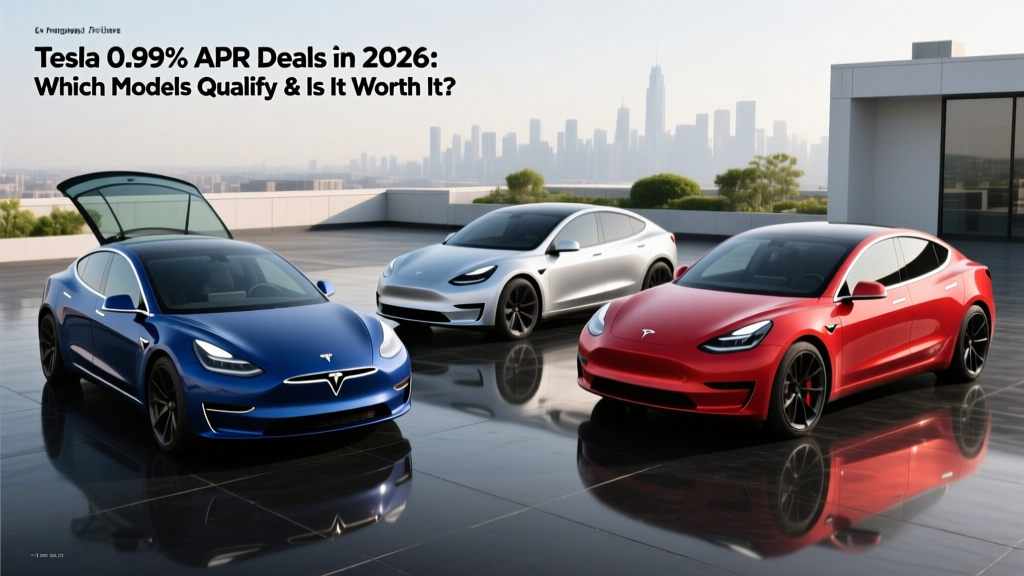
Tesla's promotional financing offers typically rotate by quarter and inventory levels. In 2026, the 0.99% APR has been most consistently available on Model 3 and Model Y configurations — Tesla's highest-volume vehicles. The Cybertruck, Model S, and Model X rarely qualify for subvented rates due to their higher price points and tighter production margins.
Key eligibility requirements for Tesla's 0.99% APR offer:
- Credit tier: Typically requires a FICO score of 720+ (Tier 1 or Tier 1+). Buyers with scores between 680-719 may see rates of 2.99-4.99%.
- Loan term: 0.99% APR is generally available on 36-month terms; 48- and 60-month terms may carry slightly higher rates (1.99-3.49%).
- Delivery window: You must take delivery within the promotional period — typically a specific quarter or month-end push.
- Vehicle eligibility: New inventory only; used Tesla vehicles go through a separate financing program at higher rates.
| Model / Trim | MSRP | After §30D Credit* | Monthly at 0.99% | Monthly at 6.5% (Market Rate) |
|---|---|---|---|---|
| Model 3 RWD | $38,990 | $31,490 | $538 | $616 |
| Model 3 Long Range | $45,990 | $38,490 | $659 | $752 |
| Model Y Long Range | $44,990 | $37,490 | $642 | $733 |
| Model 3 Performance | $52,990 | $45,490 | $778 | $889 |
*§30D credit applied as point-of-sale reduction per current IRS rules. Eligibility depends on income, battery sourcing, and MSRP caps. See IRS.gov for details.
Real-World Range and Efficiency: What to Actually Expect
The EPA range figures above assume a mix of city and highway driving at moderate temperatures. In practice:
- Highway driving (75+ mph): Expect 10-15% less than EPA. A Model 3 Long Range rated at 341 mi EPA will deliver roughly 290-305 mi at sustained highway speeds.
- Cold weather (below 32°F): Range drops 20-30% due to battery resistance and cabin heating. That same Model 3 LR may deliver 235-270 mi in freezing conditions without preconditioning.
- City/regenerative driving: You can match or slightly exceed EPA in stop-and-go traffic thanks to regenerative braking recapturing energy.
Tesla's efficiency remains among the best in the EV industry. The Model 3 RWD achieves approximately 132 MPGe combined (25 kWh/100 mi) per fueleconomy.gov, while the Model Y Long Range posts about 122 MPGe combined (28 kWh/100 mi). This efficiency means you spend less per mile on electricity compared to heavier competitors like the Ford Mustang Mach-E or Hyundai Ioniq 5.
Charging Speed: DC Fast Charging and Home Level 2
Charging speed is a top buyer concern, and Tesla's Supercharger network remains the most reliable public DC fast-charging ecosystem in North America. Here's what each model delivers:
| Model | Peak DC kW | 10-80% Time | Level 2 Home Rate | Miles Added per Hour (L2) |
|---|---|---|---|---|
| Model 3 RWD (LFP) | 170 kW | ~30 min | 11.5 kW (48A) | ~37 mi/hr |
| Model 3 Long Range | 250 kW | ~22 min | 11.5 kW (48A) | ~44 mi/hr |
| Model Y Long Range | 250 kW | ~24 min | 11.5 kW (48A) | ~42 mi/hr |
| Model 3 Performance | 250 kW | ~22 min | 11.5 kW (48A) | ~41 mi/hr |
| Cybertruck AWD | 350 kW | ~18 min | 11.5 kW (48A) | ~34 mi/hr |
Important note on charging curves: Peak kW is not sustained kW. A Model 3 Long Range peaks at 250 kW around 10-15% SoC, then tapers progressively. Average power from 10-80% is closer to 150-170 kW. LFP batteries (Model 3 RWD) have a flatter charge curve but a lower peak, which is why the 10-80% time is longer despite a smaller battery.
For home charging, Tesla's Wall Connector at 48 amps on a 60-amp circuit delivers up to 11.5 kW — adding roughly 37-44 miles of range per hour depending on the model. Most owners charging overnight from 20-80% wake up with a full daily buffer. Installation costs for a Level 2 home setup range from $500-$2,000 depending on panel capacity and conduit runs; a 200-amp panel upgrade can add $1,500-$3,000.
Federal Tax Credit: Stacking §30D with 0.99% APR
One of the biggest advantages of Tesla's promotional financing is the ability to stack it with the federal §30D clean vehicle credit. As of 2026, eligible buyers can receive up to $7,500 as a point-of-sale reduction — effectively lowering the financed amount and compounding the savings from the low APR.
- Income caps: Modified AGI ≤ $150,000 (single), $225,000 (head of household), $300,000 (joint). Source: IRS.gov
- MSRP caps: ≤ $55,000 for sedans (Model 3); ≤ $80,000 for SUVs/trucks (Model Y, Cybertruck)
- Battery sourcing: Critical minerals and battery components must meet phased-in domestic/free-trade sourcing thresholds — Tesla's US-built cells generally qualify, but confirm per VIN at purchase
- Point-of-sale transfer: You can transfer the credit to the dealer at purchase, reducing your loan principal immediately
- One credit per VIN: The vehicle must be new, for personal use, and primarily used in the US
For a Model 3 Long Range at $45,990, the $7,500 credit brings the effective purchase price to $38,490. Financing that at 0.99% APR over 60 months yields a payment of roughly $659/month — approximately $93/month cheaper than the same vehicle at a market rate of 6.5% without any promotional financing.
Consult a tax professional for your specific situation. Credit eligibility and sourcing requirements can change, and the IRS maintains the definitive rules at irs.gov.
Performance, Tech, and Interior: What You Get
Tesla's minimalist interior approach continues to divide opinions, but the tech stack remains industry-leading:
Powertrain and Performance:
- Model 3 RWD: 283 hp, single-motor rear-wheel drive, 5.8-second 0-60
- Model 3 Long Range: 384 hp, dual-motor AWD, 4.2-second 0-60
- Model 3 Performance: 510 hp, dual-motor AWD with track-oriented tuning, 2.9-second 0-60
- Model Y Long Range: 384 hp, dual-motor AWD, 4.8-second 0-60
Tech and Driver Assistance:
- 15.4-inch center touchscreen (Model 3/Y) with integrated navigation, media, and vehicle controls
- Basic Autopilot included (SAE Level 2 — driver must remain engaged at all times)
- FSD (Supervised) available as a $8,000 add-on or $99/month subscription — still SAE Level 2, requiring active supervision
- Over-the-air updates continuously add features and refinements
- Sentry Mode, Dashcam, and Dog Mode as standard software features
Cargo and Passenger Space:
- Model 3: 23 cu ft trunk + rear frunk; rear legroom 35.2 inches
- Model Y: 76 cu ft with rear seats folded; rear legroom 41.6 inches — significantly more practical for families
- Cybertruck: ~67 cu ft bed (6-foot bed), front trunk, and sail-pillar storage
Notable drawbacks: No Apple CarPlay or Android Auto (Tesla uses its proprietary infotainment exclusively). The lack of physical buttons for climate, mirrors, and glovebox frustrates some buyers. Panel gap quality has improved but still varies by production batch. Insurance premiums run 20-40% higher than comparable ICE sedans due to repair costs.
Warranty Coverage and Long-Term Ownership
Tesla's warranty structure is competitive within the EV segment:
- Basic vehicle warranty: 4 years / 50,000 miles
- Battery and drive unit: 8 years / 100,000 miles (Model 3 RWD); 8 years / 120,000 miles (Long Range and Performance variants)
- Battery retention guarantee: Tesla warrants a minimum 70% capacity retention over the warranty period
In real-world data, Tesla batteries degrade approximately 10-12% over the first 100,000 miles, with the curve flattening significantly afterward. NMC batteries (Long Range, Performance) show slightly faster early degradation than LFP cells (Model 3 RWD), but LFP batteries are heavier and offer less energy density. LFP chemistry also tolerates regular 100% charging, which is an advantage for daily commuters who need maximum range every morning.
Tesla does not publish official battery replacement costs, but third-party estimates place a Model 3/Y battery replacement between $12,000-$16,000 out of warranty. Given the 8-year coverage and observed degradation curves, most owners will never face this expense.
Is Tesla's 0.99% APR Worth It vs. Competitors?
- Dramatically lower interest cost — saves $3,000-$5,000+ over 60 months vs. market rates
- Stacks with $7,500 federal tax credit (point-of-sale)
- Access to Supercharger network — most reliable public charging in North America
- Best-in-class efficiency (lowest kWh/100mi in segment)
- Strong resale value relative to EV segment average
- OTA updates add features post-purchase
- Limited to specific trims/terms — may not qualify for your preferred configuration
- Requires excellent credit (720+ FICO typically)
- Shorter loan terms (36 mo) yield higher monthly payments even at low APR
- No Apple CarPlay/Android Auto integration
- Insurance costs run higher than segment average
- Minimalist interior not for everyone
Compared to competitors: the Hyundai Ioniq 5 and Ford Mustang Mach-E occasionally offer their own promotional financing (typically 1.9-3.9% APR), but Tesla's 0.99% rate remains the floor in the EV segment. The Ioniq 5 offers faster 800V charging architecture and Apple CarPlay; the Mach-E offers a more traditional crossover interior. But neither matches Tesla's combination of Supercharger access, efficiency, and sub-1% financing.
Frequently Asked Questions
What is the real-world range of a Tesla Model 3 at highway speeds?
A Model 3 Long Range rated at 341 miles EPA typically delivers 290-305 miles at sustained 75 mph highway speeds in moderate temperatures. In cold weather (below freezing), expect 235-270 miles without preconditioning. The LFP-equipped Model 3 RWD (272 mi EPA) delivers roughly 230-245 miles on the highway.
How fast does a Tesla charge on a Supercharger vs. at home?
On a V3 Supercharger (250 kW peak), a Model 3 Long Range charges from 10-80% in approximately 22 minutes. At home on a Level 2 Tesla Wall Connector (11.5 kW / 48A), you add roughly 44 miles of range per hour — a full overnight session from 20-80% takes about 6-7 hours.
How much does a Tesla cost after the federal tax credit?
A Model 3 Long Range at $45,990 MSRP drops to $38,490 after the $7,500 §30D credit (if eligible). A Model Y Long Range at $44,990 drops to $37,490. Eligibility requires meeting income caps, MSRP caps, and battery-sourcing requirements per current IRS rules.
Does Tesla's 0.99% APR stack with the federal EV tax credit?
Yes. The §30D credit can be applied as a point-of-sale reduction, which lowers the principal amount you finance at 0.99% APR. This double benefit — lower price and lower rate — produces the most favorable monthly payment available on a new Tesla.
Is a Tesla worth buying over a Hyundai Ioniq 5 or Ford Mach-E in 2026?
It depends on priorities. Tesla wins on charging network reliability (Supercharger), efficiency (MPGe), and financing rates (0.99% APR). The Ioniq 5 wins on 800V charging speed at non-Tesla chargers and infotainment flexibility (Apple CarPlay). The Mach-E wins on traditional crossover ergonomics. For road-trippers who value charging infrastructure, Tesla's ecosystem advantage is significant.
What credit score do I need for Tesla's 0.99% APR financing?
Tesla typically requires a FICO score of 720 or higher for its lowest promotional rate. Scores between 680-719 may qualify for intermediate promotional rates (2.99-4.99%), which still beat prevailing market rates. Check your rate through Tesla's financing portal without a hard credit pull before committing.
Bottom Line: Who Should Take the 0.99% APR Deal?
Tesla's 0.99% APR financing is the strongest EV purchase incentive in 2026 for credit-qualified buyers. The ideal candidate:
- The daily commuter who charges at home overnight and values the lowest per-mile operating cost in the segment
- The road-tripper who relies on the Supercharger network for cross-country travel
- The tech-forward buyer who wants OTA updates and integrated software over traditional infotainment
- The financially optimized buyer who can stack the 0.99% rate with the $7,500 point-of-sale credit for maximum savings
If you need Apple CarPlay, prefer physical buttons, or want a more traditional dealer experience, the Ioniq 5 or Mach-E at their own promotional rates remain strong alternatives. But on pure financial math — monthly payment, interest cost, efficiency, and charging infrastructure — Tesla's 0.99% APR offer is difficult to beat in 2026.