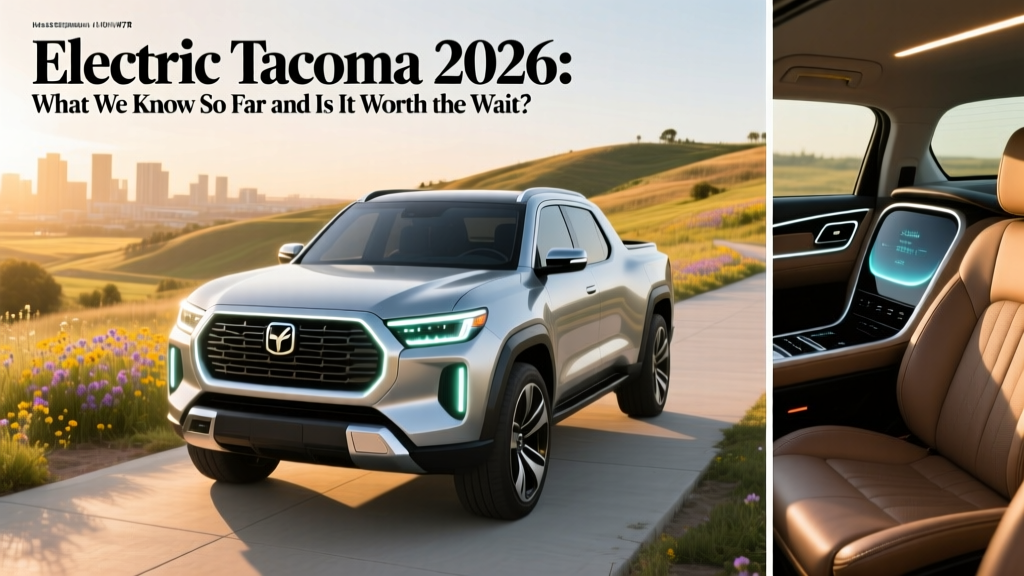
The short answer: As of early 2026, Toyota has not released an electric Tacoma, though the company has confirmed a next-generation battery-electric pickup is in development. Based on Toyota's announced EV roadmap, bZ-series platform sharing with the upcoming electric 4Runner, and industry supply-chain signals, an electric Tacoma is plausible for the 2027–2028 model years. If you need a midsize electric truck today, your only real option is the Ford Maverick PHEV (limited EV-only range) or stepping up to a full-size Rivian R1T (~$70,000+). This guide breaks down what to expect, what it would cost, and how to decide whether to wait or buy now.
Why an Electric Tacoma Matters in 2026
The Toyota Tacoma has been the best-selling midsize pickup in the U.S. for nearly two decades. According to Toyota's official lineup, the current fifth-generation Tacoma (introduced for 2024) is offered exclusively with a 2.4-liter turbocharged four-cylinder and the i-FORCE MAX hybrid powertrain — but no fully electric variant. That leaves a conspicuous gap: midsize truck buyers who want a battery-electric vehicle (BEV) have almost no options.
Toyota's broader EV strategy has shifted significantly since 2023. The company has committed to launching 30 BEV models globally by 2030 and has invested heavily in solid-state and next-generation lithium-ion battery production in North Carolina and Kentucky. An electric Tacoma would slot between the compact bZ Compact SUV and a future full-size electric Tundra, filling a segment where Ford (Maverick), Hyundai (Santa Cruz), and potentially Chevrolet (Colorado EV) are circling.
Estimated Electric Tacoma Specs: What the Data Suggests
Since Toyota has not published official specs, the table below synthesizes estimates based on Toyota's announced battery technology, platform-sharing with the bZ lineup, and competitive benchmarking against the Rivian R1T and Ford F-150 Lightning.
| Spec | Estimated (Electric Tacoma) | Current Gas Tacoma (i-FORCE MAX) |
|---|---|---|
| Battery Capacity | ~85–100 kWh usable (NMC or LFP) | N/A (1.87 kWh hybrid battery) |
| EPA Range | ~270–320 miles | ~450 miles (21-gal tank, ~22 MPG combined) |
| Peak DC Fast Charge | ~180–250 kW | N/A |
| 10–80% Charge Time | ~22–30 minutes | ~3 minutes at a gas pump |
| Level 2 Home Charge Rate | ~11.5 kW | N/A |
| Horsepower | ~350–450 hp (dual motor AWD) | 326 hp |
| 0–60 mph | ~4.5–5.5 seconds | ~6.2 seconds |
| Towing Capacity | ~5,000–7,500 lbs (est.) | 6,500 lbs |
| Payload | ~1,200–1,600 lbs (est.) | 1,709 lbs |
| Starting MSRP (est.) | $48,000–$55,000 | $31,500 |
| Battery Warranty | 8 years / 100,000 miles (expected) | Hybrid: 10 yr / 150,000 mi |
Real-world range reality check: An EPA estimate of ~300 miles in a midsize electric truck typically translates to 220–250 miles at sustained 75 mph highway speeds, and potentially 180–210 miles in sub-freezing temperatures without a heat pump. Towing a 4,000-lb trailer can cut range by 40–50%, dropping effective range to ~150 miles. These are physics, not pessimism — plan routes accordingly.
Electric Tacoma vs. Gas Tacoma vs. Hybrid Tacoma: Cost Comparison
The most common question midsize truck buyers ask is whether going electric saves money. The answer depends heavily on your driving patterns, electricity rates, and whether you qualify for the federal §30D clean vehicle credit.
| Cost Factor | Gas Tacoma SR5 ($38,000) | Tacoma i-FORCE MAX Hybrid ($46,000) | Electric Tacoma (Est. $52,000) |
|---|---|---|---|
| Purchase Price | $38,000 | $46,000 | $52,000 |
| Federal Tax Credit (§30D) | $0 | $0 | Up to $7,500 (if eligible) |
| Effective Purchase Price | $38,000 | $46,000 | ~$44,500 |
| Fuel/Energy (15,000 mi/yr) | $2,385 (22 MPG, $3.50/gal) | $1,960 (26 MPG, $3.50/gal) | $675 (3.0 mi/kWh, $0.135/kWh) |
| Maintenance (annual) | ~$600 | ~$550 | ~$250 |
| Insurance (annual avg.) | ~$1,600 | ~$1,650 | ~$1,900 |
| 5-Year Total Cost of Ownership | ~$60,925 | ~$64,050 | ~$59,625 |
Key takeaways from the numbers:
- The electric Tacoma's higher upfront cost is partially offset by the potential $7,500 federal credit and dramatically lower fuel costs — saving roughly $1,700/year vs. the gas model at national average electricity and gas prices.
- Insurance for electric trucks runs 15–25% higher on average, due to higher repair costs and battery replacement risk. Get quotes before committing.
- At 15,000 miles/year with home charging at $0.135/kWh, the electric Tacoma's energy cost is roughly $0.045/mile vs. $0.159/mile for the gas Tacoma.
- Break-even on the price premium occurs at approximately 4–5 years if you charge primarily at home.
Federal Tax Credit Eligibility: The §30D Reality for 2026
The IRS §30D credit offers up to $7,500 for qualifying new EVs, but eligibility is far from guaranteed. For a hypothetical electric Tacoma, here's what would apply:
- MSRP cap: Trucks (including pickups) must have an MSRP at or below $80,000 — an electric Tacoma at ~$52,000 would clear this easily.
- Buyer income cap: Modified adjusted gross income must not exceed $150,000 (single), $225,000 (head of household), or $300,000 (joint).
- Battery sourcing: A percentage of critical minerals and battery components must be sourced from the U.S. or free-trade-agreement countries. This threshold increases annually. Toyota's North Carolina battery plant would help, but specific cell chemistry and mineral sourcing determine the final credit amount.
- Point-of-sale transfer: As of 2024, buyers can transfer the credit to the dealer at purchase, reducing the out-of-pocket cost immediately rather than waiting for tax filing.
- FEOC restriction: Vehicles with battery components from a "foreign entity of concern" (primarily Chinese suppliers) may be disqualified.
Always consult a tax professional and check the latest fueleconomy.gov listings for current-year eligibility before purchasing.
Home Charging: The Make-or-Break Factor
For any electric truck — Tacoma included — home charging access is the single largest ownership variable. Here's what a realistic Level 2 home setup looks like:
| Component | Estimated Cost |
|---|---|
| Level 2 Charger (40A–48A, hardwired) | $400–$700 |
| Electrician labor (240V/50A circuit) | $800–$2,000 |
| Permit and inspection | $100–$300 |
| Panel upgrade (if needed, 100A→200A) | $1,500–$3,500 |
| Total (no panel upgrade) | $1,300–$3,000 |
| Total (with panel upgrade) | $2,800–$6,500 |
At 11.5 kW (48A), a ~95 kWh battery charges from 10–100% in roughly 8 hours — ideal for overnight replenishment. If your daily driving is under 60 miles, even a standard 120V Level 1 outlet (~1.4 kW, adding ~4 miles/hour) may suffice, though it's painfully slow for a full recharge.
Apartment and street-parking reality: If you lack a garage or dedicated parking with electrical access, public DC fast charging becomes your primary refueling method. At $0.30–$0.50/kWh on networks like Electrify America or EVgo, your annual fuel cost jumps to roughly $1,500–$2,500, erasing much of the EV cost advantage. Factor this in honestly.
Common Misconceptions About an Electric Tacoma
| Myth | Fact |
|---|---|
| "Electric trucks can't tow." | Electric motors deliver instant torque, making them excellent for towing. The trade-off is range: towing a 5,000-lb trailer typically reduces range by 40–50%. Plan charging stops accordingly. |
| "The battery will need replacing in 5 years." | Modern NMC and LFP batteries are engineered for 1,500–3,000+ charge cycles. At 300 miles per cycle, that's 450,000–900,000 miles before significant degradation. Toyota is expected to offer an 8-year/100,000-mile battery warranty. |
| "It will be as cheap as a gas Tacoma." | Battery packs alone cost $8,000–$15,000 at the cell level. An electric Tacoma will likely start $15,000–$20,000 above the base gas model. Total cost of ownership may converge, but the sticker price will not. |
| "Charging takes too long for road trips." | At 200+ kW DC fast chargers, a 10–80% charge takes ~25 minutes — comparable to a rest stop. However, charging above 80% slows dramatically due to the charge curve taper, and charger availability in rural areas remains inconsistent. |
| "Toyota doesn't make EVs." | Toyota sells the bZ4X and has a robust hybrid lineup. Their EV rollout has been slower than competitors, but their battery manufacturing investment is among the largest in the industry. |
Decision Framework: Should You Wait for the Electric Tacoma?
Wait for the electric Tacoma if:
- You have home Level 2 charging access (or can install it).
- Your daily driving is under 80 miles round-trip, with occasional road trips under 250 miles.
- You want a midsize truck specifically and aren't willing to step up to a full-size F-150 Lightning or Rivian R1T.
- You're not in a rush — the earliest realistic arrival is the 2027–2028 model year.
- You value Toyota's reliability reputation and dealer network over having an EV today.
Buy now (alternatives) if:
- You need a truck in the next 12 months — the Tacoma i-FORCE MAX hybrid offers 26 MPG combined with no range compromise.
- You're open to a full-size truck — the Ford F-150 Lightning starts at ~$55,000, offers 230–320 miles EPA range, and qualifies for the §30D credit.
- You want a compact truck with some electrification — the Ford Maverick Hybrid delivers 42 MPG city at ~$28,000.
- You lack home charging and rely on street parking — a hybrid eliminates charging logistics entirely.
- Towing more than 5,000 lbs regularly is part of your use case — gas and diesel midsize trucks still dominate here without range penalty.
Frequently Asked Questions
Has Toyota officially announced an electric Tacoma?
No. As of early 2026, Toyota has not confirmed an electric Tacoma by name. However, the company has announced a next-generation battery-electric pickup truck for the North American market, which industry analysts widely expect to include a midsize option based on the Tacoma's platform. Any specs discussed in this article are estimates based on Toyota's published EV roadmap and competitive benchmarking.
How would an electric Tacoma compare to the Ford F-150 Lightning?
The F-150 Lightning is a full-size truck — significantly larger, heavier, and more expensive than a midsize Tacoma. An electric Tacoma would likely be ~1,000 lbs lighter, ~20 inches shorter, and $10,000–$20,000 less expensive, with somewhat lower towing capacity but better maneuverability and trail capability. Think of it as the difference between an F-150 and a Ranger, electrified.
Would the electric Tacoma qualify for the $7,500 tax credit?
It depends on final battery sourcing and your income. Toyota's North Carolina battery plant improves the component-sourcing requirement, but critical-mineral sourcing (lithium, cobalt, nickel) is the harder threshold to meet. The MSRP cap for trucks ($80,000) and buyer income caps would likely be met. Check IRS §30D guidance and fueleconomy.gov at time of purchase for confirmed eligibility.
What about the Tacoma's off-road capability as an EV?
Electric motors offer instant torque at zero RPM, which is excellent for low-speed rock crawling and technical trails. The TRD Pro and Trailhunter trims could translate well to an electric platform with torque vectoring and precise throttle modulation. The trade-off is weight (battery packs add 1,000+ lbs) and range loss in demanding off-road conditions. Expect Toyota to offer an off-road-oriented electric Tacoma variant if the model launches.
Should I buy a gas Tacoma now or wait?
If you need a truck in 2026, the current Tacoma is excellent — the i-FORCE MAX hybrid delivers strong torque, 26 MPG combined, and Toyota's proven reliability. If you can wait 18–30 months and have home charging, an electric Tacoma could offer lower operating costs and stronger performance. But waiting always carries risk: launch delays, pricing above expectations, or tax-credit changes could shift the calculus.