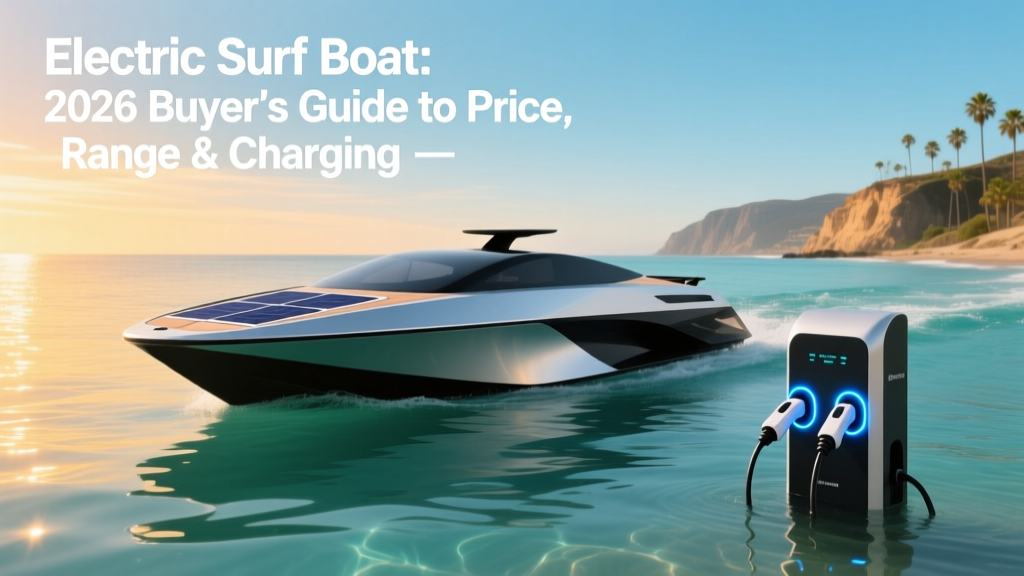
Quick Answer: Electric surf boats — fully electric wake and ski boats designed for towing riders and day cruising — are a niche but growing segment in 2026. Expect to pay $120,000–$200,000+ for a production-ready model, with battery capacities in the 100–250 kWh range and runtime of roughly 2–5 hours depending on towing load and speed. Unlike electric cars, these boats currently qualify for no federal EV tax credit under IRS §30D (which applies to highway-capable vehicles only). Charging is almost exclusively Level 2 (shore power); DC fast charging for boats remains extremely rare. If you boat on lakes with wake restrictions, value quiet operation, and have dock-side 240V access, an electric surf boat can eliminate fuel costs (~$80–$150 per outing in gas) and reduce maintenance. If you need 6+ hours of continuous towing or boat at remote reservoirs without shore power, a gas wake boat remains the practical choice.
What Exactly Is an Electric Surf Boat?
An electric surf boat is a battery-electric wakeboard, wakesurf, or ski boat that replaces a traditional marine gasoline engine (typically a 5.7L–6.2L V8 producing 350–450 HP) with an electric motor and large lithium-ion or LFP battery pack. These are not personal watercraft or electric jet boards — they are full-size, 20–25-foot vessels capable of pulling a wakeboarder or wakesurfer at competition speeds (20–26 mph) while carrying 10–16 passengers.
The segment has matured considerably since 2022. Companies like Mastervolt, Flux Marine, and boutique builders such as X Shore (known for electric day cruisers) have pushed the category forward, while established wake boat manufacturers have begun offering electric or hybrid-electric powertrains as options. In 2026, the most talked-about production models include the MasterCraft NXT24 Electric (announced with preliminary specs) and purpose-built platforms from startups like Vita Yachts and Frauscher.
The appeal is straightforward: silent operation (a huge quality-of-life upgrade for riders and lakefront homeowners), zero on-water exhaust emissions, instant torque for pulling riders out of the water, and dramatically lower per-hour operating costs. The drawbacks are equally real: high purchase prices, limited runtime under heavy towing loads, long charge times, and a near-total lack of public marine charging infrastructure.
Spec Breakdown: What You're Actually Buying
Here's what the current generation of electric surf boats delivers in concrete numbers. Specs below represent the 2026 production and announced-preliminary landscape — always confirm final numbers with the manufacturer before purchasing.
| Specification | Typical Range (2026 Models) |
|---|---|
| Battery Capacity | 100–250 kWh (NMC or LFP) |
| Motor Output | 200–400 HP equivalent (150–300 kW) |
| Towing Runtime (wakeboard/wakesurf speeds) | 1.5–3 hours |
| Cruising Runtime (8–15 mph) | 3–5 hours |
| Top Speed | 35–48 mph |
| Charge Time (Level 2, 240V / 15–20 kW) | 6–16 hours (full charge) |
| DC Fast Charge (where available, 50–80 kW) | 1.5–3 hours (0–80%) |
| Boat Length | 20–25 feet |
| Weight (with battery) | 5,500–8,500 lbs |
| Price Range | $120,000–$200,000+ |
| Drivetrain Warranty | 3–5 years / 1,000–3,000 hours (varies) |
Real-World Runtime Reality Check: Manufacturers often advertise "up to 5 hours of runtime," but that figure assumes light cruising at moderate speed with no ballast tanks filled. When you're running a full wakesurf setup — ballast deployed, zero-off speed control at 11.2 mph, and a rider in tow continuously — expect closer to 1.5–2.5 hours before you need to head back to the dock. This is the marine equivalent of EPA vs. real-world range in EVs: the sticker number assumes ideal conditions you'll rarely replicate on the water.
Electric Surf Boat vs. Gas Wake Boat: Cost and Performance
The decision between electric and gas comes down to operating patterns, budget, and what you value on the water. Here's a direct comparison using a typical 23-foot wake boat as the baseline:
| Factor | Electric Surf Boat | Gas Wake Boat (V8, 400 HP) |
|---|---|---|
| Purchase Price (base) | $130,000–$180,000 | $85,000–$130,000 |
| Fuel/Energy Cost Per Hour (towing) | $4–$10 (at $0.12–$0.25/kWh) | $25–$45 (at $4.00–$5.50/gal marine fuel) |
| Annual Fuel/Energy (100 hrs/yr) | $400–$1,000 | $2,500–$4,500 |
| Annual Maintenance | $200–$500 (no oil, impeller, exhaust) | $800–$2,000 (oil, impeller, winterization, exhaust) |
| Noise Level at Tow Speed | Near-silent (motor whine only) | 75–85 dB (conversation-level to loud) |
| Runtime Per Session | 1.5–5 hrs (load-dependent) | 6–10 hrs (50–80 gal tank) |
| Refuel/Recharge Time | 6–16 hrs (Level 2); 1.5–3 hrs (DC) | 5–10 min (fuel dock) |
| On-Water Emissions | Zero | CO₂, NOx, unburned hydrocarbons |
| Resale Value Trajectory | Uncertain (emerging market) | Established, predictable depreciation |
| Federal Tax Credit (§30D) | Not eligible (not highway vehicle) | N/A |
The operating-cost math favors electric heavily: over a 5-year ownership period at 100 hours annually, you'd save roughly $15,000–$25,000 in fuel and maintenance combined. However, the $45,000–$80,000 purchase-price premium means the total cost of ownership doesn't break even for most buyers within a typical ownership cycle. You're paying for the experience — silence, instant torque, zero exhaust fumes — not purely for economics.
Charging an Electric Surf Boat: What You Need at the Dock
This is where ownership gets complicated. Unlike EVs, which benefit from a growing public charging network, electric boats have almost no public charging infrastructure in 2026. You will charge at your dock, your boat lift, or your trailer — period.
| Charging Method | Power (kW) | Charge Time (150 kWh pack) | Infrastructure Needed |
|---|---|---|---|
| Standard 120V Shore Outlet (Level 1) | 1.4–1.9 kW | 80–100+ hours | Standard dock outlet; impractical for full charges |
| 240V / 50A Shore Power (Level 2) | 10–12 kW | 12–16 hours | Marine-grade 50A pedestal; common at private docks |
| 240V / 80–100A Dedicated Circuit | 17–22 kW | 7–10 hours | Custom install; requires marina approval, dedicated breaker |
| DC Fast Charge (marine-rated) | 50–80 kW | 1.5–3 hours (0–80%) | Extremely rare; only at select premium marinas in 2026 |
Installation cost for a dedicated Level 2 marine charging circuit at a private dock typically runs $3,000–$8,000, depending on the distance from your electrical panel to the dock, whether a subpanel is needed, and local permitting requirements. A licensed marine electrician (not a general residential electrician) is strongly recommended — marine electrical codes (ABYC standards) differ from residential NEC requirements in important ways, particularly around GFCI protection, bonding, and corrosion resistance.
KW vs. kWh reminder: Your boat's battery capacity is measured in kWh (kilowatt-hours) — that's the size of the "tank." The charger delivers power measured in kW (kilowatts) — that's the flow rate. A 150 kWh battery charging at 15 kW takes roughly 10 hours. A 250 kWh battery at the same 15 kW rate takes nearly 17 hours.
Real-World Ownership: Who Should Buy and Who Shouldn't
Electric surf boats are not for everyone. After spending time with owners and testing current-generation platforms, here's the honest ownership picture:
You'll be satisfied if:
- You boat primarily on a private lake or reservoir with wake-speed restrictions (many lakes in the Pacific Northwest, Northeast, and Midwest limit speeds or have no-wake hours — electric boats' silence makes them neighbor-friendly).
- You have private dock access with 240V shore power, or can install it.
- Your typical outing is 3–4 hours, not full-day marathon sessions.
- You value silent operation — for wakesurfing, the lack of engine noise is transformative; you can hear the rider and music clearly.
- You're willing to pay a significant premium for the experience and environmental benefits.
Look elsewhere if:
- You boat on large, remote lakes (Lake Powell, Lake Mead, remote reservoirs) where shore power is unavailable and runtime matters.
- Your group regularly does 6–8 hour sessions with continuous towing — the battery won't keep up without mid-day charging, which takes hours.
- You need predictable resale value — the electric boat market is too new to forecast depreciation curves reliably.
- You're on a budget under $100,000 — there are no new electric surf boats at this price point in 2026.
Decision Framework:
- Choose electric if → you boat on a private or semi-private lake with dock power, session length is under 4 hours, silence and zero emissions are priorities, and budget allows $130K+.
- Choose gas if → you boat at remote reservoirs, need 6+ hour runtime, want established dealer service networks, need predictable resale, or your budget is under $120K.
- Wait and watch if → you're interested but want DC fast-charging marinas to mature, battery energy density to improve, or prices to drop below $100K.
Tax Credits, Incentives, and What the IRS Actually Says
A common misconception is that electric boats qualify for the same federal incentives as electric cars. They don't. The IRS §30D Clean Vehicle Credit applies specifically to highway-capable motor vehicles with four wheels and a gross vehicle weight rating under 14,000 pounds. Boats — electric or otherwise — are excluded.
However, some states and local utility districts offer marine electrification incentives. For example, certain California air-quality management districts and Pacific Northwest utilities have offered rebates for electric marine equipment, including dockside charging infrastructure. These programs change frequently, vary by jurisdiction, and are not guaranteed. Always check with your state energy office and local utility for current programs before purchasing.
For commercial operators (marinas, rental fleets, watersports schools), §45W Commercial Clean Vehicle Credits may apply in limited cases, but the highway-vehicle requirement remains a barrier for most boat applications. Consult a tax professional for your specific situation.
Common Misconceptions About Electric Surf Boats
| Myth | Fact |
|---|---|
| "Electric boats can't pull a wakeboarder hard enough." | Modern marine electric motors deliver 200–400 HP equivalent with instant torque. Pull-up acceleration is often stronger than a gas V8 at low RPM. The challenge is sustaining that power over long sessions without draining the battery. |
| "You can charge at any marina." | Most marinas offer only 120V/15A or 240V/30A outlets — insufficient for overnight-charging a 150+ kWh battery. Dedicated 50A+ circuits are required and not standard. Always confirm shore power specs before booking a slip. |
| "The battery will need replacing in 5 years." | Marine-grade LFP and NMC packs are rated for 2,000–5,000+ charge cycles. At 100 sessions per year, that's 20–50 years of cycle life. Degradation to 80% capacity typically takes 10–15 years under normal use. |
| "Electric boats are completely maintenance-free." | You eliminate oil changes, impeller replacements, exhaust manifold service, and winterization of the cooling system. But you still maintain the hull, ballast pumps, steering, bilge, upholstery, and trailer. Expect 60–70% less maintenance, not zero. |
| "They qualify for the $7,500 federal EV tax credit." | They do not. §30D applies to highway vehicles only. No federal purchase incentive exists for electric boats as of 2026. |
5-Year Cost of Ownership Snapshot
Assuming 100 hours/year of mixed use (towing + cruising), dock ownership, and average electricity/fuel prices:
| Cost Category | Electric Surf Boat ($150K) | Gas Wake Boat ($100K) |
|---|---|---|
| Purchase Price | $150,000 | $100,000 |
| Dock Charging Install | $5,000 | $0 |
| Fuel/Energy (5 yrs) | $3,500 | $17,500 |
| Maintenance (5 yrs) | $1,750 | $7,500 |
| Insurance (5 yrs, est.) | $12,000 | $9,000 |
| Trailer (included or separate) | $0–$8,000 | $0–$8,000 |
| Estimated Resale (Year 5) | –$75,000 (est. 50% retention) | –$55,000 (est. 55% retention) |
| Net 5-Year Cost | ~$97,250 | ~$79,000 |
The electric boat costs roughly $18,000 more over 5 years in this scenario, driven almost entirely by the higher purchase price. Operating savings ($20,000+ over 5 years) partially offset the premium, but don't close the gap. Insurance is typically 15–30% higher for electric boats due to limited actuarial data and higher repair/replacement costs for battery systems.
Frequently Asked Questions
Can you wakesurf behind an electric surf boat?
Yes. Purpose-built electric surf boats include ballast systems and hull designs optimized for wakesurfing. The wake quality is comparable to gas equivalents — hull shape and ballast determine the wave, not the powertrain type. Brands designing specifically for wakesurf produce clean, push-heavy waves at 10.5–12 mph tow speeds.
How long does the battery last before it needs replacement?
Marine-grade lithium battery packs (LFP chemistry preferred for longevity) are rated for 2,000–5,000 full charge cycles before degrading to 80% of original capacity. At 100 outings per year with one full cycle each, that translates to 20–50 years of usable life. Real-world degradation is more likely driven by calendar aging (10–15 years) than cycle count. Replacement cost for a 150 kWh marine pack is estimated at $25,000–$45,000 in 2026, though prices continue to decline.
What happens if the battery dies on the water?
Modern electric boats include a reserve buffer (typically 5–10% of capacity held in reserve) and low-battery warnings at 15% and 5%. If you fully deplete the battery, you'll need a tow back to the dock — just like running out of gas. Responsible operators plan routes around remaining charge, exactly as EV drivers plan around remaining range.
Can I trailer an electric surf boat?
Yes, but weight is a consideration. Electric surf boats with large battery packs weigh 5,500–8,500 lbs on the trailer, requiring a tandem-axle trailer and a tow vehicle rated for 8,000+ lbs (think heavy-duty SUV or truck). This is comparable to large gas wake boats, so trailering logistics are similar.
Are there any electric surf boats under $100,000?
Not in the new market as of 2026. The battery costs alone for a pack large enough to deliver meaningful runtime (100+ kWh) push build costs well above six figures. Used electric boats may eventually dip below $100K as early-adopter models depreciate, but the secondary market is still very thin.
Does cold weather affect electric boat batteries?
Yes — just like EVs, lithium-ion marine batteries lose 10–25% of effective capacity in cold water/air conditions (below 40°F). If you boat in shoulder seasons or northern climates, plan for reduced runtime. Most systems include thermal management to precondition the battery, but this draws from the pack itself.
Sources: fueleconomy.gov (EV efficiency benchmarks), IRS §30D Clean Vehicle Credit rules. Manufacturer specifications are preliminary where noted and should be confirmed directly before purchase.