The Short Answer on an Electric STI
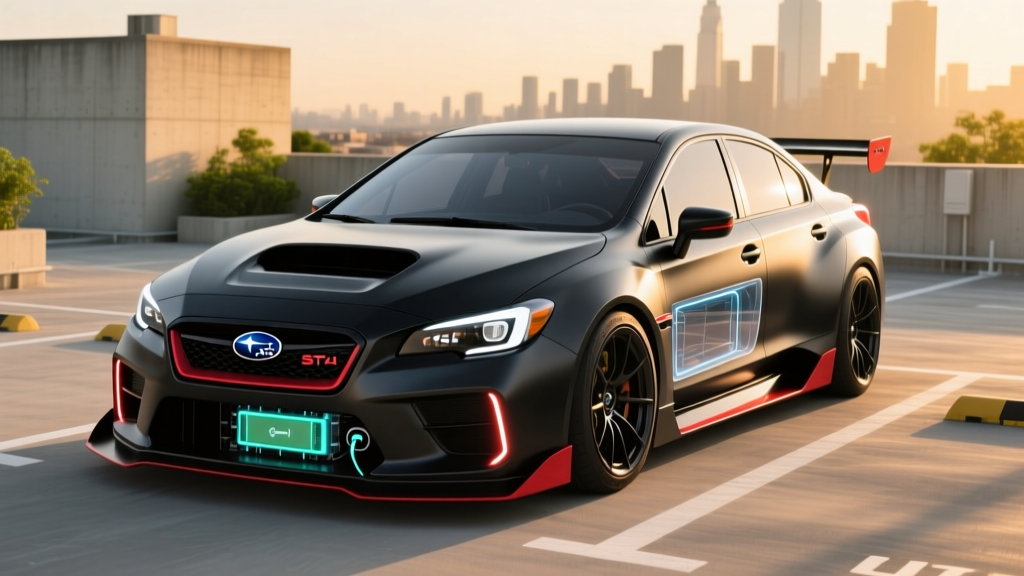
As of early 2026, Subaru does not sell an electric STI. No battery-electric vehicle wearing the STI badge exists in any market. The original WRX STI was discontinued after the 2021 model year (VA chassis), and Subaru has not announced a battery-electric performance model under the STI sub-brand. If you're searching for an "electric STI" to buy today, you'll need to look at high-performance EV alternatives from other automakers — or wait for Subaru's electrification plans to materialize, which remain vague beyond a commitment to sell only electrified vehicles by 2035.
Why the Electric STI Doesn't Exist Yet
Subaru's performance heritage lives and dies with the WRX and WRX STI — turbocharged, all-wheel-drive rally icons that defined a generation of enthusiasts. But the brand's transition to electrification has been slow and cautious. The Subaru Solterra, co-developed with Toyota on the e-TNGA platform, is Subaru's only battery-electric vehicle (BEV) as of 2026. It's a practical compact SUV with an EPA-estimated range of up to 227 miles and a focus on comfort, not performance.
Subaru has publicly stated it aims for 100% electrified vehicle sales by 2035, but "electrified" in Subaru's parlance includes mild hybrids, strong hybrids, plug-in hybrids, and BEVs. The company has confirmed a next-generation EV platform (co-developed with Toyota) expected around 2027–2028, but no STI-badged EV has been announced, teased, or spied in testing.
There's also a business reality: the STI brand has been in retreat. Subaru dissolved STI as a standalone subsidiary in 2022, folding it back into the parent company. While STI-branded parts and tuning continue, the absence of a current WRX STI (the last one was the 2021 EJ25-powered VA) signals that Subaru's performance ambitions are on hold — let alone an electric variant.
What About the WRX — Is It Hybrid or Electric?
The current-generation Subaru WRX (VB chassis, introduced for 2022) is powered by a 2.4-liter turbocharged flat-four (FA24) producing 271 hp and 258 lb-ft of torque. It is not a hybrid and not electric. Subaru has not confirmed a hybrid WRX or an electric WRX for the 2026 or 2027 model years.
Rumors of a hybrid WRX have circulated since 2023, potentially pairing the FA24 with a mild-hybrid system or a plug-in hybrid powertrain. However, these remain unconfirmed. Subaru's most recent product disclosures focus on expanding hybrid options across the Outback, Forester, and Crosstrek lines — not the WRX.
Best EV Alternatives if You Want STI-Level Performance
If the electric STI search is really about finding an EV with rally-car reflexes, all-wheel-drive grip, and 300+ horsepower, several production EVs deliver that experience today. Here's how the top contenders compare:
| Spec | Tesla Model 3 Performance (2026) | Hyundai Ioniq 5 N (2026) | BMW i4 M50 (2026) | 2021 WRX STI (Final VA, for reference) |
|---|---|---|---|---|
| Powertrain | Dual-motor AWD BEV | Dual-motor AWD BEV | Dual-motor AWD BEV | 2.5L Turbo Flat-4 AWD (gas) |
| Horsepower | 510 hp | 641 hp (N Grin Boost) | 593 hp | 310 hp |
| 0–60 mph | ~2.9 sec | ~3.25 sec | ~3.7 sec | ~4.7 sec |
| EPA Range | ~315 mi | ~221 mi | ~271 mi | ~17 mpg combined (gas) |
| Battery / Tank | ~82 kWh (NMC) | 84 kWh (NMC) | 81.5 kWh (NMC) | 15.9 gal tank |
| Peak DC Charge | 250 kW (CCS/NACS) | 238 kW (CCS) | 205 kW (CCS) | N/A |
| 10–80% DC Charge | ~25 min | ~18 min | ~31 min | N/A |
| Curb Weight | ~4,065 lbs | ~4,859 lbs | ~4,684 lbs | ~3,450 lbs |
| Base MSRP | ~$54,990 | ~$67,495 | ~$70,700 | $38,395 (2021, discontinued) |
| Federal Tax Credit (§30D) | Up to $7,500 (eligibility varies) | Not eligible (Korea-assembled) | Not eligible (Germany-assembled) | N/A |
Sources: EPA fueleconomy.gov, manufacturer spec pages. Tax credit eligibility per IRS §30D rules — verify income caps, MSRP limits, and battery-sourcing requirements before purchase.
Real-World Ownership: What an EV Performance Car Actually Costs
An STI buyer cares about driving feel, but also total cost. Here's a five-year ownership comparison between the Tesla Model 3 Performance (closest mainstream EV to an STI's price bracket and rally-bred AWD ethos) and a hypothetical gas performance sedan averaging 20 mpg combined at $3.50/gallon.
| Cost Category (5 Years) | Tesla Model 3 Performance (EV) | Gas Performance Sedan (20 mpg) |
|---|---|---|
| Purchase Price (after incentives) | $47,490 (assuming $7,500 credit) | $42,000 |
| Fuel / Electricity (60,000 mi) | $3,600 (home L2 at $0.14/kWh, ~250 Wh/mi) | $10,500 (3,000 gal × $3.50) |
| Maintenance | $1,200 (cabin filter, wipers, tire rotation) | $3,500 (oil, brakes, spark plugs, belts) |
| Insurance (est. avg) | $9,000 ($1,800/yr) | $7,500 ($1,500/yr) |
| Tires (performance rubber) | $2,400 (heavier EV = faster wear) | $1,800 |
| Total 5-Year Cost | $63,690 | $65,300 |
The EV wins on energy and maintenance but loses on insurance and tire wear. The heavier curb weight of performance EVs (4,000+ lbs) accelerates tire consumption — expect 20,000–25,000 miles from a set of Michelin Pilot Sport 4S tires under spirited driving. Insurance premiums for performance EVs run 15–25% higher than equivalent gas cars, driven by repair costs and parts pricing.
Home Charging: The Make-or-Break Factor
Performance EV ownership hinges on home charging access. A Level 2 home charger (240V, 48A) adds roughly 30–44 miles of range per hour and fully replenishes an 82 kWh battery overnight. Installation costs range from $800 to $3,500 depending on panel capacity and conduit runs — and older homes may need a $2,000–$4,000 electrical panel upgrade to support a 60A circuit.
If you lack home charging (apartment dwellers, street parkers), relying on public DC fast charging at $0.35–$0.50/kWh pushes your per-mile energy cost closer to gas-car territory — roughly $0.09–$0.12/mile versus $0.06/mile at home.
Common Myths About Electric Performance Cars
| Myth | Fact |
|---|---|
| "EVs can't handle like a real performance car" | The Ioniq 5 N and Model 3 Performance post competitive lap times at tracks like Laguna Seca. Low center of gravity and torque vectoring compensate for weight. However, sustained track use will thermally limit battery output — these are canyon-carvers, not dedicated track cars. |
| "AWD EVs have no feel or engagement" | Modern EVs simulate gear shifts (Ioniq 5 N's N e-Shift), adjust regen mapping, and offer adjustable torque splits. Whether this equals a manual WRX STI is subjective — it's different engagement, not zero engagement. |
| "EV range is fine for performance driving" | Aggressive driving cuts range 30–50%. A 315-mile Model 3 Performance drops to 160–200 miles under hard canyon or track use. Plan accordingly. |
| "Subaru will release an electric STI soon" | No official announcement exists. Subaru's next-gen EV platform targets 2027–2028, but an STI variant is speculative at best. |
| "All performance EVs qualify for the $7,500 tax credit" | Federal §30D credit requires North American final assembly, battery-sourcing thresholds, MSRP caps ($55,000 sedans), and buyer income limits. Many performance EVs (Ioniq 5 N, BMW i4 M50) do not qualify due to foreign assembly. Always verify on IRS.gov. |
Decision Framework: Should You Wait or Buy Now?
If You're Searching for an Electric STI, Here's What to Do
- Wait for Subaru IF: You're loyal to the brand, don't need a performance EV immediately, and are comfortable waiting until at least 2028–2030 for any potential STI electric model. Accept that Subaru may never revive the STI badge on an EV.
- Buy a Tesla Model 3 Performance IF: You want the closest mainstream EV to STI pricing ($55K range), daily-driver practicality, 300+ mile range, and potential §30D tax credit eligibility. Best for home-charging owners who want AWD grip and sub-3-second acceleration.
- Buy a Hyundai Ioniq 5 N IF: Driving engagement is your top priority and you're willing to pay a premium (~$67K) for simulated shifts, track modes, and the most enthusiast-tuned EV on the market. Range is the tradeoff (221 mi EPA).
- Buy a BMW i4 M50 IF: You want a luxury grand-tourer with performance credentials, premium interior quality, and don't mind the ~$71K entry price and no federal tax credit.
- Buy a used 2021 WRX STI IF: You want the last analog STI, accept rising maintenance costs and poor fuel economy, and view it as a future collector car. Expect $30,000–$45,000 for a clean, low-mileage example in 2026.
What First-Time EV Buyers Need to Know
If the electric STI search is your entry into EV ownership, here are the non-negotiable realities:
- kW vs. kWh: Kilowatts (kW) measure power — how fast you charge or accelerate. Kilowatt-hours (kWh) measure energy — your battery's total capacity. An 82 kWh battery charged at 250 kW (peak) does not charge in 20 minutes; the charge curve tapers significantly above 80% state of charge.
- Real-world range: EPA estimates assume mixed driving at moderate temperatures. Highway-only driving at 75 mph reduces range 10–15%. Cold weather (below 30°F) cuts range 20–35% due to battery resistance and cabin heating demands.
- Charging speed isn't constant: A "250 kW" peak charge rate sustains only between ~10–40% state of charge. Above 80%, speeds drop to 50 kW or lower to protect battery chemistry. Plan road trips around 10–80% charges, not 0–100%.
- Tax credits aren't guaranteed: The §30D federal credit has MSRP caps ($55,000 for sedans, $80,000 for SUVs/trucks), buyer income limits ($150K single / $300K joint for new vehicles), and critical-mineral/battery-sourcing requirements that change annually. A point-of-sale transfer option is available through registered dealers.
- Tires and insurance cost more: Budget 15–25% more for insurance on a performance EV versus a gas equivalent, and expect tire replacement every 20,000–30,000 miles due to instant torque and higher vehicle weight.
Frequently Asked Questions
Will Subaru ever make an electric WRX STI?
Subaru has not announced an electric STI of any kind. The company's next-generation EV platform is expected around 2027–2028, but performance variants under the STI badge remain purely speculative. Subaru dissolved STI as a standalone subsidiary in 2022, which complicates any revival.
What's the cheapest performance EV with AWD available in 2026?
The Tesla Model 3 Performance at ~$54,990 MSRP (potentially ~$47,490 after the $7,500 federal credit, if eligible) is the most affordable dual-motor AWD EV with genuine sports-car acceleration. The Tesla Model Y Performance (~$52,490) is another option if you need crossover cargo space.
Does the Ioniq 5 N handle like a real sports car despite its weight?
The Ioniq 5 N weighs nearly 4,900 lbs — over 1,400 lbs more than the last WRX STI. However, its low center of gravity, electronically controlled suspension, torque-vectoring AWD, and N-tuned chassis deliver genuine cornering capability. It won't match a lightweight sports car in transition speed, but it's remarkably capable for its mass. Track sessions will reveal thermal limits on the battery and brakes.
How much does it cost to charge a performance EV at home vs. public chargers?
Home Level 2 charging at the national average of ~$0.14/kWh costs roughly $0.035–$0.04 per mile for a performance EV averaging 250–280 Wh/mi. Public DC fast charging at $0.35–$0.50/kWh pushes that to $0.09–$0.14 per mile. For context, a gas car at 20 mpg and $3.50/gallon costs $0.175 per mile. Home charging is essential to realizing EV cost savings.
Can I daily-drive a performance EV in cold weather?
Yes, but expect 20–35% range loss below 30°F. A 315-mile Model 3 Performance may deliver 200–250 miles in winter conditions. Preconditioning the battery (warming it while plugged in) preserves range and enables faster DC charging. All performance EVs listed above come with heat pumps or resistive heating — heated seats and steering wheels are more energy-efficient than cabin air heating.
Is the WRX STI a future collector car?
The 2021 VA-chassis WRX STI was the last of the EJ25 era, and clean examples have held value well, trading at $30,000–$45,000 in 2026. Whether it appreciates long-term depends on Subaru's future direction. If no electric STI materializes, the final gasoline STIs could become more desirable to collectors.