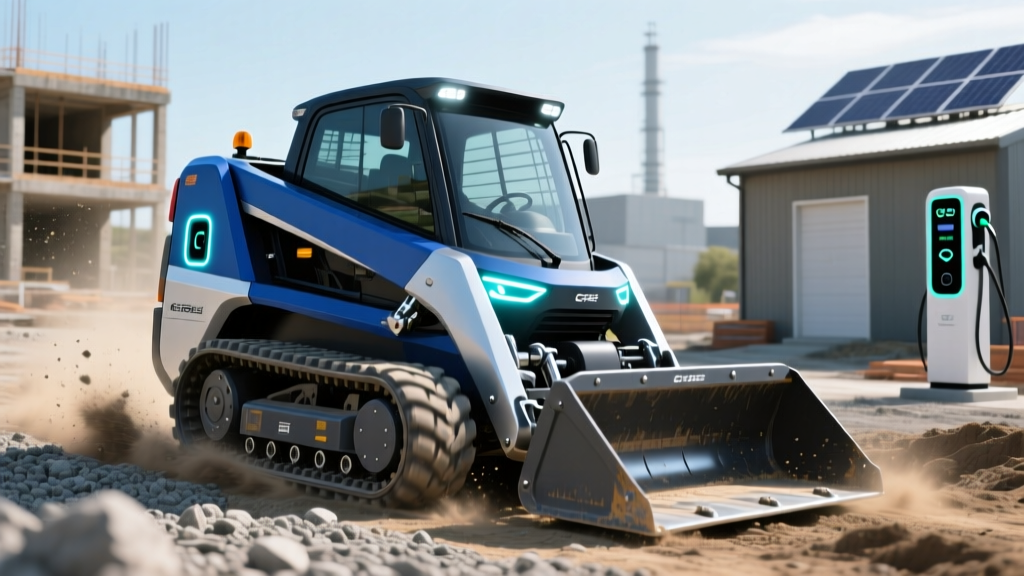
Electric skid steers are now commercially available from several manufacturers, offering zero tailpipe emissions, lower noise, and reduced maintenance compared to diesel equivalents. However, they remain a niche product best suited for specific use cases — primarily indoor demolition, utility work in noise-restricted zones, and light-to-medium landscaping where daily runtime demands stay within a single battery charge. For heavy earthmoving or remote sites without charging infrastructure, diesel still dominates.
Bottom Line for 2026
Electric skid steers from Bobcat, Volvo CE, and JCB deliver 4–8 hours of typical runtime on a 40–65 kWh LFP battery pack. Expect base pricing between $65,000–$95,000 (vs. $40,000–$60,000 for diesel). They charge in 2–4 hours on Level 2 (240V/40A) and eliminate diesel fuel and DEF costs, but range and charging logistics on remote sites remain real constraints. Best ROI: indoor/urban contractors with overnight depot charging.
Why Electric Skid Steers Exist: The Jobsite Case
Unlike highway EVs where range anxiety dominates the conversation, electric compact equipment faces a different calculus: runtime per charge vs. daily duty cycle. A skid steer operating in a warehouse demolition or a hospital expansion project may only need 4–5 hours of intermittent use per day — well within what current battery packs deliver. The value proposition isn't about replacing diesel everywhere; it's about replacing diesel where electrification unlocks access, compliance, or cost advantages.
Key demand drivers in 2026:
- Indoor air quality mandates: OSHA and building codes increasingly prohibit diesel exhaust in enclosed spaces. Electric eliminates ventilation costs and work stoppages.
- Noise ordinances: Electric skid steers operate at 70–80 dB vs. 95–105 dB for diesel — critical for night work, hospitals, schools, and residential areas.
- Maintenance reduction: No engine oil, filters, DEF fluid, DPF regeneration cycles, or fuel-system repairs. Electric motors have fewer moving parts.
- Instant torque: Electric drivetrains deliver peak torque at 0 RPM, improving breakout force responsiveness in digging and loading.
2026 Electric Skid Steer Specs: What's Actually Available
The market has consolidated around a handful of serious production models. Here's what you can actually buy and put to work this year:
| Specification | Bobcat T7X (Track) | Volvo ECR25 Electric | JCB 19C-1E (Mini) |
|---|---|---|---|
| Battery Capacity (usable) | 62 kWh (LFP) | 48 kWh (LFP) | 40 kWh (LFP) |
| Typical Runtime | 6–8 hours (intermittent) | 4–6 hours (intermittent) | 4–5 hours (intermittent) |
| Operating Weight | 9,500 lbs | 5,800 lbs | 4,200 lbs |
| Rated Operating Capacity | 2,100 lbs | 1,600 lbs | 1,100 lbs |
| Charge Time (Level 2, 240V/40A) | ~4 hours (10–100%) | ~3 hours (10–100%) | ~2.5 hours (10–100%) |
| Charge Time (DC Fast, if equipped) | ~1.5 hours (peak 30 kW) | N/A (L2 only) | N/A (L2 only) |
| Noise Level (operator ear) | ~72 dB | ~70 dB | ~68 dB |
| Base MSRP (estimated) | $85,000–$95,000 | $70,000–$80,000 | $65,000–$72,000 |
| Battery Warranty | 5 years / 5,000 hours | 5 years / 5,000 hours | 5 years / 5,000 hours |
Chemistry note: All current production electric skid steers use LFP (lithium iron phosphate) batteries. LFP sacrifices some energy density vs. NMC but offers superior cycle life (3,000+ full cycles to 80% capacity), thermal stability, and no cobalt — making it the right trade-off for equipment that charges daily and operates in harsh conditions. You won't see the degradation cliff that early NMC EV batteries sometimes exhibited; expect 80%+ capacity retention at 5,000 hours of use.
Electric vs. Diesel Skid Steer: Total Cost of Ownership
The purchase price gap is real — roughly $25,000–$35,000 more for electric. But the operating cost story flips dramatically depending on your fuel and maintenance profile. Here's a 5-year TCO model based on 1,000 operating hours per year:
| Cost Category | Electric (Bobcat T7X) | Diesel Equivalent (Bobcat T770) |
|---|---|---|
| Purchase Price | $90,000 | $55,000 |
| Fuel/Energy (5 yrs) | $4,500 ($0.12/kWh avg) | $22,500 ($4.50/gal diesel) |
| DEF Fluid (5 yrs) | $0 | $1,500 |
| Engine Maintenance (oil, filters, DPF) | $0 | $7,500 |
| Hydraulic System Maintenance | $2,000 | $3,500 |
| Estimated Resale Value (Year 5) | -$25,000 | -$20,000 |
| Net 5-Year Cost | $71,000 | $69,500 |
At 1,000 hours/year, the 5-year costs nearly converge. Push utilization to 1,500 hours/year and electric wins clearly — the fuel and maintenance savings compound while the purchase premium stays fixed. At 500 hours/year, diesel retains a cost advantage because you're not burning enough fuel to justify the premium.
Charging cost reality: At the national commercial electricity average of ~$0.12/kWh, fully charging a 62 kWh pack costs roughly $7.44. That's equivalent to about 1.6 gallons of diesel — but it delivers 6+ hours of intermittent work. The energy cost per operating hour drops from ~$4.50 (diesel) to ~$0.90 (electric).
Charging Logistics: The Real Constraint
This is where electric skid steers live or die for your operation. Unlike passenger EVs with a growing public fast-charging network, compact equipment relies almost entirely on depot charging — you charge where you store it overnight.
What You Need for Jobsite Charging
- Level 2 (240V, 40A circuit): Standard for most models. Requires a dedicated 50A circuit and a NEMA 14-50 or hardwired connection. Typical installation: $1,500–$4,000 if your panel has capacity.
- Panel upgrade: If your shop or depot has a 100A panel already near capacity, expect $3,000–$7,000 for a 200A upgrade. Factor this into first-year cost.
- Remote sites: No grid power = no charging. Some contractors use portable generators (diesel or solar+battery trailers) to top up on-site, but this adds complexity and partially defeats the emissions benefit.
- DC fast charging (limited availability): Only the Bobcat T7X currently supports DC fast charging at ~30 kW peak. Most models are Level 2 only, meaning 2.5–4 hours for a full charge.
Practical tip: If your fleet operates from a fixed depot with overnight access to 240V, electric works seamlessly — plug in at 5 PM, fully charged by 6 AM. If your crews rotate between remote sites daily, the charging logistics may disqualify electric for now.
Cold Weather and Battery Performance
LFP batteries lose 15–25% of usable capacity in sustained sub-freezing temperatures — similar to NMC chemistry in passenger EVs. For a 62 kWh pack rated for 8 hours at 70°F, expect roughly 6 hours of runtime at 20°F.
Mitigation strategies:
- Store and charge indoors: Keeping the machine above 40°F overnight preserves full capacity for morning start.
- Preconditioning: Some 2026 models offer battery preheat while plugged in, warming the pack before the workday starts without consuming runtime energy.
- Plan for seasonal variation: If your winter days are shorter and tasks lighter, the reduced runtime may not matter. Summer is when you'll see full performance.
Tax Credits and Incentives for Commercial Equipment
The IRS §45W Commercial Clean Vehicle Credit applies to qualified commercial electric vehicles, including off-road equipment in some interpretations. The credit is up to $7,500 for vehicles under 14,000 lbs GVWR and up to $40,000 for heavier equipment — but eligibility depends on battery sourcing requirements and MSRP thresholds that vary by model year.
Additionally, many utility companies offer commercial EV charging rebates covering 50–100% of Level 2 installation costs. Check with your local utility's commercial programs. State-level incentives (California's CARB voucher programs, for example) can stack significant additional savings on top of federal credits for contractors operating in regulated air-quality districts.
Consult a tax professional before claiming — equipment classification rules for off-road machinery are still evolving under current IRS guidance.
Decision Framework: Should You Go Electric?
Choose Electric If:
- You work indoors or in noise-restricted environments (hospitals, schools, residential zones)
- Your daily runtime is under 6 hours of intermittent use
- You have depot charging with 240V access overnight
- You operate 1,000+ hours per year (the fuel savings justify the premium)
- Local air-quality regulations or client sustainability requirements demand zero-emission equipment
Stick With Diesel If:
- You run 8+ hours of continuous heavy digging/grading per day
- You rotate between remote sites without grid power access
- Your annual utilization is under 600 hours
- You need maximum resale liquidity in a market that still overwhelmingly buys diesel
- You operate in extreme cold (sustained sub-0°F) where LFP capacity loss is most severe
Common Misconceptions About Electric Skid Steers
| Myth | Fact |
|---|---|
| "They don't have enough power for real work" | Electric motors deliver peak torque instantly at 0 RPM. The Bobcat T7X matches or exceeds the breakout force of comparable diesel models. Power delivery is actually more responsive. |
| "The battery will need replacing in a few years" | LFP chemistry is rated for 3,000+ full charge cycles to 80% capacity. At 1,000 hours/year with daily charging, that's 8–10+ years before meaningful degradation. All major manufacturers warrant the pack for 5 years / 5,000 hours. |
| "Charging takes too long on a jobsite" | Most contractors charge overnight at the depot — exactly like fueling a diesel at the yard pump before the workday. Mid-day charging is rarely needed if runtime matches the duty cycle. |
| "They're just for light landscaping" | Current models handle demolition, trenching, material handling, and site prep at rated capacities up to 2,100 lbs. The limitation is runtime on continuous heavy work, not capability. |
What First-Time Electric Equipment Buyers Should Know
If you're transitioning from an all-diesel fleet, the operational shift is smaller than you'd expect — but plan for these specifics:
- Train operators on energy management: Unlike diesel where you idle without thinking, electric runtime is directly tied to usage patterns. Aggressive continuous operation drains faster than intermittent use with rest periods. Most operators adapt within a week.
- Monitor State of Health (SoH): Modern electric equipment includes telematics dashboards showing battery health percentage. Track this quarterly — it's your early warning for warranty claims and resale valuation.
- Electrical infrastructure first: Before taking delivery, have a licensed electrician confirm your depot panel can handle the additional 40A continuous load. A $300 panel assessment now prevents a $5,000 surprise later.
- Insurance: Commercial equipment insurance for electric models is still being priced by carriers. Expect premiums comparable to diesel equivalents, but get quotes before purchasing — some insurers haven't updated their actuarial models for electric equipment yet.
- Resale market: The used electric compact equipment market is thin in 2026. If you plan to sell in 3–5 years, residual values are less predictable than diesel. Lease or factor in conservative depreciation.
Frequently Asked Questions
Can I use an electric skid steer in the rain or wet conditions?
Yes. Production models are IP67-rated for battery and electronics, meaning they're sealed against water ingress during rain, puddle operation, and washdown. This matches the weather resistance of diesel equipment. Do not submerge the machine or operate in standing water above axle height.
What happens if the battery dies mid-job?
Unlike a diesel running out of fuel (which can damage injectors and fuel pumps), an electric skid steer simply stops when the battery depletes. There's no mechanical damage. Tow it to a charger or bring a portable generator/charger to the site. Most telematics systems warn at 20% and 10% remaining — treat 15% as your "find a charger" threshold.
Do electric skid steers qualify for the $7,500 federal EV tax credit?
Possibly, but it depends. The IRS §45W commercial credit covers qualified vehicles, and classification of off-road compact equipment is evaluated case by case. Battery sourcing requirements (critical minerals and component manufacturing thresholds) also apply. Work with your tax advisor and request a written eligibility opinion from the manufacturer before purchase.
How does hydraulic attachment compatibility work?
Electric skid steers use electric-driven hydraulic pumps to power attachments (augers, breakers, grapples). Flow rates and pressures match diesel equivalents — standard attachments are fully compatible. The difference is that running high-flow attachments (like a mulcher) continuously will reduce runtime faster than light bucket work. Plan your battery budget around your attachment profile.
What's the real-world runtime on a demolition site?
For intermittent demolition work (break-and-load cycles with travel between cuts), expect 5–7 hours on a 62 kWh pack. Continuous heavy breaker use drops that to 3–4 hours. The manufacturer's "8-hour" claim typically assumes a 40% duty cycle with significant idle/travel time — realistic for landscaping, optimistic for full-time breaking.
Sources: Bobcat Company specifications, Volvo Construction Equipment, IRS §45W Commercial Clean Vehicle Credit guidelines.