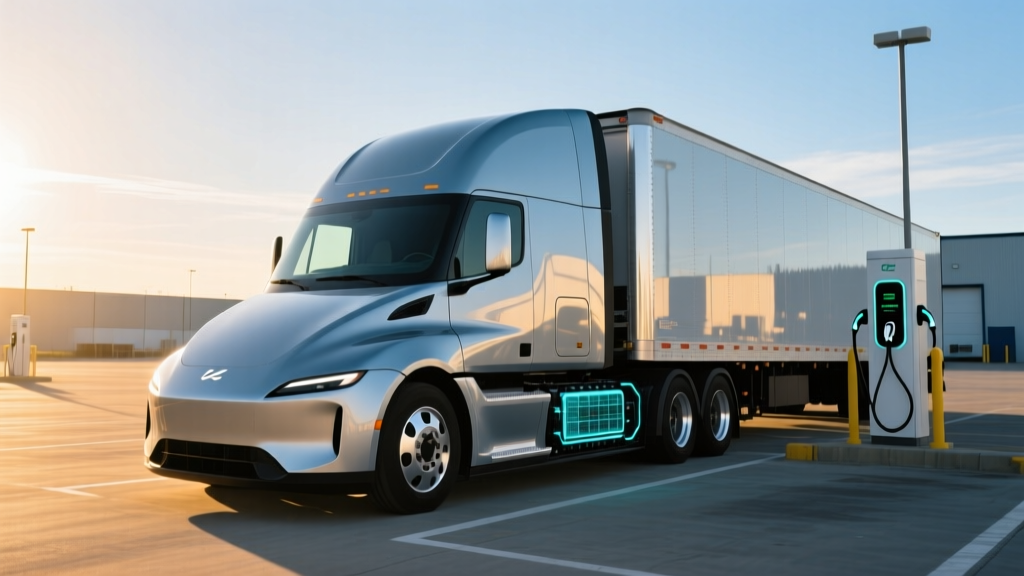
Fleet operators evaluating Class 8 electric trucks face a straightforward math problem with a complicated answer: electric semi trucks can save $0.40–$0.80 per mile in fuel and maintenance compared to diesel, but the $250,000–$400,000 upfront price tag requires 3–6 years of high-utilization operation to break even. The total cost of ownership (TCO) advantage emerges only when you combine federal and state incentives, depot charging infrastructure, and predictable regional routes under 300 miles.
Bottom Line on Electric Semi Truck Savings
Per-mile operating cost: Electric Class 8 ~$0.90–$1.30/mile vs. diesel ~$1.50–$2.10/mile (fuel + maintenance). Break-even timeline: 3–6 years depending on annual mileage, electricity rates, and incentive stacking. Best use case: Regional drayage, port operations, and dedicated routes under 250 miles with overnight depot charging.
The Current Electric Semi Truck Landscape (2026 Models)
Three production models dominate the North American Class 8 electric market heading into 2026, with a fourth gaining traction in specific vocations:
| Specification | Tesla Semi | Freightliner eCascadia | Volvo VNR Electric | Peterbilt 579EV |
|---|---|---|---|---|
| Base Price (est.) | $250,000 (300 mi) / $290,000 (500 mi) | $310,000–$350,000 | $330,000–$380,000 | $320,000–$360,000 |
| Battery Capacity | ~500 kWh (est., 300 mi) / ~900 kWh (500 mi) | 438 kWh (usable ~370 kWh) | 375 kWh (usable ~315 kWh, NMC) | 396 kWh (NMC) |
| EPA-est. Range | 300 or 500 miles (mfg. claim) | 150–230 miles (GVW-dependent) | 150–275 miles | 150–200 miles |
| Peak DC Charge Rate | ~1 MW (est.) | 350 kW (CCS) / 1 MW (MCS option) | 250 kW (CCS) | 350 kW (CCS) |
| 10–80% Charge Time | ~30 min (claimed, 1 MW) | ~90 min (350 kW CCS) | ~70 min (250 kW) | ~80 min (350 kW) |
| Motor Output | ~1,000+ hp (tri-motor) | 400 hp continuous / 536 hp peak | 455 hp | 670 hp |
| GVWR | 82,000 lbs | 82,000 lbs | 82,000 lbs | 82,000 lbs |
| Warranty (battery) | Not publicly detailed | 5 yr / 600,000 mi (battery) | 5 yr / unlimited mi (battery) | 5 yr / 600,000 mi |
Range figures require a critical caveat: a fully loaded 80,000-lb tractor-trailer operating at highway speeds will see 20–35% less range than manufacturer claims based on lighter loads or urban cycles. Cold-weather operation in northern climates can reduce usable range an additional 15–25% due to battery thermal management demands and cabin heating. A Freightliner eCascadia rated at 230 miles realistically delivers 160–185 miles at full highway load in moderate temperatures, and potentially 130–150 miles in sub-20°F conditions.
Diesel vs. Electric Semi: Per-Mile Cost Breakdown
The core savings argument for electric semis rests on two categories: energy cost and maintenance. Here's how they compare using 2026 national averages:
| Cost Category | Diesel Class 8 | Electric Class 8 | Notes |
|---|---|---|---|
| Fuel / Energy per Mile | $0.65–$0.85 | $0.18–$0.35 | Diesel at $4.10/gal, 6.5 mpg avg; electricity at $0.12–$0.22/kWh, 1.8–2.2 kWh/mi |
| Engine / Drivetrain Maintenance | $0.15–$0.22 | $0.03–$0.06 | No oil changes, no DPF/SCR, no transmission fluid, fewer moving parts |
| Brake Maintenance | $0.04–$0.08 | $0.01–$0.03 | Regenerative braking extends friction brake life 2–4x |
| Tires | $0.06–$0.10 | $0.07–$0.12 | EV torque can increase tire wear; heavier battery packs add axle load |
| DEF Fluid | $0.03–$0.05 | $0.00 | Not applicable to electric |
| Total Operating Cost per Mile | $0.93–$1.30 | $0.29–$0.56 | Excludes driver, insurance, depreciation, tolls |
At 100,000 miles per year — a realistic figure for regional and drayage operations — the annual fuel and maintenance savings range from $64,000 to $74,000. However, these savings only materialize if the truck runs enough miles to amortize the higher purchase price.
Electricity rates vary dramatically by region and time-of-use. Fleets in the Pacific Northwest with access to $0.06–$0.08/kWh industrial rates see the strongest savings, while California fleets on peak-rate commercial tariffs may pay $0.22–$0.30/kWh without managed charging. Installing depot chargers with utility demand-management programs can cut effective rates by 30–40%.
Purchase Price, Incentives, and the Real Upfront Cost
The sticker shock is real. A diesel Class 8 tractor costs $140,000–$180,000 in 2026, while electric equivalents run $250,000–$400,000 before incentives. But the incentive landscape significantly narrows this gap:
- Federal Commercial Clean Vehicle Credit (§45W): Up to $40,000 for vehicles over 14,000 lbs GVWR. Unlike the §30D consumer credit, this applies to fleet purchases and is not subject to the same MSRP or income caps. Confirm current eligibility at IRS.gov §45W.
- State HVIP and voucher programs: California's Hybrid and Zero-Emission Truck and Bus Voucher Incentive Program (HVIP) has offered $90,000–$120,000 per Class 8 truck. New York, New Jersey, and other CARB-adopting states offer $50,000–$100,000 vouchers.
- Utility infrastructure rebates: Many utilities offer $10,000–$50,000 per charger or make-ready infrastructure support for fleet depot installations.
- IRA §179 expensing: Commercial EVs can qualify for accelerated depreciation, improving near-term tax positioning.
A fleet in California purchasing a Freightliner eCascadia at $340,000 could stack a $40,000 federal credit, $100,000 HVIP voucher, and $20,000 utility rebate, bringing the net cost to approximately $180,000 — competitive with a well-equipped diesel. But these programs have limited funding windows and application deadlines that change annually.
Charging Infrastructure: The Hidden Cost Multiplier
Depot charging infrastructure represents the most underestimated expense in electric semi adoption. A single 350 kW CCS charger costs $80,000–$150,000 installed, while Megawatt Charging System (MCS) installations — necessary for the fastest Tesla Semi charging — can exceed $250,000 per pedestal.
| Infrastructure Component | Cost Range (per charger) | Notes |
|---|---|---|
| Level 2 (19.2 kW) — overnight depot | $8,000–$18,000 installed | Suitable only for low-mileage, long-dwell operations |
| DC Fast (150–180 kW CCS) | $50,000–$100,000 installed | 4–6 hour charge for Class 8; adequate for overnight |
| DC Ultra-Fast (350 kW CCS) | $80,000–$150,000 installed | ~90 min 10–80% for eCascadia; best depot balance |
| Megawatt Charging (600 kW–1.2 MW) | $150,000–$300,000+ installed | Required for Tesla Semi fast charging; limited availability |
| Electrical service upgrade (1–3 MW) | $100,000–$500,000+ | Utility transformer, switchgear, conduit; 6–18 month lead time |
A 10-truck fleet depot with 350 kW chargers and a service upgrade should budget $1.0–$2.5 million in total infrastructure. This cost amortizes over the charger's 10–15 year lifespan and can be partially offset by utility make-ready programs. Critically, the utility interconnection process can take 12–24 months — fleets must plan infrastructure before ordering trucks.
Real-World Ownership Considerations
Electric semi ownership diverges sharply from diesel in operational patterns that matter for savings calculations:
Route predictability is non-negotiable. Unlike diesel trucks that can refuel anywhere in 15 minutes, electric semis require route planning around range and charging access. Public DC fast charging for Class 8 vehicles remains extremely limited outside major freight corridors in California and Texas. Fleets operating fixed regional routes under 250 miles with depot charging see the best outcomes; long-haul irregular-route operators should wait for MCS infrastructure and 500+ mile models to mature.
Payload trade-offs exist. Battery packs add 3,000–6,000 lbs to a Class 8 tractor. Under the federal 80,000-lb GVWR limit, this directly reduces revenue payload. The Federal Highway Administration allows a 2,000-lb weight exemption for EVs (per 23 U.S.C. §127), bringing the limit to 82,000 lbs, but this only partially offsets battery weight. For weight-sensitive freight (liquids, aggregates, dense goods), this is a real revenue hit.
Battery degradation and second life. Current NMC cells in heavy-duty applications are warrantied for 5 years with capacity retention thresholds of 70–80%. Real-world data from early eCascadia and VNR Electric deployments suggests 2–4% annual degradation in moderate climates, meaning a truck might retain 85–90% of original range at year five. Battery replacement costs remain opaque — manufacturer quotes suggest $80,000–$150,000 for a Class 8 pack, which would erase several years of operating savings if needed out of warranty.
Cold-weather operations. Fleets in Minnesota, Canada, and the Northeast must account for 15–25% range loss in sustained sub-freezing temperatures. Battery preconditioning and thermal management consume energy even when stationary. Depot charging in heated garages mitigates this, but adds facility costs.
Decision Framework: Should Your Fleet Go Electric?
Electric Semi Truck Savings Decision Matrix
Choose electric if:
- Routes are predictable and under 250 miles round-trip
- Trucks return to a depot nightly with 8+ hour dwell time
- Annual mileage exceeds 60,000 miles per truck (to capture fuel savings)
- You operate in a state with HVIP-style vouchers or strong utility rebates
- Your freight is volume-limited rather than weight-limited
- You can secure depot charging infrastructure within your operational timeline
- Corporate sustainability mandates or customer requirements favor ZEV
Stick with diesel (or wait) if:
- Routes exceed 300 miles or are highly variable
- Operations rely on public truck-stop refueling networks
- Annual mileage is under 40,000 miles (insufficient savings to justify premium)
- No state or utility incentives are available in your jurisdiction
- Freight is weight-critical and the payload penalty directly impacts revenue
- Depot electrical service upgrade would exceed $500,000 with long lead times
- You need truck delivery within 6 months (EV lead times remain 12–18+ months)
Common Misconceptions About Electric Semi Savings
| Myth | Fact |
|---|---|
| "Electric semis save money immediately." | Break-even is typically 3–6 years. The higher purchase price must be offset by accumulated per-mile savings, which requires high utilization. |
| "Charging an electric semi costs the same as a car." | Commercial electricity rates, demand charges, and infrastructure costs make fleet charging economics fundamentally different from residential EV charging. |
| "Electric trucks have no maintenance costs." | Tires, suspension, HVAC, and electrical systems still require service. Maintenance is lower (~60–70% reduction in powertrain-related costs) but not zero. |
| "The range is enough for most freight." | Only for regional, drayage, and dedicated short-haul. Long-haul OTR operations (500+ mi/day) remain impractical without en-route MCS infrastructure. |
| "Federal tax credit covers $40,000 for everyone." | The §45W credit has specific eligibility requirements including domestic use, manufacturer qualification, and tax-liability offsets. Consult a tax professional for your fleet's exact position. |
5-Year Total Cost of Ownership Projection
Here's a realistic 5-year TCO model for a regional drayage fleet truck running 90,000 miles/year in California with stacked incentives:
| Cost Category (5 Years) | Diesel Class 8 | Electric Class 8 (eCascadia) |
|---|---|---|
| Net Purchase Price (after incentives) | $160,000 | $180,000 (est. after $40K federal + $100K HVIP + $20K utility) |
| Fuel / Energy (450,000 total miles) | $292,500 ($0.65/mi) | $108,000 ($0.24/mi at blended depot rate) |
| Maintenance (powertrain + brakes) | $85,500 ($0.19/mi) | $22,500 ($0.05/mi) |
| Charging Infrastructure (allocated per truck) | $0 | $35,000 (10-truck depot, amortized) |
| Insurance (est.) | $30,000 | $37,500 (higher replacement cost) |
| Estimated Residual Value (Year 5) | –$45,000 | –$55,000 (uncertain; limited used EV semi market) |
| Net 5-Year Cost | $523,000 | $328,000 |
In this scenario, the electric semi delivers roughly $195,000 in net savings over 5 years, or about $0.43 per mile. But this projection depends entirely on incentive availability, electricity rates holding steady, no unplanned battery replacement, and sufficient annual mileage. Remove the state voucher and the savings shrink to ~$95,000. Drop annual mileage to 50,000 and the electric truck barely breaks even.
For authoritative data on heavy-duty vehicle efficiency, the U.S. Department of Energy's Alternative Fuels Data Center maintains current specifications and incentive databases. The EPA's Green Vehicle Guide provides emissions and efficiency ratings for commercially available models.
What is the realistic range of an electric semi truck at full highway load?
Expect 130–185 miles for current production models (eCascadia, VNR Electric) at 80,000 lbs GVW and 65 mph in moderate temperatures. The Tesla Semi claims 300 or 500 miles depending on battery configuration, but independent real-world validation at full highway load is limited as of early 2026.
How long does it take to charge an electric semi truck?
On a 350 kW CCS charger, expect 80–100 minutes for a 10–80% charge on a ~400 kWh pack. Overnight Level 2 (19.2 kW) charging takes 18–22 hours for a full charge — adequate only for trucks with full-day dwell. Megawatt Charging System (MCS) installations can cut this to 30–45 minutes but remain scarce.
Do electric semi trucks qualify for the $7,500 consumer tax credit?
No. The §30D consumer credit applies to light-duty vehicles under 14,000 lbs GVWR with MSRP and income caps. Class 8 trucks qualify for the §45W Commercial Clean Vehicle Credit, which offers up to $40,000 per vehicle for qualifying commercial purchasers. Check current rules at IRS.gov.
What happens if an electric semi battery fails out of warranty?
Class 8 battery replacement is estimated at $80,000–$150,000 depending on capacity and chemistry. This is the single largest financial risk in electric semi ownership. Most manufacturers warranty batteries for 5 years with 70–80% capacity retention guarantees. Some fleets negotiate extended warranty packages or battery-as-a-service arrangements.
Can electric semi trucks handle cold weather?
They can operate in cold weather, but range drops 15–25% in sustained sub-freezing temperatures due to battery heating demands and cabin climate control. Fleets in cold climates should plan routes 20–25% shorter than the rated range and ensure depot charging occurs in temperature-controlled environments where possible.