Quick Answer: Is an Electric Semi Trailer Truck Right for Your Fleet?
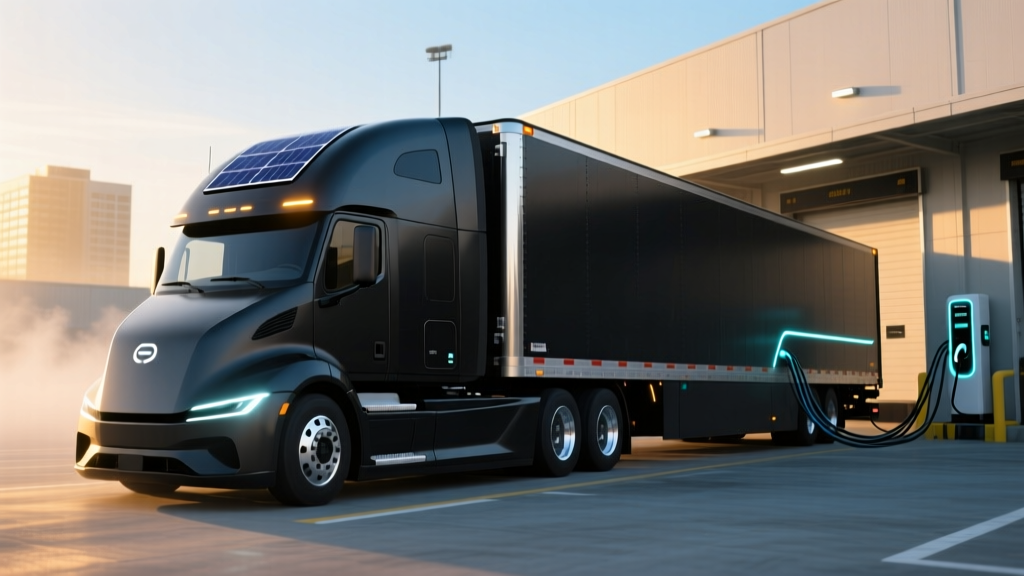
Electric semi trailer trucks are viable today for regional and drayage routes under 250 miles round-trip where depot charging is available. The Tesla Semi leads with an EPA-estimated 500-mile range (loaded at 82,000 lbs GVW) and a ~900 kWh battery pack, while the Freightliner eCascadia targets 230 miles with a 475 kWh pack for shorter hauls. Expect base pricing from $180,000–$290,000 before incentives — roughly 2–3× a comparable diesel Class 8. The payoff comes in fuel and maintenance savings: electricity at $0.12–$0.20/kWh translates to $0.15–$0.25 per mile in energy cost versus $0.65–$0.90/mile for diesel at current prices. Payback typically takes 3–5 years on high-mileage regional routes. For long-haul OTR (>500 mi/day) without reliable en-route Megawatt Charging System (MCS) infrastructure, diesel remains the practical choice.
The Electric Semi Trailer Truck Landscape in 2026
The Class 8 electric truck market has matured past early-adopter pilot programs into genuine fleet deployment. Major manufacturers now ship production units, and the Megawatt Charging System (MCS) — capable of up to 1.2 MW (1,200 kW) — is expanding at key freight corridors in California, Texas, and the Pacific Northwest. Fleet operators evaluating an electric semi trailer truck must weigh route predictability, depot electrical capacity, payload penalties from battery weight, and total cost of ownership (TCO) against the diesel baseline.
Unlike passenger EVs, where the IRS §30D federal tax credit caps at $7,500, commercial electric trucks qualify under the §45W Commercial Clean Vehicle Credit — up to $40,000 per vehicle for vehicles over 14,000 lbs GVWR, subject to battery sourcing and domestic assembly requirements. State incentives (notably California's Hybrid and Zero-Emission Truck and Bus Voucher Incentive Project, or HVIP) can stack additional savings, though availability varies by jurisdiction and funding cycle.
Spec Comparison: Leading Electric Semi Trucks
| Spec | Tesla Semi (2026) | Freightliner eCascadia | Volvo VNR Electric | Peterbilt 579EV |
|---|---|---|---|---|
| EPA-Est. Range (loaded) | 500 mi | 230 mi | 275 mi | 150 mi |
| Battery Capacity (usable) | ~900 kWh (est.) | 475 kWh | 565 kWh | 396 kWh |
| Battery Chemistry | NMC (est.) | NMC | NMC | NMC |
| Peak DC Fast Charge | ~1.2 MW (MCS) | 350 kW (CCS2) | 250 kW (CCS2) | 350 kW (CCS2) |
| 10–80% Charge Time (est.) | ~45 min (MCS) | ~90 min (CCS2) | ~70 min (CCS2) | ~60 min (CCS2) |
| Motor Output | ~1,000+ hp (tri-motor) | 400 hp (dual e-axle) | 455 hp (dual motor) | 670 hp (dual motor) |
| GCWR (max) | 82,000 lbs | 82,000 lbs | 82,000 lbs | 82,000 lbs |
| Base MSRP (approx.) | $250,000–$290,000 | $180,000–$230,000 | $200,000–$250,000 | $190,000–$240,000 |
| Battery Warranty | 8 yr / 1M mi (est.) | 5 yr / 600K mi | 5 yr / 600K mi | 5 yr / 600K mi |
| Connector | MCS / CCS2 adapter | CCS2 | CCS2 | CCS2 |
Specs reflect manufacturer-published data and industry estimates as of early 2026. Range figures assume 82,000 lbs GCWR; real-world results vary with terrain, speed, temperature, and payload. Always confirm current specs with the OEM before ordering.
Real-World Range vs. EPA Sticker
EPA range estimates for Class 8 trucks are measured under controlled conditions. In real-world fleet testing, expect:
- Highway at 65 mph (moderate climate): ~85–95% of EPA range
- Cold weather (below 32°F / 0°C): ~65–80% of EPA range (cabin heating + battery thermal losses)
- Mountain grades (loaded): ~50–70% of EPA range on sustained climbs, partially recovered on descents via regen
- Stop-and-go drayage: Can exceed EPA range due to regenerative braking recovery
A Tesla Semi rated at 500 miles may deliver ~350–400 miles in winter highway conditions — plan routes around the worst-case scenario, not the sticker.
Electric Semi vs. Diesel: Total Cost of Ownership
The purchase price of an electric semi trailer truck is 2–3× that of a diesel Class 8. The TCO equation flips in the electric truck's favor only when you factor in energy, maintenance, and incentive savings over the vehicle's operating life. Below is a 5-year TCO comparison for a regional fleet truck running 60,000 miles/year:
| Cost Category (5 yr / 300K mi) | Electric Semi | Diesel Class 8 |
|---|---|---|
| Purchase Price (base) | $230,000 | $140,000 |
| Federal §45W Credit | –$40,000 | $0 |
| State Incentive (CA HVIP est.) | –$35,000 | $0 |
| Net Acquisition Cost | $155,000 | $140,000 |
| Energy/Fuel (300K mi) | $60,000 ($0.20/mi) | $225,000 ($0.75/mi) |
| Maintenance (5 yr) | $12,000 | $45,000 |
| DEF / Exhaust Aftertreatment | $0 | $6,000 |
| Depot Charging Infrastructure (amortized) | $25,000 | $0 |
| Insurance (est. 5 yr) | $35,000 | $28,000 |
| Total 5-Year Cost | $287,000 | $444,000 |
| Cost Per Mile | $0.96/mi | $1.48/mi |
Assumes diesel at $4.50/gal at 6.5 mpg; electricity at $0.15/kWh avg. blended depot rate at 2.0 kWh/mi. Insurance is higher for EVs due to repair-cost uncertainty. Infrastructure amortization assumes a shared depot charger across 4 trucks. Your mileage — literally — will vary.
The data is clear: on high-utilization regional routes, the electric semi trailer truck wins on TCO within 3–4 years. The key variable is annual mileage. Below ~30,000 miles/year, the higher acquisition cost may not be offset before battery end-of-life. Above 80,000 miles/year, range limitations and charging downtime become the constraint.
Charging Infrastructure: The Make-or-Break Factor
Unlike passenger EVs that can rely on public networks, electric semi trucks live and die by depot charging infrastructure. Here's what fleet buyers need to budget and plan for:
Depot Charging Levels
| Level | Power (kW) | Miles Added/Hour (est.) | Use Case | Install Cost per Stall |
|---|---|---|---|---|
| Level 2 AC (J1772/CCS AC) | 19.2–40 kW | 10–20 mi/hr | Overnight top-up; not practical for full charge | $5,000–$15,000 |
| DC Fast (CCS2) | 150–350 kW | 75–175 mi/hr | Primary depot charging; 4–8 hr overnight session | $50,000–$120,000 |
| Megawatt Charging (MCS) | 600–1,200 kW | 300–600 mi/hr | En-route corridor charging; rapid turnaround | $200,000–$500,000 |
Critical kW vs. kWh distinction: A 350 kW charger delivers power at a rate of 350 kilowatts. An eCascadia with a 475 kWh battery charged at a sustained 350 kW would theoretically fill in ~81 minutes — but real charge curves taper above 80% SoC, so actual 10–80% times are longer. Peak kW is never sustained across the full session.
Depot Electrical Reality
Installing four 350 kW CCS2 chargers requires roughly 1.4 MW of electrical capacity — equivalent to powering a small neighborhood. Most fleet depots need a utility service upgrade, which can cost $100,000–$500,000+ and take 12–24 months for utility approval. Smart fleet operators are engaging their utility provider before ordering trucks. Some utilities offer make-ready programs that cover a portion of the infrastructure cost.
For en-route charging, the MCS network is expanding but remains concentrated in California (I-5 corridor), the Texas Triangle, and portions of the Pacific Northwest. Cross-country electric trucking is not yet viable without careful route planning and scheduled charging stops.
Common Misconceptions About Electric Semi Trucks
| Myth | Fact |
|---|---|
| "Electric semis can't haul full loads." | All major models are rated for 82,000 lbs GCWR. Battery weight (~8,000–12,000 lbs) does reduce available payload by ~4,000–8,000 lbs vs. diesel, which matters for weight-sensitive freight but not for most cube-limited loads. |
| "The batteries won't last." | Current NMC packs are warranted for 5–8 years / 600K–1M miles with a guaranteed capacity retention threshold (typically 70–80%). Fleet data from early eCascadia deployments shows ~8–12% degradation after 300,000 miles. Replacement cost remains high: $40,000–$80,000+ depending on pack size. |
| "Electric trucks are slower." | The Tesla Semi does 0–60 mph in ~20 seconds loaded (vs. ~45 seconds for a loaded diesel). Electric motors deliver instant torque, which improves merging and grade climbing. Governed top speeds are similar (~65–70 mph). |
| "You can't charge in cold weather." | You can, but charging speeds decrease and range drops 20–35%. Battery thermal management systems (liquid cooling/heating) mitigate this, but preconditioning the pack before a fast-charge session is essential in sub-freezing conditions. |
| "The $40,000 federal credit covers everyone." | The IRS §45W credit has domestic assembly, battery component sourcing, and critical mineral requirements. Not every truck qualifies. Consult a tax professional and verify current-year IRS guidance before building a financial model around the credit. |
First-Time Electric Truck Buyer: What You Must Know
If you're transitioning a fleet — even a single truck — from diesel to electric, the learning curve extends well beyond the vehicle itself:
- Route audit first, truck order second. GPS-log your trucks for 30–60 days. Identify which routes consistently fall within the electric truck's real-world range with a 15–20% buffer. Start with your most predictable, shortest routes.
- Utility engagement is a 12–24 month project. Contact your electric utility immediately. Ask about make-ready incentives, time-of-use (TOU) rate schedules, and demand charges. Charging during off-peak hours (overnight) can cut energy costs by 30–50%.
- Train your drivers. Regenerative braking changes driving style dramatically. One-pedal-style operation in stop-and-go traffic recovers significant energy. Drivers who adapt can extend real-world range by 10–15%.
- Plan for payload trade-offs. If your freight is weight-limited (e.g., aggregates, liquids), the battery weight penalty may be disqualifying. For volume-limited freight (e.g., e-commerce, dry goods), it's usually a non-issue.
- Budget for charger maintenance. DC fast chargers have cooling systems, cables, and software that require service contracts. Budget $2,000–$5,000/year per charger for maintenance.
- Insurance is higher — for now. EV truck insurance premiums run 15–30% above diesel equivalents due to limited repair-network familiarity and high battery replacement costs. Shop fleet insurers with specific EV experience.
Decision Framework: Should Your Fleet Go Electric?
Choose an Electric Semi Trailer Truck If:
- Your routes are under 250 miles round-trip (drayage, regional distribution, port operations)
- You have depot or yard space suitable for charger installation with utility access
- Annual mileage per truck is 40,000–80,000 miles (high enough for fuel savings to pay off the premium)
- You operate in a state with stackable incentives (CA, NY, NJ, WA, OR)
- Your freight is volume-limited, not weight-limited
- You have predictable schedules allowing overnight depot charging
- Your fleet faces zero-emission mandates (e.g., CARB Advanced Clean Fleets rule) or customer ESG requirements
Stick With Diesel (or Wait) If:
- Your routes are over-the-road (OTR) / long-haul exceeding 400+ miles daily
- You operate in regions with no MCS en-route charging infrastructure
- Your freight is weight-maxed and every pound of payload counts
- Annual mileage is under 25,000 miles (the math won't pencil out)
- Your depot has no feasible path to utility service upgrade within your timeline
- You need immediate truck deployment — lead times for electric semis can be 6–18 months
Frequently Asked Questions
What is the real-world range of an electric semi trailer truck?
Real-world range depends heavily on payload, speed, terrain, and temperature. The Tesla Semi's 500-mile EPA estimate may yield 350–450 miles in mixed highway driving loaded at 82,000 lbs. The Freightliner eCascadia's 230-mile rating typically delivers 175–210 miles in real regional use. Always plan routes around worst-case (cold, loaded, hilly) conditions.
How long does it take to charge an electric semi truck?
On a 350 kW CCS2 depot charger, expect 60–120 minutes for a 10–80% session depending on battery size. The Tesla Semi on a 1.2 MW MCS connection can reportedly add ~300+ miles in ~30 minutes. Overnight depot charging at lower rates (150–200 kW) fills most packs in 4–8 hours, aligning with driver rest periods.
What federal tax incentives apply to electric semi trucks?
The IRS §45W Commercial Clean Vehicle Credit provides up to $40,000 for qualifying vehicles over 14,000 lbs GVWR. Eligibility depends on battery component sourcing, critical mineral content, and final assembly requirements. Rules evolve annually — always verify against current IRS guidance and consult a tax professional.
How much does depot charging infrastructure cost?
A single 350 kW DC fast charger installation runs $50,000–$120,000 per stall (equipment + electrical work + permitting). A 4-stall depot with utility service upgrade can total $300,000–$800,000+. Utility make-ready programs and state/federal infrastructure grants (e.g., NEVI, EPA Clean School Bus / Clean Ports programs) may offset 25–75% of costs.
Will the battery need replacement, and what does it cost?
Current NMC battery packs in Class 8 trucks are warranted for 5–8 years or 600K–1M miles. Early fleet data suggests 8–15% degradation over 300K–500K miles. Full pack replacement is estimated at $40,000–$80,000+ depending on capacity. Most fleets plan for a potential battery replacement at year 7–10 and factor it into their TCO model.
Can electric semi trucks operate in extreme cold?
Yes, but with significant trade-offs. Expect 20–35% range loss below freezing due to cabin heating demands and reduced battery efficiency. Charging speeds also decrease unless the pack is preconditioned. Fleets in northern climates should derate range expectations and consider heated depot parking or battery thermal preconditioning protocols.
How does an electric semi compare to a hydrogen fuel cell truck?
Hydrogen fuel cell trucks (e.g., Toyota Kenworth T680 FCEV, Nikola FCET) offer faster refueling (~15–20 minutes) and longer range (~400–500 miles) but face a near-total lack of hydrogen refueling infrastructure and higher fuel cost per mile ($0.40–$0.80/mi for hydrogen vs. $0.15–$0.25/mi for electricity). Battery-electric is the more mature, lower-operating-cost option for routes within range limits. Hydrogen may suit longer hauls once infrastructure develops.
Sources: Manufacturer specification pages (Tesla, Daimler Truck, Volvo Trucks, Paccar); fueleconomy.gov; IRS §45W / §30D guidance; NHTSA. Specs and incentive rules are subject to change — verify current-year data before purchasing.