Quick Answer: Should Your District Go Electric?
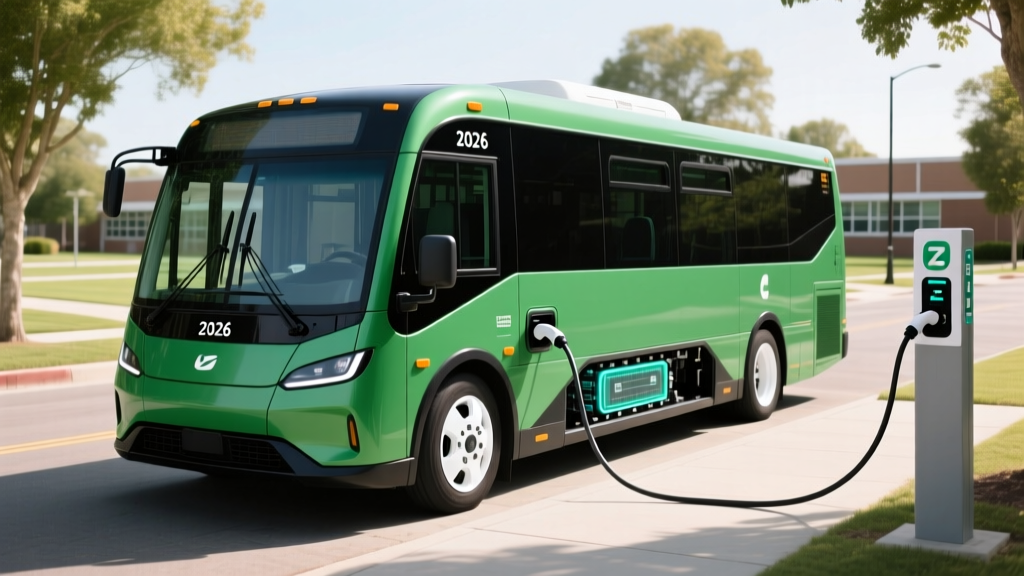
An electric school bus in 2026 costs between $230,000 and $390,000 before incentives — roughly 2.5× to 3.5× the price of a new diesel Type C bus. However, with the EPA's Clean School Bus Program rebates (up to $375,000 for qualifying districts), federal tax credits, and state-level grants, many districts are acquiring electric buses for a net cost equal to or lower than diesel. Operating savings from cheaper electricity versus diesel fuel and drastically reduced maintenance typically total $6,000 to $11,000 per bus per year. For routes under 150 miles with predictable daily patterns and access to depot charging, an electric school bus is financially and operationally viable today. Routes exceeding 180 miles, extreme cold-weather regions, or districts without overnight charging infrastructure should proceed with phased pilots rather than full fleet conversion.
The 2026 Electric School Bus Market: Who's Selling What
Three manufacturers dominate the U.S. electric school bus market heading into the 2026 model year. Each offers a Type C (conventional) or Type D (transit-style) battery-electric platform built around lithium-ion NMC or LFP battery packs ranging from 126 kWh to 196 kWh of usable capacity. Here's how the major models stack up by the numbers.
| Spec | Blue Bird Vision EV | Thomas Saf-T-Liner EFX | Lion Electric LionC |
|---|---|---|---|
| Battery Capacity (usable) | 155 kWh (NMC) | 174 kWh (LFP) | 169 kWh (NMC) |
| EPA-Estimated Range | ~150 miles | ~130 miles | ~145 miles |
| Real-World Range (mixed) | 110–140 miles | 100–125 miles | 105–135 miles |
| Max DC Fast Charge Rate | 60 kW (CCS1) | 60 kW (CCS1) | 50 kW (CCS1) |
| 10–80% DC Charge Time | ~120 minutes | ~140 minutes | ~150 minutes |
| Level 2 Charge Rate (overnight) | 19.2 kW (J1772) | 19.2 kW (J1772) | 19.2 kW (J1772) |
| Level 2 Full Charge Time | ~8 hours | ~9 hours | ~8.5 hours |
| Motor Output | 200 kW (~268 hp) | 185 kW (~248 hp) | 185 kW (~248 hp) |
| GVWR | 33,000 lbs | 33,000 lbs | 33,000 lbs |
| Seating Capacity | Up to 78 | Up to 78 | Up to 72 |
| Base Price (approx.) | $310,000–$340,000 | $320,000–$360,000 | $230,000–$280,000 |
| Battery Warranty | 10 yr / unlimited mi | 10 yr / unlimited mi | 10 yr / unlimited mi |
One immediate takeaway: kW (power) versus kWh (energy) matters here just as it does for passenger EVs. A 155 kWh battery holds the energy; the 60 kW DC charge rate determines how quickly you can replenish it. At 60 kW sustained, filling 10–80% of a 155 kWh pack takes roughly two hours — meaning mid-day opportunity charging is possible but requires significant schedule padding. Most districts rely on overnight Level 2 depot charging at 19.2 kW, which fills a depleted pack in 8–9 hours.
Real-World Range: What the EPA Number Doesn't Tell You
School bus manufacturers publish range figures that assume moderate temperatures, flat terrain, and partial passenger loads. In real-world operation, several factors compress usable range significantly:
- Cold weather (below 32°F): Expect 25%–40% range reduction. Cabin heating in a 40-foot bus draws substantial energy. A bus rated at 150 miles EPA may deliver only 90–110 miles in a Minnesota January.
- Full passenger load: Carrying 72 students adds roughly 8,000–10,000 lbs, increasing energy consumption per mile by 10%–15% versus an empty bus.
- Hilly terrain: Routes with sustained climbs above 5% grade can cut range by 15%–20%. Regenerative braking recovers some energy on descents, but not fully.
- Accessory loads: Stop-arm cameras, interior LED lighting, wheelchair lifts, and HVAC defrost cycles all draw from the traction battery.
Rule of thumb for route planning: Never assign a bus to a route longer than 65% of its EPA-rated range if your district experiences sub-freezing winters. A 150-mile EPA bus should be limited to routes of 100 miles or less in cold climates to maintain a safety buffer.
Electric School Bus vs. Diesel: The Full Cost Comparison
The upfront sticker shock of electric school buses is real. A new diesel Type C bus costs $90,000–$120,000 in 2026, while electric equivalents start at $230,000 and can exceed $360,000. But the total cost of ownership (TCO) over a typical 12-year school bus lifecycle tells a different story when fuel, maintenance, and incentives are factored in.
| Cost Category | Diesel Bus | Electric Bus (after EPA rebate) |
|---|---|---|
| Purchase Price (net of incentives) | $105,000 | $120,000–$160,000* |
| Fuel / Energy (12 yr @ 12,000 mi/yr) | $86,400** | $21,600*** |
| Maintenance (12 yr) | $48,000 | $18,000 |
| DEF Fluid / Emissions Systems | $7,200 | $0 |
| Depot Charging Infrastructure (amortized) | $0 | $15,000–$25,000 |
| Battery Replacement (if needed) | $0 | $0–$45,000**** |
| Total 12-Year Cost | $246,600 | $174,600–$268,000 |
* Assumes EPA Clean School Bus Program rebate of $200,000–$287,500 and applicable state incentives. Districts in high-need or rural categories qualify for the maximum. ** Diesel at $3.50/gal, 6 mpg avg. *** Electricity at $0.12/kWh, 2.2 kWh/mile. **** Most batteries are warrantied for 10 years; many districts retire buses before replacement is needed.
The EPA Clean School Bus Program is the single most impactful financial lever for electric school bus adoption. Funded through the Bipartisan Infrastructure Law, the program provides rebates of up to $375,000 per electric bus (plus up to $20,000 for charging infrastructure) for qualifying school districts, with priority given to high-need, rural, and tribal schools. Several states — including New York, California, Colorado, and Maryland — layer additional incentives on top, which can bring the net acquisition cost below that of a diesel bus.
Charging Infrastructure: What Depot Electrification Actually Costs
Unlike passenger EVs, school buses can't rely on public charging networks. They require depot-based charging infrastructure sized to the fleet. Here's what a realistic charging installation looks like for a 10-bus depot:
| Component | Cost Range |
|---|---|
| Level 2 chargers (19.2 kW × 10 units) | $60,000–$90,000 |
| Electrical panel upgrade & switchgear | $25,000–$75,000 |
| Utility service upgrade (transformer, feed) | $30,000–$120,000 |
| Trenching, conduit, concrete pads | $15,000–$40,000 |
| Charge management software (annual) | $3,000–$8,000/yr |
| Permitting & engineering | $10,000–$25,000 |
| Total Estimated Range | $143,000–$358,000 |
Key infrastructure considerations:
- Utility lead time: Many utilities require 6–18 months to upgrade transformer capacity for a multi-bus depot. Engage your utility on day one of the planning process.
- Managed charging: Software platforms like eBusPower, ChargePoint, or Electric Era allow you to stagger charge sessions across the night, reducing peak demand charges from the utility. Without managed charging, simultaneous charging of 10 buses at 19.2 kW draws 192 kW — which can trigger commercial demand charges of $10–$25/kW/month in some rate territories.
- V2G (Vehicle-to-Grid): Some 2026 electric school bus platforms support bidirectional charging, allowing the bus battery to export power back to the grid or building during peak hours. Blue Bird and Lion have announced V2G-capable configurations. This can generate utility demand-response revenue of $1,000–$3,000 per bus per year, partially offsetting infrastructure costs.
Maintenance Savings: Where Electric Buses Win Decisively
Diesel school buses require oil changes every 5,000–10,000 miles, fuel filter replacements, DEF fluid refills, DPF (diesel particulate filter) regeneration or cleaning, EGR valve service, transmission fluid changes, and periodic emissions system overhauls. Electric school buses eliminate nearly all of these. The maintenance items that remain include:
- Tire rotation and replacement (heavier bus = faster tire wear)
- Brake inspection (regenerative braking significantly extends pad life — many operators report 3× to 5× longer brake intervals)
- Coolant system checks (battery thermal management loop)
- Cabin air filter replacement
- 12V auxiliary battery replacement (every 4–6 years)
- Annual high-voltage system inspection by a certified technician
Industry data compiled by the U.S. Department of Energy's Alternative Fuels Data Center indicates that electric school bus maintenance costs average $0.15–$0.20 per mile versus $0.35–$0.50 per mile for diesel — a savings of $2,400–$3,600 annually per bus at 12,000 miles per year.
Common Misconceptions About Electric School Buses
| Myth | Fact |
|---|---|
| "Electric buses can't handle cold weather." | Range drops 25%–40% in extreme cold, but districts in Alaska, Minnesota, and New York operate electric buses year-round with proper route sizing and battery preconditioning. Preconditioning warms the battery pack while still plugged in, reducing cold-weather energy drain. |
| "The batteries won't last the life of the bus." | All three major manufacturers warrant battery packs for 10 years with guaranteed capacity retention above 70%–80%. Most school buses are retired or repurposed at 12–15 years. Real-world degradation data from early-adopter fleets shows 2%–3% annual capacity loss in moderate climates. |
| "Charging takes too long for school schedules." | Overnight Level 2 charging at 19.2 kW fully replenishes a 155 kWh pack in ~8 hours. Buses return to the depot by 4 PM and depart by 6 AM — more than enough time. DC fast charging at 60 kW provides a 70% charge in ~2 hours for mid-day top-ups. |
| "The grid can't handle a fleet of electric buses." | A 10-bus depot charging overnight draws ~192 kW — equivalent to a small commercial building. Most utility feeders can accommodate this with advance planning. Managed charging software further reduces peak demand by staggering sessions. |
| "Electric buses are unsafe in crashes." | Electric school buses must meet the same FMVSS (Federal Motor Vehicle Safety Standards) as diesel buses, including rollover protection, joint strength, and emergency egress. Battery packs are housed in reinforced, sealed enclosures with thermal runaway mitigation systems. |
Decision Framework: Is an Electric School Bus Right for Your District?
Choose electric if:
- Your longest daily route is under 100 miles (or 75 miles in cold climates)
- Buses return to a central depot each night with 10+ hours of dwell time
- Your district qualifies for EPA Clean School Bus Program rebates (priority categories: high-need, rural, tribal)
- Your utility can provide or upgrade service for 150–300 kW of additional load
- You operate in a state with additional electrification incentives (CA, NY, CO, MD, MA, WA)
- Your maintenance team is prepared to train on high-voltage systems or contract with the OEM for service
Hold off or run a pilot if:
- Your routes regularly exceed 150 miles per day or include long highway segments at sustained 65+ mph
- You operate in a region with winter temperatures consistently below 0°F and routes above 80 miles
- Your depot lacks electrical service capacity and the utility quotes 2+ years for an upgrade
- Your district does not qualify for significant rebates and the full $300,000+ per bus is prohibitive
- You need buses for long field trips, athletic away games, or inter-district transportation exceeding route range
What a First-Time Electric School Bus Buyer Should Know
If your district is evaluating its first electric school bus, structure the process in phases:
- Audit your routes: Map every route's daily mileage, elevation profile, and seasonal variation. Identify the 20% of routes that are longest or most demanding — these are poor first candidates. The 80% of routes under 80 miles daily are ideal.
- Engage your utility early: Before issuing an RFP for buses, contact your utility's commercial accounts team. Request a service capacity assessment for your depot address. Ask about EV-specific rate tariffs — many utilities offer off-peak rates as low as $0.06–$0.08/kWh for fleet charging.
- Apply for EPA Clean School Bus funding: The application window typically opens annually. Visit epa.gov/cleanschoolbus for current deadlines. Applications require fleet data, route information, and a commitment to scrap or replace an older diesel bus.
- Start with 1–3 buses: A pilot lets your drivers, mechanics, and dispatchers learn the platform before scaling. Use the pilot year to validate range assumptions, test charging logistics, and build operational confidence.
- Train your staff: Drivers need instruction on regenerative braking behavior (one-pedal driving feel), energy-efficient driving techniques, and dashboard SoC (State of Charge) monitoring. Mechanics need high-voltage safety certification — most OEMs offer 2–5 day training programs.
- Plan for 120V/240V auxiliary needs: Some districts install cabin pre-heaters powered by shore power to reduce battery drain during cold-weather morning warm-ups. This is a low-cost ($2,000–$5,000) addition that preserves 5–10 miles of range per cold morning.
Frequently Asked Questions
How long does an electric school bus battery last before replacement?
Manufacturer warranties cover 10 years with guaranteed capacity retention of 70%–80%. Real-world data from early-adopter fleets (2018–2022 models) shows annual degradation of 2%–3% in moderate climates and 3%–4% in extreme heat or cold. Most school buses are retired from primary service at 12–15 years, meaning many will never need a battery swap. If replacement is required, current pricing runs $35,000–$55,000 for a full pack, though prices continue to decline.
Can an electric school bus tow or use a wheelchair lift?
Yes. Electric school buses are equipped with hydraulic or electric wheelchair lifts powered by the traction battery. The energy draw of a lift cycle is minimal (~0.1 kWh per use). Towing is generally not recommended — the GVWR of 33,000 lbs leaves limited margin for trailer weight, and towing significantly reduces range.
What happens if a bus runs out of charge mid-route?
This is called "stranding" and it's the primary operational fear. Mitigation strategies include: conservative route assignment (never exceed 65% of EPA range in winter), driver training on SoC monitoring, and establishing a roadside assistance protocol with a flatbed tow truck (electric buses should not be towed with drive wheels on the ground, as this can damage the motor). Some districts keep one diesel bus in reserve for emergency substitution.
Do electric school buses qualify for the federal §30D tax credit?
The §30D clean vehicle credit applies to light-duty passenger vehicles (under 14,000 lbs GVWR). School buses exceed this weight threshold. However, the Commercial Clean Vehicle Credit (§45W) provides up to $40,000 for qualifying heavy-duty electric vehicles, including school buses purchased by private operators. Public school districts, which are tax-exempt, can benefit through "direct pay" provisions under the Inflation Reduction Act, receiving the credit as a refundable payment. Consult a tax professional for eligibility specifics.
How does charging cost compare to diesel fuel per mile?
At the national average commercial electricity rate of $0.12/kWh and a consumption rate of 2.2 kWh/mile, charging costs approximately $0.26 per mile. Diesel at $3.50/gallon and 6 mpg averages $0.58 per mile. That's a fuel savings of $0.32 per mile, or $3,840 per year at 12,000 miles. Districts with access to off-peak utility rates ($0.06–$0.08/kWh) can reduce charging costs to $0.13–$0.18 per mile — a savings of $4,800–$5,400 annually.
Are LFP or NMC batteries better for school buses?
Both chemistries have trade-offs. NMC (nickel manganese cobalt) offers higher energy density — more range per pound — which matters for vehicles with limited battery space. LFP (lithium iron phosphate) is heavier and less energy-dense but offers longer cycle life (3,000–5,000 cycles vs. 1,500–2,500 for NMC), superior thermal stability (lower fire risk), and no cobalt supply chain concerns. Thomas's switch to LFP in the Saf-T-Liner EFX reflects the industry trend toward durability and safety over maximum range in a duty cycle where 130 miles is sufficient.