The Short Answer on Electric RVs
As of 2026, there are no mass-produced, fully electric Class A, B, or C motorhomes available for retail purchase in the United States. The electric RV market consists of a handful of prototypes, concept vehicles, and small-batch electric travel trailers from companies like Winnebago (eTransit-based concept), Thor Industries (Airstream eStream), and Lightship. If you need an RV today, your realistic electrified options are: (1) towing a travel trailer behind an EV like the Ford F-150 Lightning or Rivian R1T, or (2) waiting for limited-production models expected in late 2026 or 2027. Expect towing to reduce your EV truck's range by 40–60%, and expect electric motorhome prototypes to start above $150,000.
What Is an Electric RV — And What Isn't Available Yet?
The term "electric RV" covers several vehicle categories, and the availability of each varies dramatically:
- Electric travel trailers: These have no drivetrain of their own and are towed by a vehicle. The Airstream eStream concept features a battery pack and motors to assist towing, reducing range loss on the tow vehicle. Lightship's L1 travel trailer includes a solar roof and battery system. Both remain in limited production or pre-order as of early 2026.
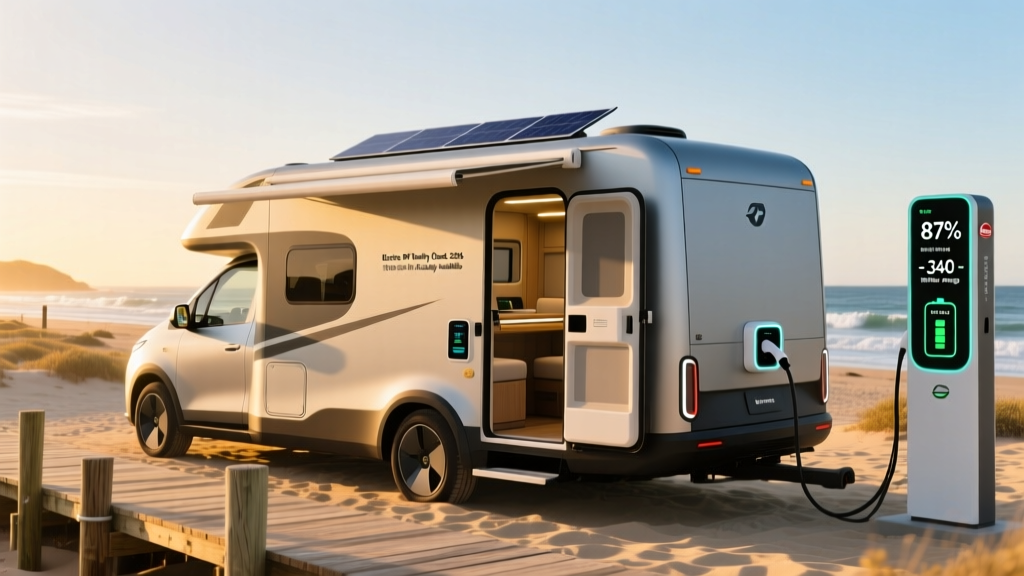
- Electric Class B camper vans: Winnebago has demonstrated an all-electric concept based on the Ford E-Transit chassis. This would offer roughly 108 miles of EPA-estimated range (based on the E-Transit's commercial specs) before accounting for the weight of camper conversion. Not yet available for retail purchase.
- Electric Class A and C motorhomes: No production models exist. Thor Industries and Forest River have shown concepts, but the battery weight and cost required for a 30,000-pound vehicle with living quarters make these economically unviable at current battery energy densities (~250 Wh/kg at cell level).
- EV truck + travel trailer combo: This is the only electric RV setup you can actually buy and use today. Pair an F-150 Lightning, Rivian R1T, Chevrolet Silverado EV, or Tesla Cybertruck with a conventional or electric-assist travel trailer.
Towing with an EV: Real-World Range Impact
If your path to an "electric RV" is towing a travel trailer with an EV pickup, the numbers matter more than the marketing. Towing is the most demanding scenario for any electric vehicle, and the range penalty is severe.
| Vehicle | EPA Range (Solo) | Estimated Range Towing 5,000-lb Trailer | Range Loss | Max Tow Rating |
|---|---|---|---|---|
| Ford F-150 Lightning (Extended Range, 131 kWh usable) | 320 mi | ~130–170 mi | 47–59% | 10,000 lbs |
| Rivian R1T (Dual Motor, Max Pack, 141 kWh usable) | 410 mi | ~180–220 mi | 46–56% | 11,000 lbs |
| Chevrolet Silverado EV (4WT, 200+ kWh pack) | 440 mi | ~200–260 mi | 41–55% | 10,000 lbs |
| Tesla Cybertruck (AWD, ~123 kWh usable) | 340 mi | ~140–180 mi | 47–59% | 11,000 lbs |
Why the massive loss? Aerodynamic drag dominates at highway speeds, and a travel trailer is essentially a rolling brick. Combined vehicle-trailer weight often exceeds 12,000 lbs, demanding sustained high power output (40–80 kW continuous at 65 mph). Regenerative braking provides minimal recovery because you rarely decelerate aggressively while towing.
Real-world caveat: These towing estimates assume 65 mph on flat terrain at 70°F. Add mountain grades, headwinds, or cold weather, and range can drop another 15–25%. On a trip from Denver to Moab, expect to charge every 90–110 miles — and not all DC fast chargers can accommodate a truck-trailer combination without unhitching.
Cost Breakdown: Electric RV Setup vs. Diesel Motorhome
Let's compare two realistic scenarios for someone considering the electric RV lifestyle.
| Cost Factor | EV Truck + Travel Trailer (2026) | Diesel Class C Motorhome (2026) |
|---|---|---|
| Vehicle purchase | $75,000–$100,000 (Rivian R1T Max Pack or F-150 Lightning Platinum) | $110,000–$160,000 (Winnebago Solis or Thor Four Winds on Mercedes Sprinter) |
| Travel trailer / camper buildout | $25,000–$55,000 (Airstream Bambi to mid-size Jayco) | Included |
| Total acquisition | $100,000–$155,000 | $110,000–$160,000 |
| Fuel / energy cost per mile | $0.12–$0.18/mi (electricity at $0.15/kWh avg, ~2 mi/kWh towing) | $0.35–$0.50/mi (diesel at $4.50/gal, 8–10 MPG) |
| Annual fuel/energy (6,000 mi) | $720–$1,080 | $2,100–$3,000 |
| Maintenance per year | $300–$500 (tires, cabin filter, brake fluid) | $1,200–$2,500 (diesel service, DEF fluid, generator, transmission) |
| Insurance (annual) | $2,200–$3,800 (truck + trailer combo) | $1,800–$3,200 |
| §30D Federal Tax Credit | Up to $7,500 for qualifying EV truck (subject to MSRP, income, and battery sourcing rules per IRS §30D) | $0 |
The bottom line: An EV truck + trailer setup costs roughly the same upfront as a diesel Class C but saves $1,500–$2,500 annually on fuel and maintenance. The break-even point is roughly 3–5 years depending on mileage. However, the trade-off is range limitation and charging logistics that a diesel motorhome simply doesn't have — a Sprinter-based Class C can cover 400+ miles on a single tank and refuel in 5 minutes anywhere.
Charging Logistics: The Uncomfortable Truth for RV Travelers
Charging infrastructure is the single biggest barrier to electric RV adoption. Here's what you need to know:
DC Fast Charging While Towing
Most DC fast charging stations are designed for passenger vehicles. Pulling a 20-foot travel trailer into a Electrify America or Tesla Supercharger stall often means:
- The trailer blocks adjacent stalls or drive lanes
- You must unhitch the trailer to reach the charge port (on some truck configurations)
- Charge speeds peak at 150–320 kW depending on the truck, but sustained rates while towing a heavy load may be lower due to thermal management demands
- A 10–80% charge on an F-150 Lightning Extended Range takes approximately 41 minutes at a 150 kW charger — longer if you factor in setup and teardown of the trailer
Campground Charging
Most RV campgrounds offer 30-amp or 50-amp shore power (120V/240V). A 50-amp hookup delivers up to 12 kW — sufficient for Level 2 charging of your tow vehicle at roughly 30–40 miles of range per hour. However:
- Many campgrounds do not permit EV charging from shore power (it overloads shared circuits)
- Even where permitted, a full charge from 10–100% on a 131 kWh battery takes 11+ hours at 12 kW
- You'll need a J1772 adapter and a heavy-duty 50-amp to EVSE adapter cable (~$150–$300)
Boondocking and Off-Grid
For off-grid camping, solar panels on a travel trailer (typically 200–600W) can provide 1–3 kWh per day — enough to power the trailer's lights, fridge, and devices, but trivially small for recharging the tow vehicle's 130+ kWh battery. A portable generator (gas or propane) remains the practical backup for remote trips.
Electric RV Prototypes: What's Coming and When
Several companies are developing purpose-built electric RVs, but timelines remain fluid:
| Company / Model | Type | Estimated Battery | Target Range | Status (2026) | Estimated Price |
|---|---|---|---|---|---|
| Winnebago e-RV (E-Transit based) | Class B | 68 kWh (NMC) | ~108 mi (EPA, before conversion weight) | Concept / limited fleet testing | ~$120,000–$150,000 (est.) |
| Lightship L1 | Travel trailer (solar + battery assist) | 80 kWh (trailer battery) | N/A (assists tow vehicle) | Pre-order, deliveries expected late 2026 | ~$75,000 base |
| Airstream eStream Concept | Travel trailer (battery + motors) | ~80 kWh (prototype spec) | N/A (reduces tow vehicle range loss by ~30%) | Concept / limited demo | TBA |
| Thor Industries / Harbinger | Class C (skateboard chassis) | ~100–150 kWh (announced) | ~150–200 mi (preliminary) | Announced, expected 2027+ | TBA |
Critical note: These are preliminary or announced specs. Battery capacity, range, and pricing are subject to change. None of these are available for retail purchase today. The Winnebago e-RV's 108-mile range — based on the stock Ford E-Transit EPA data — makes it impractical for road-tripping but potentially viable for local camping trips or as a mobile office.
Decision Framework: Should You Go Electric for RV Life?
Choose an EV Truck + Travel Trailer If:
- You take 2–4 camping trips per year within 150 miles of home
- You have Level 2 home charging (240V, 40-amp minimum circuit) and can charge overnight before trips
- You already need a pickup truck for daily use and want to eliminate fuel costs on non-towing days
- You're willing to plan routes around DC fast chargers that can accommodate truck-trailer combos
- You want to reduce per-mile energy costs from $0.40/mi (diesel) to $0.15/mi (electric)
Stick with a Diesel or Gas Motorhome If:
- You travel 8,000+ miles per year in your RV or take multi-week cross-country trips
- You frequently camp off-grid in areas with no charging infrastructure
- You need 400+ mile range without stopping and 5-minute refueling
- You tow a car behind your motorhome (adding even more weight to an already strained EV)
- You want a mature product with established dealer service networks
Wait for a Purpose-Built Electric RV If:
- You want a Class B or C motorhome specifically, not a truck-trailer combo
- You can wait until 2027–2028 for production models with proven reliability data
- You expect battery energy density improvements (300+ Wh/kg cells) to extend range meaningfully
- Your budget exceeds $150,000 for early-adopter pricing
Common Electric RV Misconceptions
| Myth | Fact |
|---|---|
| "You can buy a fully electric motorhome today." | No production electric Class A, B, or C motorhomes are available for retail purchase in the US as of 2026. Only prototypes and concepts exist. |
| "Towing doesn't affect EV range that much." | Towing a 5,000-lb travel trailer reduces EV range by 40–60%. A 320-mile F-150 Lightning becomes a 130–170-mile vehicle while towing. |
| "Solar panels on an RV can recharge the drive battery." | A typical 400W RV solar array produces ~2 kWh/day in good sun. Recharging a 131 kWh truck battery would take 65+ days of peak sunlight. |
| "Electric RVs qualify for the full $7,500 tax credit." | The §30D credit applies to qualifying new EVs subject to MSRP caps ($80,000 for trucks/vans), buyer income limits, and battery component/critical mineral sourcing rules. Check current IRS guidance — eligibility varies by vehicle and buyer. |
| "Campgrounds have EV charging." | Most RV parks offer shore power for the living quarters, not dedicated EV charging stations. Some parks prohibit EV charging from shore power entirely. |
What a First-Time EV Buyer Should Know Before Attempting Electric RV Life
If you're new to EVs and considering an electric RV setup, start here:
- Install Level 2 home charging first. A 48-amp (60-amp circuit) Level 2 charger like the ChargePoint Home Flex or Emporia VUE adds 25–35 miles of range per hour to most EV trucks. Budget $800–$2,500 for the charger and electrician, plus potential panel upgrade costs ($1,500–$4,000 if you need a 200-amp service upgrade).
- Test-tow before you commit. Rent an EV truck and trailer for a weekend to experience the range loss, charging logistics, and route planning firsthand. Platforms like Outdoorsy and RVshare occasionally list EV trucks.
- Map your charging network. Use apps like PlugShare and A Better Routeplanner to identify DC fast chargers along your typical camping routes that can physically fit a truck-trailer combo. Tesla Superchargers with Magic Dock (NACS adapter for CCS vehicles) are expanding access, but pull-through stalls remain rare.
- Budget for tires. EV trucks towing heavy loads wear through tires faster than gas trucks due to instant torque and higher vehicle weight. Expect tire replacement every 25,000–35,000 miles at $300–$500 per tire.
- Understand your battery warranty. Most EV truck batteries carry an 8-year/100,000-mile warranty (10 years for some Hyundai/Kia models) with a capacity retention threshold of 70%. Heavy towing accelerates battery cycling, but normal use within rated tow limits should not void warranty coverage.
Can I tow a fifth-wheel trailer with an EV truck?
Physically, yes — the F-150 Lightning and Silverado EV can be equipped with fifth-wheel hitch setups. However, fifth-wheel trailers typically weigh 8,000–14,000 lbs, which pushes you to the upper limits of (or beyond) the truck's tow rating and will reduce range to 100–150 miles. Charging stops every 60–90 minutes on the highway make this impractical for most trips.
Do electric-assist travel trailers (like Lightship L1) actually help?
Early data suggests yes. A trailer with its own battery and drive motors can offset 20–35% of the tow vehicle's energy consumption by providing propulsion assist on flat terrain and regenerative braking on descents. This could extend an F-150 Lightning's towing range from ~150 miles to ~190–210 miles. However, the trailer adds $40,000–$75,000 to the purchase price and adds 1,000–2,000 lbs of battery weight.
What about hydrogen or hybrid RVs?
Hydrogen fuel-cell RVs remain in concept stage only, with no refueling infrastructure outside select California corridors. Plug-in hybrid (PHEV) motorhomes based on the Ford E-Transit PHEV or similar platforms could offer 30–40 miles of electric-only range for campground maneuvering with a gas/diesel engine for highway travel. These are more practical than full-electric for cross-country RV use but are also not yet available in production form.
Will solid-state batteries make electric RVs practical?
Solid-state batteries promise 30–50% higher energy density (potentially 400+ Wh/kg vs. current ~250 Wh/kg for NMC cells), which could meaningfully extend electric RV range. However, commercial solid-state packs are not expected in large-format vehicles before 2028–2030. Even then, the weight and cost of a 200+ kWh pack for a motorhome will remain substantial.