Why Tesla Model Y Trunk Dimensions Matter More Than You Think
For many EV shoppers, the Tesla Model Y has become the default crossover benchmark — and for good reason. But while range and charging speed dominate headlines, one of the most searched owner questions is surprisingly practical: what are the actual Tesla Model Y trunk dimensions, and how does the cargo space compare to rivals like the Hyundai IONIQ 5, Ford Mustang Mach-E, or Kia EV9?
Whether you're hauling strollers, camping gear, Costco runs, or dog crates, trunk geometry matters as much as cubic-foot numbers. The 2026 Tesla Model Y (the refreshed "Juniper" generation introduced for the 2025 model year) brings a redesigned rear hatch, updated interior materials, and revised powertrain efficiency. Below, we break down every cargo measurement, real-world usability note, range figure, charging spec, and tax-credit detail you need before signing.
2026 Tesla Model Y Trunk Dimensions & Cargo Volume
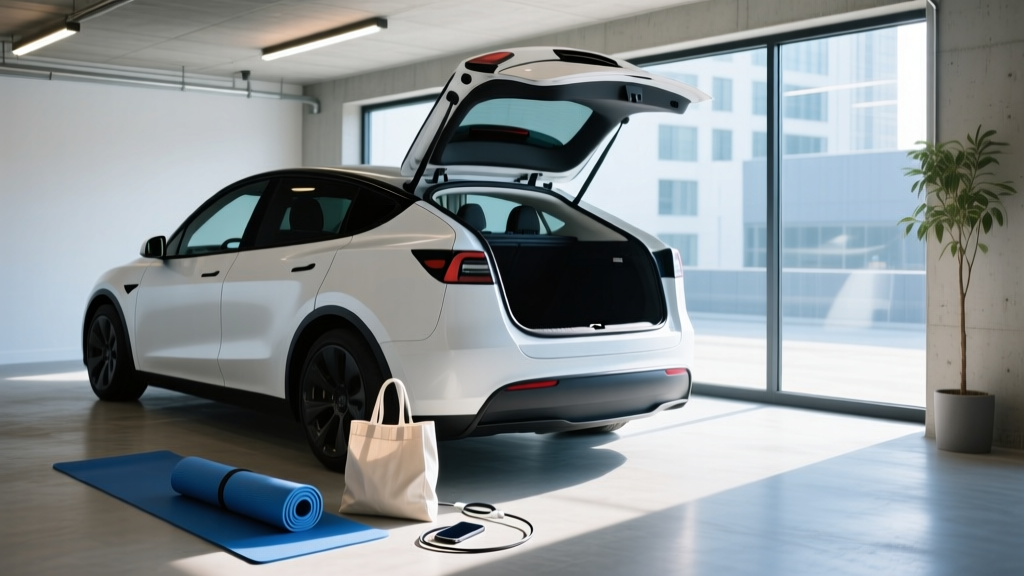
The 2026 Model Y continues as a two-row compact luxury crossover with a rear hatch, a rear sub-trunk (lower compartment), and a front trunk (frunk). Tesla does not publish granular linear dimensions (width/depth/height) in its owner manual, but independent measurements and Car and Driver's cargo testing provide the following working numbers:
| Measurement | Value |
|---|---|
| Cargo volume behind 2nd row | 30.2 cu ft |
| Cargo volume (2nd row folded) | 72.1 cu ft |
| Frunk (front trunk) | 4.1 cu ft |
| Total max cargo | 76.2 cu ft |
| Rear cargo floor width (between wheel wells) | ~37 inches |
| Rear cargo floor depth (to 2nd-row seatback) | ~38 inches |
| Cargo opening height (hatch lip to floor) | ~27 inches |
| Rear legroom (2nd row) | 41.6 inches |
| Front legroom | 41.8 inches |
| Rear headroom | 39.4 inches |
Real-world usability note: The Juniper refresh slightly reshaped the cargo floor and improved the rear hatch seal, but the wheel-well intrusion remains noticeable. A standard 28-inch rolling suitcase fits width-wise with about 3 inches to spare on each side. The under-floor rear sub-trunk adds roughly 2.5 cu ft of hidden storage — ideal for charging cables, a tire inflator, or groceries you want out of sight.
Range, Battery, and Real-World Efficiency
The 2026 Model Y is offered in three trims: Long Range RWD, Long Range AWD, and Performance AWD. All use a ~78 kWh usable NMC (nickel-manganese-cobalt) lithium-ion battery pack; Tesla does not currently offer an LFP pack in the U.S. Model Y lineup (LFP remains reserved for the Model 3 RWD).
- Long Range RWD: EPA 320 miles — expect ~275-290 highway miles, ~240-260 in sub-freezing winter.
- Long Range AWD: EPA 310 miles — expect ~265-280 highway, ~230-250 in cold weather.
- Performance AWD: EPA 285 miles — expect ~245-260 highway, ~215-235 in cold weather.
Cold-weather range loss of 15-25% is typical for NMC packs without consistent preconditioning. The Model Y's heat pump (standard since 2021) mitigates this better than many rivals.
| Trim | MPGe (combined) | kWh/100 mi |
|---|---|---|
| Long Range RWD | 123 MPGe | 27 kWh |
| Long Range AWD | 119 MPGe | 28 kWh |
| Performance AWD | 111 MPGe | 30 kWh |
Source: fueleconomy.gov.
Charging Speed: DC Fast, Level 2, and Home Setup
Charging speed is where the Juniper Model Y shows its generation. The 2026 Long Range AWD supports a peak DC fast-charge rate of 250 kW on V3 Superchargers, with a 10-80% session taking approximately 25 minutes under optimal battery preconditioning. Sustained rates taper above 60% SoC — expect an average of ~150 kW across the 10-80% window, not the full 250 kW peak.
| Level | Power | Speed / Time |
|---|---|---|
| Level 1 (120V household) | ~1.4 kW | ~3-4 miles per hour |
| Level 2 (240V home, 48A) | 11.5 kW | ~44 miles per hour / full charge in ~8 hrs |
| DC Fast (V3 Supercharger) | 250 kW peak | 10-80% in ~25 min |
| DC Fast (CCS adapter, 3rd-party) | Up to 150-175 kW typical | 10-80% in ~35 min |
Home charging note: To hit the full 11.5 kW Level 2 rate, you need a Tesla Wall Connector on a 60-amp dedicated circuit (48A continuous draw). Many homes with 100-amp panels will require a panel upgrade ($1,500-$3,000) — budget accordingly. NACS is native; no adapter needed for Tesla Superchargers.
Performance, Drivetrain, and 0-60 Times
| Trim | Drivetrain | HP | 0-60 mph |
|---|---|---|---|
| Long Range RWD | Rear-Wheel Drive | ~346 hp | 5.8 seconds |
| Long Range AWD | Dual-Motor AWD | ~384 hp | 4.8 seconds |
| Performance AWD | Dual-Motor AWD | ~456 hp | 3.5 seconds |
All trims feature regenerative braking with one-pedal driving, adaptive damping on the Performance trim, and Tesla's updated suspension tuning for the Juniper chassis which noticeably improves ride comfort over pre-2025 models.
Pricing, Trims, and Federal Tax Credit Eligibility
| Trim | Base MSRP | Federal Credit (if eligible) | Effective Price |
|---|---|---|---|
| Long Range RWD | $44,990 | Up to $7,500 | ~$37,490 |
| Long Range AWD | $47,990 | Up to $7,500 | ~$40,490 |
| Performance AWD | $52,490 | Up to $7,500 | ~$44,990 |
Federal tax credit rules (IRS §30D, 2026): Eligibility is not automatic. Per IRS guidelines, you must meet all of the following:
- MSRP cap: Vehicle MSRP must be ≤ $80,000 for SUVs (all Model Y trims qualify).
- Income cap: Modified AGI ≤ $150,000 (single), $225,000 (head of household), $300,000 (joint).
- Battery sourcing: Critical minerals and battery components must meet phased-in domestic-content thresholds (Tesla's U.S. battery assembly currently qualifies most Model Y builds, but confirm VIN-specific eligibility at purchase).
- Point-of-sale transfer: As of 2024+, the credit can be transferred to the dealer at purchase, reducing your out-of-pocket price — but you must still meet income limits at tax filing time or repay the credit.
Warranty, Tech, and Ownership Considerations
Warranty: Tesla covers the Model Y battery and drive unit for 8 years / 120,000 miles (Long Range) with a minimum 70% capacity retention threshold. The limited vehicle warranty is 4 years / 50,000 miles. This is competitive with Hyundai's 10-year battery warranty but shorter than Kia's 10/100,000-mile coverage.
Standout tech:
- 15.4-inch center touchscreen with Ryzen-based infotainment (fast, responsive)
- Tesla Autopilot (SAE Level 2) standard — adaptive cruise, lane centering, auto emergency braking
- Full Self-Driving (Supervised) available as a $8,000 add-on or $99/mo subscription — still Level 2, driver must remain engaged
- Over-the-air updates, Sentry Mode, Dog Mode, Tesla app remote preconditioning
- Ventilated front seats and ambient lighting (new for Juniper)
Notable drawbacks:
- No physical stalks (turn signals are steering-wheel buttons — polarizing)
- Minimalist interior lacks traditional instrument cluster
- Panel-gap consistency still varies by Fremont vs Austin build
- Insurance premiums run 15-25% above segment average
- No Apple CarPlay / Android Auto
Pros
- Class-leading 76.2 cu ft total cargo with frunk
- 250 kW peak DC charging, vast Supercharger network
- Strong real-world efficiency (27-30 kWh/100 mi)
- Continuous OTA improvements
- Excellent resale value retention
Cons
- Turn-signal buttons take acclimation
- No phone mirroring (CarPlay/Android Auto)
- Cold-weather range loss ~20%
- Higher insurance cost
- FSD subscription cost adds up
Who the 2026 Model Y Suits Best
- Choose the Model Y if: You want maximum cargo flexibility, Supercharger network access for road trips, fast DC charging, and a proven resale value. Ideal for families, commuters, and weekend adventurers.
- Look at the Hyundai IONIQ 5 if: You prefer 800V ultra-fast charging (10-80% in ~18 min), CarPlay support, and a more conventional interior layout.
- Look at the Kia EV9 if: You need 3-row seating and 80+ cu ft of max cargo.
- Look at the Ford Mustang Mach-E if: You want a sportier driving feel and BlueCruise hands-off highway driving.
Frequently Asked Questions
What is the real-world range of the 2026 Tesla Model Y?
Expect 265-290 miles highway in mild weather for Long Range trims, dropping 15-25% in sub-freezing conditions. The EPA sticker is 310-320 miles, but sustained 75+ mph driving and cold weather reduce this meaningfully.
How fast does the Model Y charge at home and on the road?
Home Level 2 at 11.5 kW adds ~44 miles per hour (full charge in ~8 hours). DC fast charging peaks at 250 kW, with 10-80% in about 25 minutes on a V3 Supercharger.
How much does a 2026 Model Y cost after tax credits?
The Long Range RWD starts at $44,990 MSRP. With the full $7,500 §30D credit (if you meet income, sourcing, and MSRP rules), effective price is ~$37,490. Confirm eligibility with your tax professional.
Does the Model Y qualify for the federal EV tax credit?
Yes, most U.S.-built Model Y vehicles currently qualify, subject to buyer income caps ($150K single / $300K joint) and battery-sourcing rules. Use the IRS VIN-check tool at purchase.
Are Tesla trunk dimensions big enough for a family?
With 30.2 cu ft behind the second row and 72.1 cu ft folded, the Model Y handles double strollers, a week of luggage for four, or large Costco hauls. The frunk adds 4.1 cu ft for charging cables or a soft-sided cooler.
Is the Model Y worth buying vs the IONIQ 5 or Mach-E?
If Supercharger access and cargo versatility are priorities, yes. If ultra-fast 800V charging or CarPlay matter more, the IONIQ 5 is compelling. The Mach-E wins on driving dynamics but trails on range and cargo.