Quick Answer: Electric rickshaws (e-rickshaws) are battery-powered three-wheeled passenger or cargo vehicles dominant in South and Southeast Asia. In 2026, most models use 3–6 kWh LFP (lithium iron phosphate) battery packs, deliver 40–70 miles of real-world range per charge, and cost between $1,800 and $5,500 depending on configuration. Charging takes 4–8 hours on a standard 220V outlet. They are not sold as street-legal passenger vehicles in the United States, but they are relevant to global EV adoption, micro-mobility businesses, and buyers in markets where they serve as last-mile transport.
What Is an Electric Rickshaw?
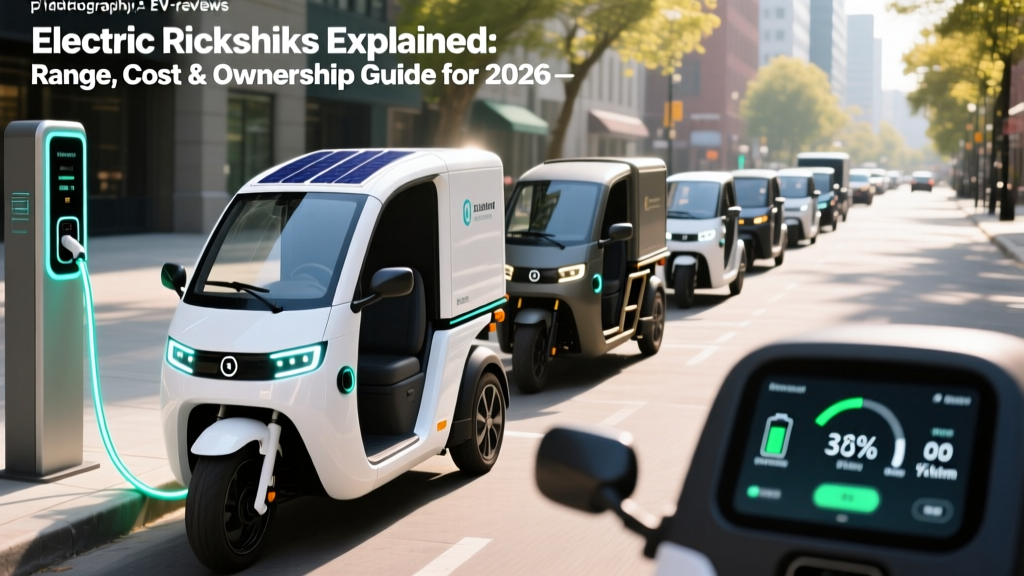
An electric rickshaw — also called an e-rickshaw, e-tuk, or electric tuk-tuk — is a three-wheeled vehicle powered entirely by a battery-electric powertrain. Unlike the traditional auto-rickshaw that runs on gasoline or compressed natural gas (CNG), the e-rickshaw uses an electric motor (typically 1–5 kW continuous, up to 8 kW peak) paired with a rechargeable battery pack. They carry 2–6 passengers or haul cargo in dense urban environments across India, Bangladesh, Nepal, the Philippines, Thailand, and increasingly parts of Africa.
The global e-rickshaw market has expanded rapidly. India alone accounts for the vast majority of production and sales, with manufacturers like Mahindra Electric, Piaggio (Ape E-Xtra), Kinetic Green, and dozens of smaller assemblers competing on price and battery configuration. The segment matters to the broader EV conversation because these vehicles represent one of the largest electrified vehicle fleets on Earth by unit volume — millions are in active service.
E-Rickshaw Specs: Battery, Range, and Charging
Understanding e-rickshaw specifications requires the same kW vs. kWh distinction that applies to full-size EVs. kW (kilowatts) measures power — how fast the motor delivers energy or how fast the battery charges. kWh (kilowatt-hours) measures energy capacity — how much total electricity the battery stores, which directly determines range.
| Specification | Budget Model | Mid-Range Model | Premium/Cargo Model |
|---|---|---|---|
| Battery Capacity | 3.0 kWh (Lead-acid) | 4.5 kWh (LFP) | 6.0 kWh (LFP) |
| Motor Power | 1 kW (continuous) | 2–3 kW | 4–5 kW |
| EPA-Equivalent Range | ~25–35 mi | ~45–60 mi | ~55–75 mi |
| Real-World Range (loaded) | ~20–28 mi | ~35–50 mi | ~45–65 mi |
| Top Speed | 15–18 mph | 20–25 mph | 25–30 mph |
| Charge Time (220V) | 6–8 hours | 5–6 hours | 4–5 hours |
| Battery Warranty | 6 months | 1–2 years | 3 years / 30,000 km |
| Approx. Price (USD) | $1,200–$1,800 | $2,200–$3,500 | $4,000–$5,500 |
Real-World Range Reality: A mid-range e-rickshaw rated at 60 km (~37 mi) with a 4.5 kWh LFP pack will typically deliver 35–50 km (~22–31 mi) when carrying 4 passengers in stop-and-go traffic at 90°F+ ambient temperatures. Battery thermal stress and accessory load (lights, horn) reduce effective range by 15–25% compared to ideal conditions.
Most e-rickshaws charge via a simple onboard charger plugged into a standard household outlet (220V in most markets). There is no DC fast charging infrastructure for this vehicle class. Battery swapping — where a depleted pack is exchanged for a charged one at a kiosk in 2–3 minutes — has emerged as a practical alternative in cities like Delhi, Bengaluru, and Jakarta. Companies such as Bounce, Sun Mobility, and Gogoro (in select markets) operate swap networks.
LFP vs. Lead-Acid: The Battery Chemistry Decision
The single biggest ownership decision for an e-rickshaw buyer is battery chemistry. Budget models still ship with lead-acid packs, while mid-range and premium models increasingly use LFP (lithium iron phosphate) cells. The difference is substantial.
| Factor | Lead-Acid | LFP (Lithium Iron Phosphate) |
|---|---|---|
| Upfront Cost | $200–$400 | $600–$1,400 |
| Cycle Life | 300–500 cycles | 2,000–3,000 cycles |
| Practical Lifespan | 6–12 months | 3–5 years |
| Weight | 80–120 kg | 25–45 kg |
| Energy Density | 30–40 Wh/kg | 90–160 Wh/kg |
| Depth of Discharge | ~50% usable | ~80–90% usable |
| Replacement Frequency | Annual or bi-annual | Every 3–5 years |
| Total 5-Year Battery Cost | $1,000–$2,000 | $600–$1,400 |
The economics clearly favor LFP for any driver covering more than 20 miles per day. A lead-acid pack may cost $300 initially, but replacing it every 8–12 months means spending $1,500+ over five years. A single LFP pack at $900 lasts the entire period. The weight savings (~60 kg) also improves range and tire wear.
Electric Rickshaw vs. Gas/CNG Rickshaw: Cost Comparison
The core buying question in markets where both are available: does the electric rickshaw save money compared to a gasoline or CNG auto-rickshaw? The answer depends on daily mileage, local fuel prices, and electricity rates.
| Cost Factor | Electric Rickshaw (LFP) | CNG Auto-Rickshaw | Gasoline Auto-Rickshaw |
|---|---|---|---|
| Purchase Price | $2,500–$4,000 | $2,800–$3,800 | $2,200–$3,200 |
| Fuel/Energy Cost per Mile | $0.01–$0.02 | $0.04–$0.06 | $0.08–$0.12 |
| Daily Fuel Cost (40 mi/day) | $0.40–$0.80 | $1.60–$2.40 | $3.20–$4.80 |
| Annual Fuel Cost (300 days) | $120–$240 | $480–$720 | $960–$1,440 |
| Annual Maintenance | $50–$100 | $200–$400 | $250–$500 |
| 5-Year Total Operating Cost | $850–$1,700 | $3,400–$5,600 | $6,050–$9,700 |
| Oil Changes Required | None | 4–6 per year | 4–6 per year |
For a commercial driver covering 40 miles daily, the electric rickshaw saves $1,000–$3,000 over five years in fuel and maintenance alone, even after accounting for one LFP battery replacement. The break-even point versus CNG typically arrives within 12–18 months. Versus gasoline, it can be as fast as 6–10 months.
However, these savings assume reliable access to overnight charging. Drivers without a dedicated parking spot with electrical access face a significant hurdle — public charging for e-rickshaws is sparse outside battery-swap ecosystems.
Real-World Ownership: What First-Time Buyers Need to Know
Buying an e-rickshaw is not like buying a Tesla or a Chevy Equinox EV. The ownership experience has distinct practical considerations:
Charging Access
Most e-rickshaw owners charge at home overnight using a standard wall outlet. A full charge of a 4.5 kWh pack at 220V/10A draws roughly 2.2 kW and takes 5–6 hours. This is analogous to Level 1 charging on a full-size EV. If you lack secure overnight parking with an outlet, battery swapping is the alternative — but swap subscription costs ($1.50–$3.00 per swap) must be factored into operating economics.
Climate and Range Impact
E-rickshaws lack the sophisticated thermal management systems found in passenger EVs. In extreme heat (common in their primary markets), battery degradation accelerates. LFP chemistry tolerates heat better than NMC, but expect 10–15% range loss at sustained 100°F+ ambient temperatures. In cooler climates or winter months, range can also drop 10–20% due to increased internal resistance — though this is less relevant in the tropical regions where most e-rickshaws operate.
Maintenance Simplicity
Electric rickshaws have dramatically fewer moving parts than ICE equivalents: no engine oil, no spark plugs, no fuel filters, no exhaust system, no clutch. The primary maintenance items are brake pads, tires, suspension bushings, and controller/electrical connections. Many owners report annual maintenance costs under $100 — a fraction of the $300–$500 typical for gas/CNG rickshaws.
Insurance and Registration
Registration requirements vary enormously by jurisdiction. In India, e-rickshaws fall under specific low-speed vehicle categories with simplified registration. Insurance premiums are generally lower than for motorized rickshaws due to lower speeds and lower replacement values, typically $40–$80 per year for basic coverage.
Common Misconceptions About Electric Rickshaws
| Myth | Fact |
|---|---|
| "E-rickshaws can't handle hills or heavy loads" | Premium models with 4–5 kW motors and 6 kWh packs handle 500+ kg payloads on moderate grades. Budget 1 kW models do struggle on inclines above 8%. |
| "The batteries are an environmental disaster" | LFP batteries contain no cobalt or nickel, are widely recycled in India's informal sector, and last 2,000+ cycles — far greener than the lead-acid packs they replaced. |
| "They're too slow for real traffic" | At 20–25 mph, e-rickshaws match the average speed of urban traffic in congested cities like Delhi (avg. 15–20 mph during peak hours). |
| "Charging takes too long for commercial use" | Most commercial drivers charge overnight (6–8 hours) and swap during the day. Battery-swap networks enable 2-minute turnaround. |
| "They're not available or relevant outside Asia" | E-rickshaw-style vehicles are expanding into African markets (Kenya, Nigeria, Rwanda) via companies like Ampersand and SPIRO. Cargo variants are being tested for last-mile delivery globally. |
Decision Framework: Is an Electric Rickshaw Right for You?
Choose an electric rickshaw if:
- You drive 20–50 miles per day in urban, low-speed environments
- You have access to overnight charging at home or a battery-swap network
- You operate in a market where e-rickshaws are street-legal and registered
- You want to minimize daily operating costs for commercial passenger or cargo use
- You prioritize low maintenance and simple mechanicals
Choose a CNG or gas rickshaw if:
- You regularly drive 60+ miles per day and lack mid-day charging/swapping options
- Your routes include sustained highway-speed travel or steep mountain grades
- You operate in a climate with extreme cold (below 32°F) for extended periods
- Local regulations do not yet permit e-rickshaw registration or commercial licensing
- You need proven long-distance range and established refueling infrastructure
Consider a full-size EV or PHEV instead if:
- You are in the US or Europe and need a street-legal, crash-tested passenger vehicle
- You require highway speeds, climate control, and modern safety features (ADAS, airbags)
- Your use case is personal commuting rather than commercial micro-mobility
E-Rickshaw Ownership Costs: 5-Year Breakdown
| Cost Category | E-Rickshaw (LFP, 4.5 kWh) | CNG Rickshaw |
|---|---|---|
| Purchase Price | $3,000 | $3,200 |
| Battery Replacement (Year 3) | $900 | N/A |
| Fuel/Energy (5 years, 40 mi/day) | $900 | $3,000 |
| Maintenance (5 years) | $350 | $1,500 |
| Insurance (5 years) | $300 | $500 |
| Registration/Licensing | $100 | $150 |
| 5-Year Total | $5,550 | $8,350 |
| Cost per Mile | $0.09 | $0.14 |
The five-year savings of roughly $2,800 are meaningful for commercial operators working thin margins. The per-mile cost advantage compounds with higher daily mileage — a driver covering 60 miles daily could save $4,000+ over five years.
One caveat: these figures assume the LFP battery lasts three years. If a driver consistently deep-cycles the pack to 0% and charges in extreme heat without thermal management, a replacement at year 2 is possible, adding $900. Good charging habits — keeping the pack between 20–80% state of charge when possible and avoiding midday charging in direct sun — extend battery life substantially.
Frequently Asked Questions
Are electric rickshaws street-legal in the United States?
No. E-rickshaws do not meet US Federal Motor Vehicle Safety Standards (FMVSS) for crashworthiness, lighting, or occupant protection. They cannot be registered for road use in any US state. They are relevant to US readers only as a global electrification phenomenon or for private-property use (large campuses, resorts, farms).
How long does an e-rickshaw battery last?
An LFP battery pack typically lasts 2,000–3,000 charge cycles, translating to 3–5 years of daily use. Lead-acid packs last 300–500 cycles, or roughly 6–12 months. Battery state of health (SoH) monitoring is minimal on most models — unlike full-size EVs, there is typically no app or dashboard showing degradation percentage.
Can I convert a gas rickshaw to electric?
Yes. Conversion kits (motor, controller, battery tray, wiring) are widely available in India and Bangladesh for $800–$1,500. The conversion replaces the ICE drivetrain with a hub motor or chain-driven electric motor. Quality varies enormously — reputable kits from established suppliers deliver reliable results, while budget kits often suffer from undersized controllers and poor wiring.
What is battery swapping and is it cheaper than home charging?
Battery swapping lets you exchange a depleted pack for a fully charged one at a kiosk in 2–3 minutes. Swap costs typically run $1.50–$3.00 per swap. Home charging at residential electricity rates ($0.06–$0.10/kWh in most South Asian markets) costs $0.30–$0.60 for a full 4.5 kWh charge. Home charging is significantly cheaper per mile, but swapping eliminates downtime for commercial drivers who cannot afford a 5-hour charge break.
Do electric rickshaws qualify for any government incentives?
India's FAME (Faster Adoption and Manufacturing of Hybrid and Electric Vehicles) scheme provides subsidies on eligible e-rickshaw models, typically reducing the purchase price by $200–$500. Several Indian states offer additional incentives including road-tax waivers and reduced registration fees. Eligibility depends on battery capacity, motor power, and manufacturer certification. Check current Ministry of Heavy Industries guidelines as subsidy amounts and qualifying models change annually.
How do e-rickshaws compare to full-size EVs in terms of technology?
They don't. E-rickshaws are intentionally simple: no regenerative braking on most models, no thermal management, no advanced driver-assistance systems (ADAS), no over-the-air updates. The value proposition is radical affordability and minimal operating cost, not technology. A $3,000 e-rickshaw and a $40,000 Tesla Model 3 share the same fundamental BEV architecture — battery, motor, controller — but at vastly different levels of sophistication and safety engineering.
Sources: Vehicle specifications aggregated from manufacturer data published by Mahindra & Mahindra and Piaggio Group. Battery chemistry and cycle-life data referenced from IEA Global EV Outlook. Incentive program details from India's Ministry of Heavy Industries.