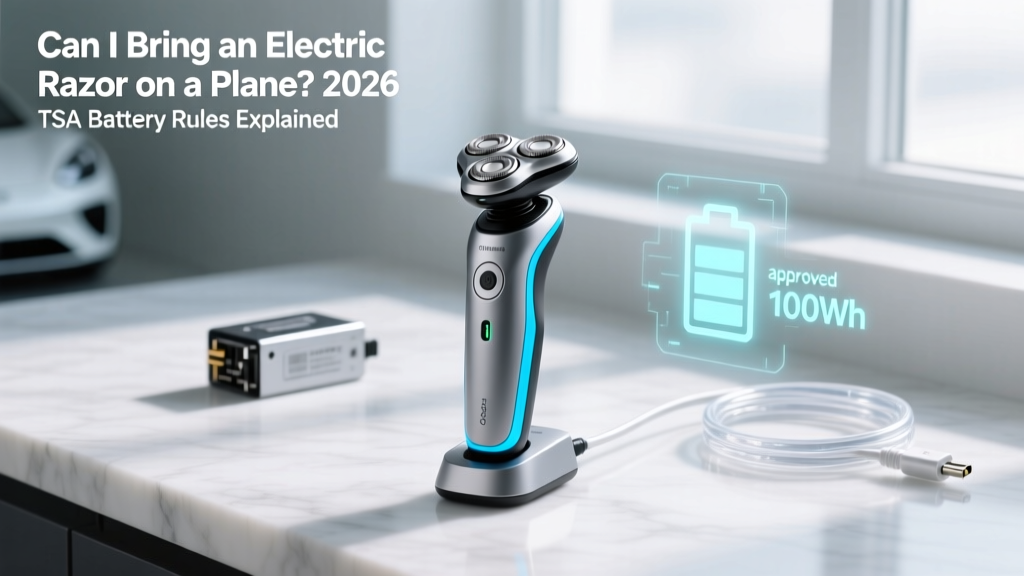
If you've ever stood in the TSA security line wondering whether your electric razor will get confiscated, you're not alone. The short answer: yes, you can bring an electric razor on a plane — in both carry-on and checked luggage. But because most modern electric razors contain lithium-ion batteries, there are specific FAA and TSA rules you need to follow to avoid delays at the checkpoint.
Quick Answer: Electric Razors on Planes (2026 Rules)
- Carry-on: ✅ Allowed — recommended by TSA and FAA for devices with lithium batteries
- Checked luggage: ✅ Allowed — but devices with installed lithium batteries must be completely powered off and protected from accidental activation
- Spare/loose lithium batteries: ❌ NOT allowed in checked bags — carry-on only
- Battery size limit: Under 100 Wh — no restriction; 100–160 Wh — airline approval needed; over 160 Wh — forbidden on passenger aircraft
While this question might seem far removed from electric vehicles, the underlying issue is the same one EV owners deal with daily: lithium-ion battery safety regulations. Whether it's the 82 kWh NMC pack in your Tesla Model Y or the 3 Wh cell in your Braun Series 9 razor, the chemistry is similar, and the regulatory framework governing air travel with these batteries affects every EV owner who flies.
Why Lithium-Ion Battery Rules Matter for Travelers
The FAA has regulated lithium batteries on aircraft since a series of cargo fires in the 2010s linked to bulk lithium-ion shipments. Today's rules, enforced by the TSA at checkpoints and codified in FAA Advisory Circular 120-42, distinguish between batteries installed in devices and spare/loose batteries.
Your electric razor falls into the "installed in device" category. Most quality electric razors — the Philips Norelco Series 9000, Braun Series 9, Panasonic Arc6 — use lithium-ion cells ranging from 2 Wh to 6 Wh. That's roughly 0.003% the capacity of a Tesla Model 3's 82 kWh battery pack, well under the 100 Wh threshold where restrictions tighten.
| Myth | Fact |
|---|---|
| "All electronics with batteries must go in carry-on only" | Devices with installed batteries can go in checked bags if powered off and protected from damage |
| "Electric razors are banned because of the blades" | Electric razors are explicitly permitted — TSA distinguishes them from safety razors with removable blades |
| "Any lithium battery is fine in checked luggage" | Spare/loose lithium batteries and power banks are never allowed in checked bags — carry-on only |
| "Bigger batteries are always banned" | Batteries 100–160 Wh are allowed with airline approval; only those over 160 Wh are universally banned on passenger flights |
The Watt-Hour Threshold: What EV Owners Should Know
Understanding watt-hours (Wh) is essential whether you're packing a razor or evaluating an EV battery. Wh is a measure of energy capacity — the same unit we use when discussing EV battery packs, just at vastly different scales.
| Device / Vehicle | Battery Capacity (Wh) | Air Travel Status |
|---|---|---|
| Electric razor (Braun Series 9) | ~5 Wh | ✅ Unrestricted (carry-on or checked) |
| Smartphone (iPhone 16 Pro) | ~16 Wh | ✅ Unrestricted |
| Laptop (MacBook Pro 16") | ~99 Wh | ✅ Under 100 Wh limit |
| Portable power station (Jackery 300) | ~293 Wh | ❌ Forbidden on passenger aircraft |
| Chevrolet Equinox EV (2026) | ~85,000 Wh (85 kWh) | N/A — vehicle, not air cargo |
| Ford F-150 Lightning (Extended Range) | ~131,000 Wh (131 kWh) | N/A — shipped via specialized freight |
The key insight: kWh and Wh are the same unit, just scaled by 1,000. When we say a 2026 Hyundai Ioniq 5 has a 77.4 kWh battery, that's 77,400 Wh — roughly 15,000 times the energy in your electric razor. The FAA's 100 Wh carry-on threshold exists because larger batteries pose greater thermal runaway risk in the unmonitored cargo hold.
Packing Your Electric Razor: Step-by-Step for 2026
Here's exactly how to pack your electric razor to breeze through TSA without issue:
For Carry-On (Recommended)
- Ensure the razor is powered off — not just in standby
- Engage the travel lock if your model has one (most Braun and Philips models do)
- Place it in your toiletry bag or a protective case to prevent damage
- No need to remove it at the checkpoint — it can stay in your bag through the X-ray
For Checked Luggage
- Power the device completely off
- Engage the travel lock or wrap a rubber band around the power button
- Wrap the razor in clothing or place it in a hard case to prevent accidental activation and physical damage
- Do not pack any spare charging cables with loose lithium battery packs in checked bags
The FAA's primary concern with checked-bag devices is accidental activation and thermal runaway in an inaccessible location. A powered-off razor in a protective case presents virtually zero risk, which is why it's permitted.
EV Owners and Air Travel: The Bigger Battery Picture
If you own an EV, you're already living with lithium-ion battery regulations daily — you just might not realize how they extend beyond your car. Here's how the same regulatory logic applies across your EV ecosystem:
EV Owner's Battery Travel Cheat Sheet
| Item | Typical Wh | Carry-On | Checked | Notes |
|---|---|---|---|---|
| Electric razor | 3–6 Wh | ✅ | ✅ | Travel lock recommended |
| EV key fob (Tesla, BMW iX) | ~1 Wh | ✅ | ✅ | Uses CR2032 coin cell, not lithium-ion |
| Portable EV charger (JuiceBox, ChargePoint) | 0 Wh (no battery) | ✅ | ✅ | Heavy — check weight limits |
| OBD-II EV diagnostic dongle | ~2 Wh | ✅ | ✅ | Small enough to forget about |
| Power bank (20,000 mAh) | ~74 Wh | ✅ | ❌ | Carry-on ONLY |
| Power bank (27,000 mAh) | ~100 Wh | ⚠️ Airline approval | ❌ | At the 100 Wh threshold |
| E-bike battery (removable) | 400–700 Wh | ❌ | ❌ | Forbidden on passenger flights |
Notice a pattern? The regulations scale with energy capacity, not device type. Your EV itself is essentially a 75,000+ Wh battery on wheels — it can't fly on passenger aircraft and is shipped via specialized ground or sea freight with hazmat protocols when transported long distances. The same chemistry that powers your 300-mile highway commute is in your razor, just at a dramatically different scale.
Real-World Travel Considerations for EV Owners
Beyond the razor question, EV owners who travel frequently face a practical planning challenge: what happens to your car while you're away, and how do you manage charging at your destination?
Leaving Your EV at Home
If you're flying out for a week or more, your EV's battery management system will continue to draw a small amount of power for thermal management and connectivity. Expect roughly 1–2% state-of-charge loss per week in moderate temperatures. In extreme cold (below 20°F), that can climb to 3–4% per week as the battery heater cycles. Best practice:
- Leave the car plugged into a Level 2 home charger with a charge limit set to 50–70% SoC
- Disable Sentry Mode (Tesla) or equivalent always-on camera features to reduce phantom drain
- Precondition the cabin on a schedule rather than letting the battery thermally manage passively
Charging at Your Destination
Rental car counters now routinely offer EV options, but availability remains inconsistent outside major metros. If you're relying on your destination's charging infrastructure:
- Check PlugShare or the DOE Alternative Fuels Station Locator before booking lodging
- Hotels with Level 2 destination chargers typically add 25–40 miles of range per hour of charging — sufficient for overnight replenishment
- If your destination is a charging desert (rural areas, many national parks), consider a PHEV rental like the Toyota RAV4 Prime (42 miles electric-only range, 38 MPG combined on gas) for flexibility
Decision Framework: When to Carry On vs. Check Your Electronics
Pack It Right: Quick Decision Guide
Choose CARRY-ON if:
- The device contains a spare/removable lithium battery or power bank
- The battery exceeds 100 Wh (requires airline pre-approval even in carry-on)
- The device is fragile or expensive (e.g., laptop, camera)
- You need the device during the flight or at a layover
Choose CHECKED if:
- The battery is permanently installed and under 100 Wh
- The device is fully powered off and protected from accidental activation
- The item is durable and replaceable (electric razor, electric toothbrush)
- Your carry-on is already at the weight/size limit
Do NOT pack on any aircraft:
- Spare lithium batteries over 160 Wh
- Hoverboards or self-balancing scooters (most airlines ban outright)
- Damaged or recalled lithium batteries (check CPSC recall database)
- E-bike batteries (typically 400–700 Wh — far above limits)
Frequently Asked Questions
Do I need to declare my electric razor at airport security?
No. Electric razors are treated as standard personal care items. You do not need to remove them from your bag at the TSA checkpoint, unlike laptops and large electronics. Simply leave it in your carry-on or toiletry bag.
Can I bring a cordless electric razor with a removable battery?
If the battery is installed in the razor, it can go in carry-on or checked luggage. If you're carrying a spare removable battery separately, that spare must go in your carry-on — never in checked luggage. This mirrors the FAA's treatment of all spare lithium-ion cells.
What about electric razors with NiMH batteries instead of lithium-ion?
Nickel-metal hydride (NiMH) batteries face fewer restrictions than lithium-ion. They're permitted in both carry-on and checked luggage without the same thermal runaway concerns. However, most premium razors made after 2018 use lithium-ion for faster charging and longer runtime.
Can I use my electric razor on the plane?
Technically, FAA rules don't prohibit using small personal care devices during cruise flight. However, most airlines prohibit it as a courtesy to other passengers — the noise is disruptive in a confined cabin. Use it in the lavatory if needed, but be aware that some airlines explicitly prohibit it in their conditions of carriage.
Do international flights have different battery rules?
The ICAO (International Civil Aviation Organization) sets baseline rules that most countries follow, and they align closely with FAA regulations. However, some countries impose additional restrictions. China's CAAC, for example, requires power banks to have clearly labeled capacity markings — unlabeled power banks will be confiscated. Always check your destination country's aviation authority rules before flying internationally with multiple battery-powered devices.
How does this relate to my EV's battery when shipping or transporting it?
EV batteries (60–131 kWh) are classified as Class 9 hazardous materials for transport. They cannot travel on passenger aircraft and require specialized hazmat ground freight or sea shipping with fire suppression systems. This is why EVs shipped internationally arrive via roll-on/roll-off cargo vessels, not air freight. The same lithium-ion chemistry that requires careful handling in your razor applies at a vastly larger scale to your vehicle's traction battery.
For the most current TSA regulations, always check the TSA Prohibited Items list before traveling. Rules can change, and individual TSA officers have discretion at the checkpoint. When in doubt, pack lithium-battery devices in your carry-on — it's always the safer regulatory choice.