Quick Answer: Yes, You Can Bring an Electric Razor on an Airplane
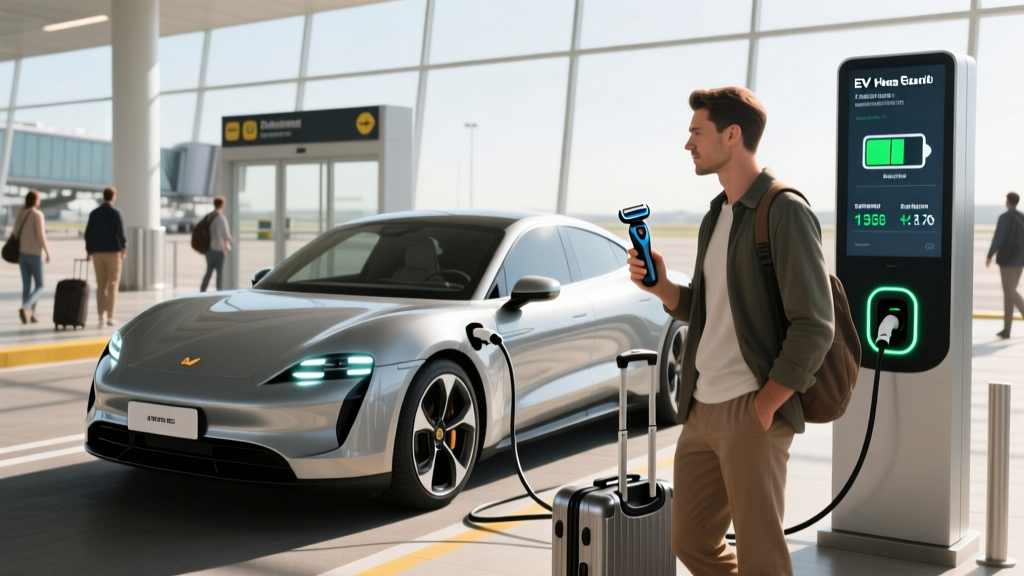
If you're wondering "can I bring an electric razor on an airplane," the short answer is yes. According to the Transportation Security Administration (TSA), electric razors are permitted in both carry-on and checked luggage. However, there are specific rules regarding the lithium-ion batteries that power many modern electric razors, and these rules intersect with broader airline policies about battery-powered devices.
Key Rules for Electric Razors on Planes
- Carry-on: Allowed without restriction for most standard electric razors
- Checked bags: Allowed, but spare lithium batteries must be in carry-on
- Battery limits: Spare lithium-ion batteries must be under 100 watt-hours (Wh); most razor batteries are 5-15 Wh
- Device power: Razor must be completely powered off (not just in standby) if checked
While the electric razor itself is straightforward, the lithium battery rules matter more if you're also traveling with larger battery-powered devices, or if you're an EV owner planning a trip that involves air travel and electric vehicle logistics at your destination.
Why Lithium Battery Rules Matter for EV Owners Who Fly
The same FAA regulations that govern your electric razor's battery apply to far larger lithium-ion systems, including the traction batteries in electric vehicles. Understanding these rules helps EV owners navigate scenarios like shipping a vehicle, flying with EV-related equipment, or renting an EV at your destination.
For context, your electric razor's battery typically holds between 5 and 15 watt-hours (Wh) of energy. A modern EV battery, by comparison, holds between 60,000 and 120,000 Wh (expressed as 60 to 120 kilowatt-hours, or kWh). The FAA limits spare lithium-ion batteries in carry-on luggage to 100 Wh per battery (with airline approval for 101-160 Wh). This is why you'll never see someone carrying a spare EV battery module onto a plane, but your razor, laptop, and phone pass through without issue.
| Myth | Fact |
|---|---|
| "All battery-powered devices are banned in checked luggage" | Battery-powered devices are allowed in checked bags if the battery is installed in the device and under 100 Wh. Spare batteries must be in carry-on. |
| "Electric razors with lithium batteries need special approval" | Standard electric razors require no special approval. Their batteries are well under the 100 Wh limit. |
| "I can't fly with any lithium batteries" | You can fly with installed lithium batteries in devices. The restriction applies to spare/uninstalled batteries over 100 Wh. |
| "TSA will confiscate my electric razor" | Electric razors are explicitly permitted. TSA agents are trained to recognize them as allowed items. |
EV Road Trips vs. Flying: A Cost and Time Comparison
Many EV owners face a decision when planning long-distance travel: drive the EV or fly and rent at the destination. This decision involves real numbers, not just convenience preferences.
| Factor | Driving Your EV (600 miles) | Flying + Renting a Gas Car | Flying + Renting an EV |
|---|---|---|---|
| Travel time (door-to-door) | ~11 hours (including 2 DC fast charges, ~25 min each) | ~5 hours (2-hr flight + airport + rental pickup) | ~5 hours (same, but EV rental availability varies) |
| Fuel/energy cost | ~$72-$96 (at $0.30-$0.40/kWh public DCFC, assuming 3 mi/kWh) | ~$105 (at $3.50/gal, 25 MPG combined, 600 mi in rental) | ~$72-$96 (same DCFC pricing if rental is EV) |
| Wear on personal vehicle | 600 miles of tire wear, battery cycles | Zero | Zero |
| Luggage flexibility | Unlimited | Airline fees for bags ($30-$35 each checked) | Same as flying |
| Destination charging access | N/A (you have your car) | N/A | Must verify hotel/public charging at destination |
The math shifts based on your specific EV's efficiency, your local electricity rates, and whether you have access to free or discounted charging networks. Tesla owners with legacy free Supercharging, for example, reduce their road-trip fuel cost to near zero, making driving more competitive against flying.
Real-World EV Ownership Considerations for Frequent Flyers
If you travel by air regularly, your EV ownership experience is shaped by a few practical realities that aren't discussed enough in EV buying guides.
Home Charging Access While Away
If you have a Level 2 home charger (typically 7.7 kW to 11.5 kW, adding 25-44 miles of range per hour), your EV will be fully charged and ready when you return from a trip. This is a significant advantage over gas cars, which require a fuel stop after any extended absence. However, if you rely exclusively on public charging, returning from a trip means an immediate detour to a charger.
Airport Parking and EV Charging
Major airports increasingly offer EV charging in parking structures, but availability varies widely. Before your trip, check whether your departure airport has Level 2 chargers in long-term parking. A 48-hour parking stint at a 7.7 kW Level 2 charger can add roughly 200+ miles of range, ensuring you're not stranded upon return. Airports like LAX, SFO, and DFW have invested in EV infrastructure; smaller regional airports may have none.
Battery Health During Extended Parking
Modern EVs lose roughly 1-2% of state of charge per week while parked, depending on ambient temperature and whether features like Sentry Mode (Tesla) or connected standby are active. For a 75 kWh battery, that's approximately 0.75 to 1.5 kWh per week, or about 3-5 miles of range. Even after a two-week vacation, your EV will have adequate charge to reach a nearby charger. However, avoid leaving your EV parked at a very low state of charge (below 10%) or very high (above 90%) for extended periods, as this accelerates lithium-ion degradation over time.
Cost Breakdown: EV Ownership vs. Gas Car for Multi-Modal Travelers
For buyers who fly several times a year and are weighing an EV against a gas car or hybrid, the total cost of ownership extends beyond daily commuting.
| Annual Cost Factor | EV (e.g., 2026 Tesla Model Y LR) | Gas Car (e.g., 2026 Toyota RAV4) | Hybrid (e.g., 2026 RAV4 Hybrid) |
|---|---|---|---|
| Purchase price (base MSRP) | $44,990 | $30,445 | $33,445 |
| Federal tax credit (§30D) | Up to $7,500 (income/MSRP/sourcing rules apply) | $0 | $0 |
| Effective purchase price | ~$37,490 (if eligible) | $30,445 | $33,445 |
| Annual fuel/energy (12,000 mi) | ~$480 (home charging at $0.13/kWh, 4 mi/kWh) | ~$1,680 ($3.50/gal, 25 MPG) | ~$1,050 ($3.50/gal, 40 MPG) |
| Annual maintenance | ~$300 (tire rotation, cabin filter, fluid top-off) | ~$900 (oil changes, filters, brakes) | ~$750 (reduced brake wear, oil changes) |
| Annual insurance (avg) | ~$2,100 | ~$1,500 | ~$1,550 |
| Airport long-term parking (4 trips/yr) | ~$480 ($120/trip, 3 days avg) | ~$480 (same) | ~$480 (same) |
| 5-year total operating cost (fuel + maint + ins) | ~$14,400 | ~$20,400 | ~$16,900 |
EV insurance premiums tend to run 15-30% higher than equivalent gas vehicles, driven by higher repair costs for battery and structural components. This is a real cost that offsets some of the fuel savings, particularly for drivers who fly frequently and park their EV unused for days at a time. However, the fuel and maintenance savings typically outweigh the insurance premium over a 5-year ownership period.
Decision Framework: Should You Drive Your EV or Fly?
Choose to Drive Your EV If:
- Your destination is under 400 miles one-way (roughly one DC fast-charge stop, 20-30 minutes)
- You need cargo flexibility (ski gear, camping equipment, large luggage)
- Your destination has reliable charging (verified via PlugShare or A Better Routeplanner)
- You're traveling with 3+ passengers (cost per person drops significantly)
- You have access to free or low-cost charging at your destination
Choose to Fly (and Rent) If:
- Your destination is over 500 miles one-way
- You're traveling solo or as a couple (flight cost per person is lower)
- Your destination is a major city with robust ride-share/transit (no rental needed)
- You're traveling during extreme cold weather (below 20°F), where EV range drops 20-30%
- Your schedule is tight and you can't absorb a 30-minute charge stop
Common Misconceptions About Batteries, Flying, and EVs
Several persistent myths cause unnecessary anxiety for EV owners and travelers carrying battery-powered devices.
"My EV battery will degrade if I leave it at the airport for a week." Lithium-ion batteries in modern EVs are managed by sophisticated battery management systems (BMS) that maintain optimal temperature and prevent deep discharge. A week of parking at 50-70% state of charge causes negligible degradation, typically less than 0.01% of total capacity.
"Lithium batteries on planes are a major fire risk." The FAA has recorded an average of roughly 70 battery-related incidents per year across all cargo and passenger flights, the vast majority involving damaged or recalled consumer electronics, not properly packed devices like electric razors or laptops. The risk from a standard electric razor battery (under 10 Wh) is statistically negligible.
"I should fully discharge my EV before flying to prevent battery issues." This is counterproductive. Lithium-ion batteries experience the most stress at extreme states of charge (0-5% or 95-100%). The optimal storage state is 40-60%. If you're leaving your EV for an extended trip, set the charge limit to 50% and leave it plugged in if you have a Level 2 home charger with scheduled charging capability.
Frequently Asked Questions
Can I bring an electric razor with a lithium battery in my carry-on?
Yes. The TSA permits electric razors in carry-on bags. The lithium-ion battery inside a standard electric razor is typically 5-15 Wh, far below the 100 Wh limit for spare batteries. No special declaration or packaging is required.
Do I need to remove my electric razor from my bag at TSA screening?
No. Unlike laptops and tablets, electric razors do not need to be removed from your carry-on bag during security screening. Simply place your bag on the X-ray belt as normal.
Can I pack a spare razor battery in my checked luggage?
No. Spare (uninstalled) lithium-ion batteries must be carried in your carry-on baggage, regardless of size. If the battery is installed inside the razor, the razor can go in checked luggage, but it must be completely powered off and protected from accidental activation.
Will my EV be okay parked at the airport for a two-week vacation?
Yes. Set your charge level to 50-60% before parking. Modern EVs lose roughly 1-2% charge per week while parked. After two weeks, expect to have lost approximately 2-4% of your battery's state of charge, which translates to roughly 6-12 miles of range on a 300-mile-range vehicle. This is negligible.
Is it better to drive my EV or fly for a 600-mile trip?
It depends on your priorities. Driving a 600-mile trip in a modern EV (300+ mile EPA range) requires one DC fast-charge stop of approximately 20-30 minutes, adding roughly $36-$48 in charging costs. Flying takes less time but adds rental car costs, baggage fees, and airport parking. For families of 3+, driving is usually cheaper. For solo travelers on tight schedules, flying often wins.
What if I'm renting an EV at my destination?
Verify charging availability before booking. Use apps like PlugShare or ChargePoint to confirm that your hotel or nearby public locations have Level 2 or DC fast chargers. Major rental companies (Hertz, Enterprise, Avis) now offer EVs in many markets, but charging infrastructure at rental car return areas is still inconsistent. Plan your final charge stop before returning the vehicle to avoid low-battery fees.