Quick Answer: Can You Take an Electric Razor on an Airplane?
Yes. The TSA permits electric razors in both carry-on and checked baggage on all U.S. flights. Lithium-ion batteries inside personal grooming devices (electric razors, trimmers, shavers) are treated like those in phones or laptops — they're allowed in carry-ons without special declaration. If your razor uses a removable lithium battery, the TSA and FAA recommend packing it in your carry-on rather than checked luggage, as loose lithium batteries are prohibited in checked bags. No watt-hour declaration is needed for small grooming-device batteries (typically under 5 Wh), which fall well below the FAA's 100 Wh carry-on limit.
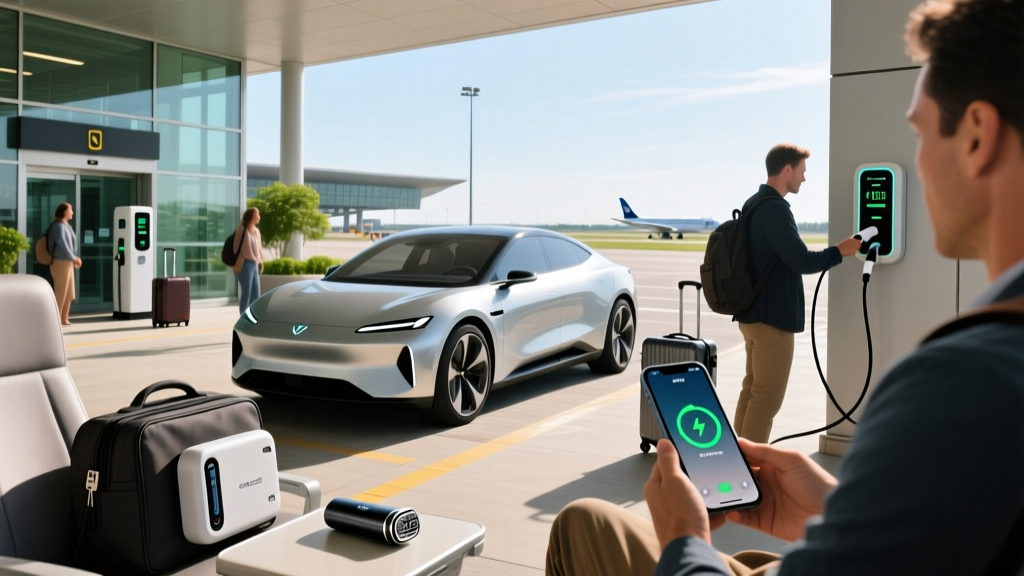
Every year, thousands of EV owners pack for flights — whether heading to a rental-car reservation, a business trip, or dropping off their EV at the airport long-term lot. The question of what electronics you can bring on a plane overlaps surprisingly with EV ownership: lithium batteries are the common thread. This guide covers the razor question in detail, then pivots to the practical realities of combining air travel with EV ownership in 2026.
Electric Razors and Airplane Rules: What the TSA Actually Says
The TSA prohibited items list distinguishes between safety razors (with removable blades, which are banned from carry-ons unless the blade is removed) and electric razors. Electric razors — rotary or foil — contain no loose blades and pose no security concern.
| Myth | Fact |
|---|---|
| "Electric razors are banned in carry-ons" | False. TSA explicitly allows electric razors in both carry-on and checked bags. |
| "Lithium batteries must always be removed from devices" | False. Batteries installed inside devices (razors, phones, laptops) can stay put. Only loose/spare lithium batteries are restricted to carry-ons. |
| "You need to declare small-device batteries at security" | False. Only spare batteries over 100 Wh require airline approval. A razor battery is typically 2–5 Wh. |
| "International flights have different razor rules" | Generally false. ICAO guidelines align with TSA on electric razors, though always check your destination country's aviation authority. |
EV Owners Who Fly: Parking, Charging, and Logistics
If you're an EV owner catching a flight, the razor question is the easy part. The harder logistics involve what to do with your EV while you're gone and how to manage battery health during extended parking.
Long-Term Airport Parking with an EV
Most major U.S. airports now offer at least some Level 2 charging in long-term parking structures. As of 2026, airports like LAX, SFO, ATL, and DFW have installed ChargePoint or EVgo stations in economy lots. Expect to pay $2.50–$4.00/hour for parking plus $0.35–$0.55/kWh for charging — meaning a 7-day trip with a full charge of a 75 kWh battery could add $26–$41 in energy cost on top of $56–$112 in parking fees.
Practical tip: Set your EV's charge limit to 50–60% State of Charge (SoC) before parking for a multi-day trip. Most modern EVs (Tesla, Hyundai, BMW, Rivian) lose roughly 1–2% SoC per day from vampire drain (telemetry, thermal management standby). Over 14 days, that's 14–28% loss — manageable if you left at 60%, problematic if you left at 30%.
Renting an EV at Your Destination
If you're flying somewhere and renting, EV availability at airport rental counters has expanded significantly. Hertz and Enterprise both stock Tesla Model Y, Hyundai Ioniq 5, and Ford Mustang Mach-E at major hubs. Expect a $15–$30/day EV premium over a comparable gas compact, but fuel savings of $8–$18/day depending on local electricity vs. gas prices.
EV Road Trips vs. Flying: The Cost Comparison
Should you drive your EV or fly? For trips between 300 and 800 miles, the math gets interesting. Here's a real comparison for a 500-mile one-way trip (e.g., Los Angeles to San Francisco, or Dallas to Austin):
| Factor | Driving EV (e.g., Tesla Model Y LR) | Driving Gas (e.g., Toyota RAV4) | Flying (Economy) |
|---|---|---|---|
| Energy/Fuel Cost | $45–$70 (DC fast charging at $0.35–$0.48/kWh) | $75–$100 (at 28 MPG, $3.80/gal) | N/A |
| Ticket/Transport | $0 | $0 | $120–$350 round trip |
| Time (door to door) | 8–9 hours (incl. 1–2 charge stops, ~20 min each) | 7.5–8.5 hours | 4–6 hours (incl. airport, security, boarding) |
| Wear/Maintenance | ~$5 (tire wear, negligible drivetrain cost) | ~$15–$25 (oil life, brake wear, tire) | $0 |
| Luggage Flexibility | Unlimited (within cargo space: 72 cu ft in Model Y) | Unlimited | $35–$75 per checked bag |
| Total One-Way Cost | $50–$75 | $90–$125 | $155–$425 |
The EV wins on cost for solo travelers, and the advantage multiplies with passengers. A family of four flying round-trip pays $480–$1,700 in tickets alone, while the EV road trip costs roughly $100–$150 round-trip in charging.
Real-World EV Charging on Road Trips: What to Expect
If you choose to drive, understanding the real-world charging experience matters more than spec-sheet numbers. Here's what a 2026 EV road trip actually looks like:
- Plan around 200–250 mile segments, not the full EPA range. A Tesla Model Y Long Range (EPA 320 miles) realistically delivers 260–280 highway miles at 70 mph in moderate weather, and 220–240 in cold or mountain conditions.
- DC fast charging is not linear. A vehicle that peaks at 250 kW will only sustain that rate from roughly 10–30% SoC. Above 60%, the charge curve tapers significantly. Expect a 10–80% charge in 18–25 minutes on a functioning 350 kW charger, but 35–50 minutes on older 50–150 kW stations.
- Preconditioning matters. If your EV has navigation-based battery preconditioning (Tesla, Hyundai/Kia E-GMP platforms, BMW iX), routing through the onboard nav to a DC fast charger warms the battery, enabling peak charge rates. Without preconditioning, cold-soaked batteries may peak at only 40–60% of rated charge speed.
- Network reliability varies. Tesla Superchargers consistently report 98%+ uptime. Electrify America and EVgo have improved but still experience occasional connector or payment-system failures. Always have a backup charger identified within 15–20 miles of your planned stop.
Decision Framework: Fly or Drive Your EV?
Choose to drive your EV if:
- The trip is under 600 miles one-way and you have 1+ passengers (cost savings are massive)
- You need flexible luggage capacity (sports gear, instruments, pets)
- Your route has reliable DC fast charging coverage (check PlugShare or A Better Routeplanner)
- You value schedule flexibility over raw speed
Choose to fly if:
- The trip exceeds 800 miles one-way and you're traveling solo
- Your destination has limited charging infrastructure (rural areas, older hotels without Level 2)
- Time is constrained (business trip, tight itinerary)
- Extreme cold (below 10°F) would reduce your EV's range by 25–40%, making the drive stressful
Common EV Travel Misconceptions
| Misconception | Reality |
|---|---|
| "You can't take an EV on a road trip — charging takes too long" | Modern 800V platforms (Hyundai Ioniq 5/6, Kia EV6, Porsche Taycan) add 180–220 miles in 18 minutes. That's a bathroom break and a coffee. |
| "EV batteries degrade if you park them at the airport" | A 1–2% daily vampire drain is normal and harmless. Park at 50–60% SoC and you'll return to a healthy battery. Avoid parking at 100% for extended periods. |
| "Flying is always faster than driving" | For 300–500 mile trips, door-to-door driving often matches or beats flying once you account for airport transit, security lines, boarding, and baggage claim. |
| "EVs can't handle cold-weather road trips" | Range drops 20–40% in sub-freezing temps, but preconditioning and route planning with shorter segments make it entirely manageable. Heat pumps (standard on most 2024+ EVs) reduce cabin-heating energy draw by 30–50%. |
Packing Electronics for EV Owners: Beyond the Razor
If you're an EV owner who travels, your packing list likely includes more lithium-powered devices than average. Here's the TSA/FAA guidance on common items:
- Electric razor: ✅ Carry-on or checked. No declaration needed.
- Laptop/tablet: ✅ Carry-on preferred. Must be removed for X-ray screening (unless you have TSA PreCheck).
- Portable power bank: ✅ Carry-on ONLY. Must be under 100 Wh (most consumer packs are 20–27 Wh). Forbidden in checked luggage.
- E-cigarettes/vapes: ✅ Carry-on ONLY. Never checked (fire risk from lithium battery).
- Drone with LiPo batteries: ✅ Carry-on preferred. Batteries under 100 Wh are fine; 100–160 Wh require airline approval.
- Jump starter pack: ⚠️ Check Wh rating. Many are 50–100 Wh (carry-on OK), but larger units may exceed limits.
The key principle: any device with an installed lithium battery can typically go in either bag, but spare/loose lithium batteries must go in carry-ons and are capped at 100 Wh without airline approval (or 160 Wh with approval, max 2 spare batteries). For reference, a Tesla Model Y's traction battery is 75,000 Wh — roughly 750 times the FAA's per-spare-battery limit, which is why EVs are governed by entirely different transport regulations (DOT hazmat rules for vehicle shipping).
Frequently Asked Questions
Do I need to remove the battery from my electric razor before flying?
No. If the battery is installed inside the razor (as with virtually all modern electric shavers), you can leave it in place. Only spare, loose lithium batteries require special handling. Pack the razor in your carry-on for convenience, or in checked luggage if you prefer — both are permitted.
Can I charge my electric razor on the plane?
Most airlines allow charging personal devices from USB seatback ports during cruise flight (not during taxi, takeoff, or landing). A small device like an electric razor draws minimal current and won't cause issues. Some budget carriers without seat power won't offer this option.
Will my EV's battery drain significantly while parked at the airport for a week?
Expect roughly 7–14% SoC loss over 7 days from standby systems (telemetry, security, thermal monitoring). If you park at 60% SoC, you'll return to approximately 46–53% — plenty of range to drive home. Avoid parking at very low SoC (under 20%) for multi-day trips.
Are airport EV charging stations reliable?
Reliability varies by airport and network. Major hubs (LAX, SFO, JFK, ATL) have invested heavily in Level 2 infrastructure, but spots can be occupied by non-EVs ("ICEing") or out of service. Check PlugShare reviews for your specific airport before relying on lot charging. Many EV owners simply charge at home before departing and manage vampire drain by setting SoC limits.
Is it cheaper to drive my EV or fly for a 400-mile trip?
For a solo traveler, driving a 2026 Tesla Model Y (averaging $0.40/kWh at DC fast chargers, ~3.5 miles/kWh highway) costs roughly $46 one-way. A comparable flight runs $120–$300+ round trip. Driving is significantly cheaper, and you avoid baggage fees and rental-car costs at your destination.