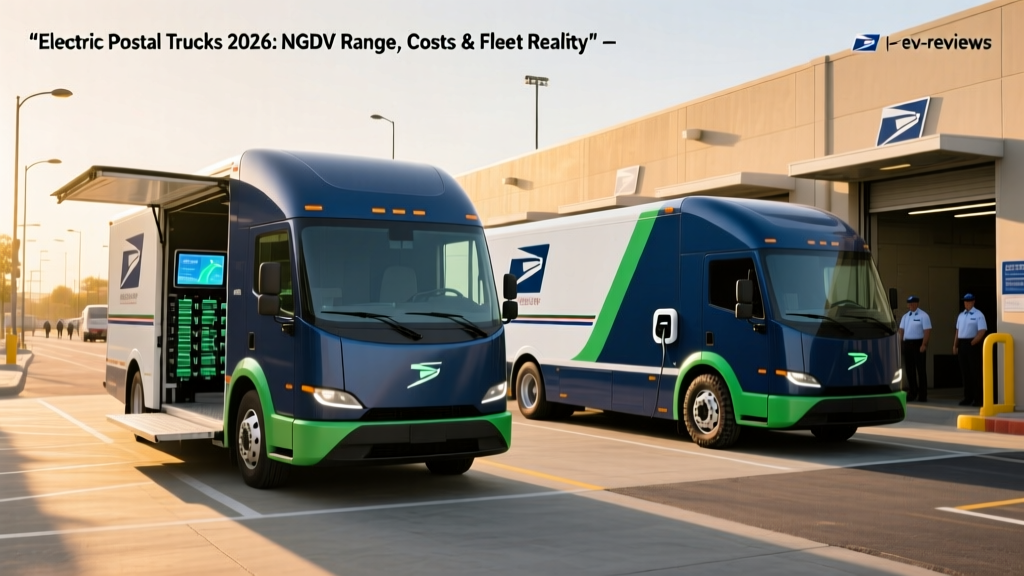
Quick answer: The USPS Next Generation Delivery Vehicle (NGDV) from Oshkosh Defense is rolling out in both battery-electric (BEV) and low-emission gas (ICE) variants. The BEV version carries a ~140 kWh battery pack with an EPA-estimated range around 70–85 miles loaded, DC fast charging at up to 75 kW (10–80% in roughly 90 minutes), and a base acquisition cost estimated near $100,000+ per unit before federal fleet funding. For 2026, USPS plans a mixed fleet — electric postal trucks handle dense urban routes while ICE variants cover long rural stretches. The BEV NGDV saves an estimated $3,500–$5,500 annually in fuel and maintenance per vehicle on qualifying routes, but range, cold-weather losses, and depot charging infrastructure remain real constraints.
What Are Electric Postal Trucks and Why Do They Matter?
If you've seen the boxy, right-hand-drive Grumman LLV rattling through your neighborhood since 1987, you've seen the vehicle the NGDV is replacing. Those aging Long Life Vehicles average 17 miles per route with no air conditioning, poor crash safety, and increasingly catastrophic maintenance bills (USPS has reported per-vehicle repair costs exceeding $5,000 annually on 30-year-old units).
The NGDV program, contracted to Oshkosh Defense under a $6 billion IDIQ (indefinite-delivery, indefinite-quantity) contract, is the largest federal fleet modernization effort in decades. As of 2026, USPS is targeting at least 45,000 NGDV units by 2028, with a minimum of 60% being battery-electric — a ratio that was hard-fought through environmental review and congressional pressure after the initial plan leaned heavily toward gas.
For EV buyers and taxpayers watching this program, electric postal trucks are significant because they represent:
- Volume validation: Tens of thousands of commercial BEVs in daily service normalizes electric fleet logistics.
- Infrastructure buildout: USPS depot charging installations in every state create electrical capacity that can benefit surrounding communities.
- Real-world durability data: Six-days-a-week, stop-and-go delivery routes are the harshest duty cycle for any powertrain.
NGDV BEV vs. NGDV ICE: The Head-to-Head Spec Breakdown
USPS is buying both powertrains because no single vehicle fits every route. Here's how the two NGDV variants compare based on published specifications and fleet testing data:
| Specification | NGDV BEV (Electric) | NGDV ICE (Gas) |
|---|---|---|
| Powertrain | Single electric motor, ~200 hp | 2.0L turbo 4-cyl, ~210 hp |
| Battery / Tank | ~140 kWh usable (NMC chemistry) | ~20-gallon fuel tank |
| EPA-Est. Range (loaded) | 70–85 miles | ~240 miles |
| Real-World Range (cold/loaded) | ~50–65 miles | ~200–220 miles |
| DC Fast Charge (peak kW) | 75 kW (CCS1) | N/A |
| 10–80% Charge Time | ~90 minutes | ~5 minutes (refuel) |
| Level 2 Depot Charging | 19.2 kW AC | N/A |
| Cargo Volume | ~135 cu ft | ~135 cu ft |
| Payload Capacity | ~2,000 lbs | ~2,300 lbs |
| HVAC | Full electric heat pump + A/C | Engine-driven A/C, heated |
| Est. Unit Cost | $100,000–$115,000 | $55,000–$65,000 |
| Annual Fuel/Energy Cost | ~$1,200–$1,800 | ~$4,500–$5,500 |
| Annual Maintenance Est. | ~$1,800–$2,500 | ~$3,500–$4,500 |
The BEV variant is roughly double the acquisition cost but recoups the premium over 6–8 years through lower energy and maintenance spend — assuming the route stays within range and depot charging is operational. The ICE variant wins on range flexibility, cold-weather reliability, and rural route coverage where depot charging infrastructure is sparse.
Real Costs and Savings: The 10-Year Fleet Ownership Picture
Understanding electric postal truck economics requires looking beyond the sticker price. USPS operates vehicles 6 days a week, roughly 250 days per year, on routes averaging 15–30 miles. Here's a modeled 10-year total cost of ownership (TCO) for a single NGDV BEV versus the ICE variant on a 20-mile daily urban route:
| Cost Category (10-Year) | NGDV BEV | NGDV ICE |
|---|---|---|
| Acquisition | $110,000 | $60,000 |
| Depot Charger Install (amortized) | $12,000 | $0 |
| Energy / Fuel | $15,000 | $50,000 |
| Maintenance | $22,000 | $40,000 |
| Battery Replacement Reserve | $8,000 | $0 |
| Insurance & Admin | $14,000 | $13,000 |
| Total 10-Year TCO | $181,000 | $163,000 |
| Cost Per Mile (250 days × 20 mi × 10 yr) | $3.62 | $3.26 |
On a pure 20-mile urban route, the BEV trails slightly in 10-year TCO due to the high acquisition premium. However, several factors shift this calculation:
- Federal fleet funding and IRA incentives can offset $20,000–$40,000 of BEV acquisition cost through the §30D clean vehicle credit framework and Clean Heavy-Duty Vehicle Program grants under the Inflation Reduction Act.
- Route optimization: On shorter 12–15 mile routes (common in dense cities), energy savings widen and battery degradation is minimal.
- Carbon compliance: Federal fleet electrification mandates may impose penalties or require offsets for ICE-heavy fleets, altering the financial calculus.
- Maintenance escalation: ICE maintenance costs rise steeply after year 6; BEV costs remain flatter.
At a 15-mile daily route with federal incentive offsets, the BEV NGDV achieves cost parity with the ICE variant by year 7 and saves an estimated $12,000–$18,000 over a 12-year service life.
Range, Charging, and the Cold-Weather Reality
The NGDV BEV's ~140 kWh battery pack is massive by consumer standards (larger than a Ford F-150 Lightning Extended Range), but postal delivery is an energy-intensive duty cycle. Frequent stops, cargo door openings, HVAC use, and low average speeds mean the vehicle consumes roughly 2.0–2.8 kWh per mile depending on load and climate.
EPA estimate: 70–85 miles loaded.
Real-world summer (urban stop-and-go): 65–80 miles.
Real-world winter (20°F, heater on, loaded): 45–60 miles — a 30–40% reduction consistent with NMC lithium-ion chemistry in cold climates.
Highway transfer driving (45 mph empty): Up to 95 miles.
Charging infrastructure is the binding constraint. USPS is installing 19.2 kW Level 2 depot chargers at processing facilities nationwide, which fully replenish a depleted NGDV BEV battery in approximately 7–8 hours — adequate for overnight turnaround. The 75 kW DC fast-charge capability (via CCS1 connector) exists for mid-day top-ups but is rarely needed on standard routes.
For context, a 75 kW peak charge rate on a 140 kWh pack means a 10–80% session takes roughly 90 minutes because the charge curve tapers significantly above 60% state of charge. This is a deliberate engineering trade-off: Oshkosh prioritized battery longevity (targeting 10–12 year service life with less than 20% degradation) over charge speed, which is appropriate for a fleet vehicle that charges overnight.
Cold-weather routes in Minnesota, Wisconsin, and New England are where the BEV NGDV faces its toughest test. USPS has acknowledged that routes exceeding 60 miles or operating in sustained sub-freezing temperatures are assigned to ICE variants until battery thermal management and depot charging density improve.
Common Misconceptions About Electric Postal Trucks
| Myth | Fact |
|---|---|
| "The USPS is going 100% electric overnight." | USPS is targeting a minimum 60% BEV mix for NGDV orders through 2028. ICE variants remain essential for rural and long routes. The full fleet replacement (replacing ~220,000 vehicles) will take 15–20 years. |
| "Electric mail trucks will break down in winter." | The NGDV BEV includes a liquid-cooled/heated battery thermal management system and an electric heat pump for cabin climate. Range drops 30–40% in extreme cold, but the vehicle operates — route assignment handles the rest. |
| "These trucks cost taxpayers more than gas trucks." | Upfront, yes — roughly double. Over a 12-year service life with federal incentive offsets and on qualifying routes, BEV TCO reaches parity or savings. The aging Grumman LLV costs USPS an estimated $5,000+ per year in maintenance alone, making any replacement financially urgent. |
| "The batteries will need constant replacement." | NMC chemistry in fleet applications with managed charging (never held at 100% SoC) and thermal management targets 80%+ capacity retention at 10 years / 150,000 miles. A single mid-life battery replacement (~$18,000–$25,000) is budgeted in the TCO model. |
| "Charging infrastructure doesn't exist for fleet vehicles." | USPS has contracted depot charging installations at over 2,000 facilities as of 2026, with 19.2 kW Level 2 chargers per vehicle bay. This is a purpose-built infrastructure program, not reliant on public charging networks. |
What This Means for EV Buyers and Taxpayers
You might wonder why a consumer-focused EV guide covers postal trucks. The NGDV program has outsized impact on the broader EV market:
Supply chain effects: Oshkosh and battery supplier partners are scaling NMC cell production in the U.S., contributing to the domestic battery manufacturing base that supports consumer EV tax credit eligibility under §30D critical-mineral and battery-component sourcing rules.
Charging infrastructure spillover: USPS depot installations often require utility transformer upgrades and new medium-voltage service at facilities. This electrical capacity benefits surrounding commercial EV charging and can accelerate public charger deployment in underserved areas.
Fleet-to-consumer technology transfer: The NGDV's thermal management system, route-optimization software, and managed charging protocols are directly applicable to commercial delivery vans (Ford E-Transit, BrightDrop Zevo) and inform consumer EV battery longevity strategies.
Taxpayer accountability: The NGDV program is funded through the Postal Service Reform Act and IRA appropriations. Understanding whether electric postal trucks deliver value protects a $6+ billion public investment.
Decision Framework: Where Electric Postal Trucks Win and Lose
Assign BEV NGDV if:
- Daily route is ≤ 60 miles (loaded, mixed climate)
- Depot has or can install 19.2 kW Level 2 charging
- Route is urban/suburban with frequent stops (regen braking recovers energy)
- Ambient temperatures rarely sustain below 10°F
- Federal fleet incentive offsets are available
Assign ICE NGDV if:
- Daily route exceeds 80 miles or includes highway segments
- Rural depot lacks electrical capacity for charger installation
- Sustained winter temperatures below 0°F are routine
- Route requires mid-day refueling/charging flexibility without depot return
- Budget constraints limit acquisition to lower-cost units
Watch for mixed-fleet optimization: Many USPS facilities will operate both variants, assigning BEVs to short urban routes and ICE to long rural routes — maximizing TCO savings where the BEV excels while maintaining service reliability where it doesn't.
Frequently Asked Questions
Who builds the USPS electric postal truck?
Oshkosh Defense, based in Oshkosh, Wisconsin, builds the NGDV under a contract awarded in 2021. The vehicle uses a purpose-built chassis (not a modified commercial van) with right-hand drive for curbside delivery. Battery cells are sourced from U.S. and allied-nation suppliers to comply with federal procurement rules.
What is the real range of the electric NGDV?
The EPA-estimated range is approximately 70–85 miles loaded. Real-world range in summer urban delivery is 65–80 miles. In winter conditions (20°F or below), expect 45–60 miles due to NMC battery chemistry limitations and HVAC energy draw. USPS assigns routes accordingly.
How long does it take to charge an electric postal truck?
At a 19.2 kW Level 2 depot charger, a full charge from empty takes approximately 7–8 hours (overnight turnaround). At a 75 kW DC fast charger (CCS1), a 10–80% session takes roughly 90 minutes due to charge-curve taper above 60% SoC. Most NGDV BEVs charge overnight at the depot and don't require mid-day charging.
Do electric postal trucks save money compared to gas?
On qualifying urban routes (≤ 20 miles/day), the BEV NGDV saves an estimated $3,500–$5,500 annually in fuel and maintenance compared to the ICE variant. However, the BEV's acquisition cost is roughly double ($110,000 vs. $60,000), so total cost parity is reached at approximately year 7–8 without federal incentives, or year 5–6 with IRA fleet funding offsets.
Will the USPS go fully electric?
Not entirely, and not quickly. USPS has committed to a minimum 60% BEV mix for NGDV orders through 2028, with ICE variants covering routes where range, cold weather, or infrastructure constraints make BEVs impractical. The full replacement of the ~220,000-vehicle legacy fleet (including Grumman LLVs and other models) will extend into the late 2030s.
How does the NGDV battery hold up over time?
The ~140 kWh NMC battery pack is designed for 10–12 years of fleet service with managed charging (typically 20–90% SoC, never held at 100%) and active liquid thermal management. Targeted capacity retention is 80%+ at 150,000 miles. USPS budgets a mid-life battery replacement (~$18,000–$25,000) in its long-term cost model, though many packs may exceed this threshold.
Can I buy an NGDV for personal use?
No. The NGDV is a federal fleet vehicle built under government contract and is not available for consumer purchase. Retired units may eventually enter surplus auctions, but USPS typically retains vehicles for 15–20+ years (as demonstrated by the Grumman LLV's 35-year service life). Consumer alternatives with similar box-van utility include the Ford E-Transit and BrightDrop Zevo 600.