The Short Answer on the Electric Porsche 911
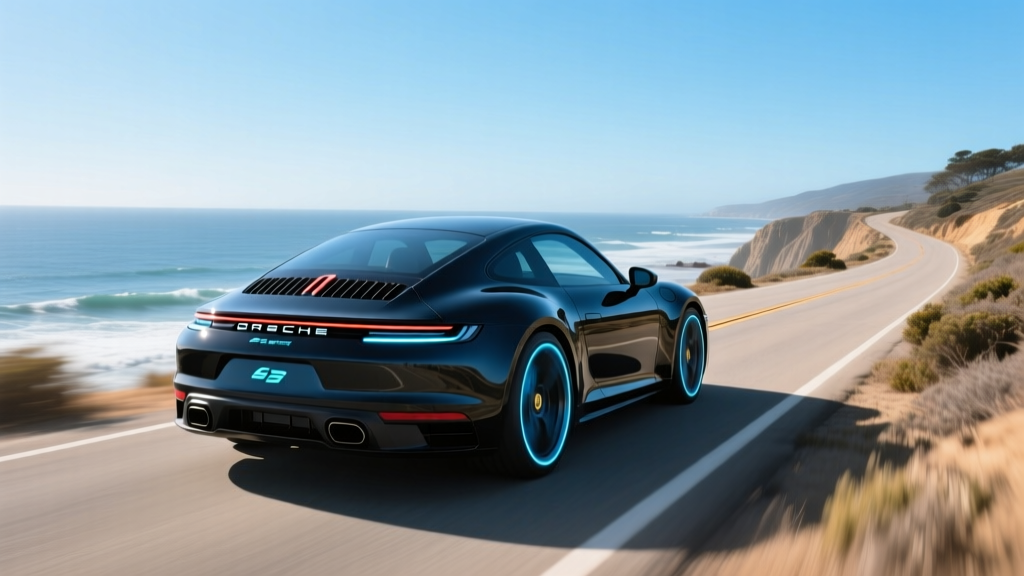
As of mid-2026, Porsche has not released a fully electric 911. The current 992-generation 911 remains available with turbocharged flat-six engines and mild-hybrid (T-Hybrid) powertrains, but no battery-electric variant is on sale. Porsche CEO Oliver Blume confirmed in late 2025 that an electric Porsche 911 will arrive later this decade, likely as a 2027 or 2028 model year, riding on a dedicated EV sports-car architecture. Until then, buyers wanting partial electrification in a 911 should look at the 911 Carrera GTS T-Hybrid (introduced for 2025), which pairs a 3.4L flat-six with a 400V mild-hybrid system for 532 hp and modest efficiency gains — but this is not a plug-in or battery-electric vehicle.
If you're researching the electric Porsche 911 to plan a future purchase, this guide covers what's known, what's estimated, and how an eventual battery-electric 911 would compare to the current gas lineup and rivals like the Tesla Roadster or Rimac Nevera on cost, performance, and daily usability.
Where the Electric Porsche 911 Stands in 2026
Porsche has been deliberate about electrifying its most iconic nameplate. The Taycan (sedan) and Macan Electric (SUV) are already on sale, but the 911 occupies a different position — it's the brand's emotional core, and Porsche has repeatedly stated that electrification must not compromise the car's weight balance, driving feel, or rear-engine packaging.
Here's what is confirmed or strongly indicated as of 2026:
- Platform: The electric 911 will likely use a new, bespoke sports-car EV platform — not the PPE (Premium Platform Electric) shared with Audi, which is optimized for sedans and SUVs. Porsche has hinted at a skateboard architecture with a low-slung battery pack to preserve the 911's center of gravity.
- Timeline: Expect an official reveal in 2027, with deliveries beginning late 2027 or early 2028. This is preliminary and subject to supply-chain or battery-tech delays.
- Not a Taycan coupe: Porsche executives have made clear the electric 911 will be a distinct vehicle, not a rebodied Taycan. The 2+2 seating, rear-engine silhouette, and lightweight ethos will be preserved as much as battery physics allows.
- The T-Hybrid bridge: The current 911 Carrera GTS T-Hybrid serves as the electrified stepping stone, using an electric turbocharger and an integrated electric motor in the transmission bell housing — but with no plug-in capability and a tiny buffer battery (~1.9 kWh) that assists rather than propels.
Expected Specs: What the Numbers Might Look Like
Based on Porsche's engineering trajectory, the Taycan's performance benchmarks, and industry reporting, here are estimated specifications for a base electric 911 Carrera and a higher-output variant. These are projections, not official figures.
| Spec | e-911 Carrera (Est.) | e-911 Turbo S (Est.) | 2026 911 Carrera GTS T-Hybrid (Actual) |
|---|---|---|---|
| Powertrain | Dual-motor AWD | Dual-motor AWD | 3.4L flat-six + mild-hybrid |
| Horsepower | ~450-500 hp | ~700-750 hp | 532 hp |
| 0-60 mph | ~3.2 sec | ~2.3 sec | 2.9 sec |
| Battery (usable, est.) | ~85-95 kWh (NMC) | ~95-105 kWh (NMC) | 1.9 kWh (buffer only) |
| EPA Range (est.) | ~250-280 mi | ~220-250 mi | N/A (gas: ~20/25 mpg) |
| Peak DC Charge Rate | ~270-320 kW | ~320-350 kW | N/A |
| 10-80% DC Charge | ~18-22 min | ~15-18 min | N/A |
| Weight (est.) | ~4,200-4,500 lbs | ~4,600-4,800 lbs | ~3,465 lbs |
| Base MSRP (est.) | ~$135,000-$150,000 | ~$220,000-$250,000 | $164,900 |
Real-World Range Reality Check
Sports cars sacrifice efficiency for performance. The Taycan Turbo GT, for reference, achieves an EPA-estimated 269 miles from its 97 kWh (usable) battery — roughly 2.7 mi/kWh. An electric 911, with similar or slightly better aero and lower weight, might hit 2.8-3.0 mi/kWh. Expect real-world highway range of 200-240 miles at sustained 75-80 mph speeds, and potentially 15-25% less in cold weather (below 32°F) due to battery heating demands and reduced regenerative braking efficiency. Track use will drain the battery far faster — anticipate 60-90 miles of equivalent range during aggressive driving.
Electric vs. Gas 911: Cost and Ownership Comparison
For buyers deciding whether to wait for the electric 911 or buy a gas 911 now, the economics differ significantly. Below is a five-year ownership projection comparing a hypothetical electric 911 Carrera (~$140,000) against the current 911 Carrera GTS T-Hybrid ($164,900 MSRP, with typical dealer pricing higher).
| Category | Electric 911 Carrera (Est.) | 911 Carrera GTS T-Hybrid |
|---|---|---|
| Purchase Price (MSRP) | $140,000 | $164,900 |
| Federal Tax Credit (§30D) | $0 (exceeds MSRP cap*) | $0 (not a PHEV/BEV) |
| Fuel/Energy (5 years) | $4,500-$6,000** | $12,500-$15,000*** |
| Maintenance (5 years) | $2,500-$3,500 | $5,000-$7,500 |
| Insurance (5 years) | $18,000-$24,000 | $16,000-$22,000 |
| Estimated Depreciation | $56,000-$70,000 (40-50%) | $50,000-$65,000 (30-40%) |
| 5-Year Total (approx.) | $125,000-$148,000 | $148,000-$175,000 |
*The IRS §30D clean vehicle credit caps eligible sedans at an MSRP of $55,000 and SUVs/pickups at $80,000. Any electric 911 will far exceed these limits, making it ineligible for the federal credit regardless of battery sourcing or buyer income.
**Assumes $0.15-$0.20/kWh average (mix of home Level 2 and public DC charging).
***Assumes premium gasoline at $4.00-$4.80/gallon, ~22 mpg combined.
Key takeaway: the electric 911 may cost less to operate annually, but depreciation is the wildcard. Gas 911s — especially GTS and Turbo variants — have historically held value exceptionally well, sometimes appreciating. An electric 911 enters uncharted territory for Porsche collectors and may depreciate more steeply in its first years, similar to the Taycan's trajectory.
Charging at Home and on the Road: What 911 EV Owners Will Face
Owning an electric sports car introduces practical considerations that gas 911 owners never think about. Here's what to plan for:
Home Charging (Level 2)
A Porsche-spec Wall Connector or equivalent Level 2 charger delivering 11-19 kW (48-80A on a 240V circuit) would replenish an estimated 90 kWh battery in 5-8 hours overnight. Installation costs vary widely:
- Simple install (panel has capacity, short run): $800-$1,500
- Panel upgrade (200A service upgrade): $2,000-$4,000+
- Equipment (Porsche Mobile Charger Connect or ChargePoint Home Flex): $500-$1,200
For a sports car driven 30-40 miles daily with weekend canyon runs, home Level 2 is essential. Relying solely on public charging would be inconvenient and more expensive ($0.35-$0.55/kWh at DC fast chargers).
DC Fast Charging (Road Trips)
Porsche's 800V architecture (already proven in the Taycan) should carry over, enabling sustained high charge rates. At a 350 kW Electrify America or Ionity station, expect:
- 10-80% in roughly 18-22 minutes (base model)
- Charge curve taper above 80%: the final 20% may take an additional 15-20 minutes
- Preconditioning is critical — the car must warm the battery before arriving at the charger to hit peak kW rates. Without preconditioning in cold weather, peak rates may drop 30-50%.
Charging Deserts and Track Days
Remote canyon roads and race tracks often lack nearby DC fast chargers. Plan track days with a full charge and a tow or flatbed home if you push the battery below 10%. Unlike a gas 911 where a jerry can solves the problem, a depleted EV battery requires a flatbed — you cannot tow an EV with wheels down without risking motor damage.
Common Misconceptions About the Electric 911
| Myth | Fact |
|---|---|
| "The electric 911 will be a rebadged Taycan." | Porsche has confirmed a dedicated sports-car platform. The 911's rear-biased weight distribution and compact dimensions require different engineering. |
| "It will qualify for the $7,500 federal tax credit." | It won't. The §30D MSRP cap for passenger cars is $55,000. The electric 911 will likely start above $130,000. |
| "Electric means it won't feel like a 911." | Electric motors offer instant torque and a lower center of gravity. The challenge is weight — batteries add 1,000+ lbs vs. the flat-six. Porsche will use rear-axle steering, active anti-roll bars, and torque vectoring to compensate. |
| "I can charge it at any public station." | Porsche uses NACS (Tesla Supercharger compatible) on newer models. Older CCS stations may require an adapter. Always verify connector compatibility before road-tripping. |
| "The battery will need replacement in 5 years." | Modern NMC batteries with active thermal management typically retain 85-90% capacity at 100,000 miles. Porsche offers an 8-year/100,000-mile battery warranty (minimum 70% capacity retention) on the Taycan; expect similar for the electric 911. |
Decision Framework: Should You Wait or Buy Now?
Choose the Current Gas 911 (992.2) If:
- You want a 911 now and don't want to wait until 2028+ for deliveries
- You prioritize light weight (~3,400 lbs) and the visceral flat-six sound
- You do track days regularly and can't risk battery depletion between sessions
- You value resale value certainty — gas 911 GTS and GT3 models hold value predictably
- You lack reliable home Level 2 charging access (apartment, street parking)
Wait for the Electric 911 If:
- You want instant torque and sub-3-second 0-60 without turbo lag
- You primarily drive daily commutes and weekend canyons, not track events
- You have home charging and want to eliminate gas station visits
- You're drawn to lower running costs (electricity vs. premium fuel, fewer fluid changes)
- You want to be an early adopter of Porsche's next-generation sports car tech
Consider the 911 T-Hybrid as a Middle Ground:
- The current Carrera GTS T-Hybrid offers mild electrification (electric turbo, integrated motor) with no range anxiety, no plug, and the flat-six character. It's the best of both worlds until the full EV arrives — but at $164,900+ MSRP, it's a premium proposition.
What First-Time EV Buyers Should Know Before Committing
If the electric 911 would be your first EV, prepare for a learning curve that gas 911 owners don't face:
- kW vs. kWh: Kilowatts (kW) measure power — how fast you charge or how hard the motors push. Kilowatt-hours (kWh) measure energy — the battery's total fuel tank. A 90 kWh battery charged at 270 kW fills fast, but peak kW only sustains briefly before tapering.
- Charge curve taper: The advertised "270 kW peak" applies roughly between 10-50% state of charge. From 50-80%, the rate drops to ~150 kW, and above 80% it falls further. Plan road-trip stops to 80% and keep moving.
- Cold weather is real: Below freezing, expect 15-25% range loss and slower charging unless you precondition the battery. Garage parking helps significantly.
- Tire costs: EVs are heavier and deliver instant torque, wearing tires 20-30% faster than equivalent gas cars. Budget $1,500-$2,500 per set for performance rubber.
- Insurance: EV insurance premiums run 10-20% higher than gas equivalents due to repair costs and battery replacement exposure. Get quotes before committing.
- Depreciation uncertainty: The Taycan has depreciated faster than the gas 911 in its first three years. Early electric 911 adopters should expect similar — plan to keep the car 5+ years to ride out the curve.
Competitive Landscape: What Else Is in This Price Range?
The electric 911 won't exist in a vacuum. Likely competitors at launch (2027-2028) include:
- Tesla Roadster (announced, repeatedly delayed): Claimed sub-2-second 0-60, 620+ mile range — but Tesla's timelines are unreliable, and the Roadster is a 2-seat mid-engine layout, not a 2+2 daily driver.
- Rimac Nevera: Already on sale at ~$2.2 million. Blistering performance (1,914 hp, 1.85-sec 0-60) but hypercar pricing and limited practicality.
- Lotus Emeya / Evija: Lotus is electrifying aggressively, but these target different buyer profiles.
- BMW i8 successor (rumored): A mid-engine electric sports car from BMW could compete on price if it materializes.
The electric 911's advantage will be brand cachet, daily usability, and Porsche's dealer/service network — not necessarily raw specs.
Electric Porsche 911: Frequently Asked Questions
When will the electric Porsche 911 be available?
Porsche has indicated late this decade, with a likely reveal in 2027 and first deliveries in late 2027 or 2028. This is preliminary and could shift based on battery supply and development timelines.
Will the electric 911 be a plug-in hybrid or fully electric?
Fully electric (BEV). The current 911 T-Hybrid is a mild-hybrid (not plug-in) that serves as the bridge. Porsche has confirmed the next major 911 evolution will be battery-electric.
How much will the electric Porsche 911 cost?
Estimated base pricing of $135,000-$150,000 for a Carrera-equivalent, and $220,000-$250,000+ for a Turbo S variant. These are projections based on current 911 pricing and Taycan EV premiums.
Will it qualify for the federal EV tax credit?
No. Under current IRS §30D rules, new clean vehicle credits are capped at $55,000 MSRP for sedans and $80,000 for SUVs/trucks. The electric 911 will far exceed these limits.
Can I charge it at Tesla Superchargers?
Likely yes. Porsche has adopted NACS (North American Charging Standard) for its newer EVs, and the electric 911 should be NACS-native, giving access to the Tesla Supercharger network without an adapter.
Will it sound like a gas 911?
No. Electric motors are near-silent. Porsche may offer an artificial sound profile (as it does in the Taycan with Porsche Electric Sport Sound), but it won't replicate the flat-six exhaust note. If sound is a dealbreaker, the gas or T-Hybrid 911 is your answer.
What about battery degradation and warranty?
Based on the Taycan, expect an 8-year/100,000-mile battery warranty guaranteeing at least 70% capacity retention. Real-world Taycan data shows ~90-93% capacity retention at 60,000 miles with proper thermal management. Avoid frequent DC fast charging above 90% state of charge for longevity.