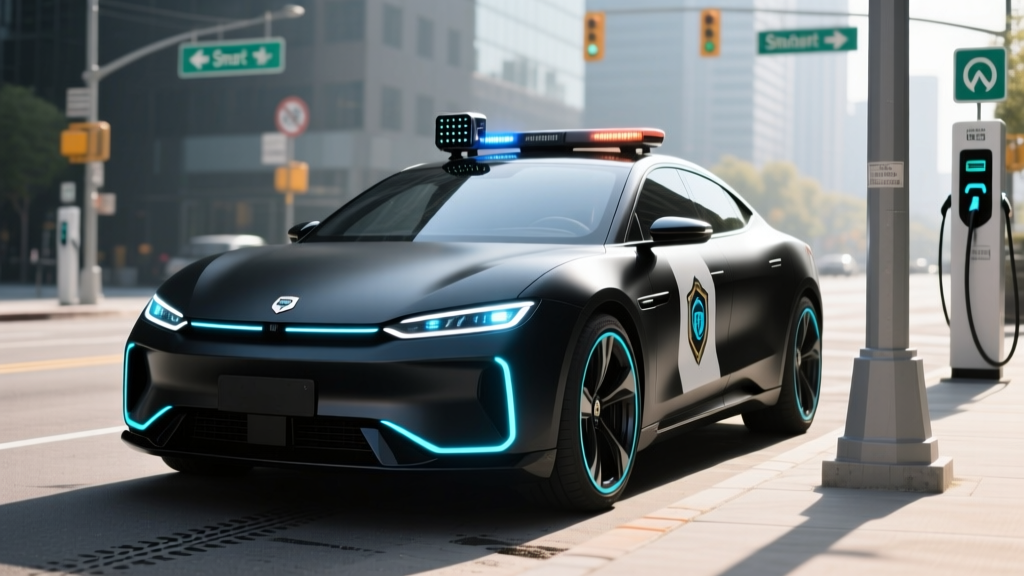
The Short Answer: Are Electric Police Cars Ready for Duty?
Yes — but with major caveats. In 2026, agencies deploying electric police cars are seeing 40–60% lower fuel and maintenance costs, but only when vehicles are assigned to roles matching their range and charging profiles. The Ford F-150 Lightning SSV (EPA 230–320 mi, starting ~$59,995) and Tesla Model Y (EPA 310 mi, ~$44,990) lead current deployments. Patrol and administrative use works well; high-speed pursuit and rural coverage remain challenging. Expect real-world range to drop 20–35% with full emergency equipment, idle-heavy shifts, and cold weather.
Which Electric Police Cars Are Actually in Service?
Several OEMs now offer purpose-built or upfitted electric vehicles certified for law enforcement use. Here's where the market stands in 2026:
| Vehicle | Role | EPA Range | Battery (kWh) | Peak DC Charge | 0–60 mph | Base MSRP |
|---|---|---|---|---|---|---|
| Ford F-150 Lightning SSV | Patrol / Utility | 230 mi (Std) / 320 mi (Ext) | 98 (Std) / 131 (Ext) — NMC | 150 kW / 210 kW | ~4.5s (Ext) | ~$59,995 |
| Ford Explorer Police Interceptor (HEV) | Patrol (Baseline) | ~460 mi (gas+hybrid) | 1.35 kWh (hybrid) | N/A | ~7.0s | ~$45,000 |
| Tesla Model Y AWD | Admin / Light Patrol | 310 mi (Long Range) | ~75 kWh — NMC | 250 kW | 4.8s | ~$44,990 |
| Chevrolet Blazer EV PPV | Patrol / Pursuit | 279 mi (2LT AWD) | ~102 kWh — NMC | 190 kW | ~5.5s | ~$50,200 |
| Dodge Charger Daytona EV | Announced / Pursuit | 317 mi (est.) | ~100 kWh (est.) | TBD | <4.0s (est.) | ~$60,000 (est.) |
The Ford F-150 Lightning SSV (Special Service Vehicle) remains the most widely adopted electric police vehicle. It's rated for light pursuit and utility work, though agencies typically assign it to community policing, detective work, and administrative duties rather than high-speed chase response. The Ford Police Fleet page details upfit packages including reinforced wheels, heavy-duty brakes, and emergency-equipment wiring.
The Chevrolet Blazer EV PPV (Pursuit Pursuit Vehicle) is the first BEV with a factory pursuit rating, designed for higher-speed durability. The Dodge Charger Daytona EV has been announced for law enforcement packages, but final fleet specs remain preliminary as of early 2026.
EV vs. Gas Patrol Car: The Real Cost Comparison
The financial case for electric police cars rests on operating cost savings that offset higher upfront purchase prices. A typical patrol vehicle runs 20,000–30,000 miles per year, with extensive idling (2–4 hours per shift). Here's how the numbers stack up over a 5-year fleet lifecycle:
| Cost Category | Ford Explorer PIU (HEV) | Ford F-150 Lightning SSV (BEV) |
|---|---|---|
| Purchase Price (upfitted) | ~$55,000 | ~$72,000 |
| Fuel / Energy (5 yrs, 125K mi) | ~$18,750 (22 MPG avg, $3.30/gal) | ~$7,500 (2.0 kWh/mi, $0.12/kWh) |
| Maintenance (5 yrs) | ~$8,500 | ~$3,200 |
| Idle-Related Fuel Waste | ~$3,800 | $0 (no idle emissions/fuel) |
| Charging Infrastructure (allocated) | $0 | ~$4,500 |
| 5-Year Total Cost | ~$86,050 | ~$87,200 |
| Residual Value (est.) | ~$12,000 | ~$18,000 |
| Net 5-Year Cost | ~$74,050 | ~$69,200 |
The BEV wins on net cost by roughly $4,800–$5,000 per vehicle over five years, primarily through fuel and maintenance savings. The gap widens significantly in jurisdictions with lower electricity rates (under $0.10/kWh) or higher gas prices (above $4.00/gal). Agencies running vehicles for 6–7 years see even larger savings as the EV's maintenance advantage compounds.
Critical note: Federal §30D tax credits of up to $7,500 apply to qualifying BEVs, but fleet purchases through government procurement channels may have different eligibility structures. Private security firms purchasing qualifying EVs can claim the credit subject to IRS §30D rules including MSRP caps, buyer income limits, and battery-sourcing requirements.
Real-World Range: Why the EPA Number Isn't the Whole Story
EPA vs. Reality for Police EVs
Ford F-150 Lightning SSV (Extended Range): EPA 320 miles. Real-world patrol duty: 210–260 miles depending on climate, equipment load, and driving pattern.
Tesla Model Y Long Range: EPA 310 miles. Real-world patrol duty: 220–270 miles.
Several factors compress police EV range well below the EPA sticker:
- Equipment weight: Light bars, cage partitions, radios, and computers add 400–800 lbs, reducing efficiency by 8–15%.
- Idle and accessory load: A patrol shift involves 2–4 hours of stationary operation with HVAC, radios, and computers drawing 2–5 kW continuously. That's 8–15 kWh consumed without moving — equivalent to 20–40 miles of range lost per shift.
- Cold-weather impact: Lithium-ion batteries lose 20–30% range at 20°F, and cabin heating in an EV draws significantly more energy than waste-heat heating in a gas car. Northern-climate agencies should plan for 150–180 usable miles from a 320-mile-rated Lightning in January.
- High-speed segments: Efficiency drops sharply above 70 mph. A pursuit or rapid-response call at 90+ mph can burn energy at 2–3× the normal rate.
Agencies that have deployed electric police cars successfully — including South Pasadena, CA (Tesla Model Y fleet) and several Michigan sheriff's offices (F-150 Lightning) — assign BEVs to specific beats and shifts where daily mileage stays under 150 miles, with charging available between shifts or at the station.
Charging Infrastructure: What Fleet Managers Must Plan For
Home charging isn't relevant here — fleet charging is the backbone of electric police car deployment. Here's what agencies need to budget for:
| Level | Power (kW) | Miles Added/Hour | Use Case | Cost per Unit (installed) |
|---|---|---|---|---|
| Level 2 (J1772/NACS) | 7.2–19.2 kW | 25–65 mi/hr | Overnight depot charging (8–12 hr shift) | $3,500–$8,000 |
| DC Fast Charge (CCS/NACS) | 50–150 kW | 150–400 mi/hr | Mid-shift top-up, backup rapid charge | $40,000–$120,000 |
| DC Ultra-Fast | 180–350 kW | 400–700 mi/hr | High-utilization fleets, highway corridor | $100,000–$250,000 |
Most police departments deploying BEVs install Level 2 chargers at the station for overnight charging between shifts. A single 19.2 kW Level 2 unit can fully recharge a Lightning's 131 kWh battery in roughly 7 hours — ideal for vehicles parked from 11 PM to 7 AM.
The F-150 Lightning's DC fast charging peaks at 210 kW (extended-range battery), delivering a 10–80% charge in approximately 40 minutes. However, the charge curve tapers significantly above 80% SoC — the final 20% can take as long as the first 70%. Fleet managers should plan for mid-shift top-ups to 80% rather than full charges.
Infrastructure costs are the single largest barrier. A 10-vehicle fleet may need $150,000–$400,000 in charging infrastructure, including panel upgrades, trenching, and utility coordination. Federal and state grants — including EPA Clean School Bus and DERA programs — can offset some costs, but availability varies by jurisdiction.
Fleet Decision Framework: Should Your Agency Go Electric?
Assign an Electric Police Car If:
- Daily route mileage stays under 150 miles per shift
- Station/depot charging can be installed (dedicated parking with electrical access)
- Vehicle role is community patrol, detective/admin, school resource, or code enforcement
- Climate is moderate (avg. winter temps above 30°F) OR heated garages are available
- Agency can absorb higher upfront cost for long-term operating savings
Stick With Gas or Hybrid If:
- Daily mileage regularly exceeds 200 miles per shift
- Vehicle must be pursuit-rated for high-speed response across large rural beats
- No charging infrastructure is feasible within budget or timeline
- Extreme cold climate (frequent sub-zero temps) with no heated parking
- Fleet rotation is under 3 years (insufficient time to recoup EV cost premium)
The most successful deployments use a mixed fleet approach: electric vehicles for predictable urban and suburban patrol beats, hybrid or gas vehicles for highway patrol, rural coverage, and pursuit-ready units. This lets agencies capture BEV savings where they work while maintaining operational flexibility.
Common Misconceptions About Electric Police Cars
| Myth | Fact |
|---|---|
| "EVs can't handle a full patrol shift." | Average patrol shift covers 80–140 miles. Even with range compression, a 320-mi rated Lightning delivers 210+ real-world miles — sufficient for most single shifts with overnight charging. |
| "EVs are too slow for pursuit." | The F-150 Lightning hits 0–60 in ~4.5 seconds, faster than most gas patrol vehicles. Instant torque provides strong acceleration. The limitation is sustained high-speed range drain, not acceleration capability. |
| "Batteries won't last in police service." | Ford covers the Lightning battery with an 8-year/100,000-mile warranty (retaining ≥70% capacity). Fleet data from early adopters shows <5% degradation after 60,000 miles. Police vehicles are typically retired at 100K–120K miles. |
| "Charging takes too long for emergency response." | No agency relies on mid-shift DC fast charging for primary operations. Depot Level 2 charging between shifts (8+ hours) is the standard model, identical to refueling at shift start. |
| "Electric police cars are more expensive overall." | Higher purchase price is offset by $11,000–$15,000 in fuel and maintenance savings over 5 years. Net TCO favors EVs in most urban deployment scenarios. |
Battery Longevity and Warranty in Police Service
Police duty is harder on batteries than civilian driving. Frequent fast-charging, accessory loads, and temperature extremes accelerate degradation. However, current data from fleet deployments is encouraging:
- Ford F-150 Lightning: 8-year/100,000-mile battery warranty (≥70% capacity retention). The 131 kWh extended-range NMC battery uses liquid thermal management to mitigate heat-related degradation during fast charging.
- Tesla Model Y: 8-year/120,000-mile battery warranty (≥70% retention). Tesla's NMC cells have demonstrated strong longevity in high-mileage applications, with many civilian Model 3/Y vehicles exceeding 150,000 miles with under 10% degradation.
- Chevrolet Blazer EV: 8-year/100,000-mile battery warranty (≥60% retention per GM's Ultium platform terms).
For fleet managers, the key metric is whether the battery will retain sufficient capacity to complete a shift at end of service life. With most patrol vehicles retired at 100,000–120,000 miles (5–7 years), the battery should still hold 80–90% of original capacity — providing 170–250 usable miles even after years of police duty.
Frequently Asked Questions
Can an electric police car handle a pursuit?
Acceleration is excellent — the F-150 Lightning's 4.5-second 0–60 beats most gas patrol cars. However, sustained high-speed driving (90+ mph) drains the battery 2–3× faster than normal driving. Agencies assign BEVs to patrol and community roles, reserving pursuit-rated gas/hybrid vehicles for highway and tactical response.
What happens if the battery runs out during a shift?
Proper fleet management prevents this. Vehicles are charged overnight and assigned to beats within their range envelope. If an unexpected high-mileage situation arises, DC fast charging at public stations (Electrify America, EVgo) can add 100+ miles in 20–30 minutes. Some agencies keep a hybrid spare available for surge situations.
Do electric police cars qualify for federal tax credits?
Government fleet purchases follow different procurement rules than consumer §30D credits. Private security firms purchasing qualifying EVs may claim up to $7,500 under IRS §30D, subject to MSRP caps ($80,000 for SUVs/trucks), income limits, and battery-sourcing requirements. Municipalities often access separate federal and state fleet electrification grants instead.
How much does it cost to charge a police EV per day?
A typical patrol shift consuming 50–70 kWh costs $6–$8.40 at commercial electricity rates ($0.12/kWh). The equivalent gas consumption for a hybrid Explorer (about 7 gallons for the same mileage) costs $23–$25 at $3.30/gal. That's a daily fuel savings of $15–$18 per vehicle.
Are there electric police motorcycles or ATVs?
Yes — the Harley-Davidson LiveWire and Zero Motorcycles offer law enforcement packages for motorcycles, and several companies produce electric ATVs for park and campus patrol. These are niche applications with shorter range requirements (40–80 miles) that map well to current battery capacity.