Quick Answer: Can US Buyers Get an Electric Peugeot?
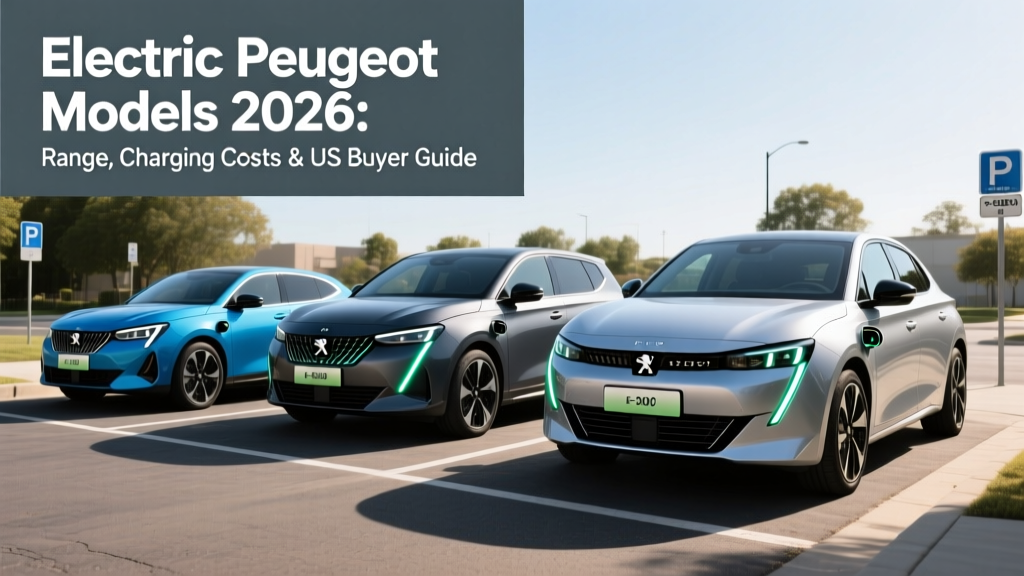
Peugeot does not sell vehicles in the United States as of 2026, and has not announced a return. The electric Peugeot lineup — including the e-208, e-2008, e-308, and e-3008 — is available exclusively in Europe, the UK, and select international markets. US-based shoppers researching the electric Peugeot lineup will find strong European-market EVs built on Stellantis's e-CMP and STLA Medium platforms, but no path to US purchase, federal tax credit eligibility, or domestic service support. If you're a US buyer drawn to Peugeot's design language, the closest Stellantis-platform alternatives include the Jeep Avenger EV (Europe-only) or the upcoming Dodge Charger Daytona EV for a performance-oriented American option.
Despite Peugeot's absence from US showrooms, the brand's electric vehicles remain among the most-searched European EVs among American enthusiasts, expats, and prospective importers. This guide breaks down the full 2026 electric Peugeot lineup with exact specs — range, battery capacity, charging speeds, and pricing — then contextualizes what ownership actually costs and how these models compare to EVs you can actually buy stateside.
The 2026 Electric Peugeot Lineup: Specs at a Glance
Peugeot has progressively electrified its core range using parent company Stellantis's shared platforms. The smaller models ride on the updated e-CMP2 architecture, while the newer e-3008 and e-5008 use the STLA Medium platform with significantly larger battery packs and longer range. All current electric Peugeot models use NMC (nickel-manganese-cobalt) lithium-ion battery chemistry, supplied primarily by CATL and Samsung SDI depending on the model and production batch.
| Model | Battery (kWh usable) | WLTP Range | Est. EPA Range | Peak DC Charge (kW) | 10–80% DC Time | Level 2 Rate (kW) | 0–62 mph (s) | HP | Starting Price (Europe, €) |
|---|---|---|---|---|---|---|---|---|---|
| e-208 | 51 | 248 mi (400 km) | ~205 mi | 100 | ~30 min | 11 | 8.1 | 156 | €33,550 |
| e-2008 | 54 | 227 mi (365 km) | ~190 mi | 100 | ~30 min | 11 | 8.6 | 156 | €37,900 |
| e-308 | 54 | 260 mi (418 km) | ~215 mi | 100 | ~30 min | 11 | 7.8 | 156 | €42,400 |
| e-3008 (Standard) | 73 | 326 mi (525 km) | ~270 mi | 160 | ~27 min | 22 | 8.8 | 213 | €44,900 |
| e-3008 (Long Range) | 97 | 435 mi (700 km) | ~360 mi | 160 | ~33 min | 22 | 8.8 | 230 | €51,400 |
Note: WLTP range figures are from Peugeot's official specifications. Estimated EPA equivalents apply a ~17–20% reduction to WLTP, consistent with observed differences between the two testing cycles. Peugeot does not publish EPA figures since it does not sell in the US market.
Real-World Range Reality Check
The e-3008 Long Range's headline 435-mile WLTP figure sounds extraordinary, but real-world conditions tell a more nuanced story. In European mixed-driving tests at 70°F (21°C), testers have achieved roughly 350–380 miles on a full charge. On sustained Autobahn or motorway driving at 75+ mph, expect that to drop to approximately 280–300 miles. In winter conditions (32°F / 0°C), range reduction of 20–30% is typical for NMC chemistry without preconditioning, potentially bringing the Long Range e-3008 down to 250–300 miles. The e-208, with its smaller 51 kWh pack, will realistically deliver 150–170 miles in cold-weather highway driving — adequate for European commutes but tight for American-style distances.
Charging Infrastructure: CCS2 in Europe, No NACS Option
Every electric Peugeot sold in 2026 uses the CCS2 (Combined Charging System Type 2) connector standard, which is the European norm. This is a critical distinction for any US-based reader: CCS2 is physically different from the CCS1 connector that was common in North America, and it's entirely different from the NACS (North American Charging Standard) that Tesla pioneered and that Ford, GM, Rivian, and others have adopted for 2025+ models.
| Charging Level | Connector | Power (kW) | Miles Added per Hour | Typical Use Case |
|---|---|---|---|---|
| Level 1 (Domestic) | Type 2 / Schuko | 2.3 | ~8–10 mi/hr | Overnight emergency top-up |
| Level 2 (Wallbox) | Type 2 | 7.4–22 | ~25–75 mi/hr | Home / workplace daily charging |
| DC Fast (e-208/2008/308) | CCS2 | Up to 100 | ~180 mi in 30 min | Motorway service stations |
| DC Fast (e-3008) | CCS2 | Up to 160 | ~220 mi in 27 min | High-power highway chargers |
The e-3008's STLA Medium platform supports 22 kW AC Level 2 charging as an option — a significant advantage over the 11 kW maximum on the smaller e-CMP2 models. At 22 kW, a full charge from empty on the 97 kWh Long Range pack takes roughly 5 hours, making destination and workplace charging genuinely practical. The 100 kW DC ceiling on the e-208 and e-308 is adequate but falls behind competitors like the Hyundai Kona Electric (which peaks at 150+ kW) and limits usefulness at 350 kW ultra-rapid chargers now common across European motorways.
One charging-curve reality worth noting: like most NMC packs, Peugeot's batteries taper charge rate significantly above 80% state of charge. The published 10–80% times are the practical fast-charging windows. Pushing from 80–100% on DC can add another 20–25 minutes — plan your road-trip stops accordingly.
Electric Peugeot vs. Gas Peugeot: Cost Comparison
For European buyers — or US expats living abroad — the financial case for electric Peugeot models hinges on energy costs, tax incentives, and total cost of ownership. Here's how the e-308 stacks up against its gasoline equivalent, the 308 1.2 PureTech, over a 5-year / 60,000-mile ownership period using European averages.
| Cost Factor (5 yr / 60,000 mi) | e-308 Electric | 308 1.2 PureTech (Gas) |
|---|---|---|
| Purchase Price (€) | €42,400 | €31,200 |
| Energy / Fuel Cost | €3,960 (home charging at €0.22/kWh) | €7,560 (at €1.80/L, 42 MPG) |
| Maintenance | €1,200 | €2,800 |
| Insurance (avg) | €4,500 | €3,900 |
| Estimated Depreciation | €18,200 | €12,500 |
| Government Incentives (France bonus) | –€4,000 | €0 |
| Total 5-Year Cost | €66,260 | €57,960 |
The electric Peugeot still carries a cost premium over five years in this scenario — roughly €8,300 more. The gap narrows significantly with higher annual mileage (the energy savings scale linearly), access to cheap overnight home charging, or in countries with stronger purchase incentives. In Norway, for instance, VAT exemptions and toll waivers can flip the math entirely. But the data makes clear that the "EVs are always cheaper" narrative depends heavily on your specific driving patterns, electricity rate, and local incentive structure.
For US readers benchmarking against American EVs: a comparably priced EPA-rated EV like the Tesla Model 3 RWD (starting ~$38,990, EPA 272 mi) or Chevrolet Equinox EV (starting ~$33,000, EPA 319 mi) would likely qualify for the §30D federal tax credit of up to $7,500 — subject to MSRP caps ($55,000 for sedans, $80,000 for SUVs), buyer income limits ($150K single / $300K joint), and battery critical-mineral sourcing requirements. That credit can close the price gap with a gas vehicle much faster than European incentives typically achieve.
US Buyer Alternatives: What to Drive Instead
If the electric Peugeot's design-forward interior, compact footprint, or Stellantis engineering appeals to you, here are US-market EVs that deliver similar qualities with full domestic support, EPA certification, and tax-credit eligibility.
Choose Your Path
Choose a Tesla Model 3 if: you want the e-308's blend of ~215-mile real-world range and premium interior, but need NACS Supercharger access, EPA-certified range (272–363 mi depending on trim), and §30D credit eligibility. Starting at ~$38,990.
Choose a Hyundai Kona Electric if: you want a compact crossover in the e-2008's class with faster DC charging (150+ kW peak), EPA 261-mile range, and a ~$32,975 starting price. Strong value with 10-year/100,000-mile powertrain warranty.
Choose a Chevrolet Equinox EV if: you want e-3008-class space and range (EPA 319 mi) at a lower price point (~$33,000 base), with GM's Ultium platform and available Super Cruise Level 2 driver assistance.
Choose a Volvo EX30 if: you crave European design sensibility closest to Peugeot's aesthetic, with 261 miles of EPA range, 153 kW DC charging, and a starting price around $34,950.
Wait for the Jeep Avenger (if US-bound): Stellantis has hinted at bringing smaller EVs to the US under the Jeep brand. The European-market Avenger EV shares e-CMP2 roots with the e-208 but wears Jeep styling. No US launch confirmed for 2026.
Common Misconceptions About Electric Peugeots
| Myth | Fact |
|---|---|
| "You can import an electric Peugeot to the US" | Federal homologation (NHTSA/EPA certification) is required for any vehicle sold or permanently imported in the US. Peugeot has not certified any current model. The 25-year import exemption won't apply to any 2026 model until 2051. Grey-market imports face enormous compliance costs and no service network. |
| "The 435-mile WLTP range means 435 real miles" | WLTP is more generous than EPA testing. Expect ~360 miles EPA-equivalent and ~280–300 miles at sustained highway speeds. Cold weather further reduces this by 20–30%. Always plan trips around 70–80% of the WLTP sticker figure. |
| "Peugeot batteries degrade quickly" | Peugeot warranties its EV batteries for 8 years / 160,000 km (~100,000 mi) with a guaranteed minimum 70% state of health. Real-world data from early e-208 owners (2019–2022 models) shows approximately 5–8% degradation after 60,000 miles — well within warranty tolerance and comparable to other NMC packs. |
| "100 kW charging is too slow for road trips" | At 100 kW peak, the e-208 adds roughly 120 miles in 20 minutes — enough for a comfortable rest stop. The real limitation is sustained rate: if the pack is cold or above 60% SoC, actual throughput may average 50–65 kW. Preconditioning (available via the MyPeugeot app) helps, but the e-3008's 160 kW peak is meaningfully better for frequent long-distance drivers. |
| "All Stellantis EVs are the same underneath" | While e-CMP2 models share platform architecture, tuning, thermal management, battery supplier, software calibration, and interior execution differ significantly between Peugeot, Citroën, Opel/Vauxhall, and Fiat. The e-308's ride quality and cabin materials, for instance, are a clear step above the mechanically related Opel Astra Electric. |
Ownership Realities: What First-Time EV Buyers Should Know
Whether you're evaluating a European electric Peugeot or a US-market alternative, first-time EV ownership involves several practical considerations that spec sheets don't capture:
Home charging access is non-negotiable for most owners. Public-only charging adds 30–60 minutes per week and costs 2–3× more per mile than home electricity. If you lack a garage or dedicated parking spot with outlet access, a PHEV (plug-in hybrid) may be a more practical bridge. Peugeot's own 308 Hybrid 180 offers 37 miles of WLTP electric-only range with a gasoline backup — available in Europe.
Insurance costs 15–25% more for EVs on average, driven by higher repair costs for battery-adjacent damage and specialized technician requirements. Get quotes before committing. In the US, insurers like State Farm, GEICO, and Progressive now offer EV-specific policies, but premiums still reflect the higher replacement value of battery packs.
Tire wear accelerates on EVs. The instant torque and added weight (the e-3008 Long Range weighs approximately 4,850 lbs / 2,200 kg) consume tires 20–30% faster than equivalent gas vehicles. Budget for premium EV-rated tires (Michelin Pilot Sport EV, Hankook iON) at $200–$300 per corner, replaced every 25,000–35,000 miles.
Software updates matter. Peugeot's connected services through the MyPeugeot app have improved substantially since 2023, offering remote preconditioning, charge scheduling, and battery health monitoring. However, European owners report occasional connectivity gaps and slower OTA (over-the-air) update cadence compared to Tesla or Rivian. Factor the software experience into your decision.
Will Peugeot Ever Return to the US?
Peugeot withdrew from the US market in 1991 after selling the 405 and 505 sedans. Since then, periodic rumors of a US return have surfaced — most credibly when Stellantis was formed in 2021 through the Fiat Chrysler–PSA merger. CEO Carlos Tavares (who stepped down in early 2025) had previously floated the idea, but Stellantis's current US strategy focuses on Jeep, Ram, Dodge, Chrysler, and Alfa Romeo. As of mid-2026, there is no confirmed plan, timeline, or homologation effort to bring Peugeot — electric or otherwise — back to American dealerships.
The practical implication: any US buyer researching the electric Peugeot should treat it as benchmarking research, not a purchase decision. The engineering is legitimate, particularly the STLA Medium platform in the e-3008, which delivers genuinely competitive range and charging. But without US availability, EPA certification, a domestic service network, or §30D tax credit eligibility, these vehicles remain a European story.
Frequently Asked Questions
What is the longest-range electric Peugeot available in 2026?
The e-3008 Long Range with its 97 kWh battery pack achieves a WLTP-rated 435 miles (~700 km). Real-world range is approximately 350–380 miles in mixed European driving and an estimated EPA-equivalent of ~360 miles. This positions it among the longest-range mainstream European EVs, competitive with the Renault Scenic E-Tech (385 mi WLTP) and Volkswagen ID.7 (382 mi WLTP).
How much does it cost to charge an electric Peugeot at home?
Using the European average electricity rate of €0.22/kWh, fully charging the e-208's 51 kWh battery costs approximately €11.22 (~$12.20). The e-3008 Long Range's 97 kWh pack costs roughly €21.34 (~$23.20) for a full charge. At US average rates of $0.16/kWh, equivalent costs would be $8.16 and $15.52 respectively — making US home charging notably cheaper per mile than European rates.
Does the electric Peugeot qualify for any US tax credits?
No. Because Peugeot does not sell vehicles in the US market, none of its models are eligible for the IRS §30D Clean Vehicle Credit. This credit requires the vehicle to be purchased new from a US-licensed dealer, meet MSRP caps, satisfy buyer income limits, and comply with battery component and critical mineral sourcing requirements — none of which apply to Peugeot's European-only sales.
What battery chemistry does Peugeot use, and how does it compare to LFP?
Peugeot uses NMC (nickel-manganese-cobalt) chemistry across its 2026 EV lineup. NMC offers higher energy density than LFP (lithium iron phosphate), enabling more range in a smaller, lighter pack — important for Peugeot's compact European vehicle segments. The trade-off: NMC degrades slightly faster than LFP over thousands of cycles and is more sensitive to sustained high state-of-charge storage. LFP packs (used in base-model Tesla Model 3, some BYD models) tolerate daily 100% charging and offer longer cycle life, but at the cost of lower energy density and reduced cold-weather performance.
Is Peugeot's driver-assistance system comparable to Tesla Autopilot?
Peugeot's Drive Assist Plus is an SAE Level 2 driver-assistance system combining adaptive cruise control with lane centering. It is not self-driving and requires continuous driver engagement — hands on or near the wheel, eyes on the road. It's competent for highway cruising but does not offer the automated lane changes, navigation-linked speed adjustments, or city-street capabilities of Tesla's FSD (Supervised) or GM's Super Cruise. No consumer vehicle currently sold anywhere offers SAE Level 3 or above for general use, though Mercedes-Benz's Drive Pilot (Level 3, limited to 40 mph on approved German highways) is the sole exception globally.
What is the battery warranty on electric Peugeot models?
Peugeot provides an 8-year / 160,000 km (~100,000 mile) battery warranty guaranteeing a minimum 70% state of health (SoH). If the battery degrades below this threshold within the warranty period, Peugeot will repair or replace modules to restore capacity above 70%. This is standard for the European EV market and comparable to Volkswagen, Renault, and Hyundai's European warranty terms. In the US, many manufacturers offer more generous coverage — Hyundai's 10-year/100,000-mile battery warranty is the segment benchmark.