Quick Verdict: A Polarizing Truck With Genuine Capability
The Tesla Cybertruck is the most talked-about EV pickup on the road — and stepping inside of Tesla truck's angular stainless-steel shell reveals a cabin that is simultaneously minimalist, surprisingly spacious, and divisive in its design choices. For 2026, the Cybertruck lineup has settled into three trims: the Dual Motor AWD, the tri-motor Cyberbeast, and a newly available Long Range AWD variant. With EPA range stretching up to 340 miles, up to 845 horsepower, and a payload/towing profile that competes with legacy pickups, the Cybertruck is a serious tool. But whether its interior ergonomics, panel-gap quirks, and $80,000+ starting price make it the right truck for you depends heavily on your priorities.
| Spec | Long Range AWD | Dual Motor AWD | Cyberbeast (Tri-Motor) |
|---|---|---|---|
| EPA Range | 340 mi | 320 mi | 320 mi |
| Battery (usable) | ~123 kWh (NMC) | ~123 kWh (NMC) | ~123 kWh (NMC) |
| Horsepower | ~600 hp | ~600 hp | 845 hp |
| 0-60 mph | 3.9 s | 3.9 s | 2.6 s |
| Max DC Fast Charge | 250 kW | 250 kW | 250 kW |
| 10-80% DC Time | ~27 min | ~27 min | ~27 min |
| Level 2 (11.5 kW) | ~44 mi/hr | ~44 mi/hr | ~44 mi/hr |
| Towing Capacity | 11,000 lb | 11,000 lb | 11,000 lb |
| Payload | 2,500 lb | 2,500 lb | 2,500 lb |
| Base MSRP | $99,990 | $79,990 | $99,990 |
Source: Tesla Cybertruck Design Page; EPA figures via fueleconomy.gov.
Inside of Tesla Truck: Cabin Design, Materials, and Space
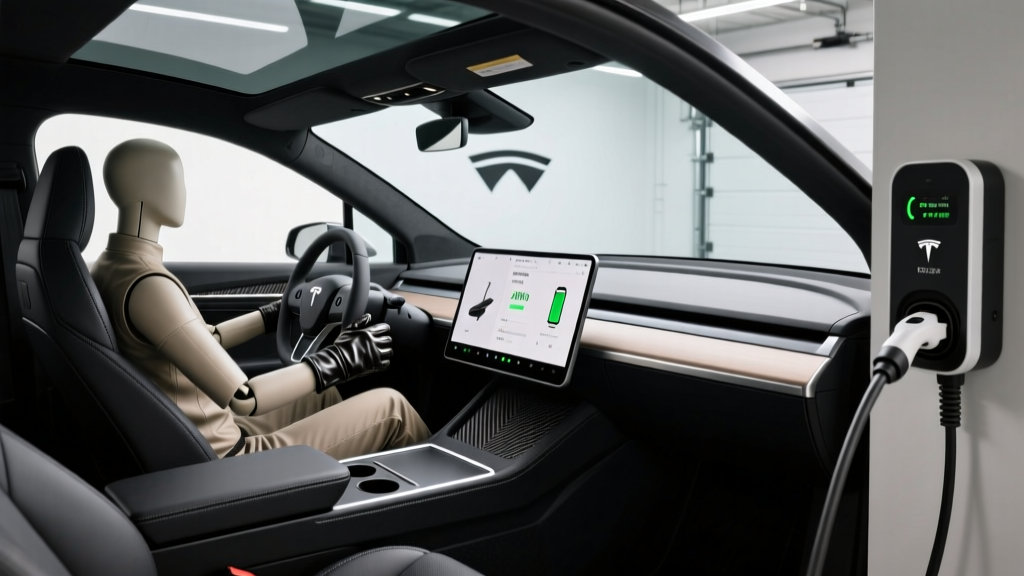
Open the door handles (which are flush-integrated buttons on the Cybertruck's B- and C-pillars) and the interior theme is unmistakable: brutalist minimalism. The dashboard is a single horizontal slab of what Tesla describes as a textile-like material — not traditional leather or soft-touch plastic. A massive 18.5-inch center touchscreen dominates the dash, handling everything from climate to media to vehicle settings. There are no physical stalks; turn signals are buttons on the steering wheel, and gear selection is a touchscreen slider (with a roof-mounted backup strip for redundancy).
Front and Rear Dimensions
The Cybertruck seats up to six across two rows. Front headroom is generous at 41.2 inches thanks to the tall roofline, and legroom measures 41.8 inches. The rear bench offers 38.4 inches of legroom — competitive with a Ford F-150 SuperCrew — though the low, flat seat cushion means thighs aren't as well supported on long drives. Rear headroom is 39.1 inches, though the sloping rear glass cuts into the feeling of openness for taller passengers.
Cargo: The Vault and the Frunk
The 6-foot bed — Tesla calls it "The Vault" — provides 67 cubic feet of lockable storage with the motorized tonneau cover closed. The bed floor is composite and includes built-in tie-down rails, a 120V/240V outlet (NEMA 14-50 capable for job-site tools or camping), and integrated LED lighting. The front trunk (frunk) adds roughly 7 cubic feet of lockable, drainable storage — useful for wet gear or groceries. Total enclosed cargo volume with the rear seats folded flat reaches approximately 121 cubic feet.
Tech and Infotainment
The Cybertruck runs Tesla's latest vehicle software on an AMD Ryzen processor, with a 15-speaker audio system, native streaming apps (Spotify, Netflix, YouTube when parked), and over-the-air updates. Standard driver assistance is Tesla Autopilot (SAE Level 2), which includes Traffic-Aware Cruise Control and Autosteer. Full Self-Driving (Supervised) is available as an $8,000 add-on or $99/month subscription — but it remains a Level 2 system requiring constant driver attention, not a self-driving solution.
Range, Efficiency, and Real-World Expectations
The 2026 Cybertruck Long Range AWD carries an EPA-estimated 340 miles of range, while the Dual Motor and Cyberbeast trims are rated at 320 miles. These numbers place the Cybertruck near the top of the electric-pickup segment, alongside the Rivian R1T (up to 420 miles with the Max Pack) and the Ford F-150 Lightning Extended Range (320 miles).
Efficiency is rated at approximately 55 MPGe combined (Dual Motor), translating to roughly 60 kWh per 100 miles — which is high by EV standards but expected for a 6,800+ lb stainless-steel truck with the aerodynamic profile of a wedge. The Cyberbeast, with its tri-motor setup and stickier tires, dips slightly to ~53 MPGe.
Charging Speed: DC Fast Charging and Home Level 2
The Cybertruck uses Tesla's proprietary NACS (North American Charging Standard) connector natively. On Tesla Superchargers V3 and V4, it peaks at 250 kW DC fast charging. In practice, the charging curve holds near peak rate from roughly 10% to 40% State of Charge, then progressively tapers — a characteristic of its NMC battery chemistry and thermal management calibration.
| Charging Level | Power / Voltage | Miles of Range Added per Hour | Notes |
|---|---|---|---|
| Level 1 (120V) | ~1.4 kW | ~3-4 mi/hr | Emergency/top-up only |
| Level 2 (240V, 48A) | 11.5 kW | ~44 mi/hr | Full charge in ~7 hours |
| DC Fast (Supercharger V3/V4) | 250 kW peak | ~150 mi in 15 min (peak) | 10-80% in ~27 min |
For home charging, the Cybertruck accepts up to 11.5 kW on a 240V/48A Level 2 circuit (Tesla Wall Connector or equivalent NACS charger). A full overnight charge from 10% to 100% takes roughly 7-8 hours. Installation of a dedicated 60A circuit for a Level 2 charger typically runs $800-$2,500 depending on panel proximity and whether a service upgrade is needed — consult a licensed electrician for your specific setup.
Charging note: With Tesla opening the Supercharger network to NACS-equipped non-Tesla EVs, the Cybertruck benefits from the largest and most reliable DC fast-charging network in North America — over 30,000 stalls as of early 2026. This is a meaningful advantage for road-trippers over CCS-only trucks like the F-150 Lightning, though adapters exist.
Pricing, Trims, and Federal Tax Credit Eligibility
The 2026 Cybertruck lineup starts at $79,990 for the Dual Motor AWD, rises to $99,990 for the Long Range AWD and Cyberbeast. Adding FSD (Supervised) at $8,000, premium paint options, or the Armor Glass upgrade can push a Cyberbeast past $110,000 as-tested.
| Trim | Base MSRP | Federal §30D Credit | Effective Price (if eligible) |
|---|---|---|---|
| Dual Motor AWD | $79,990 | Up to $7,500 | ~$72,490 |
| Long Range AWD | $99,990 | Up to $7,500 | ~$92,490 |
| Cyberbeast | $99,990 | Up to $7,500 | ~$92,490 |
Federal tax credit caveats (IRS §30D, 2026 rules): The Cybertruck qualifies as a light truck, so it falls under the $80,000 MSRP cap for trucks/vans/SUVs. This means the Dual Motor AWD at $79,990 base narrowly qualifies, but adding options that push MSRP above $80,000 will disqualify it. The Long Range and Cyberbeast trims, at $99,990, do not qualify for the federal credit. Additionally, buyer income caps apply ($150,000 single / $300,000 joint AGI), and battery critical-mineral and component sourcing requirements must be met. The credit can be transferred to the dealer at point of sale as a discount. Always verify current eligibility on IRS.gov and consult a tax professional before purchasing.
Performance and Driving Impressions
The Cyberbeast's 845 horsepower and 2.6-second 0-60 mph time make it one of the quickest production vehicles ever sold, let alone a pickup truck. Even the Dual Motor AWD, at 3.9 seconds to 60 mph, outruns most sports cars. The tri-motor setup provides torque-vectoring across the rear axle, giving the Cyberbeast remarkable cornering poise for its weight.
Ride quality benefits from the Cybertruck's adaptive air suspension, which offers up to 12 inches of ground clearance in Off-Road mode and can lower the truck for highway efficiency. Steering is quick (and variable-ratio), but the steer-by-wire system — which replaces the mechanical connection between wheel and tires with electronic signals — takes adjustment. Some drivers love its precision at low speeds and stability on the highway; others miss the tactile feedback of a traditional rack. The 4-wheel steering system gives the Cybertruck a turning circle of just 37.4 feet, tighter than a Toyota RAV4, despite the truck's 231-inch length.
Battery, Warranty, and Long-Term Ownership
The Cybertruck uses a ~123 kWh (usable) NMC (nickel-manganese-cobalt) structural battery pack integrated into the vehicle's exoskeleton. NMC chemistry provides high energy density — essential for fitting 340 miles of range in a heavy truck — but it's more sensitive to sustained 100% charge states than LFP. Tesla recommends daily charging to 80-90% for routine use and 100% only before long trips.
Tesla's battery and drive-unit warranty covers 8 years or 120,000 miles (whichever comes first) with a minimum 70% capacity retention threshold. The limited vehicle warranty is 4 years / 50,000 miles. These terms are competitive with the industry standard, though some rivals like Hyundai offer longer bumper-to-bumper coverage.
Insurance note: Cybertruck insurance premiums run 25-40% higher than a comparable F-150 Lightning, driven by stainless-steel body repair complexity, high parts costs, and the vehicle's performance profile. Get quotes before purchasing.
Pros, Cons, and Who Should Buy the Cybertruck
Pros
- Class-leading performance (2.6s 0-60 Cyberbeast)
- 11,000-lb towing and 2,500-lb payload
- Access to Tesla Supercharger network (NACS native)
- Stainless-steel exoskeleton: dent- and corrosion-resistant
- 4-wheel steering gives surprisingly tight turning radius
- 240V bed outlet for tools, camping, and V2L use
- OTA software updates continuously add features
Cons
- MSRP above $80K disqualifies most trims from federal tax credit
- Steer-by-wire takes significant adaptation
- Interior materials feel sparse for the price point
- Real-world highway and cold-weather range drops notably
- No Apple CarPlay or Android Auto support
- Panel fit and finish variability (improving, but still reported)
- High insurance premiums relative to competitors
Who This EV Suits Best
Buy the Cybertruck if: You want an electric truck that can genuinely tow, haul, and handle job-site duty while delivering supercar acceleration; you value Supercharger network access for road trips; you're comfortable with a minimalist, screen-centric interface; and your budget accommodates a $80K-$110K truck.
Look elsewhere if: You need a traditional truck interior with physical controls and CarPlay (consider the F-150 Lightning or Rivian R1T); you want to maximize federal tax credit savings (the Lightning and R1T base trims qualify more easily); or you prioritize plush ride comfort over performance.
Frequently Asked Questions
What is the real-world range of the Tesla Cybertruck?
The EPA rates the Long Range AWD at 340 miles and the Dual Motor/Cyberbeast at 320 miles. In real-world highway driving at 75 mph, expect roughly 260-285 miles. In freezing temperatures, plan for 210-240 miles. Towing a heavy trailer will cut range to 140-170 miles between stops.
How fast does the Cybertruck charge at home and on the road?
On a Tesla Supercharger (250 kW peak), the Cybertruck charges from 10% to 80% in approximately 27 minutes. At home on a 240V Level 2 charger (11.5 kW), it adds about 44 miles of range per hour, fully charging overnight in 7-8 hours.
Does the Cybertruck qualify for the $7,500 federal EV tax credit?
The base Dual Motor AWD at $79,990 MSRP narrowly qualifies under the §30D truck cap of $80,000, assuming the buyer meets income limits ($150K single / $300K joint) and battery-sourcing requirements are satisfied. The Long Range and Cyberbeast at $99,990 exceed the cap and do not qualify. Always verify on IRS.gov.
Is the Cybertruck worth buying vs. the Ford F-150 Lightning or Rivian R1T?
The Cybertruck wins on raw performance, Supercharger network access, and futuristic design. The F-150 Lightning offers a more traditional truck experience, lower starting price, easier tax-credit qualification, and Ford dealer service. The Rivian R1T provides a more refined interior, up to 420 miles of range (Max Pack), and better off-road capability. Your choice depends on whether you prioritize performance and Tesla's ecosystem (Cybertruck), conventional usability and value (Lightning), or adventure refinement and range (R1T).
How big is the inside of the Tesla truck Cybertruck cabin?
The Cybertruck seats up to six with 41.8 inches of front legroom and 38.4 inches of rear legroom. The 6-foot bed offers 67 cubic feet of lockable storage, and the frunk adds roughly 7 cubic feet. Total enclosed cargo with seats folded reaches approximately 121 cubic feet.
Does the Cybertruck have steer-by-wire, and is it safe?
Yes, the Cybertruck uses a fully electronic steer-by-wire system with no mechanical connection. It includes redundant backup systems and has been validated under NHTSA compliance standards. Most drivers adapt within a few days, but the lack of traditional road feel is a notable departure.