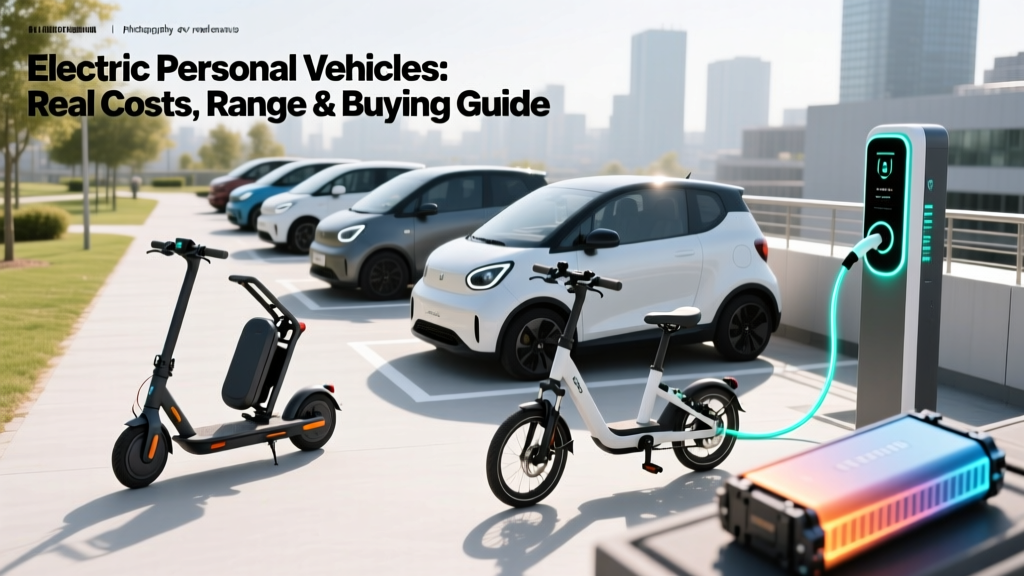
The Short Answer on Electric Personal Vehicles
Electric personal vehicles (EVs) make financial sense for most drivers who can charge at home and drive 200+ miles weekly — expect fuel savings of $800–$1,500 annually versus a comparable gas car, with near-zero drivetrain maintenance. A typical 2026 EV with 270–320 miles of EPA range, priced between $35,000 and $50,000, will cost roughly $0.04–$0.06 per mile on home electricity versus $0.12–$0.16 per mile for a 28-MPG gas car at $3.40/gallon. However, if you lack home charging access, regularly drive in sub-20°F winters, or tow heavy loads, a plug-in hybrid may serve you better. The upfront price premium has narrowed to $2,000–$5,000 for many segments, and the federal §30D tax credit can offset up to $7,500 at the point of sale — but eligibility depends on your income, the vehicle's MSRP, and battery-mineral sourcing requirements.
What Are Electric Personal Vehicles in 2026?
Electric personal vehicles encompass any passenger car, SUV, or truck powered entirely by a battery-electric drivetrain (BEV) or partially by a plug-in hybrid system (PHEV). The market has matured significantly: over 60 distinct EV models are available in the U.S. for the 2026 model year, spanning from the $28,000-segment Chevrolet Equinox EV to the $90,000+ Rivian R1T and Tesla Model X. Battery packs now commonly range from 60 kWh to over 100 kWh, and the median EPA range across new models sits around 280–310 miles.
The core decision for buyers isn't whether EVs are viable — they are — but whether the specific economics, charging logistics, and driving patterns of your household align with battery-electric ownership. Let's break that down with real numbers.
EV vs Gas: The Real Cost Comparison
Marketing materials often highlight fuel savings, but a true comparison must account for purchase price, electricity versus gasoline, insurance, maintenance, and depreciation. Below is a 5-year cost comparison between a representative 2026 EV (similar to a Hyundai Ioniq 5 or Tesla Model 3) and a comparable gasoline sedan (similar to a Toyota Camry or Honda Accord).
| Category | 2026 EV (280 mi range) | Gas Sedan (30 MPG) | Difference |
|---|---|---|---|
| Purchase Price (base MSRP) | $42,000 | $32,000 | +$10,000 EV |
| Federal Tax Credit (§30D) | −$7,500 | $0 | −$7,500 EV |
| Effective Purchase Price | $34,500 | $32,000 | +$2,500 EV |
| Fuel/Energy (5 years) | $3,750 (home charging, $0.14/kWh) | $8,500 ($3.40/gal) | −$4,750 EV |
| Maintenance (5 years) | $1,200 | $3,500 | −$2,300 EV |
| Insurance (5 years) | $9,500 | $7,500 | +$2,000 EV |
| Depreciation (est. 5-yr) | $18,000 | $14,000 | +$4,000 EV |
| Total 5-Year Cost | $66,950 | $65,500 | +$1,450 EV |
Key takeaway: The EV is nearly cost-neutral over five years when the full federal credit applies and you charge primarily at home. Without the tax credit, the EV costs roughly $9,000 more. If you rely exclusively on DC fast charging at $0.35–$0.50/kWh, your energy cost jumps to $7,500–$10,000 over five years — erasing most fuel savings.
Range Reality: EPA Stickers vs the Real World
EPA range estimates are standardized laboratory tests that don't fully account for highway speeds, cold weather, or terrain. Here's what to actually expect from a typical 2026 EV rated at 300 miles EPA:
Real-World Range Expectations (300-Mile EPA Vehicle)
- Mild weather, mixed driving (city + highway): 270–290 miles
- Sustained 75-MPH highway: 240–265 miles
- Cold weather (20°F), cabin heat on: 195–230 miles (25–35% loss)
- Cold weather + highway speeds: 180–210 miles
- Towing (if equipped, 3,000+ lbs): 140–180 miles
Cold-weather range loss is the single biggest surprise for first-time EV buyers in northern states. Vehicles equipped with a heat pump — standard on most 2026 Hyundai, Kia, Tesla, and BMW models — recover roughly 5–10% of that loss compared to resistive heating. If you live where winters regularly dip below freezing, budget for at least 30% range reduction and consider a vehicle with 320+ miles of EPA range as your practical minimum.
According to fueleconomy.gov, EV efficiency is measured in MPGe (miles per gallon equivalent) and kWh per 100 miles. A typical 2026 midsize EV achieves 110–130 MPGe combined, consuming 25–30 kWh/100 mi. The most efficient models, like the Hyundai Ioniq 6 and Tesla Model 3 Highland, reach 140+ MPGe and under 24 kWh/100 mi.
Charging: Home Access Is the Make-or-Break Factor
The single most important ownership variable is whether you can charge at home. Approximately 70–80% of EV charging happens at home for owners with access, making daily ownership effortless. Without it, you'll rely on public infrastructure, which in 2026 is more robust than ever but still inconsistent in reliability and significantly more expensive.
| Level | Power (kW) | Miles Added/Hour | Cost per kWh | Best For |
|---|---|---|---|---|
| Level 1 (120V outlet) | 1.2–1.9 kW | 3–5 mi/hr | $0.12–$0.18 | Overnight top-up, PHEVs |
| Level 2 (240V home) | 7.2–11.5 kW | 20–40 mi/hr | $0.12–$0.18 | Daily home charging |
| DC Fast Charge | 50–350 kW | 150–800+ mi/hr | $0.30–$0.55 | Road trips, emergency top-ups |
kW vs kWh — the critical distinction: kW (kilowatts) measures charging power — how fast energy flows into the battery. kWh (kilowatt-hours) measures battery capacity — how much total energy is stored. A 75-kWh battery charged at 150 kW would theoretically fill in 30 minutes, but in practice, charging slows dramatically above 80% state of charge to protect battery health. This is the charge curve: a vehicle might peak at 250 kW from 10–40% SoC, then taper to 80 kW by 70% and 25 kW by 90%.
For a typical 2026 EV with a 75–85 kWh battery and 200+ kW peak capability, expect a 10–80% DC fast charge in 18–25 minutes at a compatible station. Plan road-trip stops around 25–30 minutes for meaningful range additions.
Home Level 2 installation costs vary widely based on your electrical panel's capacity and the distance from panel to charger location:
| Component | Low Estimate | High Estimate |
|---|---|---|
| Level 2 charger hardware (hardwired or NEMA 14-50) | $300 | $700 |
| Electrician labor (standard install, <30 ft run) | $500 | $1,200 |
| Electrical permit | $50 | $200 |
| Panel upgrade (200A service, if needed) | $1,500 | $3,500 |
| Total (no panel upgrade) | $850 | $2,100 |
| Total (with panel upgrade) | $2,350 | $5,600 |
Many 2026 EVs qualify for a separate residential charging credit (up to $1,000 under §30C), though it has its own eligibility rules and has faced legislative uncertainty — verify current status with a tax professional.
The Federal Tax Credit: §30D Rules That Actually Apply
The federal clean vehicle credit under IRS §30D remains a major purchase incentive, but qualifying is more nuanced than "get $7,500." Here's the 2026 eligibility framework:
§30D Federal EV Tax Credit Requirements (2026)
- Buyer income cap: Modified AGI ≤ $150,000 (single) / $225,000 (head of household) / $300,000 (married filing jointly)
- Vehicle MSRP cap: ≤ $55,000 for sedans/wagons; ≤ $80,000 for SUVs/pickups/vans
- Battery sourcing: Required percentages of critical minerals and battery components must be sourced from the U.S. or free-trade-agreement countries (thresholds increase annually)
- Final assembly: Vehicle must be assembled in North America
- Point-of-sale transfer: You can transfer the credit to the dealer at purchase for an immediate price reduction, or claim it on your tax return
- Credit amount: Up to $7,500 ($3,750 for critical minerals + $3,750 for battery components — you may qualify for one or both halves)
Critical minerals and battery-component sourcing requirements have tightened each year since 2023, and several popular models have gained or lost eligibility as automakers shift supply chains. Always check the latest fueleconomy.gov tax credit listings before purchasing — a model that qualified in January may not qualify in June if sourcing changes.
Common Misconceptions — Fact-Checked
| Myth | Fact |
|---|---|
| "EV batteries need replacing every 5 years" | Modern NMC and LFP packs degrade ~1.5–2.5% per year. At year 8, most retain 82–90% capacity. Federal law mandates battery warranties of at least 8 years/100,000 miles covering capacity below 70%. |
| "EVs are worse for the environment" | Even on coal-heavy grids, lifecycle emissions are 50–70% lower than gas cars over 150,000 miles (Union of Concerned Scientists data). On clean grids, the advantage exceeds 80%. |
| "Charging takes too long for road trips" | With 200+ kW DC fast chargers now widespread on major corridors, a 10–80% charge takes 18–25 minutes — comparable to a rest stop with food and restroom break. |
| "EVs don't work in cold climates" | EVs function in all climates. Range drops 20–35% in deep cold, but preconditioning (warming the battery while plugged in) recovers charging speed. Norway — with brutal winters — has over 80% new-car EV adoption. |
| "The grid can't handle EVs" | Most charging occurs overnight during off-peak hours. Utilities actively manage load with time-of-use rates. A single EV adds roughly the equivalent of one central AC unit to household demand. |
| "Insurance is always double" | EV insurance averages 15–25% higher than comparable gas cars, not double. Some insurers now offer EV-specific policies with competitive rates. |
First-Time Buyer Decision Framework
Should You Buy an EV, a PHEV, or Stick with Gas?
Choose a full EV (BEV) if:
- You have reliable home or workplace Level 2 charging access
- Your daily driving is under 80 miles round-trip (well within one-charge range)
- You take road trips fewer than 6–8 times per year, or routes have DC fast charging
- You want the lowest per-mile fuel cost and minimal maintenance
- You qualify for the §30D tax credit (check income + vehicle eligibility)
Choose a plug-in hybrid (PHEV) if:
- You lack consistent home charging but can plug in occasionally
- You frequently drive 300+ miles in a day or travel through charging-desert corridors
- You live in an apartment without charging infrastructure and public options are sparse
- You want 25–40 miles of electric-only commuting with gas-engine range security
- Cold-weather range loss is a dealbreaker for your commute reliability
Stick with a conventional hybrid (HEV) or gas car if:
- You have zero charging access at home, work, or in your community
- Your budget is under $28,000 and you need the lowest possible purchase price
- You regularly tow over 5,000 lbs and need maximum range between stops
- You plan to keep the vehicle 15+ years and want to avoid long-term battery uncertainty
Battery Longevity: What 2026 Data Shows
Battery degradation remains a top concern, but real-world data from high-mileage fleets and owner surveys has eased fears considerably. Most 2026 EVs use either NMC (nickel-manganese-cobalt) or LFP (lithium iron phosphate) chemistry:
| Factor | LFP (Lithium Iron Phosphate) | NMC (Nickel-Manganese-Cobalt) |
|---|---|---|
| Energy Density | Lower (heavier pack for same range) | Higher (lighter, more range per kg) |
| Cycle Life | 3,000–5,000+ cycles | 1,500–2,500 cycles |
| Cold Performance | Weaker in sub-freezing temps | Better cold-weather range retention |
| Charging to 100% | Recommended regularly for calibration | Best kept at 80% daily; 100% for trips only |
| Cost | Lower (no cobalt or nickel) | Higher |
| Found In | Tesla Model 3 RWD, standard-range models | Most long-range and AWD models |
Replacement costs, if needed out of warranty, range from $8,000 to $18,000 depending on pack size and vehicle — but fewer than 2% of EV batteries have required full replacement within the first 10 years of ownership, per industry warranty-claim data. The standard warranty is 8 years/100,000 miles with a capacity-retention threshold of 70%.
Frequently Asked Questions
Do electric personal vehicles save money long-term?
Yes, for most drivers with home charging. Over 5 years and 75,000 miles, an EV typically saves $4,000–$7,000 in fuel and maintenance versus a gas car, partially offset by higher insurance and potentially faster depreciation. The federal tax credit, when applicable, tips the balance firmly in the EV's favor. Without home charging or the tax credit, the financial case weakens significantly.
What happens if I run out of charge on the road?
The same thing that happens if you run out of gas: you need a tow. However, EV range estimation in 2026 vehicles is highly accurate (typically within 5% of displayed range under similar conditions), and built-in navigation systems route through charging stations automatically. Running out is almost always a planning failure, not a vehicle failure.
Can I charge an EV with a regular household outlet?
Yes — that's Level 1 charging at roughly 1.4 kW, adding 3–5 miles of range per hour. For a vehicle with a 75-kWh battery, a full charge from empty would take 50+ hours. Level 1 works fine for PHEVs with smaller batteries or for BEV owners who drive fewer than 30 miles daily. For regular BEV use, a Level 2 (240V) installation is strongly recommended.
How do EVs handle in snow and ice?
EVs have a low center of gravity (battery pack under the floor) and instant torque control, which helps traction. The main winter concern is range loss, not drivability. AWD EV models from Tesla, Hyundai/Kia, Ford, and others perform well in snow. Preconditioning the battery while plugged in preserves range and ensures fast-charging capability at your first stop.
Are EVs safe in crashes?
Yes. EVs consistently earn top ratings from both NHTSA and IIHS. Battery packs are housed in reinforced structures below the passenger cabin, and thermal management systems reduce fire risk. EV fire rates per 100,000 vehicles are lower than those of internal-combustion vehicles, according to NTSB data.
What's the best electric personal vehicle for a first-time buyer?
For 2026, the strongest value propositions include the Tesla Model 3 ($38,990 base, 341 mi EPA, 250 kW peak charging), Hyundai Ioniq 5 ($42,600 base, 303 mi EPA, 240 kW peak), and Chevrolet Equinox EV ($33,600 base, 319 mi EPA, 150 kW peak). The right choice depends on your charging access, space needs, and whether the §30D credit applies to your specific configuration.