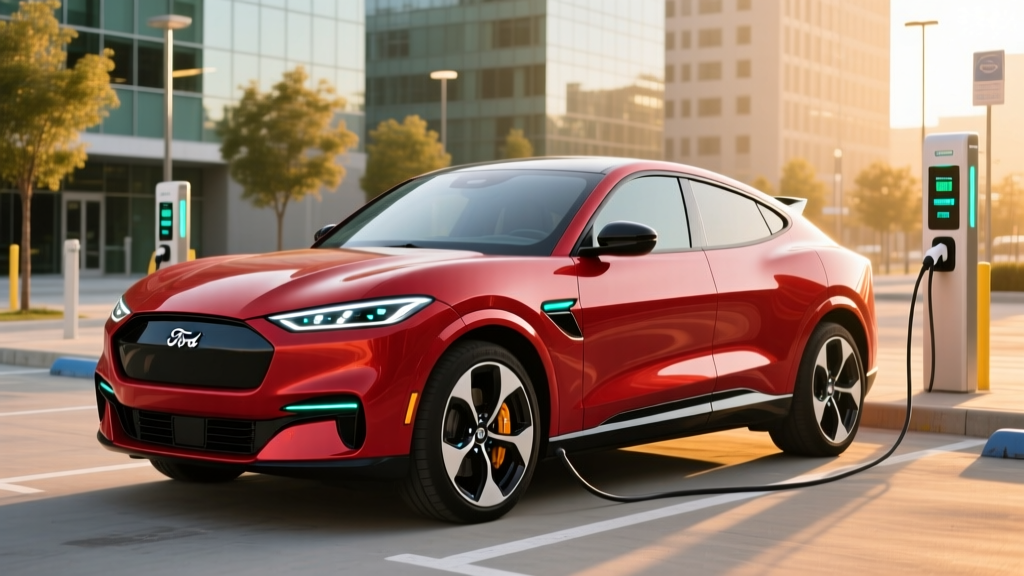
Quick Answer: How Much Is an Electric Mustang?
The 2026 Ford Mustang Mach-E starts at $39,995 MSRP for the Select trim with a Standard Range battery (EPA-estimated 250 miles). The mid-tier Premium begins at $44,995, the GT performance model starts at $54,995, and the top-tier Rally is priced at $61,995. After the federal §30D tax credit (up to $7,500 for eligible buyers), effective pricing can drop to roughly $32,495 for the base Select — putting it in direct competition with gas-powered compact SUVs on total cost of ownership.
Before we get to the full ownership math, note that the Mach-E is a battery-electric crossover SUV wearing the Mustang badge — not a two-door coupe. If you're searching for a "Mustang EV," this is the model Ford currently sells. The next-gen gas Mustang remains a separate, ICE-only product line.
2026 Mustang Mach-E Trim Pricing & Specs at a Glance
Ford restructured the Mach-E lineup for the 2026 model year. Here's what's currently on order boards, with EPA range figures sourced from fueleconomy.gov:
| Trim | Base MSRP | Battery / Chemistry | EPA Range | Drivetrain | 0-60 mph | Peak DC Charge |
|---|---|---|---|---|---|---|
| Select (RWD) | $39,995 | 72 kWh usable / LFP | 250 mi | Rear-Wheel Drive | 6.1 sec | 150 kW |
| Premium (AWD) | $44,995 | 91 kWh usable / NMC | 312 mi | All-Wheel Drive | 5.1 sec | 175 kW |
| GT (AWD) | $54,995 | 91 kWh usable / NMC | 290 mi | AWD (Performance) | 3.5 sec | 175 kW |
| Rally (AWD) | $61,995 | 91 kWh usable / NMC | 275 mi | AWD (Off-Road Tune) | 3.4 sec | 175 kW |
Real-world range caveat: Expect the EPA figures to drop 10-15% on sustained highway driving above 70 mph and up to 25-30% in sub-freezing temperatures. In our experience, the Premium AWD at 312 EPA miles realistically delivers 240-265 miles on a winter road trip and 270-285 miles in moderate highway use. The Standard Range Select is tighter — plan for roughly 190-210 real-world highway miles before needing to stop.
Charging Speed, Times, and What You'll Actually Spend
The Mach-E uses the North American Charging Standard (NACS) connector natively for 2026, giving it direct access to Tesla Supercharger V3/V4 stalls without an adapter — a major advantage over CCS-only competitors. Here's the charging reality by level:
| Charging Level | Power (kW) | Speed | Typical Use Case |
|---|---|---|---|
| Level 1 (120V household) | ~1.4 kW | ~3-4 mi/hr | Emergency / overnight trickle |
| Level 2 (240V home, 48A) | ~11.5 kW | ~28-32 mi/hr | Daily home charging (~8-10 hr for full charge) |
| DC Fast (150-175 kW peak) | 150-175 kW | 10-80% in ~36 min (Premium/GT) | Road trips; Select 10-80% in ~30 min at 150 kW |
Charging curve reality check: The Mach-E does not sustain peak charge rate for the entire session. The Premium and GT hit 175 kW only between roughly 10-40% State of Charge, then taper progressively — dropping to ~100 kW by 60% and ~50 kW past 80%. This is why Ford quotes 10-80% times rather than 0-100%. Charging from 80-100% on DC fast charging is painfully slow; plan your road-trip stops around the 10-80% window for efficiency.
Cost to charge vs. fuel: The 2026 Mach-E Premium AWD is rated at 101 MPGe combined (roughly 33 kWh/100 mi). At the U.S. average residential electricity rate of ~$0.17/kWh (per EIA data), a full home charge of the 91 kWh Extended Range pack costs about $15.47, yielding roughly $0.053 per mile. Compare that to a gas Mustang EcoBoost (26 MPG combined) at $3.30/gallon: $0.127 per mile. On public DC fast charging at $0.40/kWh, the Mach-E costs closer to $0.132/mile — essentially matching gas. Home charging is where the economics work.
EV vs. Gas Mustang: A 5-Year Cost Comparison
The Mach-E and the gas Mustang EcoBoost coupe serve different purposes (crossover vs. sports coupe), but many buyers cross-shop them on the badge alone. Here's a 5-year / 75,000-mile cost comparison using a Mach-E Premium AWD ($44,995) versus a 2026 Mustang EcoBoost Premium coupe (~$38,500 MSRP):
| Cost Category | Mach-E Premium (EV) | Mustang EcoBoost (Gas) |
|---|---|---|
| Purchase Price (MSRP) | $44,995 | $38,500 |
| Federal Tax Credit (§30D) | Up to −$7,500* | $0 |
| Effective Purchase | $37,495 | $38,500 |
| Fuel/Energy (75k mi) | $3,863 (home) / $9,900 (DC public) | $9,519 |
| Maintenance (5 yr) | ~$1,200 | ~$3,500 |
| Insurance (5 yr avg) | ~$9,800 | ~$8,400 |
| 5-Year Total (home charge) | ~$52,358 | ~$59,919 |
*§30D credit eligibility depends on buyer AGI income limits ($150k single / $300k joint), vehicle MSRP caps ($80k for SUVs), and battery critical-mineral/component sourcing requirements. The Mach-E's eligibility has fluctuated as Ford shifts supply chains — verify current status at IRS.gov before purchasing. Point-of-sale transfer is available through registered dealers.
The takeaway: With home charging and the full tax credit, the Mach-E saves roughly $7,500 over five years despite its higher sticker price. Without home charging — relying entirely on public DC fast stations — the energy cost advantage disappears, and the gas Mustang actually costs less to operate. This is the single biggest variable in EV ownership economics.
Real-World Ownership: What First-Time EV Buyers Must Know
Buying a Mach-E as your first EV involves considerations that don't appear on any spec sheet:
Home Charging Is Non-Negotiable for Cost Savings
A Level 2 home charger (240V, 48-amp circuit) costs $800-$2,200 installed depending on your electrical panel's capacity. If your home has a 200-amp panel with spare breaker slots, expect the lower end. A panel upgrade to 200A adds $1,500-$3,000. This upfront cost is essential — without it, you're either trickle-charging on 120V (adding ~30 miles overnight) or paying premium rates at public chargers. Consult a licensed electrician for a site-specific quote before committing to the car.
Cold Weather Range Loss Is Real
The Mach-E's liquid-cooled battery includes a heat pump for efficiency, but physics wins in deep cold. In sustained 20°F conditions with cabin heating active, expect 20-30% range reduction. The 312-mile Premium drops to roughly 220-250 real-world miles. Preconditioning the battery while plugged in (using the FordPass app) mitigates this and also improves regenerative braking performance, which is reduced when the pack is cold.
Insurance Costs More
EV insurance premiums run 15-25% higher than comparable gas vehicles, driven by higher repair costs, specialized labor, and battery replacement risk. Mach-E owners report annual premiums of $1,800-$2,200 depending on state and driving record. Get quotes before purchasing — this line item erodes the fuel savings for some buyers.
Maintenance Is Minimal, But Tires Aren't
The Mach-E has no engine oil, spark plugs, timing belts, or transmission fluid. Expect cabin air filter changes and brake fluid checks. However, EVs are heavy (the Premium AWD weighs ~4,800 lbs) and deliver instant torque — tire wear accelerates 15-20% versus a gas equivalent. Budget for a tire replacement every 30,000-40,000 miles at $800-$1,200 for a set of EV-rated touring tires.
Federal Tax Credit Eligibility: Can You Actually Get $7,500?
The §30D Clean Vehicle Credit is the single biggest price variable, but qualifying is not automatic. Here's the current eligibility framework:
- Buyer income cap: AGI must not exceed $150,000 (single), $225,000 (head of household), or $300,000 (joint filing)
- Vehicle MSRP cap: $80,000 for SUVs (all Mach-E trims qualify)
- Battery sourcing: Critical minerals and battery components must meet phased percentage thresholds from U.S. or FTA-partner countries; vehicles with "foreign entities of concern" battery materials are disqualified
- Point-of-sale transfer: You can transfer the credit to the dealer at purchase for an immediate price reduction, or claim it on your tax return (Form 8936)
- Assembly: Vehicle must undergo final assembly in North America (the Mach-E is built in Cuautitlán, Mexico — which qualifies under USMCA)
The Mach-E's credit eligibility has shifted during 2024-2026 as Ford restructured its battery supply chain away from restricted sources. As of the current model year, select configurations qualify for the full $7,500, while others may receive $3,750 (meeting critical-mineral requirements but not component thresholds). Always verify the specific VIN's eligibility through the dealer's IRS portal at point of sale — do not assume eligibility based on model year alone.
Myths vs. Facts: Common Mach-E Misconceptions
| Myth | Fact |
|---|---|
| "The Mach-E isn't a real Mustang" | It's a Ford-branded performance crossover with Mustang design cues and tuning. It shares zero mechanical parts with the gas Mustang. Whether that matters is subjective — but on performance metrics, the GT's 3.5-second 0-60 outpaces every gas Mustang except the Dark Horse. |
| "The battery will need replacing in 5 years" | Ford warrants the high-voltage battery for 8 years / 100,000 miles against capacity loss below 70%. Real-world degradation data from 2021-2023 Mach-E fleets shows ~5-8% capacity loss at 60,000 miles — well within warranty. Full battery replacement (rare) costs $15,000-$22,000 out of warranty. |
| "You can't road-trip an EV" | The Mach-E's NACS connector gives access to 25,000+ Tesla Superchargers plus Ford's BlueOval Charge Network. On interstates, plan 15-20 minute stops every 200-250 miles. It's slower than a gas fill-up, but viable for 2-3 road trips per year. |
| "EVs are worse for the environment" | Manufacturing an EV creates ~30-40% more emissions initially (battery production). However, over a 150,000-mile lifetime on the average U.S. grid, the Mach-E produces roughly 50-60% fewer lifecycle emissions than a comparable gas vehicle (per Argonne National Laboratory GREET model). On cleaner grids (Pacific Northwest, upstate NY), the advantage widens to 70%+. |
| "Charging takes hours" | At home on Level 2, yes — but you're asleep or working. On DC fast charging, a 10-80% session takes ~36 minutes. The real frustration isn't time, it's broken or occupied chargers. Tesla's Supercharger network reports >97% uptime; Electrify America and others lag at ~85-90%. |
Decision Framework: Should You Buy the Mach-E?
Choose the Mach-E if:
- You can install a Level 2 home charger (this is the make-or-break factor)
- Your daily commute is under 80 miles round-trip (covers 95% of U.S. drivers)
- You take 1-3 road trips per year and can tolerate 20-minute charging stops
- You qualify for the §30D tax credit (income + sourcing requirements)
- You want crossover utility with strong performance and low running costs
Look elsewhere if:
- You live in an apartment or lack reliable home/workplace charging access
- You regularly tow heavy loads (Mach-E max towing is only 2,300 lbs on AWD trims)
- You drive 300+ miles daily without time to stop
- You live in extreme cold climates (<0°F regularly) where range loss compounds
- You need a true sports coupe — the gas Mustang EcoBoost or a Porsche Taycan may better match expectations
Frequently Asked Questions
Is the Mustang Mach-E being discontinued?
No. Ford confirmed the Mach-E will continue through at least the 2028 model year with ongoing updates. The 2026 model year received a mild refresh with NACS native charging, updated infotainment, and revised battery chemistry on the Select trim (LFP for lower cost and longer cycle life, at the trade-off of lower energy density and range).
What's the cheapest electric Mustang I can buy?
The 2026 Mach-E Select at $39,995 MSRP. With the full $7,500 §30D credit and point-of-sale transfer, effective pricing drops to $32,495. On the used market, 2022-2023 Mach-E Select models appear in the $22,000-$28,000 range, and the used EV credit (§25E) can knock up to $4,000 off if the vehicle is under $25,000 and you meet income limits.
Does the Mach-E have a frunk?
Yes. The front trunk offers 4.7 cubic feet of storage with a drain plug — useful for storing charging cables or, yes, filling with ice for tailgates. Total cargo volume is 29.7 cu ft behind the rear seats, expanding to 59.7 cu ft with seats folded.
Is the Mach-E AWD system good in snow?
The dual-motor AWD system provides excellent traction, with independent torque control front and rear. Combined with winter tires (strongly recommended), the Mach-E performs well in moderate snow. Ground clearance is 5.7 inches — adequate for plowed roads but not deep snow. The Rally trim adds slightly more ride height and an off-road drive mode.
What's the difference between LFP and NMC batteries in the Mach-E?
The Select trim uses an LFP (lithium iron phosphate) battery — it's heavier and holds less energy (72 kWh, 250 mi range) but offers longer cycle life, better thermal stability, and can be charged to 100% daily without accelerated degradation. The Premium, GT, and Rally use NMC (nickel manganese cobalt) chemistry — higher energy density (91 kWh, 312 mi) but Ford recommends capping daily charges at 80-90% for longevity, reserving 100% for road trips.
How reliable is Ford BlueCruise on the Mach-E?
BlueCruise is Ford's SAE Level 2 hands-free driver-assist system, available on divided highways in pre-mapped zones (130,000+ miles of compatible roads as of 2026). It handles steering, braking, and acceleration while monitoring driver attention via an interior camera. It is not self-driving — you must remain alert and ready to take over. In practice, it reduces highway fatigue significantly but disengages at construction zones, complex interchanges, and in heavy rain. The 2026 model year includes BlueCruise 1.4 with improved lane-change assist.