The Quick Answer: Yes, the Electric Mustang Exists
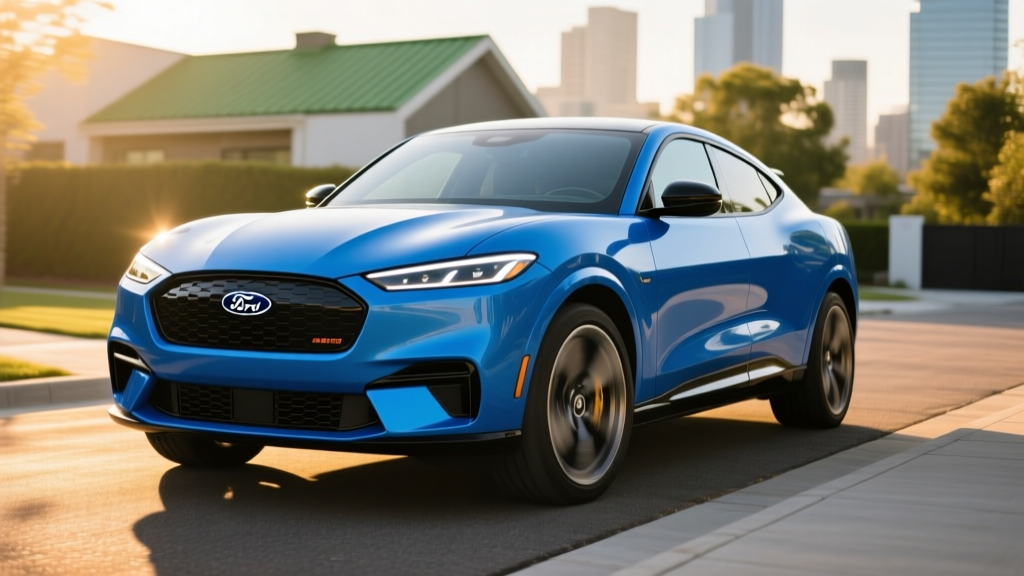
Yes. The electric Mustang is the Ford Mustang Mach-E, a battery-electric crossover SUV that Ford introduced for the 2021 model year and continues to sell in 2026. It is not a coupe replacement for the gas Mustang — it's a five-passenger EV with a hatchback form factor that borrows Mustang styling cues, performance branding, and available GT-badged trims.
The 2026 Mustang Mach-E lineup starts at approximately $39,995 MSRP (Select trim) and stretches to roughly $59,995 for the GT Performance Edition. EPA-estimated range spans 250 to 320 miles depending on trim and battery pack. DC fast charging peaks at 150 kW, achieving a 10–80% charge in roughly 36 minutes.
When people search "is there an electric Mustang," they're usually asking one of two things: whether Ford makes a battery-electric version of the iconic pony car, or whether the Mach-E is worth considering as an EV purchase. This guide answers both — with the exact specs, costs, and ownership realities you need to decide.
2026 Mustang Mach-E: Range, Battery, and Charging Specs
The Mach-E is available with two battery sizes and multiple drivetrain configurations. Here's the full spec breakdown for the current model year:
| Spec | Select / Premium (Std Range) | Premium (Ext Range RWD) | GT (Ext Range AWD) | GT Perf. Edition |
|---|---|---|---|---|
| EPA Range | ~250 mi | ~320 mi | ~290 mi | ~280 mi |
| Battery (usable) | ~70 kWh (LFP) | ~91 kWh (NMC) | ~91 kWh (NMC) | ~91 kWh (NMC) |
| Horsepower | 266 hp | 290 hp | 480 hp | 480 hp |
| 0–60 mph | ~6.1 sec | ~5.2 sec | ~3.8 sec | ~3.5 sec |
| Peak DC Charge Rate | 115 kW | 150 kW | 150 kW | 150 kW |
| 10–80% DCFC Time | ~38 min | ~36 min | ~36 min | ~36 min |
| Level 2 (240V) Rate | 10.5 kW | 10.5 kW | 10.5 kW | 10.5 kW |
| Drivetrain | RWD or eAWD | RWD or eAWD | eAWD | eAWD |
| Base MSRP | $39,995 | $45,995 | $55,995 | $59,995 |
| Battery Warranty | 8 years / 100,000 miles (≥70% capacity retention) | |||
Real-World Range Reality: The EPA rates the Extended Range RWD at 320 miles, but expect ~250–275 miles on sustained highway driving at 70+ mph, and ~200–230 miles in sub-freezing winter conditions due to battery chemistry and cabin heating demands. The GT trims sacrifice roughly 30–40 miles of range for the performance bump — a worthwhile trade for enthusiasts, but factor it into road-trip planning.
On the charging front, the Mach-E's 150 kW peak is adequate but not class-leading. Competitors like the Hyundai Ioniq 5 and Kia EV6 peak at 240 kW on 800V architecture, achieving 10–80% in roughly 18 minutes. The Mach-E uses a 400V system, which limits peak charge speed but keeps costs lower. Ford includes access to the Tesla Supercharger network via the FordPass charging network using a NACS adapter (included with new vehicles as of the 2025 model year).
Mustang Mach-E vs. Gas Mustang: What You're Actually Comparing
The Mach-E shares little beyond the badge and some design DNA with the gas Mustang coupe. They serve fundamentally different buyers. Here's a direct comparison:
| Attribute | 2026 Mach-E Premium (Ext Range RWD) | 2026 Mustang EcoBoost Fastback |
|---|---|---|
| Body Style | 5-passenger crossover SUV | 4-passenger coupe |
| Powertrain | Battery electric, RWD | 2.3L turbo I-4, RWD |
| Horsepower | 290 hp | 315 hp |
| 0–60 mph | ~5.2 sec | ~5.0 sec |
| EPA Range / Fuel Econ | 320 mi / 101 MPGe combined | ~330 mi range / 25 MPG combined |
| Cargo Volume | 29.7 cu ft (rear seats up) + 4.7 cu ft frunk | 13.5 cu ft trunk |
| Starting MSRP | $45,995 | ~$32,500 |
| "Fuel" Cost per Mile | ~$0.04–0.06 (home charging) | ~$0.12–0.15 (gas at $3.30/gal) |
| Federal Tax Credit | Potentially up to $7,500 (§30D) | None |
| Annual Maintenance | ~$300–500 | ~$600–900 |
The gas Mustang is a sports coupe at a lower entry price. The Mach-E is a practical family EV that happens to be quick. If you want a two-door weekend car, the gas Mustang wins. If you want daily usability, lower running costs, and electric torque, the Mach-E is the electric Mustang you're looking for.
Real Ownership Costs: 5-Year Breakdown
Sticker price tells only part of the story. Here's a realistic 5-year / 60,000-mile ownership cost comparison for the Mach-E Premium Extended Range RWD versus a comparably equipped gas crossover (using the Ford Edge as a baseline, since it's closer in utility than the Mustang coupe):
| Cost Category | Mach-E Premium Ext Range | Gas Crossover Baseline |
|---|---|---|
| Purchase Price (MSRP) | $45,995 | $40,000 |
| Federal Tax Credit (§30D) | –$3,750 to –$7,500* | $0 |
| Effective Purchase | $38,495–$42,245 | $40,000 |
| Fuel/Energy (60k mi) | $2,400–$3,600 | $7,200–$9,000 |
| Maintenance (5 yr) | $1,500–$2,500 | $3,000–$4,500 |
| Insurance (5 yr avg) | $8,500–$10,500 | $6,500–$8,000 |
| Estimated Depreciation | $18,000–$22,000 | $15,000–$18,000 |
| 5-Year Total Cost | $68,895–$80,845 | $71,700–$79,500 |
*Tax credit eligibility depends on your income, the vehicle's battery sourcing compliance, and MSRP caps under IRS §30D rules. The Mach-E has historically qualified for a partial credit ($3,750) due to critical-mineral sourcing requirements. Always verify current-year eligibility with a tax professional.
The Mach-E's higher insurance premiums (typically 15–25% more than gas equivalents, per industry data) and steeper depreciation partially offset fuel and maintenance savings. However, if you charge primarily at home on off-peak electricity rates (~$0.12/kWh), the energy savings are substantial — roughly $4,800–$5,400 over five years compared to gasoline.
What First-Time EV Buyers Must Know About the Mach-E
If you're coming from a gas car, the Mach-E introduces a few ownership patterns that differ from what you're used to:
Home Charging Is the Backbone
Roughly 80–90% of EV charging happens at home. A Level 2 home charger (240V, 40-amp circuit) adds roughly 25–30 miles of range per hour, meaning an overnight session fully replenishes the battery. Installation costs typically run $800–$2,000 depending on your electrical panel's capacity and the distance from panel to garage. If your home has a 200-amp panel with spare capacity, expect the lower end. A panel upgrade to 200A can add $1,500–$3,000.
Without home charging access, owning a Mach-E becomes significantly less convenient — you'll rely on public DC fast chargers and Level 2 destination chargers, which adds time and cost. If you can't charge at home, consider a plug-in hybrid instead.
DC Fast Charging: Plan Around the Curve
The Mach-E's 150 kW peak charge rate applies only at a low state of charge (around 15–20%) and tapers significantly above 80%. On a road trip, plan stops around the 10–80% window (~36 minutes) rather than charging to full. Charging from 80–100% can take nearly as long as 10–80% due to the taper — a characteristic of all lithium-ion batteries managed by the battery management system (BMS) to protect cell longevity.
Cold Weather Cuts Range
In temperatures below 32°F, expect 20–30% range reduction due to increased battery internal resistance and cabin heating demands. The Mach-E offers an available heat pump (standard on some trims) that recovers some efficiency by scavenging waste heat rather than using resistive heating. Preconditioning the battery while plugged in — using the FordPass app to warm the cabin and battery before departure — mitigates cold-weather losses and preserves range.
Common Misconceptions: Myth vs. Fact
| Myth | Fact |
|---|---|
| "The Mach-E isn't a real Mustang." | It's a Mustang-branded EV crossover — not a coupe replacement, but a distinct model with GT-level performance (3.5-sec 0–60 on the Perf. Edition). Ford markets it within the Mustang family. |
| "EV batteries need replacing every few years." | Ford warranties the Mach-E battery for 8 years/100,000 miles at ≥70% capacity. Industry data shows most EV batteries retain 85–90% capacity at 100k miles. Full replacement, if needed, runs $12,000–$18,000 out of warranty. |
| "You can't take an EV on a road trip." | The Mach-E's 250–320 mi range and Supercharger network access (via NACS adapter) make road trips viable. Plan 25–35 minute charging stops every 200–250 miles. Tools like A Better Routeplanner automate this. |
| "The $7,500 tax credit applies to every Mach-E." | Credit amounts vary based on battery sourcing compliance, buyer income caps ($150k single / $300k joint for new EVs), and MSRP limits ($80k for SUVs). Verify on fueleconomy.gov for current-year status. |
| "Electricity isn't cleaner than gas." | Even on a coal-heavy grid, EVs produce fewer lifecycle emissions per mile than gas cars (per EPA analysis). On renewables-heavy grids, the advantage is dramatic. |
Decision Framework: Is the Mach-E the Right EV for You?
Choose the Mustang Mach-E if:
- You want a practical 5-passenger EV with 250+ miles of range and available performance (GT trims).
- You have access to home Level 2 charging (or can install it).
- You value Ford's dealer network for service and Supercharger access via NACS adapter.
- You prefer a crossover SUV form factor over a sedan or traditional coupe.
- You want BlueCruise (Ford's Level 2 hands-free highway driver-assist) for long commutes.
Look elsewhere if:
- You need the fastest DC charging available — the Ioniq 5 or EV6 charge roughly twice as fast (240 kW / ~18 min 10–80%).
- You want a true sports coupe — the gas Mustang or a Porsche Taycan fits that brief.
- You lack home charging and can't install it — a PHEV like the Toyota RAV4 Prime may be more practical.
- You need three rows of seating — consider the Kia EV9 or Ford Explorer EV (for markets where available).
- Maximum range is your top priority — the Lucid Air or Tesla Model S offer 400+ miles.
Frequently Asked Questions
Is Ford making an electric version of the gas Mustang coupe?
As of 2026, Ford has not announced a battery-electric version of the traditional two-door Mustang coupe. The Mach-E is Ford's electric Mustang-branded vehicle — a crossover SUV, not a direct coupe successor. The gas Mustang coupe continues in the lineup alongside it.
Does the Mustang Mach-E qualify for the federal EV tax credit?
The Mach-E has historically qualified for a partial credit (typically $3,750) due to battery-component and critical-mineral sourcing rules under §30D. Eligibility depends on your taxable income (capped at $150k single / $300k joint filers), the vehicle's MSRP (must be under $80k for SUVs), and current-year sourcing compliance. The credit can be transferred to the dealer at point of sale as a purchase-price reduction. Check IRS.gov and fueleconomy.gov for the latest qualification status before purchasing.
How long does it take to charge the Mach-E at home?
On a Level 2 home charger (240V, ~10.5 kW), a full 0–100% charge takes roughly 9–10 hours for the Extended Range battery. Most owners charge from 20–80% overnight, which takes about 5–6 hours. On a standard 120V outlet (Level 1), expect roughly 3–4 miles of range per hour — sufficient only for light daily driving or as an emergency trickle.
What's the real-world highway range of the Mach-E?
The Extended Range RWD is EPA-rated at 320 miles, but sustained highway driving at 70–75 mph typically yields 250–275 miles in moderate temperatures. Add a roof cargo box or tow (the Mach-E is rated for up to 2,300 lbs with the factory tow package), and expect further reductions. In winter, plan for 200–230 miles between charges.
Is the Mach-E GT faster than a gas Mustang GT?
The Mach-E GT Performance Edition hits 0–60 in approximately 3.5 seconds (480 hp), which is quicker than the gas Mustang GT with the 5.0L V8 (~4.2 seconds). However, the gas GT offers a higher top speed, a more engaging manual-transmission option, and a sound experience the EV can't replicate. They're different kinds of fast.
What does it cost to insure a Mustang Mach-E?
Insurance for the Mach-E averages $1,700–$2,100 per year depending on trim, driver profile, and state. GT trims cost more to insure due to higher repair costs and performance classification. Get quotes from multiple carriers before purchasing — EV insurance premiums vary widely between providers.