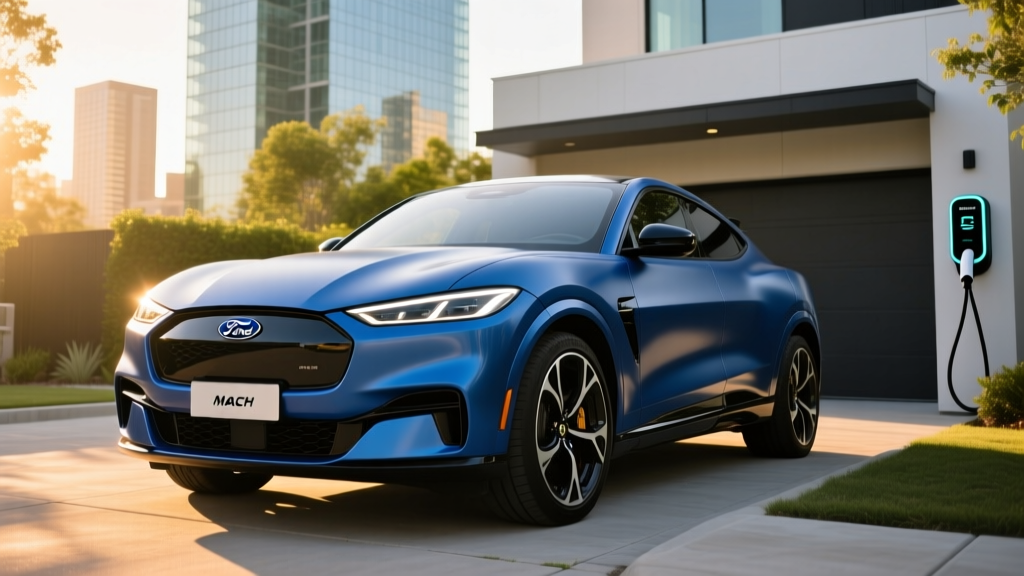
The 2025 Ford Mustang Mach-E is a battery-electric crossover that delivers between 250 and 320 miles of EPA-estimated range depending on trim and battery pack, starts at $39,995 before incentives, and accelerates from 0-60 mph in as little as 3.5 seconds in the GT variant. For buyers searching for an electric Mustang 2025 model year, the Mach-E remains Ford's sole electrified Mustang-badged vehicle — there is no gas-to-electric swap happening in the coupe lineup. The real question isn't whether it's fast enough (it is), but whether the ownership math works for your driving pattern, charging access, and climate.
Quick Verdict: Who Should Buy the 2025 Mach-E?
Buy it if: You want a sporty electric crossover with 250+ miles of real-world range, access to Level 2 home charging, and a total cost of ownership that undercuts a comparably equipped gas Mustang EcoBoost over five years.
Skip it if: You live in an apartment without charging access, regularly drive 300+ miles in sub-freezing weather without reliable DC fast-charging along your route, or need the traditional Mustang coupe body style.
Range, Battery, and Efficiency: What the EPA Numbers Actually Mean
The 2025 Mach-E lineup uses two battery configurations. The Standard Range pack is a 70 kWh (usable) lithium-ion battery with NMC (nickel-manganese-cobalt) chemistry, while the Extended Range pack provides 91 kWh usable, also NMC. Ford does not currently offer an LFP (lithium iron phosphate) option in the Mach-E, meaning you'll want to follow the 20-80% daily charging guideline to minimize long-term degradation.
| Trim | Battery | Drivetrain | EPA Range | MPGe (Combined) | kWh/100 mi |
|---|---|---|---|---|---|
| Select SR | 70 kWh | RWD | 250 mi | 101 MPGe | 33 |
| Premium SR | 70 kWh | AWD | 232 mi | 93 MPGe | 36 |
| Premium ER | 91 kWh | RWD | 320 mi | 104 MPGe | 32 |
| GT ER | 91 kWh | AWD | 280 mi | 84 MPGe | 40 |
Real-World Range Reality Check
EPA 320 mi (Premium ER RWD): Expect approximately 270-290 miles in mixed driving at 65-75 mph. In sustained highway driving at 80 mph, plan for 240-260 miles. In temperatures below 30°F, reduce that to 200-230 miles due to battery chemistry limitations and cabin heating load. The Mach-E's heat pump (standard on 2025 models) mitigates some cold-weather loss compared to resistive heating, but physics still applies.
EPA 250 mi (Select SR RWD): Highway driving at 70+ mph yields roughly 210-225 miles. Cold weather drops this to approximately 170-190 miles.
The efficiency figures (32-40 kWh/100 mi) place the Mach-E in the middle of the electric crossover pack — less efficient than a Tesla Model Y (28-30 kWh/100 mi) but comparable to a Hyundai Ioniq 5 or Kia EV6. That difference matters when you're paying for electricity away from home.
Charging Speed and Infrastructure: Home and Public
Charging is where kW (power — how fast energy flows) and kWh (energy — the battery's capacity) distinction matters most. The Mach-E's onboard charger and DC fast-charge capability define your daily and road-trip experience.
| Level | Power | Connector | Charge Time | Miles Added/Hour |
|---|---|---|---|---|
| Level 1 (120V) | ~1.4 kW | NACS (native) | ~50 hrs (0-100%) | ~3-4 mi/hr |
| Level 2 (240V, 48A) | 11.5 kW | NACS (native) | ~8 hrs (0-100%) | ~28-32 mi/hr |
| DC Fast Charge | Peak 150 kW | NACS (native) | 10-80% in ~36 min | ~150 mi in 20 min (peak) |
Starting with the 2025 model year, the Mach-E comes equipped with a native NACS (North American Charging Standard) port — the Tesla-style connector. This means direct access to the Tesla Supercharger network (over 25,000 stalls in North America) without an adapter, a significant infrastructure advantage over CCS-equipped competitors.
However, the 150 kW peak DC fast-charge rate is a limitation. Competitors like the Hyundai Ioniq 5 (peak 240 kW, 10-80% in ~18 minutes) and the Porsche Macan EV (peak 270 kW) charge substantially faster. The Mach-E's charge curve also tapers significantly above 80% state of charge — expect the final 20% to take as long as the first 60%. On road trips, plan to charge to 80% and move on rather than waiting for a full battery.
Home Level 2 Charging Installation Cost
| Component | Estimated Cost |
|---|---|
| Level 2 charger (Ford Connected Charge Station or equivalent 48A) | $500 - $750 |
| Electrician labor (240V/60A circuit run) | $800 - $2,500 |
| Permit & inspection | $100 - $300 |
| Electrical panel upgrade (if needed, 100A to 200A) | $1,500 - $3,500 |
| Total (no panel upgrade) | $1,400 - $3,550 |
| Total (with panel upgrade) | $2,900 - $7,050 |
Always get a licensed electrician to assess your panel capacity before purchasing equipment. A 48A charger requires a 60A breaker — many older homes with 100A service cannot support this without an upgrade.
Performance: 0-60, Horsepower, and the GT Question
| Trim | Horsepower | Torque (lb-ft) | 0-60 mph | Top Speed |
|---|---|---|---|---|
| Select/Premium SR RWD | 266 hp | 317 | 6.3 sec | 112 mph |
| Premium SR AWD | 312 hp | 417 | 5.2 sec | 112 mph |
| Premium ER RWD | 290 hp | 317 | 5.8 sec | 112 mph |
| GT ER AWD | 480 hp | 634 | 3.5 sec | 124 mph |
The GT's 3.5-second 0-60 time puts it in genuine sports-car territory — faster than a 2025 Mustang GT with the 5.0L V8 (4.3 seconds to 60). The instant torque delivery from dual electric motors means real-world acceleration feels even more immediate than the numbers suggest, particularly in 30-70 mph passing situations.
That said, the GT's 280-mile EPA range (dropping to roughly 220-240 real-world highway miles) and 40 kWh/100 mi efficiency mean you'll charge more often and pay more per mile than the Premium ER RWD. Unless you're prioritizing performance above all else, the Premium ER RWD offers the best balance of range, acceleration, and operating cost.
Pricing, Tax Credits, and the Real Purchase Cost
| Trim | Base MSRP | Destination | Total Starting |
|---|---|---|---|
| Select SR RWD | $39,995 | $1,595 | $41,590 |
| Premium SR AWD | $46,495 | $1,595 | $48,090 |
| Premium ER RWD | $48,995 | $1,595 | $50,590 |
| GT ER AWD | $59,995 | $1,595 | $61,590 |
Federal tax credit eligibility under IRS §30D is complex for the 2025 Mach-E and varies by buyer. Key requirements include:
- MSRP cap: SUVs must be under $80,000 — all Mach-E trims qualify.
- Buyer income cap: Modified AGI must not exceed $150,000 (single), $225,000 (head of household), or $300,000 (joint).
- Battery sourcing: Critical minerals and battery components must meet phased-in percentages from US/free-trade-agreement countries. Ford has worked to localize supply chains, but eligibility can shift — confirm on the IRS clean vehicle credit list at point of purchase.
- Point-of-sale transfer: You can transfer the credit to the dealer at purchase, reducing your out-of-pocket cost immediately rather than waiting to claim it on your tax return.
The maximum credit is $7,500, but partial credits ($3,750) apply if only one of the two sourcing requirements (critical minerals or battery components) is met. Always verify current eligibility at fueleconomy.gov before committing to a purchase.
Total Cost of Ownership: Mach-E vs Gas Mustang EcoBoost
The most common cross-shop isn't against another EV — it's against the gas Mustang. Here's how a 2025 Mach-E Premium ER RWD ($50,590) stacks up against a 2025 Mustang EcoBoost Premium coupe ($39,590) over five years and 75,000 miles.
| Cost Category | Mach-E Premium ER RWD | Mustang EcoBoost Premium |
|---|---|---|
| Purchase price (MSRP + destination) | $50,590 | $39,590 |
| Federal tax credit (estimated) | -$7,500 | $0 |
| Effective purchase price | $43,090 | $39,590 |
| Fuel / electricity (75k mi) | $3,600 (home charging avg $0.14/kWh) | $9,750 (25 MPG combined, $3.25/gal) |
| Maintenance (5 yrs) | $1,200 (tire rotation, cabin filter, fluid top-off) | $3,800 (oil changes, brakes, belts) |
| Insurance (5 yrs, avg) | $9,500 | $8,250 |
| Depreciation (est. 5-yr) | -$19,500 | -$15,000 |
| Total 5-Year Cost | $37,890 | $46,390 |
| Cost per mile | $0.51/mi | $0.62/mi |
The Mach-E saves approximately $8,500 over five years despite the higher sticker price, driven primarily by fuel and maintenance savings. However, this assumes consistent home charging at residential electricity rates. If you rely exclusively on public DC fast charging at $0.40-$0.55/kWh, your fuel cost jumps to $6,000-$8,000 over five years, narrowing the gap significantly.
Insurance is notably higher for the Mach-E — EV-specific collision repair costs and battery replacement risk drive premiums 10-20% above comparable gas vehicles. Get quotes before purchasing.
Common Misconceptions About the Electric Mustang
| Myth | Fact |
|---|---|
| "The Mach-E isn't a real Mustang." | Ford applied the Mustang brand to signal performance DNA. The GT's 3.5-second 0-60 outpaces the V8 Mustang GT. Whether the name belongs on a crossover is subjective, but the performance is real. |
| "The battery will need replacing in 5 years." | Ford warranties the battery for 8 years/100,000 miles with a minimum 70% capacity retention threshold. Industry data shows NMC packs typically retain 85-90% capacity at 100,000 miles with proper charging habits (avoiding frequent 100% charges and DC fast charging when possible). |
| "You can't road-trip an EV." | With native NACS access to Tesla Superchargers, the Mach-E can add ~150 miles in 20 minutes. A 600-mile trip requires two 30-minute stops — comparable to gas-car rest breaks if you plan around them. |
| "EVs are worse in cold weather." | Range drops 15-30% in freezing temperatures, yes. But the Mach-E's heat pump and battery preconditioning (activate via the FordPass app before driving) mitigate this. EVs also start reliably in extreme cold — no cold-cranking amps to worry about. |
| "I need a special electrical setup." | Most homes with a 200A panel can support a 48A Level 2 charger. A licensed electrician can assess this in a standard service call. Level 1 (120V) charging from a standard outlet adds ~3-4 miles per hour — sufficient for drivers covering under 40 miles daily. |
Decision Framework: Is the 2025 Mach-E Your Next Car?
Choose the Mach-E Premium ER RWD ($50,590) if:
- You drive 200-300 miles per week and can charge at home overnight
- You value a quiet, torque-rich daily driver with crossover practicality (59.5 cu ft cargo with seats folded)
- You want access to the Tesla Supercharger network natively
- You qualify for the full $7,500 federal tax credit
Choose the Mach-E GT ($61,590) if:
- Sub-4-second 0-60 performance is a priority over maximum range
- You have reliable home charging and most trips are under 200 miles
- You want AWD traction and the MagneRide adaptive suspension
Choose the Mustang EcoBoost (gas) instead if:
- You live in an apartment or lack home/workplace charging access
- You regularly drive 400+ miles in a single day through areas with sparse charging (rural Great Plains, remote mountain routes)
- You prefer the coupe body style and analog driving feel
- Your five-year ownership horizon means depreciation risk on an EV concerns you
Consider a PHEV (like the Ford Escape PHEV) if:
- You want 30-40 miles of electric-only commuting but gas flexibility for road trips
- You can only install Level 1 (120V) charging at home
- Your budget caps around $38,000
Frequently Asked Questions
Is there a gas-electric hybrid Mustang for 2025?
No. Ford does not offer a hybrid or plug-in hybrid Mustang. The traditional Mustang coupe (EcoBoost and GT) is gas-only, while the Mach-E is fully electric. If you want a Ford PHEV, look at the Escape PHEV (37 miles electric-only range, 42 MPG combined after battery depletion).
How long does the Mach-E battery last?
Ford warranties the high-voltage battery for 8 years or 100,000 miles against defects and capacity loss below 70%. Based on industry degradation data for NMC chemistry, expect 85-90% state of health at 100,000 miles if you primarily charge to 80-90% and limit DC fast charging to road trips. Battery replacement out of warranty currently costs $15,000-$20,000, though prices are declining as the supply chain matures.
Can I use Tesla Superchargers with the 2025 Mach-E?
Yes. The 2025 Mach-E has a native NACS charge port, meaning you can plug directly into any Tesla Supercharger V3 or V4 stall without an adapter. This is a significant change from the 2021-2024 models, which required a Ford-provided CCS-to-NACS adapter.
What does it cost to charge the Mach-E at home vs. gas?
At the US average residential rate of $0.14/kWh, fully charging the 91 kWh Extended Range battery costs approximately $12.74, yielding about 320 miles of EPA range — roughly $0.04 per mile. A gas Mustang EcoBoost at 25 MPG combined with $3.25/gallon fuel costs $0.13 per mile. Over 15,000 annual miles, that's $600 in electricity vs. $1,950 in gasoline.
Does the Mach-E qualify for the $7,500 federal tax credit?
Eligibility depends on your income, the vehicle's battery component and critical mineral sourcing (which can change mid-year), and the MSRP cap ($80,000 for SUVs — all trims qualify). Check the current eligibility list at fueleconomy.gov and consult a tax professional. The credit can be transferred to the dealer at point of sale as of 2024, reducing your purchase price directly.
Is Blue Cruise actually self-driving?
No. Ford's BlueCruise is an SAE Level 2 driver-assistance system. It handles steering, acceleration, and braking on pre-mapped divided highways (over 130,000 miles of compatible roads), and allows hands-off operation with an in-cabin camera monitoring your eyes. However, you remain the responsible driver and must be prepared to take over instantly. It is not a Level 4 autonomous system like Waymo's driverless robotaxis.