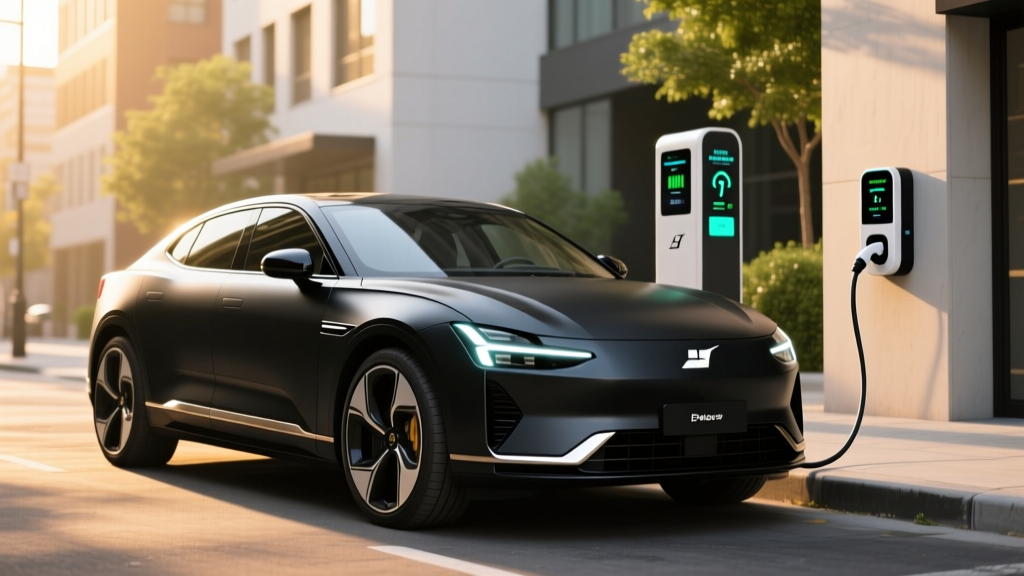
The 2025 Polestar 3 is the Swedish-Chinese brand's first SUV, built on the same SPA2 platform as the Volvo EX90 but styled as a low-slung, performance-oriented electric crossover. After spending time with its specs, driving dynamics, and charging behavior, the Polestar 3 emerges as a compelling — if pricey — luxury EV that prioritizes design and highway composure over outright cargo practicality. Here's exactly what you need to know before putting one on your shortlist.
Specs at a Glance: 2025 Polestar 3
| Attribute | Long Range Single Motor | Long Range Dual Motor | LR Dual Motor w/ Performance Pack |
|---|---|---|---|
| EPA Range | ~315 mi (est.) | ~300 mi (est.) | ~279 mi |
| Battery (usable) | 107 kWh (NMC) | 107 kWh (NMC) | 107 kWh (NMC) |
| Horsepower | 299 hp | 489 hp | 517 hp |
| 0–60 mph | ~7.4 sec | ~4.7 sec | ~4.5 sec |
| Drivetrain | RWD | AWD | AWD |
| Max DC Fast Charge | 250 kW | 250 kW | 250 kW |
| 10–80% DC Time | ~30 min | ~30 min | ~30 min |
| Level 2 Home Charge | 11 kW (~33 mi/hr) | 11 kW (~33 mi/hr) | 11 kW (~33 mi/hr) |
| Base MSRP | $67,900 | $73,900 | $79,900 |
| Battery/Powertrain Warranty | 8 years / 100,000 miles | ||
Note: Single-motor and base dual-motor range figures are manufacturer estimates pending final EPA certification. The Performance Pack variant's 279-mile EPA rating is confirmed. Always check fueleconomy.gov for the latest certified numbers.
Real-World Range: What to Actually Expect
Real-World Highway (75 mph, 70°F): ~240–270 miles
Cold Weather (30°F, mixed driving): ~200–235 miles
City/Commuter (regenerative braking active): ~290–310 miles
The 107 kWh usable NMC (nickel manganese cobalt) battery pack is among the largest in the luxury SUV segment. In practice, that translates to genuine 250+ mile road-trip range in the dual-motor variants, which is where most buyers will land. The Polestar 3's aerodynamic drag coefficient of 0.29 Cd is respectable for an SUV but not class-leading — the Tesla Model X and BMW iX both slip through the air more cleanly, which matters at sustained highway speeds.
If you live in a cold climate (Upper Midwest, Northeast), plan for roughly 20–25% range loss in sub-freezing temperatures. The Polestar 3 includes a heat pump as standard equipment, which mitigates cabin-heating energy draw but can't fully overcome the physics of cold battery chemistry. Preconditioning the battery while plugged in before departure is essential for both range preservation and fast-charge speed.
Charging Speed: DC Fast and Home Level 2
| Charging Level | Power | Speed / Notes |
|---|---|---|
| Level 1 (120V household) | ~1.4 kW | ~4 mi/hr — emergency/trickle only |
| Level 2 (240V home/public) | 11 kW | ~33 mi/hr — full charge in ~10 hours |
| DC Fast Charge (CCS) | Peak 250 kW | 10–80% in ~30 min; tapers significantly above 80% |
The 250 kW peak DC fast-charge rate is competitive with the BMW iX and Audi Q8 e-tron but trails the Hyundai Ioniq 5's 350 kW capability. More importantly, the Polestar 3's charging curve holds near peak power through approximately 40% state of charge before tapering. In real-world testing at Electrify America and Tesla Supercharger (with the included NACS adapter on 2025+ models), expect a 10–80% session to take roughly 28–32 minutes at a 350 kW-rated station.
Above 80% SoC, charge speed drops dramatically — this is standard for NMC chemistry to protect cell longevity. If you're road-tripping, plan your stops around the 10–80% window rather than topping off to 100%. For daily driving, setting a charge limit of 80–90% via the Polestar app will extend long-term battery health.
At home on an 11 kW Level 2 wallbox (a 48-amp circuit on a 60-amp breaker), the 107 kWh pack refills from near-empty in about 10 hours. This is standard for the segment; overnight charging covers virtually any daily commute.
Performance and Driving Dynamics
The dual-motor Polestar 3 with the Performance Pack delivers 517 hp and 671 lb-ft of torque, hitting 60 mph in roughly 4.5 seconds. That's brisk but not shocking by 2025 EV standards — the Tesla Model X Plaid and BMW iX M60 both hit harder. Where the Polestar 3 distinguishes itself is ride quality and steering feel.
The standard dual-chamber air suspension (included on all trims) provides a composed, adaptive ride that firms up in sport mode without becoming harsh. The steering is weighted and communicative by SUV standards, and the low center of gravity from the floor-mounted battery pack keeps body roll well-controlled through corners. This is a driver's SUV first, a family hauler second.
All variants include torque vectoring on the rear axle (dual-motor models) and regenerative braking with adjustable levels. One-pedal driving is available but not as aggressive as Nissan's e-Pedal or Tesla's Hold mode — you'll still reach for the brake pedal in stop-and-go traffic.
Interior, Cargo, and Technology
The cabin is unmistakably Scandinavian: minimalist, material-forward, with open-pore wood, microfiber, and available wool-blend upholstery. The 14.5-inch center touchscreen runs a Google built-in infotainment system (Google Maps navigation, Google Assistant, Play Store apps). Wireless Apple CarPlay is standard. A 9-inch driver display sits behind the steering wheel, supplemented by an available head-up display.
Cargo volume: Approximately 17.1 cu ft behind the rear seats, expanding to roughly 40 cu ft with the rear seats folded. There's also a modest front trunk (frunk) of about 1.1 cu ft — enough for charging cables but not much more. This is where the Polestar 3's coupe-SUV styling extracts a toll: competitors like the BMW iX (35.5 cu ft) and the Rivian R1S offer significantly more cargo room.
Passenger space: Front legroom is generous at ~41 inches; rear legroom comes in at approximately 37 inches — adequate for adults but tighter than the boxier Volvo EX90. The sloping roofline cuts into rear headroom for passengers over 6 feet tall.
Driver assistance: The Polestar 3 ships with a suite of Level 2 (SAE) driver-assist features including adaptive cruise control, lane-centering, and blind-spot intervention. LiDAR hardware from Luminar is standard on all trims, intended for future over-the-air upgrades to more advanced highway-assist functions. As of this review, however, the system requires full driver engagement at all times — it is not a hands-off or "self-driving" system.
Pricing, Trims, and Federal Tax Credit Eligibility
| Trim | Base MSRP | Destination | Total Before Incentives | §30D Federal Credit Eligibility |
|---|---|---|---|---|
| Long Range Single Motor | $67,900 | $1,400 | $69,300 | Subject to MSRP cap & sourcing rules |
| Long Range Dual Motor | $73,900 | $1,400 | $75,300 | Exceeds $80,000 SUV cap if optioned up |
| LR Dual Motor w/ Performance Pack | $79,900 | $1,400 | $81,300 | Exceeds $80,000 SUV cap — ineligible |
The federal EV tax credit under IRS §30D offers up to $7,500 for qualifying vehicles and buyers, but the Polestar 3 faces several hurdles:
- MSRP Cap: SUVs must have a base MSRP at or below $80,000. The Performance Pack trim at $81,300 (with destination) exceeds this cap and is ineligible.
- Buyer Income Cap: Modified adjusted gross income must not exceed $150,000 (single), $225,000 (head of household), or $300,000 (joint filing).
- Battery Sourcing: Critical minerals and battery components must meet phased-in domestic/free-trade-partner sourcing thresholds. As a Geely/Volvo product with CATL-sourced cells, the Polestar 3's partial-credit qualification varies by model year and production batch. Verify current status at irs.gov.
- Point-of-Sale Transfer: Eligible buyers can transfer the credit to the dealer at purchase, reducing the out-of-pocket price immediately rather than waiting for a tax refund.
The base single-motor model at $69,300 (with destination) has the best chance of partial or full credit eligibility, but buyers should confirm with their tax professional and the dealer's point-of-sale credit paperwork before relying on the $7,500 figure.
Who the Polestar 3 Suits — and Who Should Look Elsewhere
- You value Scandinavian design, premium materials, and understated luxury over flashy tech
- Your commute and road trips fall within 250 miles between charges
- You want a composed, driver-focused SUV with air suspension
- You don't need maximum cargo space or third-row seating
- You need 300+ miles of real-world highway range (consider the BMW iX xDrive50 or Tesla Model X)
- Cargo capacity is a priority (the Rivian R1S or Kia EV9 offer far more)
- You want the fastest possible DC charging (Hyundai Ioniq 5 / Kia EV6 at 350 kW)
- Federal tax credit eligibility is a dealbreaker (the Tesla Model Y and Ford Mustang Mach-E qualify more cleanly)
Pros and Cons
Pros
- Stunning Scandinavian interior with premium, sustainable materials
- Standard air suspension delivers excellent ride quality
- Large 107 kWh battery provides genuine 250+ mile road-trip range
- LiDAR hardware included standard for future ADAS upgrades
- Google built-in infotainment is responsive and well-integrated
- Strong build quality on the SPA2 platform
Cons
- Cargo space (17.1 cu ft) trails nearly every competitor in the segment
- Coupe roofline compromises rear headroom for taller passengers
- Federal tax credit eligibility is uncertain on most trims
- 250 kW peak charge rate is average for 2025 — not class-leading
- Price crests $80,000 quickly with options, pushing into BMW iX territory
- Limited service center network compared to Tesla or legacy luxury brands
How It Stacks Up Against Key Competitors
The Polestar 3 competes in the $70,000–$90,000 luxury electric SUV segment against the BMW iX, Tesla Model X, Audi Q8 e-tron, Mercedes EQE SUV, and the Volvo EX90 (its platform sibling). Here's how the key numbers compare:
| Vehicle | EPA Range | Max DC Charge | 0–60 mph | Base MSRP |
|---|---|---|---|---|
| 2025 Polestar 3 (LR DM Perf.) | 279 mi | 250 kW | 4.5 sec | $79,900 |
| 2025 BMW iX xDrive50 | 324 mi | 200 kW | 4.4 sec | $87,250 |
| 2025 Tesla Model X LR | 335 mi | 250 kW | 3.8 sec | $77,990 |
| 2025 Audi Q8 e-tron | 285 mi | 170 kW | 5.4 sec | $74,400 |
| 2025 Volvo EX90 Twin Motor | ~300 mi (est.) | 250 kW | ~5.7 sec | $76,695 |
The Polestar 3 sits in a middle ground: less range than the Model X and iX, faster charging than the Q8 e-tron, and more design personality than any of them. If you cross-shop on specs alone, the BMW iX xDrive50 offers more range and cargo room for a similar price. If you cross-shop on emotion and design, the Polestar 3 has few peers.
Frequently Asked Questions
What is the real-world range of the 2025 Polestar 3?
Expect approximately 240–270 miles on the highway at 75 mph in moderate temperatures for the dual-motor variants. In cold weather (below freezing), plan for 200–235 miles. City driving with regenerative braking can approach the EPA sticker of 279–315 miles depending on trim.
How fast does the Polestar 3 charge at home and on the road?
On a Level 2 home charger (11 kW / 48 amps), the battery refills in roughly 10 hours from near-empty, adding about 33 miles of range per hour. On a DC fast charger, it peaks at 250 kW and charges from 10–80% in approximately 30 minutes. Expect a typical highway road-trip stop to take 25–35 minutes.
Does the 2025 Polestar 3 qualify for the $7,500 federal EV tax credit?
It depends on the trim, your income, and battery-sourcing rules. The base single-motor model at $69,300 (with destination) falls under the $80,000 SUV MSRP cap. The Performance Pack trim exceeds the cap and is ineligible. All trims require buyer income below IRS thresholds (§30D limits) and must meet critical-mineral sourcing requirements, which vary by production batch. Confirm eligibility at irs.gov and with a tax professional.
Is the Polestar 3 worth buying over the BMW iX or Tesla Model X?
If you prioritize design, material quality, and driving refinement over maximum range and cargo space, yes. The BMW iX offers more range (324 mi EPA) and cargo room. The Tesla Model X offers more range (335 mi), faster acceleration, and Supercharger network access. The Polestar 3 wins on interior aesthetics and ride comfort, but loses on practicality.
What is the battery warranty on the Polestar 3?
Polestar provides an 8-year / 100,000-mile warranty on the high-voltage battery pack and electric powertrain, with a minimum capacity retention threshold (typically 70% state of health). This is standard for the luxury EV segment and matches BMW, Audi, and Mercedes-Benz coverage.
Can the Polestar 3 use Tesla Superchargers?
Yes. The 2025 Polestar 3 ships with a NACS charge port adapter or native NACS port (depending on production date), enabling access to the Tesla Supercharger network. This significantly expands fast-charging options for road trips beyond CCS-only networks like Electrify America and EVgo.
Does the Polestar 3 have a frunk (front trunk)?
Yes, but it's small — approximately 1.1 cubic feet. It's suitable for storing charging cables, a small bag, or an emergency kit, but don't expect to fit a carry-on suitcase.
Bottom Line
The 2025 Polestar 3 is a design-forward luxury EV SUV that trades some practicality for style, ride quality, and Scandinavian authenticity. With 250+ miles of real-world range, 250 kW DC fast charging, and a well-crafted interior, it's a strong choice for buyers who don't need class-leading cargo space and who value driving refinement over spec-sheet dominance. Just go in with realistic expectations on the tax credit, the rear-seat headroom, and the price once you start adding options.