When you pop the hood of an electric vehicle, you won't find pistons, spark plugs, or a timing belt. Instead, the electric motor inside an EV is a compact, high-efficiency machine that converts electrical energy from a battery pack into rotational force with far fewer moving parts than any internal combustion engine. For buyers, this means instant torque, minimal maintenance, and efficiency ratings that dwarf gas powertrains — but also unique trade-offs around upfront cost, charging infrastructure, and cold-weather performance.
The Quick Answer
An EV's electric motor is 85–95% efficient at converting stored energy into motion, compared to just 20–35% for a gasoline engine. A typical modern EV motor produces 200–500+ horsepower from a unit smaller than a carry-on suitcase, requires no oil changes, and has a lifespan exceeding 200,000 miles. The real ownership question isn't the motor itself — it's the battery that feeds it, the charging infrastructure that supports it, and whether your driving patterns and budget align with EV ownership in 2026.
How the Electric Motor Inside an EV Actually Works
Most EVs on the road today use one of two motor architectures: permanent magnet synchronous motors (PMSM) or AC induction motors. Tesla popularized the induction motor in the Model S, while most other automakers — including Hyundai, BMW, Ford, and Rivian — have standardized on PMSM designs for their superior efficiency at partial loads.
Here's what happens when you press the accelerator:
- The inverter converts DC power from the battery pack into precisely timed AC current.
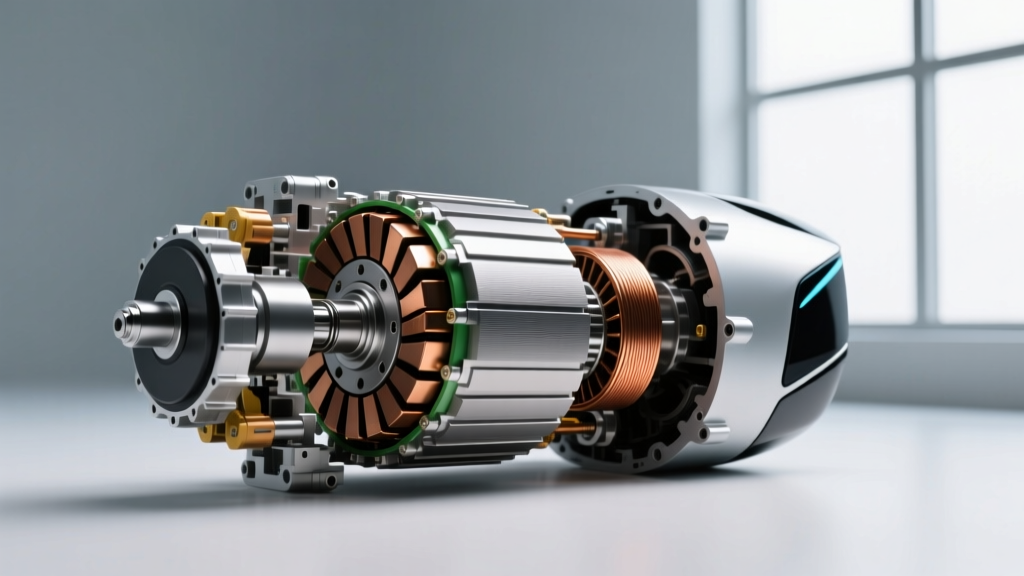
- Electromagnets in the stator (the stationary outer ring) create a rotating magnetic field.
- The rotor (the spinning inner shaft) follows that field, generating torque.
- A single-speed reduction gear transfers that torque to the wheels.
The result is seamless, linear acceleration with no gear shifts. A motor like the one in the 2026 Hyundai Ioniq 6 SE produces 168 hp and 258 lb-ft of torque from a unit weighing roughly 80 lbs. The dual-motor AWD variant bumps that to 320 hp with a 0–60 mph time of approximately 5.1 seconds. By comparison, a turbocharged 2.5L four-cylinder gas engine making similar power weighs over 350 lbs and requires a multi-speed transmission, exhaust system, cooling loops, and emissions equipment.
Electric Motor vs. Gas Engine vs. Hybrid: The Numbers
The electric motor inside an EV doesn't just change the driving experience — it fundamentally alters the ownership math. Here's how the three main powertrain types stack up on the metrics that matter:
| Metric | Battery EV (e.g., 2026 Tesla Model 3 LR) | PHEV (e.g., 2026 Toyota RAV4 Prime) | Gas (e.g., 2026 Toyota RAV4 LE) |
|---|---|---|---|
| Powertrain efficiency | 85–95% | ~40% (engine) + 90% (electric) | 20–35% |
| EPA range / economy | 341 mi / 132 MPGe | 42 mi electric + 38 MPG gas | 30 MPG combined |
| Moving parts in powertrain | ~20 | ~200+ | ~200+ |
| Routine maintenance (5 yr) | ~$300–$500 | ~$1,800–$2,500 | ~$2,200–$3,000 |
| Fuel/energy cost (15k mi/yr) | ~$540–$810/yr | ~$900–$1,300/yr | ~$1,650–$2,100/yr |
| Base MSRP (2026) | ~$42,380 | ~$44,590 | ~$30,590 |
| Federal tax credit (§30D) | Up to $7,500 (eligibility varies) | Up to $7,500 (eligibility varies) | $0 |
The efficiency gap is the single biggest differentiator. When you put 1 kWh of energy into a battery, the electric motor inside the EV turns roughly 0.90 kWh of that into forward motion. A gas engine wastes most of its fuel energy as heat, friction, and exhaust — which is why a 75 kWh battery can push an EV 300+ miles while a 15-gallon gas tank (holding roughly 500 kWh of chemical energy) only delivers a similar range.
The Real Cost of Ownership: 5-Year Breakdown
Upfront price is where EVs still sting, but the gap narrows significantly once you account for fuel savings, maintenance reduction, and federal incentives. Here's a realistic 5-year total cost of ownership comparison for a midsize crossover driven 15,000 miles annually:
| Cost Category | EV (Tesla Model Y LR AWD) | Gas (Toyota RAV4 LE AWD) |
|---|---|---|
| Purchase price (MSRP) | $46,630 | $32,090 |
| Federal tax credit (§30D) | –$5,000 (est., varies by sourcing/income) | $0 |
| Effective purchase price | $41,630 | $32,090 |
| Energy/fuel (5 yr, 75k mi) | $3,100 (home charging avg.) | $9,400 |
| Maintenance (5 yr) | $450 | $2,600 |
| Insurance (5 yr avg.) | $9,500 | $7,200 |
| Estimated depreciation | $18,500 | $12,800 |
| 5-Year Total Cost | ~$73,180 | ~$64,090 |
The EV still costs roughly $9,000 more over five years in this scenario — but that gap is highly sensitive to your electricity rate, annual mileage, local incentives, and whether you qualify for the full federal §30D tax credit. If you drive 20,000+ miles annually, charge at home on a cheap utility rate ($0.08–$0.12/kWh), and qualify for the full credit plus a state rebate, the EV can break even or win on total cost within 3–4 years.
Key caveat on the §30D credit: Eligibility in 2026 depends on buyer income caps ($150K single / $300K joint), vehicle MSRP caps ($55K sedans / $80K SUVs and trucks), battery critical-mineral sourcing requirements, and North American final assembly. Always verify your specific situation on IRS.gov or with a tax professional before counting on the credit.
What First-Time EV Buyers Need to Know
The electric motor inside an EV is the least of your worries — it's reliable, efficient, and essentially maintenance-free. The real ownership variables live elsewhere. Here's what actually determines whether an EV works for you:
Home Charging Access Is Non-Negotiable for Most Owners
Over 80% of EV charging happens at home. If you have a garage or driveway where you can install a Level 2 charger (240V, 30–48 amps), an EV becomes a "plug in at night, wake up full" experience. A typical Level 2 installation costs $800–$2,200 including the charger unit, electrician labor, and permits — more if your electrical panel needs an upgrade to 200 amps. Without home charging, you're relying on public DC fast chargers and Level 2 destination chargers, which adds time, cost ($0.30–$0.50/kWh at public stations vs. $0.10–$0.16/kWh at home), and unpredictability.
Cold Weather Cuts Range 20–40%
Battery chemistry slows in cold temperatures, and cabin heating draws significant power. A 300-mile EPA-rated EV may deliver only 180–240 real-world miles in sub-freezing conditions. Vehicles equipped with a heat pump (standard on most 2026 Hyundai, Tesla, and BMW models) recover 10–15% of that loss by efficiently scavenging ambient and waste heat. If you live in Minnesota or Maine, plan your routes around the worst-case range, not the EPA sticker.
Charging Speed Matters More Than Peak Range
A 350-mile range with sluggish 100 kW charging is less practical on road trips than a 280-mile range with 250 kW peak charging. Look for vehicles that can add 150–200 miles in a 15–20 minute DC fast-charge session. The 2026 Hyundai Ioniq 5, for example, peaks at 240 kW on a 350 kW charger and charges from 10–80% in approximately 18 minutes — one of the fastest in its class thanks to its 800V architecture.
Common Misconceptions About EV Motors and Ownership
| Myth | Fact |
|---|---|
| "EV motors wear out like gas engines." | Electric motors have minimal friction surfaces. Most are warrantied for 8 years/100,000 miles and routinely last 200,000+ miles with no internal service. |
| "Battery replacement will cost $20,000." | Full pack replacement on a 2026 model typically runs $8,000–$16,000 depending on the vehicle. But EPA data and long-term fleet studies show most modern LFP and NMC packs retain 85–92% capacity at 150,000 miles. Federal warranty mandates require 8 yr/100,000 mi coverage with a minimum 70% capacity retention threshold. |
| "EVs are worse for the environment because of electricity generation." | Even on the dirtiest US grids (coal-heavy), an EV produces 50–60% fewer lifetime emissions than a comparable gas car, per EPA lifecycle analysis. On cleaner grids, the advantage is 70%+. |
| "Regenerative braking means you never use brake pads." | Regen handles most deceleration, extending pad life to 100,000+ miles in many cases — but pads and rotors still require periodic inspection and eventual replacement, especially in wet or salty climates where corrosion builds up. |
| "All EVs qualify for the $7,500 federal tax credit." | Many don't. Battery sourcing rules, MSRP caps, buyer income limits, and final-assembly requirements disqualify several popular models. Always check the current fueleconomy.gov tax credit list before purchasing. |
Decision Framework: Is an EV Right for You?
The electric motor inside an EV is proven, reliable, and efficient. The question is whether the rest of the ownership picture fits your life. Use this framework:
Choose a Battery EV If:
- You have reliable home or workplace Level 2 charging access.
- Your daily driving is under 80 miles round-trip (covers 95%+ of US commuters).
- You want the lowest per-mile energy cost and near-zero powertrain maintenance.
- You qualify for federal and/or state EV incentives that close the upfront price gap.
- You take road trips fewer than 4–6 times per year and can plan around DC fast-charging corridors.
Choose a PHEV If:
- You want electric-only commuting (25–45 miles) but also need 400+ mile road-trip range without planning.
- Your home charging situation is uncertain or you live in an apartment without charger access.
- You want to reduce fuel consumption without full EV commitment.
Stick With Gas or Hybrid (HEV) If:
- You have zero access to home or workplace charging and your area lacks reliable public DC infrastructure.
- You regularly tow heavy loads (5,000+ lbs) over long distances — EVs lose 30–50% range when towing.
- Your budget is strictly under $30,000 and you can't wait for used-EV prices to drop further.
- You live in an extreme-cold climate and frequently drive 300+ miles between stops in winter.
Maintenance Reality: What the Electric Motor Inside Actually Costs You
Here's the maintenance schedule for a typical 2026 EV over 100,000 miles:
- Cabin air filter: Every 20,000–30,000 miles (~$30–$60 per replacement)
- Tire rotation: Every 7,500–10,000 miles (~$40–$80 per visit; EVs wear tires 20–30% faster due to instant torque and higher weight)
- Brake fluid check: Every 2 years (~$50–$80)
- Coolant flush (battery thermal loop): Every 5 years or 100,000 miles (~$150–$250)
- Windshield washer fluid, wiper blades: As needed
That's it. No oil changes ($150–$300/yr on a gas car), no spark plugs, no transmission fluid, no timing belt, no exhaust system, no catalytic converter, no emissions testing. The electric motor itself is essentially a sealed unit — there are no brushes to replace in modern AC designs, and the bearings are the only wear item, typically lasting the life of the vehicle.
The one maintenance cost that's higher on EVs? Tires. A midsize EV like the Ford Mustang Mach-E weighs roughly 4,700 lbs — 500–800 lbs more than a comparable gas crossover — and delivers instant torque that accelerates tread wear. Budget for a tire replacement every 30,000–45,000 miles instead of the 50,000–60,000 you might expect from a gas vehicle. EV-specific tire compounds (like Michelin's e.Primacy or Hankook's iON) can help close this gap.
Frequently Asked Questions
Do electric motors in EVs need to be replaced?
Rarely. Modern EV electric motors are designed to outlast the vehicle. There are no consumable internal parts like piston rings or valve seals. Motor failures before 200,000 miles are extremely uncommon and typically covered under the powertrain warranty (usually 8 years/100,000 miles). The components more likely to need attention are the inverter, onboard charger, or reduction gear bearings — all covered under the same warranty period.
How much does it cost to charge an EV at home vs. fueling a gas car?
At the US average residential electricity rate of ~$0.16/kWh, charging a 75 kWh battery from empty to full costs about $12. That delivers roughly 270–320 miles of range. The equivalent distance in a 30 MPG gas car at $3.40/gallon costs about $34. On an annual basis (15,000 miles), home charging runs $540–$810 vs. $1,650–$2,100 for gasoline. Public DC fast charging is more expensive ($0.30–$0.50/kWh), so the savings are largest when you charge at home.
Are EVs reliable long-term compared to gas cars?
The electric motor and single-speed gearbox are simpler and more reliable than a gas powertrain. The variable is the battery. Long-term data from high-mileage Tesla fleets and commercial EV operators shows modern NMC and LFP packs losing 8–15% of original capacity over 150,000–200,000 miles. That's meaningful but not catastrophic — a 300-mile EV with 12% degradation still delivers 264 miles of range.
Can I install a Level 2 home charger myself?
You can buy the charger unit yourself ($350–$700 for a quality 40–48 amp unit), but the 240V electrical work should always be done by a licensed electrician. Depending on your panel capacity and the run distance, expect $500–$1,500 in labor and materials. If your home has a 100-amp panel and you need a 200-amp upgrade, add $1,500–$3,000. Some utilities offer rebates that offset $200–$500 of the installation cost.
What happens if the battery degrades beyond the warranty threshold?
Federal law mandates that EV batteries carry a warranty of at least 8 years/100,000 miles with a minimum 70% capacity retention guarantee. If your battery drops below that threshold within the warranty period, the manufacturer must repair or replace it at no cost. Out of warranty, a full battery replacement runs $8,000–$16,000 depending on pack size and chemistry, though individual module replacement (when supported) can cost $2,000–$5,000.
The electric motor inside an EV is one of the most reliable, efficient, and low-maintenance propulsion systems ever put into a passenger vehicle. The ownership decision in 2026 isn't about whether the motor will hold up — it will. It's about whether your charging situation, driving patterns, climate, and budget align with the rest of the EV ecosystem. Run the numbers honestly, test your specific commute and road-trip routes against real-world range data, and the right powertrain choice becomes clear.