The Short Answer: What the Electric Motor Industry Means for You
The electric motor industry in 2026 is defined by three buyer-impacting trends: permanent-magnet motors using less expensive heavy rare earths, a shift toward 800-volt architectures that cut 10–80% DC charging to roughly 18 minutes on capable models, and in-house motor production by automakers that has pushed base MSRPs on mainstream EVs into the $30,000–$40,000 range before incentives. For buyers, this means more range per dollar, faster public charging on newer platforms, and a widening efficiency gap between EVs and gas cars — but also new things to check on a spec sheet, like motor type, voltage architecture, and whether the model qualifies for the federal §30D tax credit under current IRS sourcing rules.
Why Motor Tech Suddenly Matters at the Dealership
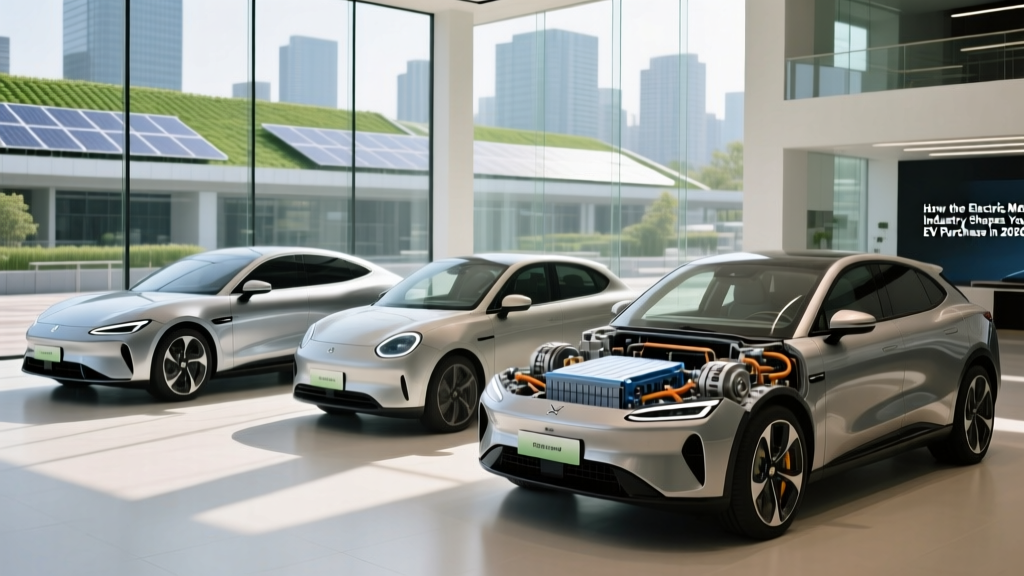
Five years ago, most buyers only asked about range. In 2026, the motor itself is a meaningful differentiator. The U.S. Department of Energy notes that permanent-magnet synchronous motors (PMSMs) still dominate for efficiency and power density, but newer induction and externally-excited synchronous designs from BMW, Renault, and others have closed the gap while avoiding costly neodymium and dysprosium. That matters to you in two ways: it stabilizes vehicle pricing, and it changes which trims deliver peak efficiency versus peak power.
Practically, here is what to look for on a 2026 window sticker or spec sheet:
- Voltage architecture: 800V platforms (Hyundai/Kia E-GMP, Porsche, Lucid, some newer GM and Ford models) sustain higher DC charge kW longer than older 400V architectures.
- Motor count and type: Single-motor RWD/FWD trims typically add 15–30 miles of EPA range versus dual-motor AWD on the same battery.
- Heat pump standard or optional: A heat pump can recover 15–25% of cold-weather range versus resistive cabin heating.
- Usable kWh, not just gross: A 77 kWh usable pack behaves very differently from an 82 kWh gross pack with a large buffer.
EV vs Gas vs Hybrid: The 2026 Numbers
Motor-industry efficiency gains show up most clearly when you put an EV next to a comparable gas car and a hybrid on the same commute. Below is a realistic 15,000-mile/year comparison using a mainstream 2026 compact crossover EV (EPA 120 MPGe, 30 kWh/100 mi), a 38 MPG combined gas crossover, and a 50 MPG combined hybrid, with electricity at $0.16/kWh and gasoline at $3.40/gallon.
| Powertrain | Efficiency | Energy cost/year | 5-year energy cost |
|---|---|---|---|
| Battery EV (30 kWh/100 mi) | 120 MPGe | $720 | $3,600 |
| Hybrid (50 MPG combined) | 50 MPG | $1,020 | $5,100 |
| Gasoline (38 MPG combined) | 38 MPG | $1,342 | $6,710 |
On energy alone, the EV saves roughly $1,620 over a hybrid and $3,110 over gas across five years. Maintenance savings are additive: no oil changes, far fewer brake jobs thanks to regen, and no transmission fluid. AAA and Consumer Reports analyses have repeatedly pegged lifetime EV maintenance 20–35% lower than ICE equivalents, though insurance premiums on EVs still run 10–20% higher on average.
The Real Cost Breakdown Buyers Miss
Purchase price gets the headlines, but the electric motor industry's move to integrated drive units and structural packs shows up in ownership math. Here is a 5-year total-cost snapshot for a $38,000 base-MSRP EV that qualifies for a $7,500 point-of-sale §30D credit versus a $32,000 gas equivalent with no credit.
| Line item | EV (after credit) | Gas car |
|---|---|---|
| Effective purchase price | $30,500 | $32,000 |
| Energy (electricity vs gas) | $4,320 | $6,710 |
| Maintenance | $1,400 | $2,600 |
| Insurance (5 yr total) | $9,800 | $8,200 |
| Depreciation (est.) | $14,500 | $12,800 |
| 5-year total | $60,520 | $62,310 |
Two caveats worth stating plainly. First, the §30D credit has MSRP caps, buyer income limits, and battery-sourcing requirements that change frequently — confirm eligibility on IRS.gov and with the dealer at signing, not the brochure. Second, if you cannot charge at home and rely entirely on DC fast charging at $0.40–$0.60/kWh, the EV's energy cost roughly doubles and the 5-year advantage narrows or flips.
What a First-Time EV Buyer Should Actually Check
Motor-industry marketing loves peak horsepower and 0–60 times. For daily ownership, these four items predict satisfaction far better:
- Real-world highway range. EPA stickers assume mixed driving. Expect 10–15% less range at sustained 70–80 mph, and 20–35% less in sub-freezing weather without a heat pump. A 310-mile EPA rating typically delivers 250–270 highway miles in mild weather and 210–240 in cold.
- Sustained DC charge rate, not peak. A motor/charger combo that peaks at 240 kW but tapers hard above 60% SoC may be slower overall than a 200 kW pack with a flat curve. Look for published 10–80% minutes; 18–22 minutes is excellent in 2026, 30+ minutes is dated.
- Home charging feasibility. A 48-amp Level 2 circuit on a 200-amp panel typically costs $800–$2,000 installed; older homes may need a $2,000–$5,000 panel upgrade. Get an electrician's quote before, not after, delivery day.
- Battery warranty and chemistry. LFP packs tolerate daily 100% charging and tend to degrade more slowly at the top of SoC; NMC packs generally offer more energy density and cold-weather performance. Most 2026 warranties guarantee 70–75% capacity retention at 8 years/100,000 miles.
Common Motor and EV Myths, Checked Against Data
| Myth | Fact |
|---|---|
| EV motors wear out like gas engines. | Electric motors have far fewer moving parts; failures are rare and typically tied to coolant leaks or inverter issues, not wear. |
| All EVs charge at the same speed. | 800V architectures in 2026 can sustain 200+ kW; older 400V models often taper to 50–80 kW above 60% SoC. |
| EVs are always cheaper to own. | Without home charging, or on high-premium trims with elevated insurance, TCO can match or exceed a hybrid. |
| Rare-earth shortages make EVs risky to buy. | Motor designs have diversified; warranty and resale are driven more by battery health than motor materials. |
| Level 2 driver-assist is self-driving. | Features like Autopilot, FSD Supervised, BlueCruise, and Super Cruise are SAE Level 2 — you must remain engaged at all times. |
A Practical Decision Framework
Choose a BEV if: you can install Level 2 at home or have reliable workplace charging, your typical day is under 80 miles, and you take fewer than six long road trips per year.
Choose a PHEV if: you want 25–45 miles of electric-only commuting but regularly drive 300+ miles between charging opportunities, or you live in an apartment without charging access.
Choose a hybrid (HEV) if: you have no charging access at all, your budget is tight, and your priority is low fuel cost without behavior change.
Wait or pick an 800V model if: you rely heavily on public DC charging — sustained charge speed matters more than peak kW once you are on the road.
Frequently Asked Questions
Does the type of electric motor affect my electricity bill?
Yes, modestly. PMSM motors tend to be 2–5% more efficient at part-load highway cruising than induction motors in 2026 tunings, which translates to roughly 1–2 kWh per 100 miles — about $25–$50 per year at average driving and electricity rates.
Should I care whether an EV uses an 800V architecture?
If you road-trip more than a few times a year, yes. An 800V pack typically cuts 10–80% DC charging to 18–22 minutes on a 350 kW-capable stall, versus 30–40 minutes on older 400V vehicles limited to 150 kW or less.
Are EV motors covered under the same warranty as the battery?
Usually yes. The motor and reduction gear are bundled into the "electric powertrain" warranty, which on most 2026 models runs 8 years/100,000 miles, matching the high-voltage battery. Verify the exact terms per manufacturer.
Do EVs lose more range in winter than gas cars lose MPG?
Proportionally, yes. Cold batteries and cabin heating can cut EV range 20–35%, while gas cars typically lose 10–20% fuel economy in winter. A heat pump and battery preconditioning significantly narrow that gap.
Is the federal tax credit guaranteed on any new EV?
No. Under current IRS §30D rules, eligibility depends on MSRP caps, buyer income limits, final assembly, and battery critical-mineral and component sourcing. Always confirm on IRS.gov and with the dealer at the point of sale.