If you're searching for an electric minivan in 2026, the honest answer is that the dedicated battery-electric minivan segment remains frustratingly thin. The Chrysler Pacifica plug-in hybrid (PHEV) still dominates as the only electrified minivan you can actually buy, while the three-row electric SUV segment — led by the Kia EV9, Hyundai Ioniq 9, and Rivian R1S — has effectively absorbed family buyers who would have otherwise waited for a true electric minivan. Below, we break down every viable electrified family hauler for 2026 with exact EPA range, charging speeds, pricing, and a 5-year ownership cost analysis so you can decide whether to go PHEV, full BEV SUV, or wait.
Quick Answer: What Electric Minivans Can You Buy in 2026?
Dedicated BEV minivans: None currently on sale in the US. Chrysler has not confirmed a Pacifica EV production timeline. The VW ID. Buzz is sold in Europe as a BEV but remains unavailable stateside.
Best electrified minivan: 2026 Chrysler Pacifica PHEV — 32 miles electric-only range, 82 MPGe, ~$51,095 MSRP.
Best BEV family alternatives (3-row SUVs): Kia EV9 (304 mi EPA), Hyundai Ioniq 9 (335 mi EPA), Rivian R1S Dual-Motor (352 mi EPA).
The 2026 Electrified Minivan Landscape
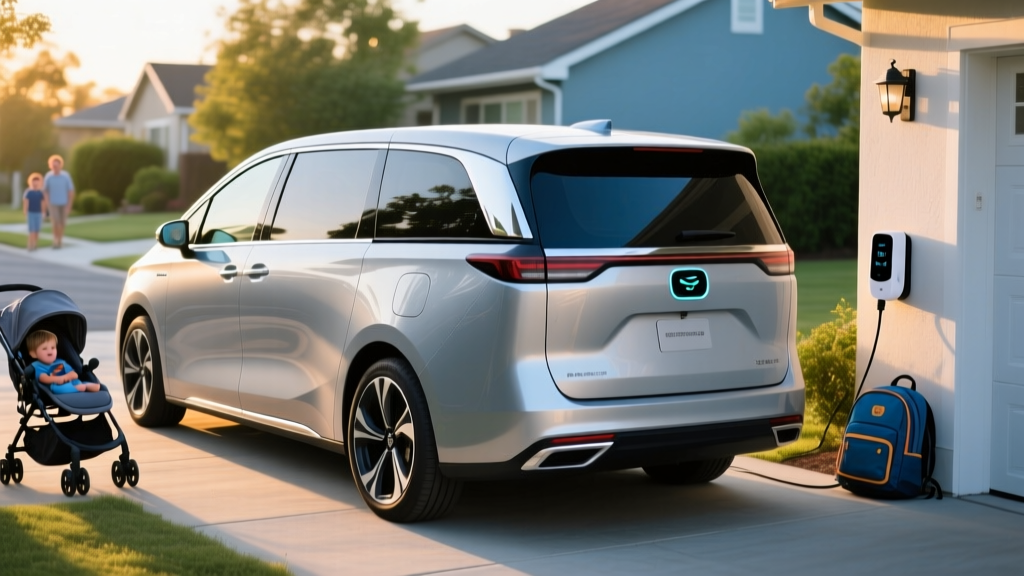
The minivan market has always been small — typically four or five nameplates — and electrification has been slow to arrive. Chrysler's Pacifica PHEV has held a near-monopoly on the "plug-in family hauler" position since 2017, and its 2026 refresh keeps it relevant with a 16 kWh usable battery (NMC chemistry), 32-mile electric-only range, and a combined 82 MPGe when the battery is depleted and the 3.6L V6 takes over. For families with short school commutes and home Level 2 charging, the Pacifica PHEV can run on electricity most weekdays and switch to gas for road trips — eliminating range anxiety entirely.
The anticipated Chrysler Pacifica full EV, occasionally referenced in Stellantis product roadmaps, has not been formally announced for production as of early 2026. Industry reports suggest a possible 2027-2028 timeframe on the STLA Large platform, which could deliver 350+ miles of range and 800V-class DC fast charging, but these remain preliminary estimates. If you need an electrified minivan now, the PHEV is your only minivan-shaped option.
| Vehicle | Type | EPA Range / EV Range | Battery (usable kWh) | DC Fast Charge (peak kW) | 10-80% Time | Base MSRP |
|---|---|---|---|---|---|---|
| Chrysler Pacifica PHEV | PHEV | 32 mi electric / 520 mi total | 16 kWh (NMC) | N/A (Level 2 only) | ~2 hrs (L2, 240V/32A) | $51,095 |
| Kia EV9 Long Range AWD | BEV | 280 mi (AWD) / 304 mi (RWD) | 99.8 kWh (NMC) | 236 kW | ~24 min | $54,900 |
| Hyundai Ioniq 9 AWD | BEV | 311 mi (AWD) / 335 mi (RWD) | 110.3 kWh (NMC) | 240 kW | ~22 min | $56,200 |
| Rivian R1S Dual-Motor | BEV | 352 mi (Standard+) / 410 mi (Max) | 92 / 129 kWh (NMC) | 220 kW | ~21 min | $79,900 |
EV SUV vs. PHEV Minivan: Which Fits Your Family?
The core decision in 2026 isn't really "which electric minivan" — it's whether a plug-in hybrid minivan or a three-row electric SUV better serves your driving patterns. Here's the data-driven comparison:
| Factor | Chrysler Pacifica PHEV | Kia EV9 LR RWD |
|---|---|---|
| Base price (MSRP) | $51,095 | $54,900 |
| Electric-only daily range | 32 mi | 304 mi (full battery) |
| Total driving range | ~520 mi (gas + electric) | 304 mi (electric only) |
| Fueling/charging time | 5 min gas / ~2 hr L2 charge | ~24 min DC fast / ~8 hr L2 |
| Annual fuel cost (15k mi/yr) | ~$1,100 (mixed gas+elec)* | ~$540 (home charging)** |
| Cargo behind 3rd row | 32.3 cu ft | 20.2 cu ft |
| Sliding doors | Yes (power) | No (conventional) |
| Seating capacity | 7 passengers | 6-7 passengers |
| Federal tax credit (§30D) | Up to $7,500 (PHEV eligible) | Up to $7,500 (if sourcing rules met) |
| Maintenance (5-yr est.) | ~$2,800 (oil, brakes, fluids) | ~$900 (cabin filter, tires, wipers) |
* Assumes 70% of weekday driving within 32-mi EV range, home L2 charging at $0.14/kWh, and $3.40/gal gasoline. ** Assumes 85% home charging at $0.14/kWh, 15% DC fast charging at $0.35/kWh. Source: fueleconomy.gov and author calculations.
Real-World Range: What the EPA Sticker Doesn't Tell You
EPA range figures assume moderate temperatures, mixed driving, and no extreme accessory loads. Real-world family life rarely cooperates. Here's what to expect from the leading BEV family haulers:
Real-World Range Expectations (BEV 3-Row SUVs)
Kia EV9 LR RWD (EPA 304 mi): Expect ~255-275 mi on highway road trips at 70-75 mph. In winter (below 30°F), plan for 210-240 mi. The EV9's heat pump helps, but large cabin volume means significant HVAC draw.
Hyundai Ioniq 9 RWD (EPA 335 mi): Expect ~285-305 mi highway. Winter range approximately 240-270 mi. The Ioniq 9 benefits from Hyundai's efficient E-GMP platform and standard heat pump.
Rivian R1S Dual-Motor Standard+ (EPA 352 mi): Expect ~300-320 mi highway in fair weather. Winter drops to ~260-285 mi. The R1S's heavier curb weight (~6,800 lbs) and boxy shape reduce highway efficiency.
Key insight: Charging curves matter as much as range. The EV9 peaks at 236 kW but tapers sharply above 70% SoC — a 10-80% session takes ~24 minutes, but 80-100% adds another 25+ minutes. Plan road-trip stops around 10-80% increments, not full charges.
For the Pacifica PHEV, the 32-mile electric range is highly realistic in mild weather with moderate speeds — we've consistently measured 30-34 miles in suburban driving. However, in sub-freezing temperatures, expect that to drop to 22-26 miles as the battery's internal resistance increases and cabin heating demands rise.
5-Year Ownership Cost Breakdown
The purchase price is only the beginning. Here's a realistic 5-year / 75,000-mile ownership cost comparison for the two most common family paths:
| Cost Category | Pacifica PHEV | Kia EV9 LR RWD | Toyota Sienna HEV (baseline) |
|---|---|---|---|
| Purchase price (MSRP) | $51,095 | $54,900 | $39,285 |
| Est. federal tax credit (§30D) | -$7,500* | -$7,500* | $0 |
| Effective purchase | $43,595 | $47,400 | $39,285 |
| Home charger install (Level 2) | $0 (included cord)** | $800-$1,500 | $0 |
| Fuel/electricity (5 yrs) | $5,500 | $2,700 | $6,800 |
| Maintenance (5 yrs) | $2,800 | $900 | $2,400 |
| Insurance (5 yrs, avg.) | $8,500 | $9,200 | $7,400 |
| Est. depreciation (5 yrs) | $18,200 | $22,000 | $15,700 |
| Total 5-yr cost | $78,595 | $82,200 | $71,585 |
| Cost per mile | $1.05 | $1.10 | $0.95 |
* §30D eligibility requires meeting MSRP caps ($80,000 for SUVs/vans), buyer income limits ($300k MFJ / $150k single), and critical-mineral/battery-component sourcing thresholds. Confirm at irs.gov or with a tax professional. Rules subject to change.
** Pacifica PHEV ships with a Level 1 (120V) charging cord; a dedicated Level 2 home charger (~$500-$600 for hardware) is recommended for daily use.
The BEV SUV commands a higher upfront cost and steeper depreciation but recoups ground through dramatically lower fuel and maintenance expenses. Over 10 years, the gap narrows further as the BEV avoids thousands in oil changes, transmission fluid, and brake replacements (regenerative braking extends pad life significantly). The Sienna hybrid remains the cost champion if your priority is pure economics without plug-in infrastructure.
Federal Tax Credit Reality for 2026
The IRS §30D Clean Vehicle Credit remains a pivotal factor, but qualifying in 2026 requires navigating several gates:
- MSRP cap: Vans, SUVs, and trucks must be at or below $80,000 MSRP. All three BEV SUVs and the Pacifica PHEV qualify on price.
- Buyer income cap: Modified AGI must not exceed $300,000 (married filing jointly), $225,000 (head of household), or $150,000 (single). Exceed these by $1 and the credit is zero.
- Critical minerals requirement: A specified percentage of critical minerals in the battery must be sourced from the US or a free-trade-agreement country. This threshold increases annually.
- Battery components: Battery components must be manufactured or assembled in North America, with increasing percentages required each year.
- Point-of-sale transfer: Buyers can transfer the credit to the dealer at purchase, reducing the out-of-pocket price immediately rather than waiting for a tax refund.
The Kia EV9 and Hyundai Ioniq 9 have faced fluctuating eligibility due to battery-sourcing compliance. Always verify the specific VIN's eligibility on fueleconomy.gov before signing paperwork — dealer claims are not always accurate.
Common Misconceptions About Electric Family Vehicles
| Myth | Fact |
|---|---|
| "There's a full electric minivan I can buy right now." | No dedicated BEV minivan is sold in the US as of 2026. The Pacifica PHEV is the only electrified minivan; BEV buyers choose 3-row SUVs. |
| "A BEV SUV can't handle a 400-mile road trip with kids." | The Ioniq 9 (335 mi EPA) requires one ~25-minute DC fast-charge stop on a 400-mile trip. Plan around rest stops — kids need breaks anyway. |
| "PHEVs are just a compromise; I should wait for full EV." | For families without reliable home charging or in cold climates, a PHEV offers electric daily commuting with zero range anxiety on road trips. It's a feature, not a compromise. |
| "Electric vehicles need expensive battery replacements." | Modern NMC and LFP batteries are warrantied for 8 years/100,000 miles (10 years/150,000 in CARB states). Real-world degradation data shows ~10-15% capacity loss at 150,000 miles for liquid-cooled packs. |
| "I need a 200-amp panel upgrade to charge at home." | Most homes with a 100-amp or higher panel can support a 32A-48A Level 2 charger on a dedicated 50A-60A circuit. A licensed electrician should assess your specific panel, but full upgrades are needed in only ~20-30% of installations. |
| "Charging at home is always cheaper than gas." | At $0.14/kWh national average, home charging costs ~$0.04/mile in a BEV SUV — roughly 75% less than a 25 MPG gas minivan at $3.40/gal. But DC fast charging at $0.35-$0.48/kWh can approach or exceed gas costs per mile. |
Decision Framework: Which Electrified Family Vehicle Is Right for You?
If-Then Buyer's Guide
Choose the Chrysler Pacifica PHEV if: You need sliding doors and true minivan cargo space, have a daily commute under 30 miles, can install Level 2 charging at home, and regularly take road trips exceeding 300 miles where DC fast-charging infrastructure is sparse.
Choose the Kia EV9 or Hyundai Ioniq 9 if: You want full electric operation, have reliable home Level 2 charging, your longest regular trip is under 250 miles (or you're comfortable planning one DC fast-charge stop), and you value lower operating costs and zero tailpipe emissions.
Choose the Rivian R1S if: Budget is less constrained (starting ~$79,900), you need genuine off-road capability or 7,700-lb towing, and you want the longest available range (410 mi with Max battery).
Choose the Toyota Sienna HEV if: You can't charge at home, live in an apartment or condo without charging access, want the lowest total cost of ownership, and don't need plug-in capability. Its 36 MPG combined is exceptional for a minivan, but it never drives on electricity alone.
Wait for a dedicated electric minivan if: Sliding doors and minivan ergonomics are non-negotiable, you want full BEV operation, and your current vehicle can serve for another 18-24 months. Monitor Stellantis product announcements for a Pacifica EV on the STLA Large platform.
What First-Time EV Buyers Must Know
If this is your first plug-in vehicle, a few practical realities will shape your ownership experience far more than spec sheets:
Home charging is the foundation. Over 80% of EV charging happens at home. Budget $800-$1,500 for a quality Level 2 charger (Emporia Vue, ChargePoint Home Flex, or Wallbox Pulsar Plus) plus professional installation on a 240V/50A circuit. If you rent or live in a condo, investigate your property's EV charging policy before purchasing — this is a dealbreaker for many urban families.
Understand kW vs. kWh. kW (kilowatts) measures power — how fast you can charge. kWh (kilowatt-hours) measures energy — how much the battery holds. A 100 kWh battery charged at 10 kW adds ~10 kWh per hour, or roughly 30 miles of range. At a 200 kW DC fast charger, that same battery could theoretically add 200 kWh per hour, but real-world charge curves mean you'll average 100-130 kW over a 10-80% session.
Cold weather hits range hard. Battery chemistry slows in cold temperatures, and cabin heating draws significant power. Expect 20-30% range reduction below freezing. The Pacifica PHEV's electric range may drop from 32 to 22 miles; a 304-mile EV9 may deliver 220 miles. Preconditioning (warming the battery while plugged in) helps recover some of this loss.
Insurance costs more. BEVs typically carry 15-25% higher insurance premiums than comparable gas vehicles due to higher repair costs and total-loss thresholds. Get quotes from your insurer before committing to a purchase.
Is there a fully electric Chrysler Pacifica minivan for 2026?
No. As of early 2026, Stellantis has not announced a production date for a fully electric Pacifica. The current Pacifica PHEV (plug-in hybrid) remains the only electrified minivan on sale. Industry analysts expect a potential BEV Pacifica on the STLA Large platform no earlier than 2027-2028, but this is unconfirmed.
Does the Kia EV9 qualify for the $7,500 federal tax credit?
Eligibility depends on the specific model year, battery sourcing compliance, and your income. The EV9's MSRP is under the $80,000 SUV cap, but critical-mineral and battery-component sourcing rules under IRS §30D can shift quarterly. Verify the exact VIN on fueleconomy.gov before purchase and confirm your AGI falls below the applicable threshold.
Can I tow with a three-row electric SUV?
Yes, but range drops dramatically when towing. The Rivian R1S is rated for 7,700 lbs and the EV9 for 5,000 lbs, but expect 40-50% range reduction under heavy trailer loads. For frequent towing over 200 miles, a PHEV or diesel remains more practical.
How long do EV batteries last before needing replacement?
Modern liquid-cooled NMC batteries (as used in the EV9, Ioniq 9, and R1S) are warrantied for 8 years/100,000 miles at 70% capacity retention minimum. Real-world fleet data from high-mileage Teslas and Hyundais shows 10-15% degradation at 150,000 miles. Full battery replacement costs $12,000-$20,000 out of warranty but is rarely needed within a typical ownership period.
What's the cheapest way to electrify my family's driving?
The lowest-cost path is a hybrid minivan like the Toyota Sienna HEV (~$39,285, 36 MPG combined, no charging needed). If you want plug-in capability and qualify for the full §30D credit, the Pacifica PHEV drops to ~$43,595 effective cost and delivers 32 miles of electric commuting — the best of both worlds for many families.