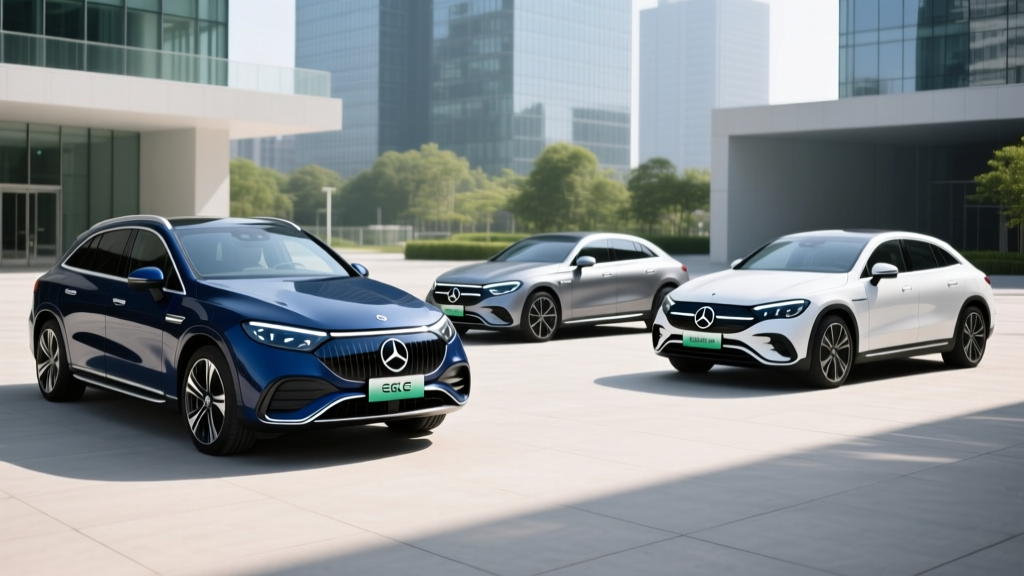
Quick Answer: Mercedes-Benz sells five electric car lines in the US for 2026: the EQB compact SUV (from ~$54,000, EPA 245 mi), the EQE sedan and SUV (from ~$76,000, up to EPA 308 mi), the flagship EQS sedan and SUV (from ~$105,000, up to EPA 390 mi), and the new G 580 with EQ Technology (from ~$161,000, EPA 244 mi). None currently qualify for the federal §30D tax credit due to battery-sourcing and MSRP-cap rules. Expect real-world highway range to run 10–15% below EPA stickers, and plan for Level 2 home charging as essential — DC fast charging peaks at 170–200 kW across most models, with 10–80% in roughly 28–32 minutes.
The 2026 Electric Mercedes Lineup at a Glance
Mercedes-Benz has committed to an electric future under its "Ambition 2039" strategy, but the current US lineup reflects a transitional reality: a mix of dedicated EV platforms (EVA2 underpinning the EQS and EQE) and adapted architectures (the EQB, derived from the GLB). For buyers, this means meaningful differences in interior packaging, charging speed, and driving dynamics across the range.
Here is how the core models stack up on the numbers that matter most:
| Model | Body Style | Battery (kWh usable) | EPA Range | Peak DC Charge | 10–80% Time | 0–60 mph | Base MSRP |
|---|---|---|---|---|---|---|---|
| EQB 300 4MATIC | Compact SUV | 66.5 kWh (NMC) | 245 mi | 100 kW | ~32 min | 7.7 sec | $54,200 |
| EQE 350+ Sedan | Mid-size Sedan | 90.6 kWh (NMC) | 308 mi | 170 kW | ~31 min | 6.2 sec | $76,050 |
| EQE 350 4MATIC SUV | Mid-size SUV | 90.6 kWh (NMC) | 279 mi | 170 kW | ~31 min | 6.4 sec | $78,050 |
| EQS 450+ Sedan | Full-size Sedan | 118 kWh (NMC) | 390 mi | 200 kW | ~31 min | 5.9 sec | $105,550 |
| EQS 450 4MATIC SUV | Full-size SUV | 118 kWh (NMC) | 330 mi | 200 kW | ~31 min | 5.7 sec | $108,050 |
| G 580 w/ EQ Tech | Off-road SUV | 116 kWh (NMC) | 244 mi | 200 kW | ~32 min | 4.6 sec | $161,400 |
Source: Mercedes-Benz USA spec sheets and fueleconomy.gov (EPA). Real-world highway range typically 10–15% below EPA; cold-weather (below 32°F) can reduce range an additional 20–30% depending on cabin heating demands and whether the vehicle is preconditioned.
Real-World Range vs. EPA Stickers: What to Actually Expect
The EPA test cycle includes a mix of city and highway driving at moderate speeds. Most Mercedes EV buyers will spend significant time at 70–80 mph on interstates, where aerodynamic drag and higher speeds erode efficiency. Here is a practical reconciliation:
EQS 450+ Sedan: EPA 390 mi → Expect ~320–340 mi on a highway road trip at 75 mph in mild weather. In winter conditions (20–30°F), plan for ~260–290 mi unless you precondition while plugged in.
EQE 350+ Sedan: EPA 308 mi → Expect ~250–270 mi highway, ~210–240 mi in cold weather.
EQB 300 4MATIC: EPA 245 mi → Expect ~200–215 mi highway. This is the lineup's range weak point — adequate for commuting, tight for road trips without planned stops.
The EQS sedan's 0.20 drag coefficient — one of the lowest of any production car — is a key reason its real-world highway efficiency holds up better than the boxier SUV models. The G 580, by contrast, is aerodynamically penalized: 244 mi EPA from a massive 116 kWh battery reflects its brick-like profile.
Charging Speed and Infrastructure: The Practical Picture
Mercedes-Benz uses the CCS1 connector on all current US-market EVs, though the brand has confirmed adoption of the NACS (Tesla-style) connector for future models. For now, CCS1 gives you access to Electrify America, EVgo, ChargePoint, and most non-Tesla networks. Tesla Supercharger access requires a manufacturer-approved adapter — check with your dealer for compatibility and warranty implications.
| Charging Level | Power (kW) | Typical Miles Added per Hour | Use Case |
|---|---|---|---|
| Level 1 (120V household) | ~1.4 kW | 3–5 mi/hr | Emergency / overnight trickle for PHEVs |
| Level 2 (240V home) | 7.7–11.5 kW | 20–35 mi/hr | Daily charging — full overnight replenishment |
| DC Fast Charge (EQB) | Up to 100 kW | ~150–180 mi in 30 min | Road trips, limited by peak rate |
| DC Fast Charge (EQE/EQS/G 580) | 170–200 kW | ~180–220 mi in 30 min | Road trips — adequate but not class-leading |
Charging-curve reality: The "peak" kW figure is just that — a peak. On the EQS 450+, you will see 200 kW only briefly between roughly 10–25% State of Charge. The rate tapers progressively: expect ~150 kW through 50%, then ~100 kW through 70%, and a slow crawl above 85%. This is why 10–80% times (~31 minutes) are a more honest metric than peak kW alone. Mercedes' battery thermal management is competent but not class-leading — Hyundai/Kia's E-GMP platform at 800V still charges faster (10–80% in ~18 minutes).
Home charging is essential. Level 2 installation (a 48-amp hardwired charger on a 60-amp circuit) typically costs $1,200–$2,500 including equipment, electrician labor, and permits, assuming your electrical panel has capacity. A panel upgrade from 100A to 200A adds $1,500–$3,500. Without home charging, relying on public DC fast charging at $0.30–$0.50/kWh significantly increases your per-mile cost and adds inconvenience.
Electric Mercedes vs. Gas and Hybrid: Cost Comparison
The financial case for an electric Mercedes depends on your driving volume, electricity rate, and whether you can access off-peak home charging. Here is a five-year comparison using the EQE 350+ sedan against its closest internal-combustion sibling, the E 350 sedan, and a luxury hybrid alternative:
| Factor | EQE 350+ (EV) | E 350 Sedan (Gas) | BMW 530e (PHEV) |
|---|---|---|---|
| Base MSRP | $76,050 | $59,900 | $60,900 |
| Federal Tax Credit (§30D) | $0 (sourcing/MSRP) | $0 | $0 (MSRP cap applies to sedans at $55K) |
| Fuel/Energy Cost (5 yr, 60K mi) | ~$4,800 (home @ $0.14/kWh) | ~$10,500 (premium @ $4.20/gal, 26 MPG) | ~$7,200 (mixed gas + electric) |
| Maintenance (5 yr est.) | ~$2,200 | ~$4,800 | ~$4,200 |
| Insurance (5 yr est.) | ~$14,500 | ~$11,000 | ~$11,800 |
| Estimated Depreciation (5 yr) | ~$38,000 (50%) | ~$27,000 (45%) | ~$29,000 (48%) |
| 5-Year Total Cost | ~$97,550 | ~$83,200 | ~$83,100 |
Assumptions: 12,000 miles/year, national average electricity at $0.14/kWh (EIA), premium gasoline at $4.20/gal. Insurance estimates from industry averages for luxury sedans. Depreciation based on current luxury EV resale trends. Your actual costs will vary by state, driving pattern, and electricity rate.
The honest takeaway: On pure economics, the gas E 350 and the BMW 530e PHEV cost less over five years, primarily because the EQE's higher purchase price, steeper depreciation, and pricier insurance offset its fuel and maintenance savings. The electric Mercedes wins on driving refinement, instant torque, and tailpipe emissions — not on total cost of ownership for most buyers. If your electricity rate is below $0.10/kWh (common with time-of-use plans in some states) or you drive 15,000+ miles annually, the math shifts closer to parity.
Tax Credit Eligibility: The §30D Reality for Mercedes EVs
As of 2026, no new electric Mercedes model qualifies for the federal §30D Clean Vehicle Credit (up to $7,500). The reasons are twofold:
- MSRP Cap: The §30D credit applies only to sedans priced below $55,000 and SUVs/trucks/vans below $80,000. The EQB 300 starts at $54,200 (under the SUV cap), but most trims and options push it above. The EQE and EQS exceed their respective caps.
- Battery Sourcing Requirements: The credit requires that a percentage of critical minerals and battery components are sourced from the US or free-trade-agreement countries. Mercedes' current battery supply chain (primarily CATL and other non-FTA suppliers for key components) does not meet the thresholds. The IRS enforces these rules strictly — see IRS §30D guidance for current-year details.
- Income Caps: Even if a vehicle qualified, buyers must have modified adjusted gross income below $150,000 (single), $225,000 (head of household), or $300,000 (joint).
Point-of-sale transfer: If you find a qualifying EV from another brand, the §30D credit can now be transferred to the dealer at purchase, reducing your out-of-pocket cost immediately rather than waiting for a tax refund. This does not apply to Mercedes models currently.
Used EV credit (§25E): If you are open to a pre-owned EQE or EQB, the used clean vehicle credit offers up to $4,000 (30% of sale price, capped) on vehicles under $25,000 sold by a licensed dealer. Income caps are lower: $75,000 single / $150,000 joint. Given current resale values, finding a qualifying used Mercedes EV under that price threshold is unlikely before 2027–2028.
Common Misconceptions About Electric Mercedes Cars
| Myth | Fact |
|---|---|
| "The EQS gets 390 miles so I'll never need to charge on a road trip." | At sustained highway speeds (75+ mph), expect ~320–340 miles. In winter, that drops to ~260–290. Plan one 20-minute DC fast stop on any trip over 250 miles. |
| "I can charge on any Tesla Supercharger." | Current Mercedes EVs use CCS1 connectors. Tesla Supercharger access requires a Mercedes-approved adapter, and not all Supercharger stalls have been opened to non-Tesla vehicles. Check the Tesla app or Mercedes me Charge app for compatible stations. |
| "EV maintenance is nearly zero." | You skip oil changes and transmission fluid, but tire wear is 20–30% faster on EVs due to higher vehicle weight and instant torque. Budget $800–$1,200 for a set of premium touring tires every 25,000–35,000 miles. Cabin air filters, brake fluid checks, wiper fluid, and 12V battery replacement still apply. |
| "The battery will need replacing and cost $20,000+." | Mercedes warranties the high-voltage battery for 8 years / 100,000 miles against degradation below 70% of original capacity. Industry data shows NMC batteries in thermally managed systems (like Mercedes') typically retain 85–90% capacity at 100,000 miles. Full replacement is rare and usually covered under warranty during that period. |
| "Electric Mercedes are self-driving with Drive Pilot." | Mercedes Drive Pilot is an SAE Level 3 system approved in Nevada and California for speeds up to 40 mph on limited-access highways in specific conditions. It is NOT a full self-driving system. You must remain available to resume control within seconds when prompted. The vast majority of driving still requires your full attention. |
Decision Framework: Which Electric Mercedes Is Right for You?
Choose the EQB 300 if: You want the most affordable entry into the Mercedes EV lineup, need a compact SUV with optional third-row seating (small children only), primarily commute under 50 miles daily, and can charge at home. Accept that 245 miles of EPA range makes road trips require planning.
Choose the EQE 350+ Sedan if: You want a mid-size luxury EV with strong real-world range (~260+ mi highway), appreciate the dedicated EVA2 platform's smooth ride and low center of gravity, and value MBUX Hyperscreen technology. This is the sweet spot for luxury EV sedan buyers who don't need the flagship price.
Choose the EQS 450+ Sedan if: Range is your top priority and you want the longest EPA figure in the lineup (390 mi). The 118 kWh battery and exceptional aerodynamics deliver the best real-world highway endurance. Budget must accommodate a $105K+ starting price with no federal credit.
Choose the EQS 450 4MATIC SUV if: You need three-row seating (standard on the EQS SUV), want a commanding ride height, and prioritize passenger space over maximum range. Expect ~280 miles real-world highway.
Choose the G 580 with EQ Technology if: You want a statement vehicle with genuine off-road capability (four individual wheel motors, G-Turn tank turns, 33.7° approach angle), accept the efficiency penalty of a boxy design, and have the budget for a $161K+ luxury icon. This is an emotional purchase, not an economic one.
Consider a PHEV alternative (like the GLC 350e) if: You lack reliable home charging, frequently drive in rural areas with sparse DC fast-charging infrastructure, or want to reduce fuel consumption without full EV commitment. The GLC 350e offers ~34 miles of electric-only range plus a gas engine for unlimited flexibility.
First-Time EV Buyer Essentials: What to Know Before You Sign
If this is your first electric vehicle, the ownership experience differs from gas cars in ways that go beyond the fuel pump:
Home charging setup is non-negotiable for convenience. A Level 2 home charger (240V, 48 amps) will fully replenish any Mercedes EV overnight — typically 8–12 hours from near-empty. Budget $1,200–$2,500 for professional installation. Confirm your electrical panel has a spare 60-amp breaker slot before purchasing the car.
Preconditioning matters. Use the Mercedes me app to warm or cool the cabin and battery while the car is still plugged in. This preserves range (the car uses grid power instead of battery power for climate control) and enables faster DC charging by bringing the battery to optimal temperature before you arrive at the station.
Tire costs are higher. The EQS 450+ weighs over 5,600 pounds. EV-specific tires (like the Michelin Pilot Sport EV or Hankton iON) carry a premium but are engineered for lower rolling resistance and noise reduction. Budget accordingly.
Insurance runs 15–30% higher than equivalent gas Mercedes models, driven by higher repair costs (specialized body shop requirements, battery protection protocols) and elevated vehicle values. Get quotes from your insurer before committing to a purchase.
Regenerative braking changes how you drive. Mercedes offers adjustable regen levels via steering-wheel paddles, but unlike some competitors, it does not offer true one-pedal driving to a complete stop in all modes. Expect a brief adaptation period.
Frequently Asked Questions
Do any electric Mercedes cars qualify for the $7,500 federal tax credit in 2026?
No. Current §30D rules require battery components and critical minerals to meet US/FTA sourcing thresholds, and MSRP caps ($55,000 for sedans, $80,000 for SUVs) apply. The EQB SUV starts under the cap but its supply chain does not meet sourcing requirements. Always verify current rules at IRS.gov before purchasing.
How long does it take to charge an electric Mercedes at home?
On a Level 2 home charger (11.5 kW), the EQS with its 118 kWh battery takes roughly 10–11 hours from empty to full. The EQE takes about 8 hours. The EQB takes about 6 hours. Most owners charge nightly, topping up 20–40% — which takes 2–4 hours.
Is the Mercedes EQS reliable compared to gas S-Class models?
Long-term reliability data for the EVA2 platform is still accumulating (the EQS launched for the 2022 model year). The powertrain has fewer moving parts than an S 500, which reduces mechanical failure points, but the complex electronics (MBUX Hyperscreen, rear-axle steering, air suspension) add potential service items. Mercedes' 4-year/50,000-mile bumper-to-bumper warranty and 8-year/100,000-mile battery warranty provide baseline coverage.
Can I road-trip an electric Mercedes cross-country?
Yes, with planning. The EQS 450+ can cover 280–320 real-world highway miles between 30-minute DC fast-charge stops. Use the Mercedes me Charge system or apps like PlugShare and A Better Routeplanner to identify CCS-compatible stations along your route. Electrify America's network covers most interstate corridors, though reliability varies by station — factor in a backup stop within 50 miles of your primary target.
Will Mercedes switch to the Tesla NACS connector?
Mercedes-Benz has announced it will adopt the North American Charging Standard (NACS) on future EV models, but current-production EQS, EQE, EQB, and G 580 vehicles retain CCS1. If you buy a 2026 model, expect CCS1. Mercedes me Charge and the included CCS adapter ecosystem will continue to support existing vehicles on CCS networks even after the transition.
What is the battery warranty on electric Mercedes cars?
Mercedes-Benz covers the high-voltage traction battery for 8 years or 100,000 miles, whichever comes first, against defects and capacity degradation below 70% of original usable capacity. If your battery falls below that threshold within the warranty period, Mercedes will repair or replace it to restore capacity above 70%.