The Short Answer
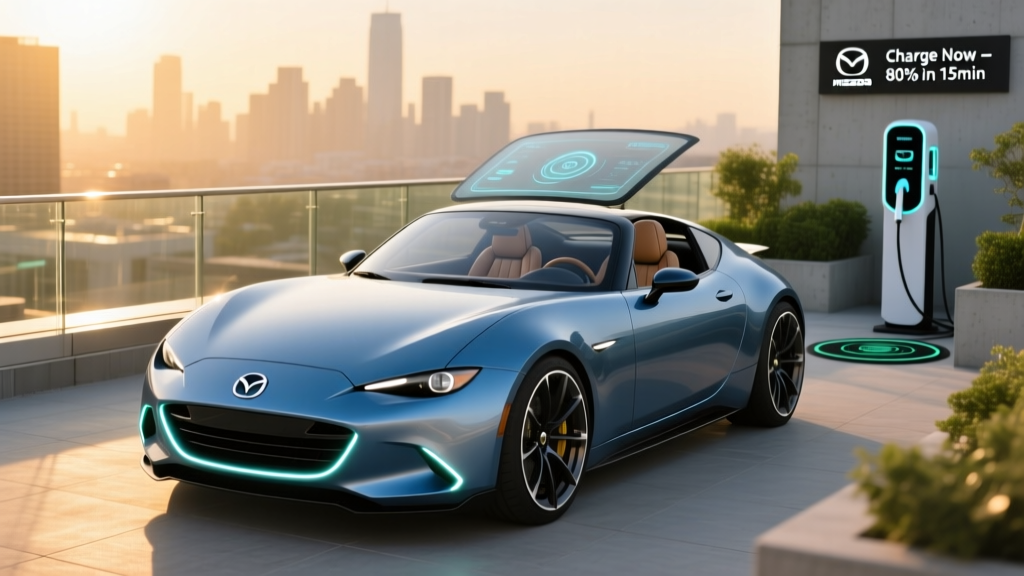
As of early 2026, there is no production electric Mazda Miata (MX-5). Mazda has not announced a battery-electric MX-5, and the current fourth-generation (ND) Miata remains gas-only, powered by a 2.0L Skyactiv-G engine producing 181 hp. Mazda's EV roadmap includes electrified models, but a dedicated EV sports car wearing the Miata badge does not exist in showrooms or on the announced product timeline. If you want a lightweight, two-seat electric sports car today, you'll need to look at alternatives — and we break those down below with real numbers.
Why Mazda Hasn't Built an Electric Miata Yet
The MX-5 Miata has always been defined by a specific formula: low weight, balanced chassis, affordable price, and a naturally aspirated engine paired with a manual transmission. The current ND-generation Miata weighs roughly 2,340 lbs — one of the lightest production sports cars sold in the U.S. Adding a battery pack large enough for meaningful range would fundamentally challenge that identity.
Consider the physics. A usable 60 kWh battery pack (enough for roughly 220–250 miles of EPA range in a small, efficient car) adds approximately 800–950 lbs. That would push an electric Miata past 3,100 lbs, erasing the nimble, tossable character that defines the model. Mazda has acknowledged this tension publicly; executives have stated that the MX-5's future powertrain decisions will prioritize preserving the car's driving dynamics above all else.
Mazda's broader electrification strategy has also moved slower than most legacy automakers. The CX-90 PHEV and CX-70 PHEV represent the brand's current plug-in offerings, while the MX-30 — a limited-range EV sold only in California — was discontinued after the 2023 model year with just 100 miles of EPA range. That cautious approach makes a near-term electric Miata unlikely before 2028 at the earliest.
The Best EV Alternatives to an Electric Miata
If the idea of an electric Mazda Miata appeals to you — a fun, compact, driver-focused EV — here are the closest production alternatives available in 2026, with exact specs:
| Spec | BMW Z4 / Toyota Supra (Gas Baseline) | MG Cyberster (EV) | Porsche Boxster EV (Announced) | Fiat 124 Spider (Gas Baseline) |
|---|---|---|---|---|
| Powertrain | 2.0L Turbo I4 | Dual-motor BEV | Single/Dual-motor BEV | 1.4L Turbo I4 |
| Horsepower | 255 hp | ~536 hp | TBD (est. 350–450 hp) | 160 hp |
| 0–60 mph | 5.0 sec | ~3.2 sec | TBD | 6.8 sec |
| EPA Range | ~370 mi (gas tank) | ~270 mi (est.) | TBD | ~360 mi (gas tank) |
| Curb Weight | ~3,340 lbs | ~4,200 lbs | TBD | ~2,475 lbs |
| Base MSRP | ~$53,000 | Not U.S.-available | TBD (est. $70,000+) | Discontinued |
| Body Style | 2-seat roadster/coupe | 2-seat roadster | 2-seat roadster | 2-seat roadster |
The honest reality: no current EV replicates the Miata's sub-2,400-lb, affordable roadster formula. The MG Cyberster is the closest in spirit — a two-seat electric roadster — but it isn't sold in the United States and weighs nearly twice as much as a Miata. Porsche's upcoming electric 718 Boxster (announced, not yet on sale) will offer genuine sports car dynamics but at a price point three to four times the Miata's ~$30,000 starting MSRP.
Cost Reality: Miata Gas vs. EV Sports Car Ownership
For buyers cross-shopping a gas Miata against an electric sports car, the total cost picture matters. Here's a five-year ownership estimate comparing a 2026 Mazda MX-5 against a hypothetical EV sports car in the $45,000 range:
| Category | 2026 Mazda MX-5 ($30,170 MSRP) | Hypothetical EV Sports Car ($45,000) |
|---|---|---|
| Purchase Price (base) | $30,170 | $45,000 |
| Federal Tax Credit (§30D) | $0 | Up to $7,500 (see eligibility below) |
| Fuel / Electricity (5 yr) | ~$8,750 (26 MPG combined, $3.25/gal) | ~$3,200 (home charging, $0.14/kWh, 3.5 mi/kWh) |
| Maintenance (5 yr) | ~$2,800 (oil, filters, brakes) | ~$900 (cabin filter, tires, fluid top-offs) |
| Insurance (5 yr avg.) | ~$7,500 | ~$9,000 (EVs typically cost 15–20% more to insure) |
| Estimated 5-Year Total | ~$49,220 | ~$60,600 (after credit) |
The gas Miata wins on upfront cost and total expenditure over five years. The EV's fuel and maintenance savings — roughly $7,450 combined — don't fully offset a $14,830 price gap, even with a maximum federal §30D tax credit. However, if you prioritize instant torque, silent operation, and home charging convenience, the EV ownership experience offers intangible benefits that spreadsheets don't fully capture.
Federal Tax Credit Rules for EV Sports Cars
If you do pursue an electric sports car alternative, the §30D New Clean Vehicle Credit has strict 2026 eligibility requirements:
- MSRP cap: Vans, SUVs, and pickups are capped at $80,000; all other vehicles (including sports cars and sedans) are capped at $55,000.
- Buyer income limits: AGI must not exceed $150,000 (single), $225,000 (head of household), or $300,000 (joint).
- Battery sourcing: Increasing percentages of critical minerals and battery components must be sourced from the U.S. or FTA partners — rules that tighten annually through 2029.
- Point-of-sale transfer: Eligible buyers can transfer the credit to the dealer at purchase, reducing the purchase price directly rather than waiting for a tax refund.
- Assembly: Final assembly must occur in North America.
Most European- or Asian-built EV sports cars will not qualify regardless of price, due to the North American assembly requirement. Always verify eligibility on fueleconomy.gov before purchasing.
Common Misconceptions About an Electric Miata
| Myth | Fact |
|---|---|
| "Mazda is releasing an electric Miata in 2026." | No official announcement exists. The ND Miata remains gas-only for the 2026 model year. |
| "An EV Miata would have instant torque and be faster." | True on acceleration, but a 60+ kWh battery adds ~900 lbs, fundamentally altering the car's handling balance and weight-dependent charm. |
| "Converting a gas Miata to electric is easy and cheap." | Aftermarket EV conversions typically cost $25,000–$50,000, yield 80–120 miles of range, void all factory warranties, and require custom engineering. Not practical for most buyers. |
| "Any roadster EV is basically an electric Miata." | The Miata's identity is inseparable from its light weight (~2,340 lbs) and ~$30,000 price. Heavier, pricier EV roadsters are a different category. |
Real-World Ownership: What First-Time EV Buyers Must Know
If the EV sports car concept appeals to you and you're considering an alternative, these practical factors matter more than spec sheets:
Home charging is nearly mandatory. Public DC fast charging a sports car at $0.35–$0.50/kWh erases most fuel-cost savings. A Level 2 home charger (240V, 40–48 amps, ~9.6–11.5 kW) adds roughly 30–40 miles of range per hour of charging and costs $800–$2,000 installed, depending on your electrical panel. If you live in an apartment or lack dedicated parking, EV ownership becomes significantly less convenient.
Cold weather reduces range 20–35%. A 270-mile EPA-rated EV roadster might deliver only 175–215 miles in sub-freezing conditions. Sports cars with lower ride heights and minimal ground clearance also face additional winter practicality challenges.
Insurance costs more. EVs carry higher repair costs (specialized battery and motor service), and insurers price accordingly. Expect premiums 15–25% above an equivalent gas sports car. Get quotes before committing.
Charging on road trips requires planning. Unlike a Miata that refuels in 3 minutes at any gas station, EV road trips require routing through compatible DC fast chargers. A 300-mile trip in an EV with 250 miles of range means one 20–30 minute charging stop — manageable, but different from the spontaneity a gas car affords.
Decision Framework: Should You Wait or Buy Now?
Choose the gas Mazda MX-5 if:
- You want a sub-$35,000 lightweight roadster today
- You value a manual transmission and sub-2,400-lb curb weight
- You lack reliable home charging access
- You take frequent road trips and don't want to plan charging stops
- You live in a region with harsh winters (the Miata's simplicity and low repair cost are advantages)
Choose an EV sports car alternative if:
- You have home Level 2 charging and mostly drive under 200 miles/day
- You want instant torque and silent, vibration-free cruising
- You're willing to spend $45,000+ and accept a heavier vehicle
- You qualify for the §30D tax credit and can verify the model's eligibility
- You prioritize lower ongoing fuel and maintenance costs over upfront price
Wait for a possible electric Miata if:
- Mazda announces an electrified next-generation MX-5 (likely a hybrid or range-extender before a full BEV)
- Solid-state battery technology delivers meaningful weight reduction — still expected post-2028 for mass production
- You're comfortable with a 3–5 year timeline and no guaranteed outcome
Frequently Asked Questions
Will Mazda ever make an electric Miata?
Mazda has not confirmed plans for a battery-electric MX-5. Industry analysts expect the next-generation MX-5 (likely arriving around 2028–2030) to offer some form of electrification — possibly a mild-hybrid or plug-in hybrid system — before a full EV variant. Mazda's leadership has emphasized preserving the Miata's lightweight character, which conflicts with current battery weight.
Can I convert a gas Miata to electric?
Aftermarket EV conversion kits exist, but they typically cost $25,000–$50,000, yield limited range (80–120 miles), add significant weight, and void all factory safety and emissions certifications. For most buyers, selling the gas Miata and purchasing a production EV is more practical, safer, and more cost-effective.
What's the closest thing to an electric Miata I can buy today?
No current U.S.-market EV matches the Miata's formula of a lightweight, affordable, two-seat roadster. The closest alternatives in spirit are the BMW Z4 (gas, ~$53,000) or waiting for Porsche's announced electric 718 Boxster (est. $70,000+, not yet on sale). The Fiat 500e offers playful EV dynamics at ~$36,500 but is a hatchback, not a roadster.
Does the Mazda MX-5 qualify for any EV tax credits?
No. The current MX-5 is a gasoline-only vehicle with no hybrid or plug-in variant. It does not qualify for the federal §30D New Clean Vehicle Credit, which applies only to battery-electric, plug-in hybrid, and fuel-cell vehicles meeting sourcing and assembly requirements.
What about the Mazda MX-30 — wasn't that an electric Mazda?
The MX-30 was Mazda's first mass-production EV, but it was only sold in California and was discontinued after the 2023 model year. It had just 100 miles of EPA range from a 35.5 kWh battery — far too limited for most buyers — and was a crossover, not a sports car. It has no connection to the Miata lineage.