Quick Answer: Should You Buy an Electric Lexus SUV?
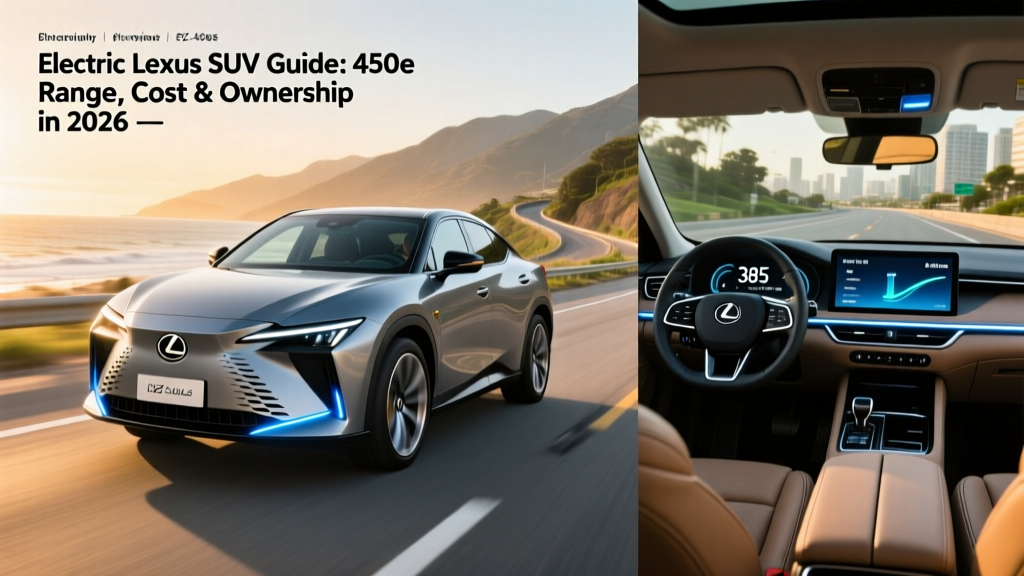
The 2026 Lexus RZ 450e is a premium electric compact SUV starting at approximately $55,550 with an EPA-estimated 220 miles of range (19-inch wheels) and up to 150 kW DC fast charging. It's best suited for current Lexus owners who want a luxury EV for daily commuting and have access to Level 2 home charging. However, its range falls short of rivals like the Genesis GV60 (248 mi) and BMW iX (324 mi). If you frequently drive over 250 miles between stops or live in extreme cold climates, the RZ's real-world range of ~170–190 miles may feel limiting.
What the Electric Lexus SUV Lineup Looks Like in 2026
Lexus entered the battery-electric market with the RZ 450e, built on Toyota's e-TNGA platform shared with the Subaru Solterra and Toyota bZ4X. For 2026, Lexus continues to offer the RZ 450e in two main trims — Premium and Luxury — with the option of 18-inch or 20-inch wheels (the 20-inch wheels reduce range). A lower-output RZ 300e variant (FWD, single motor) was announced for select markets, offering slightly more range at a lower entry price, though availability in the U.S. remains limited. The RZ 450e remains the primary electric Lexus SUV buyers can purchase stateside.
Lexus's approach prioritizes refinement, ride comfort, and brand familiarity over chasing maximum range or performance numbers. That philosophy will appeal to some buyers and frustrate others — it depends on what you value in an electric SUV.
RZ 450e Specs: Range, Battery, Charging & Performance
| Specification | 2026 Lexus RZ 450e (Premium) |
|---|---|
| EPA Range (18-in wheels) | 220 miles |
| EPA Range (20-in wheels) | 196 miles |
| Battery Capacity (usable) | ~71.4 kWh (NMC chemistry) |
| Drivetrain | Dual-motor AWD (DIRECT4) |
| Horsepower | 308 hp |
| 0–60 mph | ~5.0 seconds |
| Max DC Fast Charge Rate | 150 kW (peak) |
| 10–80% DC Charge Time | ~30 minutes |
| Level 2 Charging Rate | 7.2 kW (onboard charger) |
| Level 2 Full Charge Time | ~10.5 hours |
| Connector | CCS1 (J1772 for L2) |
| EPA Efficiency | 102 MPGe combined (18-in) |
| Battery Warranty | 8 years / 100,000 miles |
| Base MSRP | ~$55,550 (Premium, incl. destination) |
Real-World Range vs. EPA Sticker
The EPA rates the RZ 450e at 220 miles with 18-inch wheels, but real-world results vary significantly:
- Mixed driving (city/suburban): ~200–215 miles achievable with moderate climate use
- Sustained highway (70+ mph): ~170–190 miles — aerodynamic drag reduces efficiency sharply
- Cold weather (below 32°F): ~150–175 miles — NMC batteries lose 15–30% capacity in freezing temps without consistent preconditioning
- Mountain/terrain driving: Expect 160–185 miles depending on elevation changes and regen usage
Source: fueleconomy.gov
Charging the RZ 450e: What You Need to Know
The RZ 450e uses a CCS1 connector for DC fast charging and a J1772 connector for Level 2 AC charging. Lexus does not currently include NACS (Tesla-style) ports, though adapters are available for accessing Tesla Supercharger networks.
| Charging Level | Power | Miles Added per Hour | Best Use Case |
|---|---|---|---|
| Level 1 (120V household) | ~1.2 kW | ~3–4 mi/hr | Emergency top-ups only |
| Level 2 (240V home/public) | 7.2 kW | ~22–25 mi/hr | Daily overnight charging |
| DC Fast Charging | Up to 150 kW peak | ~150+ mi in 30 min (10–80%) | Road trips |
Charging curve reality: The RZ 450e peaks at 150 kW only at low state-of-charge (roughly 10–30% SoC). From 50–80%, charge speed tapers significantly, typically dropping to 50–70 kW. This means the 10–80% time of ~30 minutes is realistic, but an 80–100% top-off can add another 40+ minutes. Plan road-trip stops to charge to 80% and move on.
Home charging access matters most. A Level 2 home charger (240V, 32–48A circuit) is practically essential for RZ ownership. Budget $500–$1,200 for a quality Level 2 unit (ChargePoint Home Flex, Emporia Vue, or Wallbox Pulsar Plus) and $800–$2,500 for professional electrician installation, depending on whether your electrical panel needs an upgrade to 200A service. Without home charging, relying on public Level 2 or DC fast chargers daily becomes expensive and time-consuming.
Electric Lexus SUV vs. Gas Lexus RX: Cost Comparison
Many cross-shoppers compare the RZ 450e against the gas-powered Lexus RX 350, the brand's best-selling SUV. Here's how the math works over 5 years of ownership at 12,000 miles/year:
| Cost Factor (5 years / 60,000 mi) | Lexus RZ 450e (Electric) | Lexus RX 350 AWD (Gas) |
|---|---|---|
| Base MSRP | $55,550 | $51,500 |
| Estimated Federal Tax Credit (§30D) | $0–$7,500* | $0 |
| Fuel / Electricity (60k mi) | $3,200–$4,800** | $8,400–$9,600*** |
| Maintenance (5 yr) | $1,200–$1,800 | $3,500–$4,500 |
| Insurance (5 yr avg) | $10,500–$13,000 | $8,500–$10,500 |
| Estimated Depreciation | ~$22,000–$27,000 | ~$18,000–$22,000 |
| Approx. 5-Year Total Cost | $52,000–$65,000 | $54,000–$64,000 |
* §30D tax credit eligibility depends on battery sourcing, buyer income caps ($150k single / $300k joint), and MSRP limits ($80k for SUVs). The RZ 450e's credit availability varies by model year and manufacturing changes — verify at IRS.gov before purchasing.
** Electricity cost assumes $0.14–$0.20/kWh average; home charging is cheaper, DCFC is more expensive.
*** Gas cost assumes $3.50–$4.00/gal at 24 MPG combined (per EPA).
The RZ 450e can break even with or beat the RX 350 on total cost over five years, but only if you qualify for the tax credit and charge primarily at home. Public DC fast charging at $0.35–$0.50/kWh erodes the fuel savings quickly. Higher EV insurance premiums ($200–$400/year more) and steeper depreciation also narrow the gap.
EV vs. Hybrid: Should You Consider the Lexus RX Hybrid Instead?
Lexus also offers the RX 350h hybrid at ~$53,000, achieving an EPA-estimated 36 MPG combined with no plug-in requirement. For buyers without home charging access or who regularly drive 300+ miles between stops, the RX 350h eliminates range limitations entirely while still reducing fuel costs by ~40% compared to the gas RX 350.
| Factor | RZ 450e (EV) | RX 350h (Hybrid) | RX 350 (Gas) |
|---|---|---|---|
| EPA Range / Efficiency | 220 mi / 102 MPGe | 580 mi / 36 MPG | 430 mi / 24 MPG |
| Home Charging Needed? | Yes (practically required) | No | No |
| Road-Trip Convenience | 30-min stops every ~170 mi | 5-min stops every ~550 mi | 5-min stops every ~400 mi |
| Annual Fuel/Energy Cost | $640–$960 | $1,400–$1,600 | $2,100–$2,400 |
| Tax Credit Eligible? | Possibly (§30D) | No | No |
The hybrid is the pragmatic choice for one-car households that take frequent long road trips, live in apartments without charging access, or operate in extreme cold climates where EV range loss is significant.
Common Misconceptions About the Electric Lexus SUV
| Myth | Fact |
|---|---|
| "The RZ 450e gets $7,500 off automatically." | The §30D credit requires meeting battery sourcing, MSRP, and buyer income requirements. Eligibility changes — always verify at IRS.gov before purchase. Point-of-sale transfer is available through registered dealers. |
| "220 miles of range is enough for road trips." | Real-world highway range is closer to 170–190 miles. With charging infrastructure gaps in rural areas, you'll need to plan stops carefully. The 30-minute charge time is acceptable but adds up on multi-day trips. |
| "EV maintenance is nearly free." | You save on oil changes, spark plugs, and transmission fluid. But tire replacement (EVs wear tires faster due to weight and torque), cabin air filters, brake fluid, and wiper service still cost money. Budget $1,200–$1,800 over 5 years. |
| "I can charge on any Tesla Supercharger." | The RZ uses CCS1. Tesla's NACS Supercharger network requires a certified adapter (available from Tesla and third parties). Not all Supercharger stalls have been opened to non-Tesla vehicles — check the Tesla app for station compatibility. |
| "The battery will need expensive replacement soon." | Lexus warranties the battery for 8 years / 100,000 miles against degradation below 70% capacity. NMC batteries in modern EVs typically retain 85–90% capacity after 100,000 miles. Full replacement costs $12,000–$18,000 if needed out of warranty, but this is rare within the first decade. |
First-Time EV Buyer Checklist for the RZ 450e
If you're transitioning from a gas Lexus to your first electric vehicle, here's what to prepare before signing the purchase agreement:
- Confirm home charging feasibility. Check if your garage or parking area has access to a 240V circuit (NEMA 14-50 or hardwired). Get a quote from a licensed electrician — a panel upgrade from 100A to 200A can cost $1,500–$3,500.
- Map your daily driving. If your round-trip commute plus errands stays under 80–100 miles, the RZ 450e handles it easily with overnight Level 2 charging. If you regularly exceed 150 miles daily, consider a longer-range EV or a PHEV.
- Research your local public charging. Use PlugShare or the EVgo/Electrify America apps to identify DC fast chargers along your common routes. CCS1 compatibility is widespread, but reliability varies by network.
- Get an insurance quote before buying. EV insurance premiums run 15–25% higher than equivalent gas vehicles. Get a firm quote from your provider to avoid surprises.
- Verify tax credit eligibility. Use the IRS's clean vehicle credit tool and confirm with your tax professional. The credit can be applied at point-of-sale through participating dealers, reducing your out-of-pocket cost immediately.
- Understand the charging learning curve. Preconditioning the battery (using the car's navigation to set a DC charger as your destination) warms the battery and enables faster charging. This is especially critical in cold weather.
Decision Framework: Is the Electric Lexus SUV Right for You?
Choose the Lexus RZ 450e if:
- You have Level 2 home charging (or can install it)
- Your daily driving stays under 100 miles round-trip
- You value Lexus's refinement, warranty, and dealer experience
- You want a luxury EV without the Tesla ecosystem
- You qualify for the §30D federal tax credit (reduces effective price to ~$48,000)
- You take road trips 2–3 times per year and can plan charging stops
Choose the Lexus RX 350h (Hybrid) if:
- You lack home charging access (apartment, street parking)
- You regularly drive 300+ miles between fueling/charging stops
- You live in a region with extreme winters (–10°F or below)
- You want the simplest ownership experience with no new infrastructure
- You prefer a proven platform with lower depreciation risk
Look at competitors (Genesis GV60, BMW iX, Tesla Model Y) if:
- Range is your top priority — the BMW iX xDrive50 delivers 324 EPA miles
- You want faster charging — the Hyundai Ioniq 5 / GV60 charges 10–80% in ~18 min at 350 kW
- You need a larger charging network — Tesla Model Y has exclusive Supercharger access
- Performance matters — the Genesis GV60 Performance does 0–60 in 3.9 seconds
Frequently Asked Questions
Does the Lexus RZ 450e qualify for the $7,500 federal tax credit?
Eligibility depends on several factors under IRS §30D: the buyer's modified adjusted gross income must not exceed $150,000 (single) or $300,000 (joint), the vehicle MSRP must be under $80,000 (SUV threshold), and the battery must meet critical-mineral and component-sourcing requirements. These rules change periodically. Verify current eligibility at IRS.gov or through your dealer's point-of-sale system before committing.
How long does it take to charge the RZ 450e at home?
On a Level 2 home charger (240V, 32A), the RZ 450e's 7.2 kW onboard charger fills the ~71.4 kWh battery from empty to full in approximately 10–11 hours. Most owners charge overnight from 20–80% SoC, which takes about 6 hours — more than enough for daily needs.
How does the RZ 450e perform in cold weather?
Like all EVs with NMC batteries, the RZ 450e experiences range reduction in freezing temperatures. Expect a 15–30% drop, bringing real-world range to roughly 150–175 miles in sub-32°F conditions. The RZ includes a battery preconditioning system that mitigates this when navigating to a charger, but cold-weather range loss is unavoidable. A heat pump (standard on the RZ) helps reduce cabin-heating energy draw.
Is the Lexus RZ 450e a good first EV?
It can be, if your lifestyle fits. The RZ is refined, quiet, and backed by Lexus's strong dealer and warranty network — a comfort factor for first-time EV buyers. However, its 220-mile EPA range is modest for 2026, and the CCS1 charging speed of 150 kW peak is slower than the 250–350 kW competitors offer. If range and charging speed are priorities, consider the Hyundai Ioniq 5, Kia EV6, or Tesla Model Y instead.
What's the difference between kW and kWh?
This is the most common EV confusion. kW (kilowatts) measures power — how fast energy flows, like water pressure in a hose. A 150 kW DC charger delivers energy quickly. kWh (kilowatt-hours) measures energy capacity — how much the battery holds, like the size of a water tank. The RZ 450e has a ~71.4 kWh battery. Charging at 150 kW for one hour would theoretically add 150 kWh (though in practice, charging tapers and the battery can't accept that rate continuously).
Will the Lexus RZ hold its resale value?
EV depreciation has been steeper than gas vehicles in recent years, with some models losing 40–50% of value in the first three years. Lexus's brand strength helps, but the RZ's modest range and evolving EV market put pressure on residuals. Expect roughly $22,000–$27,000 in depreciation over 5 years. Leasing can hedge this risk by locking in a guaranteed residual value.