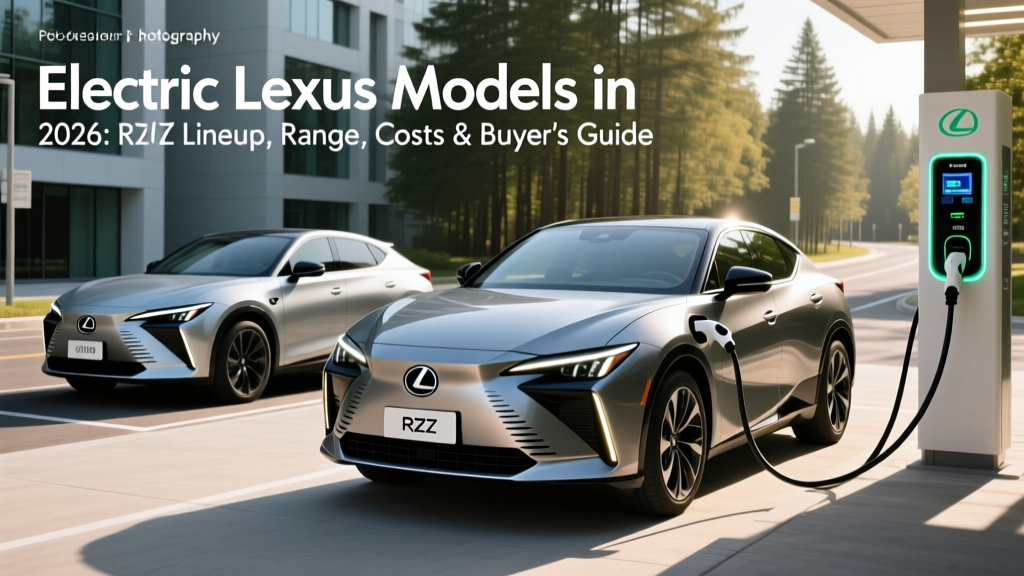
The short answer: As of the 2026 model year, Lexus offers two fully electric vehicles in the U.S.: the RZ 450e (dual-motor AWD, 222-mile EPA range, starting around $59,850) and the RZ 300e (single-motor FWD, 266-mile EPA range, starting around $55,850). Neither currently qualifies for the full $7,500 federal §30D tax credit at point of sale due to battery-sourcing requirements — a critical factor in your purchase math. The RZ lineup prioritizes luxury refinement and ride quality over class-leading range, making it best suited for buyers with reliable home charging and daily commutes under 150 miles.
The 2026 Electric Lexus Lineup: What's Available Now
Lexus entered the dedicated EV space with the RZ, built on Toyota's e-TNGA platform (shared with the bZ4X and Subaru Solterra). For 2026, the lineup remains focused on this compact luxury crossover segment, offered in two distinct powertrain configurations. Lexus has not announced additional electric models for U.S. sale as of early 2026, though parent company Toyota has teased a broader EV rollout through the decade.
| Specification | RZ 450e (AWD) | RZ 300e (FWD) |
|---|---|---|
| EPA Range | 222 mi (18" wheels) / 196 mi (20" wheels) | 266 mi (18" wheels) |
| Battery Capacity | 72.8 kWh usable (NMC lithium-ion) | 72.8 kWh usable (NMC lithium-ion) |
| Horsepower | 308 hp combined | 201 hp |
| 0–60 mph | 5.0 seconds | 7.4 seconds |
| Peak DC Fast Charge | 150 kW (CCS1 / NACS adapter) | 150 kW (CCS1 / NACS adapter) |
| 10–80% DC Charge Time | ~30 minutes | ~30 minutes |
| Level 2 Charge Rate | 7.2 kW (~22 mi/hr) | 7.2 kW (~22 mi/hr) |
| MPGe (Combined) | 102 MPGe | 118 MPGe |
| Base MSRP | $59,850 | $55,850 |
| Battery Warranty | 8 yr / 100,000 mi | 8 yr / 100,000 mi |
The battery uses NMC (nickel manganese cobalt) chemistry, which offers higher energy density than LFP (lithium iron phosphate) but requires more careful state-of-charge management for long-term longevity. Lexus recommends keeping daily charge limits around 80% for NMC batteries and charging to 100% only before longer trips — a practice that meaningfully extends cell life.
Real-World Range: What the EPA Sticker Doesn't Tell You
RZ 450e on 18" wheels — EPA: 222 miles. Expect approximately 185–200 miles in mixed highway driving at 70+ mph. In cold weather (below 32°F), plan for 155–175 miles of usable range. The 20" wheel Premium trim drops EPA to 196 miles, with real-world highway use closer to 160–175 miles.
RZ 300e — EPA: 266 miles. Real-world highway driving yields roughly 225–245 miles. Cold-weather highway range drops to approximately 185–210 miles. This makes the FWD model significantly more practical for range-conscious buyers.
The RZ's range figures fall short of competitors in the luxury EV crossover segment. The Genesis GV60 (248 mi), BMW iX xDrive50 (324 mi), and Cadillac Lyriq (314 mi) all exceed the RZ 450e on the EPA cycle. This gap stems from the RZ's relatively modest 72.8 kWh battery and the efficiency losses inherent in its dual-motor AWD system.
One factor often overlooked: the RZ's heat pump, standard on all trims, significantly reduces cold-weather range loss compared to EVs using resistive cabin heating. In testing, the RZ exhibits roughly 20–25% range reduction in freezing temperatures — better than the 30–40% loss seen in EVs without heat pumps, but still a material reduction for winter commuters.
Charging Speed and Infrastructure: The Practical Reality
The RZ's 150 kW peak DC fast-charge rate is the most debated spec in this lineup. While competitors like the Hyundai Ioniq 5 (peak 240 kW on 800V architecture) and the Porsche Macan EV (peak 270 kW) charge considerably faster, the RZ's 10–80% time of roughly 30 minutes is adequate for most road-trip scenarios — provided you plan stops around the battery's charge curve.
| Charging Level | Power | Speed (Approx.) | Use Case |
|---|---|---|---|
| Level 1 (120V outlet) | ~1.2 kW | ~4 mi/hr | Emergency / overnight trickle |
| Level 2 (240V home) | 7.2 kW | ~22 mi/hr | Daily home charging (full charge in ~10 hr) |
| DC Fast Charge | Up to 150 kW | ~150 mi in 30 min (10–80%) | Road trips |
Charge curve reality: The RZ hits peak 150 kW only between roughly 10–30% state of charge. From 30–60%, it sustains around 100–110 kW. Above 80%, charging tapers sharply to under 40 kW — typical for NMC chemistry but worth knowing if you're tempted to charge past 80% on a road trip. The last 20% can add 25+ minutes. Plan to charge to 80% and drive.
For connector compatibility, the 2026 RZ ships with a CCS1 inlet, but Lexus provides access to Tesla Supercharger networks via a NACS adapter (included or available depending on trim). This significantly expands usable fast-charging infrastructure, particularly in rural corridors where Superchargers often outnumber Electrify America or EVgo stations.
Cost of Ownership: Electric Lexus vs. Gas and Hybrid Alternatives
Understanding the true cost of owning an electric Lexus requires looking beyond the sticker price. Here's how the RZ compares to its closest internal-combustion sibling, the Lexus RX 350, and the Lexus RX 500h hybrid over five years and 75,000 miles of driving.
| Cost Factor (5 yr / 75k mi) | RZ 450e (EV) | RX 350 (Gas) | RX 500h (Hybrid) |
|---|---|---|---|
| Base MSRP | $59,850 | $51,900 | $63,550 |
| Federal Tax Credit (§30D) | $0 (sourcing rules)* | $0 | $0 |
| Fuel / Energy Cost | ~$3,900 (home L2)** | ~$9,400 (26 mpg, $3.25/gal) | ~$6,800 (36 mpg, $3.25/gal) |
| Maintenance | ~$1,800 | ~$3,500 | ~$3,200 |
| Insurance (avg) | ~$11,500 | ~$9,200 | ~$10,100 |
| 5-Year Total (est.) | ~$77,050 | ~$74,000 | ~$83,650 |
* The RZ's battery does not currently meet §30D critical-mineral and battery-component sourcing requirements. Verify current eligibility at IRS.gov before purchase, as sourcing rules update periodically.
** Based on national average electricity rate of $0.17/kWh and 3.5 mi/kWh efficiency. Actual costs vary significantly by state and utility rate.
The RZ's energy cost advantage is substantial — roughly $5,500 less than the gas RX 350 over five years with exclusive home charging. However, higher insurance premiums (typically 20–25% above gas equivalents for luxury EVs) and the lack of a federal tax credit narrow the gap. For buyers relying primarily on public DC fast charging at $0.35–$0.50/kWh, energy costs rise to approximately $5,500–$7,800 over five years, erasing much of the fueling advantage.
Home Charging Installation: A Key Variable
Most RZ owners will need a Level 2 home charger to make daily ownership practical. Budget $500–$800 for a quality Level 2 station (ChargePoint Home Flex, Emporia V2, or Wallbox Pulsar Plus) and $800–$2,500 for electrician installation, depending on panel proximity and whether your electrical panel requires a 200-amp upgrade ($1,500–$3,500 additional). Total home charging setup: $1,300–$6,800.
Buyers without access to home or workplace charging should carefully evaluate public charging density in their area before purchasing. The RZ's 222-mile range means frequent public charging sessions — likely 2–3 times per week for average drivers — which adds both cost and time compared to gas fueling.
Common Misconceptions About Electric Lexus Models
| Myth | Fact |
|---|---|
| "The RZ gets the same $7,500 tax credit as other EVs." | The RZ does not currently qualify for the §30D credit due to battery-sourcing rules. Always check the IRS qualified vehicles list before committing. |
| "222 miles of range is enough for any road trip." | At highway speeds in cold weather, real range can drop to ~155 miles. You'll need to plan DC fast-charge stops every 2–2.5 hours on longer trips. |
| "EVs don't need maintenance." | Tires (heavier EV wear), cabin air filters, brake fluid, coolant, and wiper fluid still require service. Expect ~$350–$450/year in maintenance — less than gas, but not zero. |
| "The battery will need expensive replacement." | NMC batteries in modern thermal-managed EVs like the RZ typically retain 85–90% capacity at 100,000 miles. Lexus warranties the battery for 8 years/100,000 miles against dropping below 70% capacity. |
| "Charging takes too long." | Home Level 2 charging replenishes the RZ overnight (10 hours from empty). You start every morning "full." Road-trip DC charging adds 20–30 minutes every 2 hours — comparable to rest stops. |
Who Should Buy an Electric Lexus — And Who Shouldn't
Choose the RZ 300e if:
- You prioritize maximum range and lower cost over AWD performance
- Your daily commute is under 100 miles round-trip
- You live in a mild climate where cold-weather range loss is minimal
- You have reliable Level 2 home charging
Choose the RZ 450e if:
- You need AWD for snow, rain, or mountain driving
- You value the 5.0-second 0–60 performance and dual-motor torque vectoring
- Your daily driving stays under 80 miles, leaving comfortable range buffer
- You frequently drive on 20" wheels and accept the 196-mile EPA trade-off
Look elsewhere (BMW iX, Genesis GV60, Cadillac Lyriq) if:
- You need 300+ miles of range for frequent long-distance travel
- You want faster DC charging (200+ kW) for road-trip efficiency
- Federal tax credit eligibility is a deal-breaker for your budget
- You need three-row seating or larger cargo capacity
Lexus positions the RZ as a luxury experience first and an EV second. The cabin materials, ride isolation, and Lexus Safety System+ 3.0 suite (a Level 2 driver-assist system — not self-driving) are genuine strengths. The 14-inch touchscreen, standard wireless CarPlay/Android Auto, and available 13-speaker Mark Levinson audio system meet luxury expectations. But if range and charging speed are your top priorities, the RZ trails key competitors on paper and in practice.
First-Time EV Buyer Checklist for the Lexus RZ
- Confirm home charging feasibility. Get a quote from a licensed electrician for a 240V/40-amp (minimum) circuit near your parking spot. This is the single biggest ownership variable.
- Check your electrical panel. A 200-amp service panel is typically required. Older homes with 100-amp panels may need a costly upgrade.
- Verify §30D eligibility at purchase. Rules change. Confirm on IRS.gov and consult a tax professional. Income caps apply ($150K single / $300K joint for new vehicles).
- Test your real commute range. During a test drive, ask the dealer for a route that includes highway miles. Monitor the energy consumption display (kWh/mi) to estimate your actual range.
- Understand the charge curve. Don't plan road trips around "150 kW charging." The sustained rate is lower. Use tools like A Better Routeplanner to model real trips.
- Compare insurance quotes. EV insurance is typically 20–25% higher than equivalent gas vehicles. Get quotes before signing.
- Ask about the NACS adapter. Confirm whether the Tesla Supercharger adapter is included or a separate purchase, and ensure the vehicle's firmware supports Supercharger handshaking.
Frequently Asked Questions
Does Lexus make any other electric vehicles besides the RZ?
As of the 2026 model year, the RZ 300e and RZ 450e are the only fully electric Lexus models sold in the United States. Lexus also offers several hybrid (HEV) and plug-in hybrid (PHEV) models, including the NX 450h+ PHEV (37 miles electric-only range) and the RX 500h. Toyota has announced plans for a broader Lexus EV lineup later this decade, but nothing is confirmed for 2027 U.S. sale.
Is the Lexus RZ eligible for any state or local EV incentives?
While the RZ doesn't qualify for the federal §30D credit, many states offer separate rebates or HOV-lane access regardless of federal eligibility. California's CVRP, Colorado's state credit, and various utility rebates may still apply. Check your state's energy office and local utility for current programs — these vary significantly by jurisdiction and change frequently.
How does the RZ compare to the Toyota bZ4X it's based on?
The RZ shares the e-TNGA platform and 72.8 kWh battery with the Toyota bZ4X, but Lexus tunes the suspension for a quieter, more compliant ride and uses higher-grade interior materials. The RZ 450e's 308 hp outpaces the bZ4X AWD's 214 hp. Range figures are similar. The price premium (~$12,000–$15,000) buys luxury refinement, additional sound insulation, and the Lexus dealer experience.
What happens if the RZ battery degrades significantly?
Lexus warranties the high-voltage battery for 8 years or 100,000 miles against capacity loss below 70%. Based on data from similar NMC batteries in thermal-managed systems (including the Toyota bZ4X and Hyundai Ioniq 5), most owners report 90–93% capacity retention at 50,000 miles and 85–88% at 100,000 miles. Out-of-warranty battery replacement costs $12,000–$18,000 based on current parts pricing — a worst-case scenario that remains rare.
Can I tow with the Lexus RZ?
The RZ 450e has a maximum towing capacity of 1,500 pounds when properly equipped — enough for a small utility trailer or a pair of dirt bikes, but not a boat or camper. The RZ 300e is not rated for towing. Towing significantly reduces range (expect 30–40% loss), making the already modest range even tighter.
Is the Lexus RZ a good first EV?
It depends on your driving profile. If you have home charging, a commute under 100 miles, and primarily drive in moderate climates, the RZ is a refined and comfortable entry into EV ownership. If you frequently drive 300+ miles in a day, live in a charging desert, or lack home charging access, a longer-range EV (or a plug-in hybrid like the NX 450h+) may be a more practical first electrified vehicle.