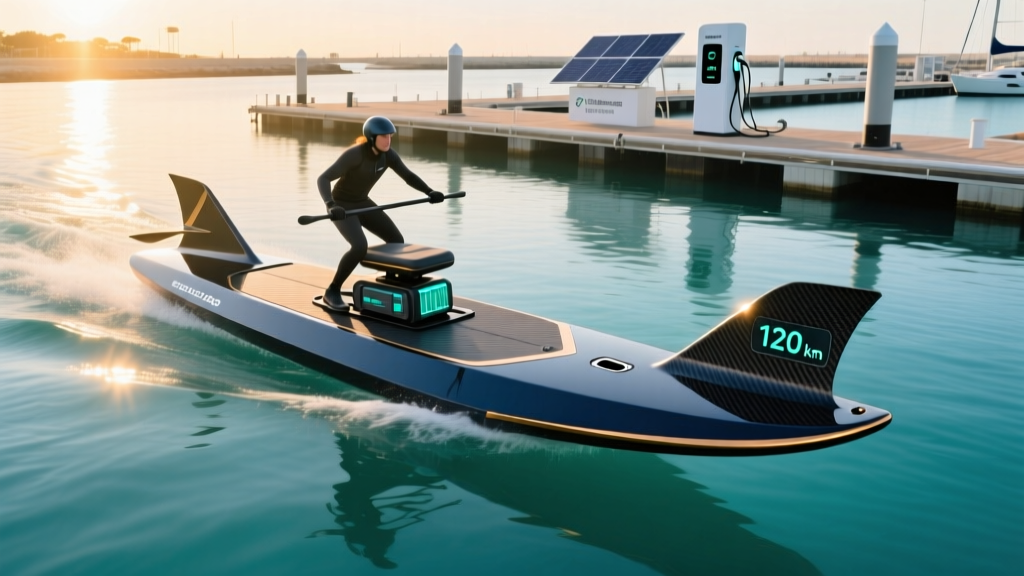
Quick Answer: An electric hydro foil (eFoil) is a battery-powered hydrofoil board that lifts above water on a carbon-fiber wing, eliminating drag and enabling silent, emission-free riding at 10–25 mph. Expect to pay $6,000–$15,000 for a complete setup, get 45–90 minutes of ride time per charge (roughly 10–25 miles depending on rider weight and conditions), and recharge the removable lithium-ion battery in 1.5–2.5 hours from a standard 120V outlet. Unlike electric cars, eFoils have no federal tax credit eligibility, but their per-session energy cost is under $0.50 — a fraction of what a gas-powered jetski burns in fuel.
What Is an Electric Hydro Foil?
An electric hydro foil — commonly called an eFoil — pairs a surfboard-style hull with a submerged electric motor and hydrofoil wing assembly. As the motor accelerates, the wing generates lift, raising the board entirely out of the water. This eliminates hydrodynamic drag, which is why eFoils achieve remarkable efficiency: a 2–3 kWh battery can propel a rider 15+ miles at cruising speed, something that would require a far larger energy store in a displacement-hull watercraft.
The category was pioneered by Lift Foils around 2017 and has since expanded to include brands like Fliteboard, Awake, and HydroFlyer. Modern 2026 models feature brushless DC motors in the 4–12 kW range, swappable NMC (nickel manganese cobalt) lithium-ion batteries, Bluetooth hand controllers, and GPS-enabled safety features like geofencing and return-to-home.
While eFoils are not automobiles, they sit squarely in the personal electric-vehicle ecosystem — sharing battery chemistry, motor technology, and charging infrastructure concepts with EVs. For buyers evaluating electrified recreation alongside an EV purchase, understanding eFoil ownership helps complete the picture of a fully electric lifestyle.
Range, Battery & Charging Specs: What the Numbers Actually Mean
eFoil manufacturers quote ride time in minutes rather than miles because water conditions, rider weight, and foiling style dramatically affect energy consumption. Here's how the leading 2026 models stack up:
| Spec | Lift E3 Explorer | Fliteboard Ultra L | Awake Ravik S |
|---|---|---|---|
| Motor Power | 5.5 kW peak | 6.0 kW peak | 11.0 kW peak |
| Battery Capacity | 2.1 kWh (NMC) | 1.8 kWh (NMC) | 3.0 kWh (NMC) |
| Ride Time (avg rider) | 60–90 min | 60–75 min | 45–60 min |
| Effective Range | ~15–22 mi | ~12–18 mi | ~10–15 mi |
| Top Speed | 28 mph | 30 mph | 34 mph |
| Charge Time (120V) | ~2 hours | ~1.5 hours | ~2.5 hours |
| Weight (complete) | ~62 lbs | ~55 lbs | ~72 lbs |
| Base Price (MSRP) | $12,900 | $13,400 | $14,900 |
eFoil vs Gas Jetski: Cost & Ownership Comparison
The most common cross-shopping question isn't eFoil vs another eFoil — it's eFoil vs a traditional gas-powered personal watercraft (PWC) like a Sea-Doo or Yamaha WaveRunner. The economics tell a very different story depending on how you plan to use the craft.
| Factor | Electric Hydro Foil (eFoil) | Gas PWC (Sea-Doo GTI 130) |
|---|---|---|
| Purchase Price | $7,000–$15,000 | $10,500–$14,000 |
| Fuel/Energy per Hour | $0.30–$0.50 (electricity) | $12–$18 (87 octane) |
| Annual Maintenance | $50–$150 (seals, prop inspection) | $400–$800 (oil, impeller, winterization) |
| Insurance (annual) | $150–$350 (specialty marine) | $300–$600 |
| Noise Level | Near-silent (motor hum only) | 75–85 dB at idle |
| Emissions | Zero at point of use | Unburned hydrocarbons in water |
| Passengers | 1 rider only | 1–3 riders |
| Range/Session | 10–25 miles (45–90 min) | 80–120 miles (full tank) |
| Trailer Required? | No — fits in SUV/truck bed | Yes |
| Storage | Garage or closet | Garage + trailer or marina slip |
Over five years of moderate use (50 sessions per year), the eFoil saves roughly $2,500–$4,000 in fuel and maintenance compared to a gas PWC, partially offsetting its higher upfront cost for premium models. The break-even point typically arrives around year three for riders who log consistent hours on the water.
Total Cost of Ownership: 5-Year Breakdown
| Cost Category | eFoil (Mid-Range $10K) | Gas PWC ($11K) |
|---|---|---|
| Purchase | $10,000 | $11,000 |
| Energy/Fuel (5 yr) | $100–$125 | $3,000–$4,500 |
| Maintenance (5 yr) | $500–$750 | $2,000–$4,000 |
| Insurance (5 yr) | $1,000–$1,750 | $1,500–$3,000 |
| Trailer/Storage | $0 | $1,500–$3,000 |
| Battery Replacement (yr 4–5) | $1,200–$2,000 | N/A |
| 5-Year Total | $12,800–$14,625 | $19,000–$25,500 |
The wildcard in eFoil ownership is battery replacement. NMC cells degrade with charge cycles — expect 70–80% capacity retention after 300–500 full cycles (roughly 3–5 years of regular use). Replacement batteries from Lift and Fliteboard run $1,200–$2,000. This is the marine equivalent of EV battery degradation, though at a much smaller dollar figure due to the tiny pack size.
Battery Chemistry & Longevity: What First-Time Buyers Should Know
Nearly all production eFoils use NMC (nickel manganese cobalt) lithium-ion cells, chosen for their high energy density — critical when you're carrying the battery on a board that needs to stay under 65 lbs total. This mirrors the NMC vs LFP trade-off in electric vehicles: NMC delivers more range per pound, but LFP lasts more cycles and tolerates 100% daily charging better.
For eFoils, the weight advantage of NMC wins out. But buyers should understand the care requirements:
- Storage charge: Store at 40–60% state of charge (SoC) — never fully charged or fully depleted for extended periods.
- Temperature: Don't charge a battery that's below 40°F or above 110°F. Let it acclimate to room temperature first.
- Saltwater protocol: Rinse the battery compartment and connectors with fresh water after every saltwater session. Corrosion is the #1 killer of eFoil electronics, not battery degradation.
- Cycle counting: A "cycle" is one full 100%→0% discharge. Partial discharges (riding for 30 minutes, then recharging) count as fractional cycles. Most riders won't hit 300 cycles in the first three years.
Battery warranties vary by brand: Lift offers a 1-year warranty on batteries, while Fliteboard provides 2 years. Neither covers capacity loss from improper storage — a common dispute point in eFoil ownership.
Charging Logistics: Where and How You'll Recharge
Unlike EVs, eFoils don't use standardized charging connectors (no NACS or CCS here). Each brand uses a proprietary DC barrel connector and dedicated charger. The good news: all current chargers run on standard 120V household outlets, drawing 500–900 watts. This means:
- At home: Plug into any standard outlet. A full charge from 10% takes 1.5–2.5 hours depending on battery size.
- At the lake: Many marinas and parks have outdoor 120V outlets. Bring your charger and you can top off between sessions.
- From your EV: Some EV owners use a portable power station (EcoFlow, Bluetti) charged from their car's 120V outlet or V2L (vehicle-to-load) capability to recharge eFoil batteries remotely — a practical synergy between EV and eFoil ownership.
- Spare battery strategy: Serious riders buy a second battery ($1,200–$2,000) and rotate them, effectively doubling session time without waiting for a recharge.
There is no DC fast-charging equivalent for eFoils. The small battery size means Level 1 (120V) charging is already fast enough — a 2 kWh battery at 800W charges in roughly 2.5 hours, which is adequate for most use patterns.
Common Misconceptions About Electric Hydro Foils
| Myth | Fact |
|---|---|
| "eFoils are banned everywhere" | Regulations vary by jurisdiction. Many US lakes and coastal areas allow eFoils, though some no-wake zones and protected marine areas restrict them. Always check local waterway authority rules before riding. Several states classify them as "vessels" requiring registration. |
| "You need perfect waves to ride" | eFoils are self-propelled — you don't need waves at all. Flat lakes, calm bays, and slow rivers are actually ideal for beginners. Wave riding is an advanced use case. |
| "The battery will die mid-lake and strand you" | All major brands include low-battery warnings at 20% and 10%, plus a limp-home mode that reduces motor power to extend range. The board floats and can be paddled to shore if needed. |
| "eFoils qualify for the EV tax credit" | The IRS §30D Clean Vehicle Credit applies only to highway-capable vehicles with four wheels. eFoils are classified as recreational marine equipment — no federal tax credit applies. |
| "It's just a toy — not real transportation" | Correct — eFoils are recreational, not commuter vehicles. They have no passenger capacity, no cargo space, and limited range. Position them as an electric alternative to a jetski, not a boat or car replacement. |
Decision Framework: Should You Buy an Electric Hydro Foil?
Choose an electric hydro foil if:
- You ride solo and want a silent, portable watercraft you can load into an SUV without a trailer
- You have access to calm or moderately choppy water (lakes, bays, sheltered coast)
- You value near-zero ongoing fuel cost and minimal maintenance over passenger capacity
- You're comfortable with a 45–90 minute session limit and planning recharges into your day
- You want to surf boat wakes, ocean swells, or flat water with one piece of equipment
- Budget: $7,000–$15,000 upfront with $200–$400/year in ongoing costs
Choose a gas PWC or boat instead if:
- You need to carry passengers (kids, friends, a second rider)
- You plan long open-water rides exceeding 20+ miles per session
- You need towing power for water skiing, wakeboarding, or tube pulling
- You ride in areas with no electrical access and can't carry a spare battery
- You're on a sub-$8,000 budget (used gas PWCs are plentiful in this range)
First-Time Buyer Checklist
If you've decided an eFoil is right for you, here's what to verify before purchase:
- Wing selection: Beginners need a larger wing (high-aspect, 200+ cm²) for stability at low speeds. Performance riders want smaller wings for carving. Most brands sell wing kits separately ($400–$900).
- Propeller guard: Essential for swimming-area use and beginner safety. Some jurisdictions require them by law.
- Registration: Check with your state's boating authority. Several states (California, Florida, Washington) require eFoil registration as a motorized vessel.
- PFD requirement: The US Coast Guard classifies eFoils as vessels — a Coast Guard-approved life jacket is legally required in most states.
- Insurance: Standard homeowner's policies rarely cover eFoils. You'll need a specialty marine or personal watercraft endorsement. Expect $150–$350/year.
- Dealer support: Buy from a brand with a service center or certified technician within driving distance. Saltwater corrosion issues and motor seal replacements require specialized tools.
Frequently Asked Questions
How long do eFoil batteries last before needing replacement?
Most NMC eFoil batteries retain 70–80% of original capacity after 300–500 full charge cycles. For a rider who goes out twice a week and uses one full cycle per session, that translates to roughly 3–5 years before noticeable range reduction. The battery still works beyond that point — you just get shorter sessions. Replacement costs $1,200–$2,000 depending on brand and capacity.
Can I charge an eFoil battery from my electric vehicle?
Not directly — eFoil chargers need a standard 120V AC outlet, and most EVs don't output AC power. However, if your EV has V2L (vehicle-to-load) capability — available on the Hyundai Ioniq 5, Kia EV6, Ford F-150 Lightning, and Genesis GV60 — you can plug the eFoil charger directly into the vehicle's V2L outlet. A typical 2 kWh eFoil battery draws about 1.6 kWh from the EV's pack per charge, a negligible amount for any modern EV battery.
Are electric hydro foils safe for beginners?
eFoils have a learning curve of 2–5 sessions for most adults to ride comfortably. The primary risks are falling onto the wing/mast assembly (the board's carbon fiber foil is sharp) and collisions with other watercraft. Beginners should always wear a helmet, impact vest, and PFD, and start in open, unpopulated water. Most brands include beginner speed limits (8–12 mph) accessible through the Bluetooth controller.
Do eFoils work in saltwater?
Yes, but saltwater demands rigorous post-ride maintenance. Rinse the entire board, motor housing, battery compartment, and controller with fresh water after every saltwater session. Inspect O-ring seals and electrical connectors monthly. Brands like Lift and Fliteboard use marine-grade anodized aluminum and sealed motor housings, but corrosion remains the leading cause of eFoil failure in saltwater environments.
What's the real cost per session compared to a gas jetski?
At the US average electricity rate of $0.17/kWh (per EIA data), a full eFoil charge of a 2 kWh battery costs about $0.34. A gas PWC burning 3–4 gallons per hour at $3.50/gallon costs $10.50–$14.00 per hour of riding. Over 50 sessions per year, the eFoil saves roughly $500–$700 in energy alone, with additional savings from zero oil changes, no winterization, and no impeller replacements.