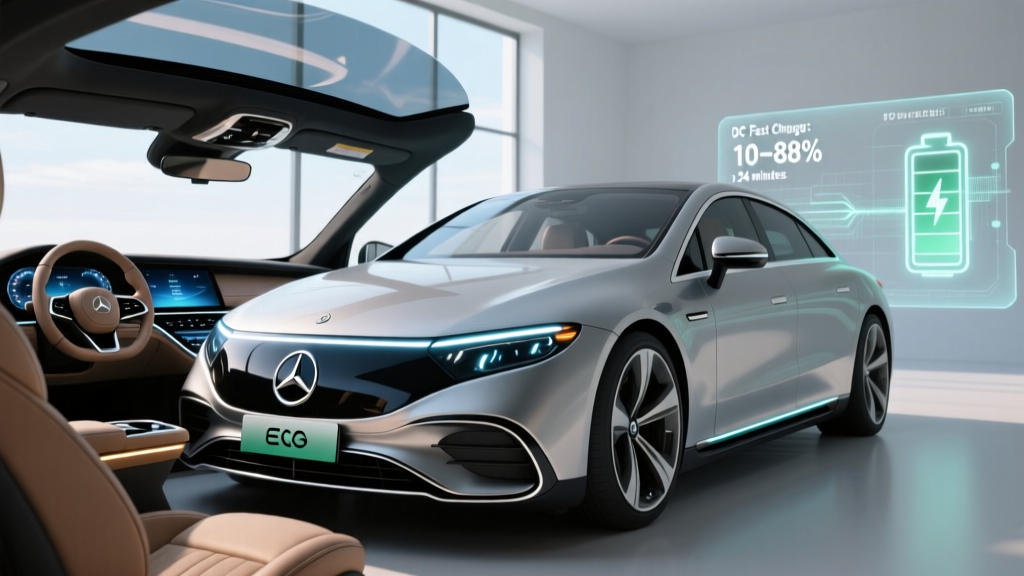
The Mercedes-Benz EQS 580 4MATIC occupies a rare space in the EV market: a six-figure luxury sedan that pairs executive-level cabin technology with genuine long-range capability. For 2026, the EQS 580 carries forward with its 118.0 kWh (usable) NMC battery pack, dual-motor all-wheel drive, and the dashboard-dominating Hyperscreen that has defined the model since its launch. But luxury EV buyers are asking tougher questions now — about real-world range, charging speed, tax credit eligibility, and whether the EQS 580 still justifies its premium against refreshed rivals from BMW, Lucid, and Tesla.
This review breaks down every number that matters: EPA range versus what you'll actually see on the highway, the charging curve behavior at DC fast chargers, the full interior dimensions, and the §30D federal tax credit rules that may — or may not — apply depending on your income and the vehicle's battery sourcing.
2026 Mercedes EQS 580 at a Glance: Core Specs
| Spec | Value |
|---|---|
| EPA Range | 345 miles (est.) |
| Battery (usable) | 118.0 kWh, NMC lithium-ion |
| Drivetrain | Dual-motor AWD (4MATIC) |
| Horsepower | 536 hp |
| Torque | 631 lb-ft |
| 0-60 mph | 4.1 seconds |
| Max DC Fast Charge | 200 kW (CCS1) |
| 10-80% DC Charge Time | ~31 minutes |
| Level 2 Home Charge Rate | 9.6 kW (~28 mi/hr) |
| MPGe (combined) | 95 MPGe (est.) |
| Efficiency | 35 kWh/100 mi |
| Base MSRP | ~$128,350 |
| Battery Warranty | 10 years / 155,000 miles |
| Federal Tax Credit (§30D) | See eligibility notes below |
The Mercedes EQS 580 Interior: Hyperscreen, Space, and Material Quality
The Mercedes EQS 580 interior remains one of the most technologically dense cabins in any production vehicle. The centerpiece is the 56-inch MBUX Hyperscreen, which spans the full dashboard width and integrates three displays — a 12.3-inch instrument cluster, a 17.7-inch central OLED touchscreen, and a 12.3-inch passenger display — under a single curved glass panel. The system runs MBUX with AI-driven personalization, voice control via "Hey Mercedes," and wireless Apple CarPlay and Android Auto.
Material quality matches the price point: standard Nappa leather upholstery, open-pore wood or aluminum trim, ambient lighting with 64 colors, and heated/ventilated/massaging front seats. The rear cabin offers executive-level comfort with available rear-seat entertainment screens, heated and ventilated outboard seats, and a rear tablet for climate and media control.
Interior Dimensions and Cargo Space
| Dimension | Measurement |
|---|---|
| Front Headroom | 39.8 in |
| Front Legroom | 41.7 in |
| Rear Headroom | 37.8 in |
| Rear Legroom | 41.0 in |
| Cargo Volume (trunk) | 22.0 cu ft |
| Cargo (seats folded) | 63.0 cu ft |
| Frunk | Not available |
The 22.0 cu ft trunk is generous for a sedan — larger than the BMW i7's 17.7 cu ft and competitive with the Lucid Air's 22.1 cu ft. However, the absence of a frunk is a missed opportunity at this price point; competitors like the Lucid Air and Tesla Model S offer front-trunk storage. The hatchback-style liftgate (despite the sedan silhouette) makes loading bulky items practical.
Real-World Range vs. EPA Estimate: What to Expect
EPA Estimated: 345 miles
Real-World Highway (70-80 mph, mild weather): ~280–310 miles
Real-World City/Mixed: ~320–340 miles
Cold Weather (below 30°F, highway): ~230–265 miles
The EQS 580's 118.0 kWh battery is large, but its 5,400+ lb curb weight and 0.20 Cd drag coefficient create a tug-of-war between mass and aerodynamics. Highway speeds above 75 mph and cold temperatures significantly reduce range.
The EPA's 345-mile estimate for the EQS 580 is achievable in moderate city and suburban driving where regenerative braking recovers energy. On a 300-mile highway road trip at 75-80 mph in 70°F weather, expect to arrive with roughly 35-65 miles of buffer remaining — meaning you'll want to plan at least one DC fast-charge stop. In winter conditions (20-30°F), cabin heating and battery thermal management draw significant energy from the pack; cold-weather range loss of 20-30% is typical for NMC chemistry without preconditioning.
The EQS 580's heat pump (standard on 2026 models) mitigates some cold-weather loss by scavenging waste heat from the drivetrain rather than relying solely on resistive heating. Preconditioning the battery while plugged in before a DC fast-charge session also helps maintain charging speed in cold conditions.
Charging Performance: DC Fast Charge and Home Level 2
| Charging Level | Power | Speed / Time |
|---|---|---|
| Level 1 (120V household) | ~1.4 kW | ~4 mi/hr |
| Level 2 (240V home/public) | 9.6 kW | ~28 mi/hr; full charge ~12.5 hrs |
| DC Fast Charge (CCS1) | Peak 200 kW | 10-80% in ~31 min |
The EQS 580 charges at a peak rate of 200 kW on DC fast chargers using the CCS1 connector. That's competitive with the BMW i7 xDrive50 (195 kW) but trails the Lucid Air Grand Touring (300+ kW) and the Hyundai Ioniq 6 (up to 350 kW on 800V architecture). The 10-80% charge time of approximately 31 minutes is adequate for road-trip stops but not class-leading.
A critical detail for road-trippers: the EQS 580's charge curve tapers noticeably above 80% state of charge (SoC). Charging from 80-100% can add another 25-30 minutes at reduced power. For optimal road-trip efficiency, plan stops that bring you to 80% and move on — this is standard practice for all EVs but especially relevant with the EQS's large 118.0 kWh battery, where the final 20% represents a significant amount of energy at slow rates.
At home on a Level 2 charger (240V, 40A circuit), the 9.6 kW onboard charger replenishes approximately 28 miles of range per hour. A full overnight charge from 10% to 100% takes roughly 12-13 hours — feasible with off-peak electricity rates. Home Level 2 installation typically costs $800-$2,500 depending on panel capacity and wiring distance, according to the U.S. Department of Energy.
Performance: 536 HP, 4.1-Second 0-60, and Ride Quality
The EQS 580's dual-motor 4MATIC powertrain produces 536 horsepower and 631 lb-ft of torque, launching the 5,400-pound sedan to 60 mph in 4.1 seconds. That's brisk but not supercar territory — the Lucid Air Grand Touring hits 60 in 3.0 seconds, and the Tesla Model S Plaid does it in under 2.0 seconds. The EQS 580's performance is tuned for effortless, silent acceleration rather than track-day aggression.
Ride quality is where the EQS 580 earns its luxury badge. Standard AIRMATIC air suspension with adaptive damping absorbs road impermissions with composure. Rear-axle steering (standard, up to 10 degrees) dramatically reduces the turning circle to 35.8 feet — making this 17-foot sedan surprisingly maneuverable in parking garages and urban environments. The EQS 580 is a highway cruiser first, and its 0.20 coefficient of drag makes it one of the most aerodynamic production cars ever sold.
Pricing, Trim Levels, and Federal Tax Credit Eligibility
| Item | Detail |
|---|---|
| Base MSRP (EQS 580 4MATIC) | ~$128,350 |
| As-Tested (with options) | $135,000–$145,000+ |
| MSRP Cap (§30D sedan) | $55,000 |
| Federal Tax Credit | Does NOT qualify — MSRP exceeds cap |
| Income Cap (§30D) | $150K single / $300K joint (not relevant here) |
The 2026 EQS 580 starts at approximately $128,350 before destination, placing it firmly in ultra-luxury territory. With popular option packages — the AMG Line exterior, Executive Rear Seat package, and Burmester 4D surround sound — as-tested prices routinely reach $140,000 or more.
Regarding the federal EV tax credit: the EQS 580 does not qualify for the §30D new EV credit. Under current IRS rules, the credit applies only to sedans with an MSRP at or below $55,000 (and SUVs/trucks/vans up to $80,000). At $128,350, the EQS 580 exceeds the sedan cap by a wide margin. Buyer income caps and battery-sourcing requirements are moot in this case — the MSRP alone disqualifies the vehicle. Buyers should not factor a $7,500 credit into their purchase budget.
Some buyers may be eligible for state or local incentives (such as California's Clean Fuel Reward or utility company rebates), which have separate eligibility criteria. Always check your state's official energy office or utility provider for current programs.
ADAS and Smart Driving Features
The EQS 580 comes equipped with Mercedes-Benz's latest Driver Assistance Package, which includes adaptive cruise control with stop-and-go, active lane-keeping assist, active blind-spot monitoring, and evasive steering assist. The available DRIVE PILOT system — Mercedes' conditional Level 3 automated driving feature — is approved for use on limited highway sections in Nevada and California at speeds up to 40 mph in heavy traffic.
The EQS 580's standard Driver Assistance Package is SAE Level 2 — the driver must remain attentive and keep hands on or near the wheel at all times. The optional DRIVE PILOT is a conditional Level 3 system, meaning the vehicle can handle all driving tasks under specific, limited conditions (approved highways, under 40 mph, good weather) while the driver may look away from the road. It is not a full self-driving system. Outside of those narrow operating conditions, the driver is fully responsible.
Warranty, Ownership Costs, and Battery Longevity
Mercedes-Benz provides a robust warranty package for the EQS 580:
- New Vehicle Limited Warranty: 4 years / 50,000 miles
- High-Voltage Battery Warranty: 10 years / 155,000 miles (capacity retention guaranteed above 70% State of Health)
- Powertrain Warranty: 6 years / 72,000 miles (electric motors, onboard charger)
- Corrosion Perforation: 4 years / 50,000 miles
The 10-year / 155,000-mile battery warranty is among the most generous in the luxury segment, matching BMW and exceeding Tesla's 8-year / 120,000-mile coverage. The 70% State of Health (SoH) threshold is industry-standard; if the battery degrades below 70% of its original 118.0 kWh capacity within the warranty period, Mercedes will repair or replace it. Real-world degradation data from early EQS owners suggests NMC packs in this application lose approximately 5-8% capacity over the first 100,000 miles under normal use — well within the warranty buffer.
Insurance costs for the EQS 580 are significant. Expect annual premiums of $3,500-$5,500 depending on your location, driving record, and coverage level — roughly 40-60% higher than a comparable internal-combustion S-Class due to repair costs for aluminum body panels and the Hyperscreen assembly.
Pros, Cons, and Verdict
Pros
- Class-leading 345-mile EPA range among luxury sedans
- Hyperscreen is visually stunning and functionally deep
- Exceptional ride quality with AIRMATIC and rear-axle steering
- Generous 10-year / 155,000-mile battery warranty
- Spacious rear cabin with 41.0 inches of legroom
- Ultra-quiet cabin at highway speeds (0.20 Cd)
Cons
- $128K+ MSRP with no federal tax credit eligibility
- 200 kW peak DC charge rate trails Lucid Air and 800V rivals
- No frunk (front trunk) despite EV skateboard platform
- High insurance premiums ($3,500-$5,500/year)
- Hyperscreen learning curve — touch-heavy, minimal physical buttons
- Heavy curb weight (5,400+ lbs) impacts tire wear and efficiency
Is the EQS 580 Worth Buying vs. Competitors?
The EQS 580's competitive set is narrow but formidable:
- BMW i7 xDrive50 (~$120K): Slightly less range (318 mi EPA), lower peak charge rate, but a more traditional luxury interior with physical controls. Better for buyers who prefer tactile feedback over screen-based interfaces.
- Lucid Air Grand Touring (~$125K): 516-mile EPA range, 300+ kW DC charging, 3.0-second 0-60. The Lucid wins on range and charging speed decisively. Interior quality is good but not quite at Mercedes' material level.
- Tesla Model S Long Range (~$80K): 402-mile EPA range, Supercharger network access, but a spartan interior that doesn't compete with the EQS on luxury. Best for value-conscious buyers who prioritize range and charging infrastructure.
Choose the EQS 580 if: You want the most technology-forward luxury sedan interior available, value ride quality and cabin quietness above outright performance, and your budget accommodates a $130K+ vehicle without needing tax-credit assistance.
Choose the Lucid Air if: Maximum range (516 mi) and fastest DC charging are priorities, and you're willing to trade some interior opulence for efficiency.
Choose the BMW i7 if: You prefer a more conventional luxury sedan experience with physical controls and don't need class-leading range.
Frequently Asked Questions
What is the real-world range of the Mercedes EQS 580?
The EPA rates the EQS 580 at 345 miles, but real-world highway driving at 75-80 mph yields approximately 280-310 miles in mild weather. City and mixed driving can approach the EPA figure. Cold weather (below 30°F) reduces range to roughly 230-265 miles on the highway due to battery thermal management and cabin heating demands.
How fast does the EQS 580 charge at home and on DC fast chargers?
On a Level 2 home charger (9.6 kW), the EQS 580 gains about 28 miles of range per hour, with a full charge taking approximately 12.5 hours. On a DC fast charger, it peaks at 200 kW and charges from 10-80% in about 31 minutes. Charging above 80% slows significantly — plan road-trip stops around the 80% mark for best efficiency.
Does the EQS 580 qualify for the federal EV tax credit?
No. Under current IRS §30D rules, new sedans must have an MSRP at or below $55,000 to qualify. The EQS 580's base MSRP of ~$128,350 far exceeds this cap, making it ineligible regardless of buyer income or battery sourcing. State and local incentives may still apply — check your jurisdiction's official sources.
How does the EQS 580 interior compare to the BMW i7 and Lucid Air?
The EQS 580 interior leads on technology integration with its 56-inch Hyperscreen and MBUX AI features. Material quality (Nappa leather, open-pore wood, Burmester audio) is on par with the BMW i7 and a step above the Lucid Air. Rear-seat space (41.0 inches of legroom) is excellent across all three. The EQS's main interior weakness is the lack of physical controls — nearly all functions are screen-based, which some buyers find distracting.
What is the battery warranty on the EQS 580?
Mercedes covers the high-voltage battery for 10 years or 155,000 miles, whichever comes first, with a guaranteed capacity retention above 70% of original State of Health. This is one of the longest battery warranties in the luxury EV segment.
Is the EQS 580 a good EV for road trips?
Yes, with caveats. The 345-mile EPA range means fewer stops than most EVs, and the ultra-quiet, comfortable cabin makes long drives pleasant. However, the 200 kW peak charge rate and 31-minute 10-80% time mean longer stops than competitors like the Lucid Air (which can add 200 miles in ~12 minutes on a 350 kW charger). Plan stops at reliable CCS networks like Electrify America or EVgo, and precondition the battery for fastest charging.
Sources: EPA fuel economy data at fueleconomy.gov, IRS clean vehicle credit rules at irs.gov, and Mercedes-Benz USA official specifications.