Quick Answer: Can You Charge an EV From a Campground Hookup?
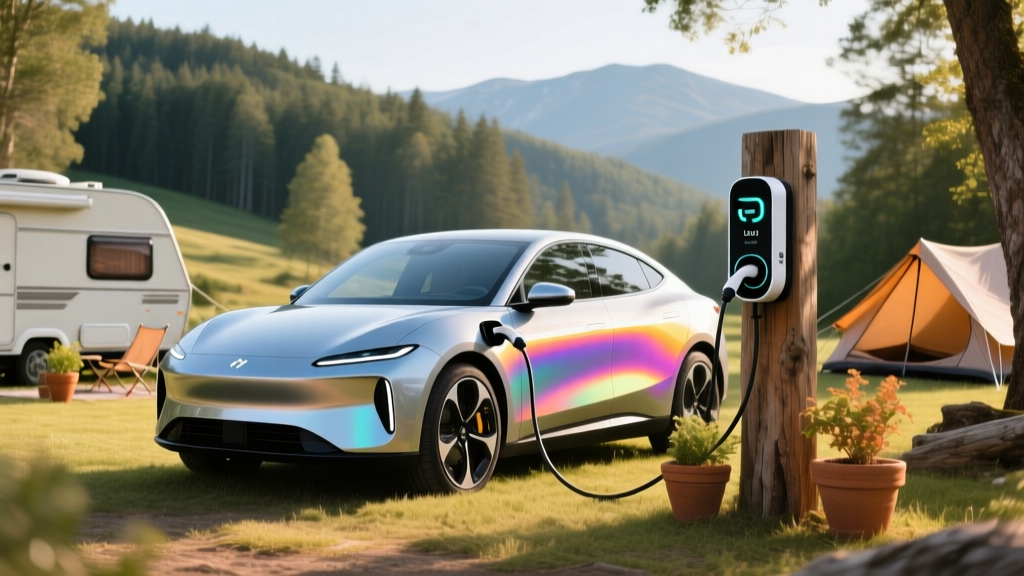
Yes — but slowly. A standard campground electric hook up for camper (typically a 30-amp or 50-amp pedestal) can charge an electric vehicle using a portable Level 2 EVSE with the correct adapter. On a 30A/120V outlet (NEMA TT-30), expect roughly 1.4 kW of charging power — adding about 4–5 miles of range per hour. On a 50A/240V outlet (NEMA 14-50), you can pull up to 9.6–11.5 kW, adding roughly 30–40 miles per hour. Overnight (10–12 hours), that translates to 40–50 miles on a 30A hookup or 300–400 miles on a 50A hookup — enough to top off most EVs for the drive home.
Understanding Campground Electrical Pedestals
Most US campgrounds offer three types of electrical connections at each site pedestal, designed primarily for RVs and travel trailers:
| Outlet Type | Voltage | Max Amps | Max Power | Common Name |
|---|---|---|---|---|
| NEMA TT-30 | 120V | 30A | 3.6 kW (usable ~2.8 kW) | "30-amp camper plug" |
| NEMA 14-50 | 240V | 50A | 12 kW (usable ~9.6–11.5 kW) | "50-amp RV plug" |
| NEMA 5-15/5-20 | 120V | 15–20A | 1.8–2.4 kW (usable ~1.4–1.9 kW) | Standard household outlet |
The critical detail most EV owners miss: the TT-30 outlet is 120V, not 240V, despite being rated for 30 amps. This means it delivers far less power than a home Level 2 charger on a 240V circuit. The 14-50 outlet, however, is the same 240V connection many EV owners install at home for Level 2 charging — and it's available at most RV parks with full-hookup sites.
Adapter requirements: You'll need a portable EVSE (electric vehicle supply equipment) with interchangeable plugs or a dedicated adapter cable. Companies like Lectron, Emporia, and Charge Creek sell TT-30 and 14-50 adapter pigtails ($40–$120) that connect to portable Level 2 chargers. Never use a cheap, unshielded "cheater" adapter — campground wiring varies in quality, and a ground fault in wet conditions is a real safety risk.
Real-World Charging Speeds: What to Expect at a Campsite
Let's run the numbers for three popular 2026 EVs charging overnight at a campground, comparing the two most common hookups:
| Vehicle (2026 Model Year) | Battery (kWh usable) | TT-30 (30A/120V) — 12 hrs | 14-50 (50A/240V) — 12 hrs |
|---|---|---|---|
| Tesla Model Y Long Range | 75 kWh | ~17 kWh (~55 mi added) | ~115 kWh (full charge, ~330 mi) |
| Ford F-150 Lightning Std Range | 98 kWh | ~17 kWh (~35 mi added) | ~115 kWh (~240 mi added) |
| Hyundai Ioniq 5 (84 kWh pack) | 77.4 kWh | ~17 kWh (~60 mi added) | ~100 kWh (full charge, ~300 mi) |
Key takeaway: The TT-30 hookup is best thought of as a maintenance trickle — it'll keep your EV from losing range overnight and add enough for short local drives, but it won't fully recharge a depleted battery. The 14-50 hookup is a legitimate Level 2 charging solution that can fully replenish most EVs overnight.
One real-world caveat: campground voltage can sag under heavy load (summer weekends when every site is running A/C). I've measured TT-30 outlets delivering as low as 108V at busy parks, which drops your effective charge rate to ~1.1 kW. If your EVSE shows an error or the charge rate seems low, check the pedestal voltage with a multimeter before troubleshooting the charger.
Cost Breakdown: Campground Charging vs. Gas vs. DC Fast Charging
| Energy Source | Cost per kWh (or gallon) | Cost for 300 mi (avg EV at 3 mi/kWh) | Time Required |
|---|---|---|---|
| Campground 14-50 hookup (incl. in site fee) | $0 (included in $35–$85/night site) | $0 marginal (already paying for site) | 8–12 hours overnight |
| Campground 14-50 (metered, $0.15/kWh) | $0.15/kWh | $15.00 | 8–12 hours overnight |
| Home Level 2 ($0.13/kWh avg US residential) | $0.13/kWh | $13.00 | 7–9 hours overnight |
| DC fast charging (Electrify America, $0.48/kWh avg) | $0.48/kWh | $48.00 | 30–45 minutes (10–80%) |
| Gas truck (25 MPG combined, $3.40/gal) | $3.40/gal | $40.80 | 5 minutes |
If your campground includes electricity in the nightly site fee (most do for tent and RV sites), charging your EV from the hookup costs nothing extra. This makes campground charging one of the cheapest ways to refuel an EV — effectively free energy bundled into your camping trip. Even metered campsite power at $0.15/kWh undercuts DC fast charging by 70%.
Compared to a gas truck getting 25 MPG, the EV owner camping for a weekend saves roughly $25–$40 in fuel costs per trip by topping off at the campsite, assuming a 300-mile round trip. Over a season of 10 camping trips, that's $250–$400 in savings — enough to offset a quality portable EVSE and adapter kit.
EV vs. Gas for Camping: The Real Ownership Picture
| Factor | Electric Vehicle (e.g., F-150 Lightning) | Gas Vehicle (e.g., Ford F-150 3.5L EcoBoost) |
|---|---|---|
| EPA range / tank range | 230–320 mi (EPA); ~200–260 mi towing | 450–600 mi per tank |
| "Refueling" at campsite | Yes — charge overnight from pedestal | No — must drive to gas station |
| Trailer towing range loss | 40–55% range reduction (verified) | 25–35% MPG reduction |
| Off-grid power (V2L/V2H) | Yes — Pro Power Onboard, up to 9.6 kW | No (requires separate generator) |
| Remote-area refueling risk | High if no charging infrastructure nearby | Low — gas stations widespread, jerry cans possible |
| Cold-weather range loss (20°F) | 20–35% reduction | 5–10% MPG reduction |
| Fuel cost per 300 mi (no towing) | $0–$15 (campsite/home charging) | $40–$45 |
The honest truth: EVs are excellent for destination camping where you park for 1–3 days and can charge overnight, but they remain challenging for overlanding or remote boondocking where DC fast chargers are scarce and distances are vast. The F-150 Lightning's Pro Power Onboard (up to 9.6 kW of vehicle-to-load output) is a genuine advantage — it can power campsite lights, a portable fridge, laptop chargers, and even a small induction cooktop without a gas generator. No gas truck offers this natively.
However, towing a travel trailer with any current EV cuts range dramatically. A Model Y towing a 2,500-lb teardrop trailer will see its EPA 330-mile range drop to roughly 170–200 real-world miles at highway speeds. Plan your routes around DC fast chargers if you're towing more than 100 miles one-way.
Common Misconceptions About Charging an EV at Campgrounds
| Myth | Fact |
|---|---|
| "You can't charge an EV from a camper hookup — it'll trip the breaker." | A portable EVSE with proper amperage settings (set to 12A on a 15A circuit, 24A on a 30A circuit) draws within safe limits. Modern EVSEs communicate with the vehicle to limit current. |
| "Campground power is too dirty/unstable for EV batteries." | EV onboard chargers convert AC to DC and regulate voltage. Minor sags or surges won't damage the battery, though they may pause charging. A surge-protective EVSE adds a safety layer. |
| "You need a special 'RV charger' for your EV." | Any quality portable Level 2 EVSE with the correct plug adapter (TT-30 or 14-50) works. The EV doesn't know or care that the outlet was designed for an RV. |
| "Charging from a 120V outlet will damage the battery." | Slow AC charging (Level 1 or low-power Level 2) is actually gentler on battery chemistry than DC fast charging. LFP and NMC batteries both handle prolonged slow charging without accelerated degradation. |
| "All campgrounds have 50-amp service." | Many tent-only and older parks have only 30A (TT-30) or even 15/20A (NEMA 5-15/5-20) pedestals. Always check the campground listing or call ahead to confirm outlet types. |
What First-Time EV Buyers Should Know About Campground Charging
If you're buying an EV and camping is part of your lifestyle, here's a practical decision framework:
Choose an EV with a large battery (80+ kWh usable) if:
- You tow a trailer more than 80 miles one-way to your campsite
- Your campground only has 30A (TT-30) hookups and you need maximum range for the drive home
- You camp in cold weather (below 40°F) where range loss compounds
- Examples: Ford F-150 Lightning Extended Range (131 kWh usable, ~$70,000 MSRP), Rivian R1T Dual Max (149 kWh, ~$87,000), Chevrolet Silverado EV 4WT (200+ kWh, fleet pricing varies)
Choose a mid-size EV (60–80 kWh) if:
- You drive to your campsite without towing (or tow a light teardrop under 1,500 lbs)
- Your campground has 50A (14-50) hookups, so overnight charging fully replenishes the pack
- You want lower purchase price and better daily efficiency
- Examples: Tesla Model Y Long Range (75 kWh, ~$46,000 MSRP), Hyundai Ioniq 5 Long Range (77.4 kWh, ~$47,000), Kia EV6 (77.4 kWh, ~$44,000)
Stick with a PHEV or gas vehicle if:
- You regularly boondock in areas with no electrical infrastructure and no DC fast chargers within 100+ miles
- You tow heavy trailers (5,000+ lbs) over long mountain passes
- Your camping style involves daily long-distance driving between remote sites
- Examples: Toyota Tacoma i-FORCE MAX Hybrid, Ford F-150 PowerBoost Hybrid (25 MPG combined, 400+ mi range)
Essential Gear Checklist for Campground EV Charging
- Portable Level 2 EVSE with adjustable amperage (12A–48A): Lectron V-Box Pro (~$350) or Emporia Level 2 Portable (~$300)
- NEMA TT-30 adapter pigtail (for 30A/120V campground outlets): $40–$70
- NEMA 14-50 adapter pigtail (for 50A/240V outlets — often included with EVSE): $0–$60
- Heavy-duty 10-gauge extension cord (25 ft max, only for 120V Level 1): $40–$60 — avoid for 240V
- Surge protector / circuit tester: $25–$50 — verifies proper grounding before plugging in your EVSE
- Padlock for EVSE: campground pedestals are in shared spaces; secure your $300+ charger
Total gear investment: $450–$800 for a complete campground charging kit. This pays for itself within 10–15 camping trips compared to DC fast charging on the road.
Federal Tax Credits and EV Purchase Considerations for 2026
If you're buying an EV partly for the camping lifestyle, the IRS §30D Clean Vehicle Credit can offset up to $7,500 — but eligibility depends on several factors that change regularly:
- MSRP caps: Vans, SUVs, and pickups must be under $80,000; sedans under $55,000
- Buyer income caps: $300,000 joint / $225,000 head of household / $150,000 single (modified AGI)
- Battery sourcing requirements: Critical minerals and battery components must meet escalating domestic/free-trade-partner sourcing thresholds — this disqualifies some models in 2026 that qualified in prior years
- Point-of-sale transfer: You can transfer the credit to the dealer at purchase, reducing your out-of-pocket cost immediately rather than waiting for tax filing
Always verify current eligibility on fueleconomy.gov before purchasing, as the qualified vehicle list updates frequently based on manufacturer battery sourcing disclosures. Consult a tax professional for your specific situation.
Frequently Asked Questions
Can I use the Tesla Mobile Connector at a campground?
Yes. The Tesla Mobile Connector supports NEMA 14-50 (up to 32A/7.7 kW on 240V) and NEMA 5-15 (12A/1.4 kW on 120V) with the included adapters. For TT-30 outlets, you'll need a third-party TT-30 to 14-50 adapter cable (~$50) and should manually set the charge current to 24A or less in the Tesla app to avoid tripping the 30A breaker.
Will charging from a campground outlet damage my EV's battery?
No. Slow AC charging is among the gentlest charging methods for lithium-ion batteries (both NMC and LFP chemistries). The onboard charger handles voltage regulation, and the battery management system (BMS) monitors cell temperatures and state of charge. The main risk is a poorly grounded pedestal — use a circuit tester before connecting.
How long does it take to fully charge an EV from a 50-amp campground hookup?
On a NEMA 14-50 (50A/240V) outlet delivering ~9.6–11.5 kW, a 75 kWh battery (Tesla Model Y) charges from 10% to 100% in roughly 7–8 hours. A larger 131 kWh pack (F-150 Lightning Extended Range) takes 12–14 hours. This is comparable to a dedicated home Level 2 charger on a 48A circuit.
Do campgrounds charge extra for EV charging?
Most campgrounds include electricity in the nightly site fee ($35–$85/night at public parks, $50–$120 at private RV resorts). Some private parks have begun installing dedicated EV charging stations (Level 2 or DC fast) with separate per-kWh billing ($0.25–$0.50/kWh), but the standard pedestal hookup remains included. Call ahead to confirm the park's policy — a few have started posting "no EV charging from pedestals" rules due to breaker-tripping incidents from overloaded circuits.
What's the best EV for camping in 2026?
For destination camping with hookups, the Ford F-150 Lightning (Pro Power Onboard, available 131 kWh battery, 7,700-lb towing) and Rivian R1T (up to 149 kWh Max pack, camp kitchen accessory, gear tunnel) lead the pack. For lighter-duty camping without towing, the Tesla Model Y (camp mode with climate control, 330 mi EPA range, ~$46,000 MSRP) remains the most practical and affordable option. For remote boondocking without charging access, a PHEV like the Toyota RAV4 Prime (42 mi electric-only, 38 MPG gas) offers more flexibility.