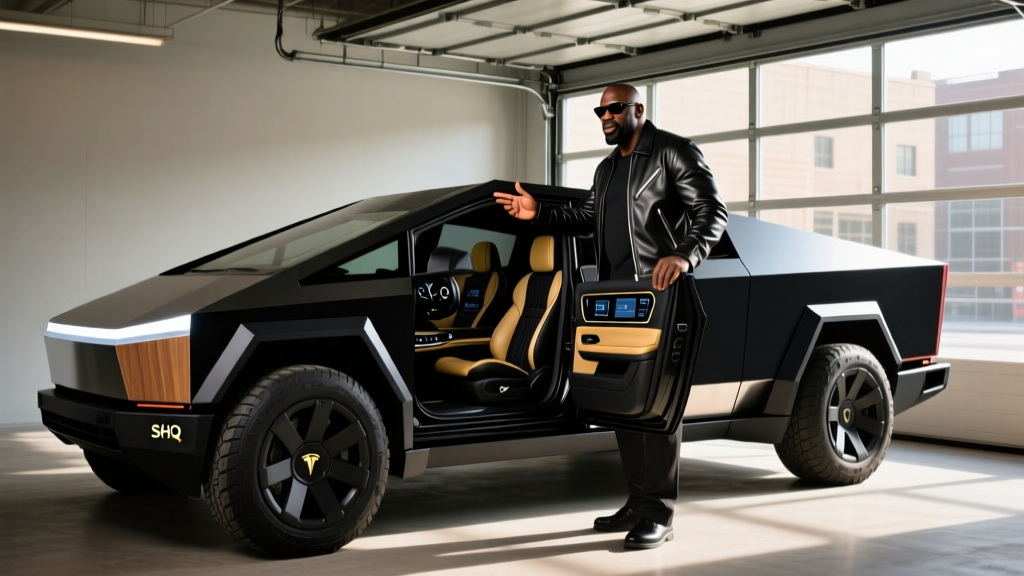
When Shaquille O'Neal—7'1", 325+ lbs, and one of the most recognizable athletes on the planet—started posting his Tesla Cybertruck on social media, the internet had questions. Could a man of Shaq's proportions actually fit inside Tesla's angular electric truck? More importantly, does the Cybertruck make sense as a daily driver for larger individuals, families who need serious cargo space, or anyone considering a full-size electric pickup?
The "Shaq Tesla" moment became a cultural touchstone for EV accessibility, but beyond the memes lies a serious vehicle worth evaluating on its own merits. Here's a complete 2026 breakdown of the Tesla Cybertruck—range, charging, space, pricing, and whether it actually delivers for the drivers who need it most.
Cybertruck Quick Verdict: Built Different, Drives Different
The 2026 Tesla Cybertruck is available in three trims: the Rear-Wheel Drive (RWD), the All-Wheel Drive (AWD), and the Cyberbeast. It remains one of the most polarizing vehicles on the road—love-it-or-hate-it styling, stainless steel exoskeleton, and a driving experience that's genuinely unlike any other pickup. For large drivers specifically, the Cybertruck offers surprising headroom and a wide cabin, though the fixed glass roof and angular interior design create trade-offs that taller buyers should test in person before committing.
| Spec | RWD | AWD | Cyberbeast |
|---|---|---|---|
| EPA Range | ~250 mi (est.) | 340 mi | 320 mi |
| Battery (usable, est.) | ~85 kWh | ~123 kWh | ~123 kWh |
| 0-60 mph | ~6.5 sec | 4.1 sec | 2.6 sec |
| Horsepower | ~315 hp | 600 hp | 845 hp |
| Drivetrain | RWD (single motor) | AWD (dual motor) | AWD (tri-motor) |
| Towing Capacity | 7,500 lbs | 11,000 lbs | 11,000 lbs |
| Base MSRP | $60,990 | $79,990 | $99,990 |
| MPGe (combined) | TBD | ~68 MPGe | ~65 MPGe |
Note: RWD trim specs are preliminary based on Tesla's announced pricing and expected delivery timeline. Dual-motor and Cyberbeast figures reflect EPA-confirmed data from fueleconomy.gov.
Real-World Range: What the EPA Sticker Doesn't Tell You
EPA Estimate: 340 miles (AWD) / 320 miles (Cyberbeast)
Real-World Highway (70-80 mph): Expect ~260–290 miles
Cold Weather (below 32°F): Expect ~220–260 miles, depending on cabin heat usage and preconditioning
The Cybertruck's stainless steel body and large frontal area create more aerodynamic drag than a sleek sedan like the Model S or Model 3. At highway speeds above 70 mph, efficiency drops noticeably. In EPA testing, the dual-motor AWD achieves 340 miles, but sustained highway driving at 75+ mph in real-world conditions typically yields 75–85% of that figure.
Cold weather compounds the issue. The Cybertruck uses a heat pump for cabin heating (more efficient than resistive heating), but the large glass roof and steel body still lose heat faster than insulated sedans. Preconditioning the battery while plugged in is essential for maximizing winter range and fast-charging speeds. If you live in the northern U.S. and plan road trips in winter, budget for 220–250 miles of usable range per charge.
The Cybertruck's battery pack uses a structural 4680-cell architecture with nickel-based chemistry (NMC-type), chosen for energy density rather than the LFP chemistry Tesla uses in some Model 3/Y Standard Range vehicles. This means better range per pound but slightly faster long-term degradation compared to LFP—though Tesla's battery management system is among the best in the industry.
Charging Speed: DC Fast, Level 2, and the Supercharger Advantage
The Cybertruck supports Tesla's NACS (North American Charging Standard) connector natively—no adapter needed at Superchargers. It's also compatible with the growing network of third-party NACS chargers from Electrify America, EVgo, and others that have adopted the standard.
| Charging Level | Power / Rate | What You Get |
|---|---|---|
| Level 1 (120V outlet) | ~1.4 kW | ~3–4 miles per hour |
| Level 2 (240V home, 48A) | ~11.5 kW | ~30–34 miles per hour |
| DC Fast Charge (peak) | Up to 250 kW (V3 Supercharger) | 10–80% in ~25–30 min |
| DC Fast Charge (V4 Supercharger) | Up to 350 kW capable | 10–80% in ~18–22 min (theoretical) |
Charging curve reality: The Cybertruck peaks at around 250 kW on V3 Superchargers, but that peak only holds between roughly 10–30% State of Charge (SoC). Above 50%, the charge rate tapers significantly—dropping to ~100 kW by 70% and ~40 kW by 90%. This is normal for lithium-ion packs and managed by the battery thermal system, but it means a 10–80% session takes about 25–30 minutes, not the "15 minutes" marketing headlines sometimes suggest.
For home charging, a Tesla Wall Connector on a 60-amp circuit (48A continuous) delivers roughly 30–34 miles of range per hour. A full overnight charge from 20% to 80% takes about 6–7 hours. Most owners will need a 240V/60A circuit installed; expect $800–$2,000 for a professional Level 2 home installation depending on panel proximity and local permitting. If your home has a 100-amp main panel, you may need a panel upgrade ($1,500–$3,000 additional) to support a 60A dedicated circuit.
Interior Space: Can Big Drivers Actually Fit?
This is the question Shaq's Cybertruck ownership raised, and it's a legitimate concern for anyone over 6'3" or with a broader build. Here's what the numbers say:
- Front headroom: ~41.0 inches (generous for a truck, aided by the tall roofline)
- Front legroom: ~41.5 inches
- Front shoulder room: ~62.0 inches (wide cabin, a real advantage for broad-shouldered drivers)
- Rear headroom: ~38.5 inches (tighter due to the sloping roofline—tall rear passengers will notice)
- Rear legroom: ~38.0 inches
- Cargo bed: 6 ft × 4 ft (74.3 cu ft with tonneau cover closed)
- Front trunk (frunk): ~7.1 cu ft
- Total enclosed cargo: ~120+ cu ft (bed + frunk + rear cabin fold-down)
The front seats are wide and flat rather than heavily bolstered, which works well for larger body types but offers less lateral support during aggressive cornering. The seat adjusts on a long track, accommodating very long legs. The steering column telescopes generously.
The real limitation is the rear seat. The Cybertruck's angular roofline cuts into rear headroom, and the rear seat cushion is mounted relatively low. Passengers over 6'2" will find their knees high and heads close to the glass. For family use with children or average-height adults in back, it's fine. For six-adult duty, a Ford F-150 Lightning or Rivian R1T offers more rear comfort.
One Shaq-sized note: the Cybertruck's power-folding tonneau cover is rated for 300 lbs of static load, and the bed walls are tall enough to secure large items. The stainless steel bed doesn't need a liner. For someone who needs to haul equipment, furniture, or gear, the 11,000-lb towing capacity (AWD/Cyberbeast) and integrated bed features are genuinely practical.
Pricing, Trims, and Federal Tax Credit Eligibility
The 2026 Cybertruck lineup starts at $60,990 for the RWD (expected to begin deliveries later in the model year) and climbs to $99,990 for the tri-motor Cyberbeast. Here's the current pricing and federal tax credit picture:
| Trim | Base MSRP | As-Tested (typical options) | §30D Tax Credit Eligible? |
|---|---|---|---|
| RWD | $60,990 | $63,000–$66,000 | Likely yes (under $80K MSRP cap) |
| AWD | $79,990 | $83,000–$89,000 | Borderline—MSRP must stay under $80,000 cap for trucks |
| Cyberbeast | $99,990 | $102,000–$108,000 | No (exceeds $80K MSRP cap for trucks) |
Federal tax credit rules (IRS §30D, 2026): The $7,500 clean vehicle credit is subject to multiple requirements that change frequently:
- MSRP cap: Trucks, SUVs, and vans must have an MSRP under $80,000. The AWD at $79,990 barely qualifies at base—but adding options like FSD, premium paint, or accessories can push the MSRP above the cap, disqualifying it.
- Buyer income cap: Modified Adjusted Gross Income (MAGI) must not exceed $150,000 (single), $225,000 (head of household), or $300,000 (joint filing).
- Battery sourcing: A percentage of critical minerals and battery components must be sourced from the U.S. or free-trade-agreement countries. Tesla's U.S.-built battery cells give the Cybertruck an advantage here, but requirements tighten annually.
- Point-of-sale transfer: Eligible buyers can transfer the credit to the dealer at purchase, reducing the upfront price by up to $7,500 instead of waiting for a tax refund.
Always verify current eligibility on IRS.gov before purchasing, as battery-sourcing rules and eligible vehicle lists update periodically. A tax professional can confirm your personal eligibility.
Performance and Driving Dynamics
The Cyberbeast's 2.6-second 0-60 mph time is absurd for a 6,800-lb truck. Even the dual-motor AWD at 4.1 seconds will surprise anyone at a stoplight. The tri-motor setup uses torque vectoring across the rear axle for sharper cornering than a truck this size has any right to deliver.
The steer-by-wire system (no mechanical connection between steering wheel and wheels) is the Cybertruck's most debated feature. It's precise and requires only 340 degrees of lock-to-lock rotation, meaning you never need to cross your arms during a turn. Most drivers adapt within a day, but it feels disconnected at first—particularly at low speeds in parking lots.
Ride quality is firm. The adaptive air suspension offers adjustable ride height (from 10 to 16+ inches of ground clearance) and can level the truck under load, but the stainless steel body and heavy battery pack mean you feel sharper impacts more than in a body-on-frame truck with a traditional suspension. For highway cruising, it's composed. For washboard roads, it's busy.
Towing is a mixed bag. The 11,000-lb rating is competitive, but towing at max capacity cuts range roughly in half—expect 150–170 miles when towing 10,000+ lbs. The integrated trailer brake controller and rear-view camera system are well-executed, and Tesla's trailer assist features help with hitching and backing up.
Tech, Driver Assists, and Standout Features
The Cybertruck runs Tesla's latest infotainment system on an 18.5-inch front touchscreen and a 9.4-inch rear screen. The interface is fast, responsive, and controls nearly every vehicle function—there are almost no physical buttons. Climate vents are digitally directed from the screen. The glovebox opens from the touchscreen. This minimalist approach is polarizing: tech-forward buyers love it, traditionalists find it distracting while driving.
Autopilot and FSD (Supervised): Every Cybertruck comes with basic Autopilot (adaptive cruise control + lane centering). Tesla's Full Self-Driving (Supervised) package is a $8,000 option (or $99/month subscription as of 2026) that adds automatic lane changes, traffic light/stop sign recognition, and city-street navigation.
Important: FSD (Supervised) is an SAE Level 2 driver-assistance system. The driver must remain fully attentive, keep hands on the steering wheel (or demonstrate attention via the cabin camera), and be prepared to take over at any moment. It is not self-driving. Only Level 4 services like Waymo operate without a human driver in geofenced areas.
Standout features unique to the Cybertruck include:
- Bioweapon Defense Mode: HEPA-grade air filtration that pressurizes the cabin
- Armor glass: Laminated glass designed to resist impacts (it famously cracked during the 2019 demo, but production glass is significantly improved)
- Powered frunk and bed: Both open via app, voice, or screen
- Onboard air compressor: Built-in with a tire inflator and accessory port
- Powershare (V2L/V2H): Vehicle-to-load capability lets you power tools, appliances, or even parts of your home during an outage (up to 11.5 kW output)
- Wade mode: Seals the battery and raises suspension for water crossings up to ~28 inches
Notable drawbacks: The Cybertruck has no traditional key—entry is via phone Bluetooth, keycard, or the app, which can be frustrating if your phone dies. Panel gaps and build quality have improved since 2024 launch but still lag behind legacy automakers. The tonneau cover can be slow to open/close. There is no rear windshield wiper (the rear camera gets dirty in rain). Insurance premiums are high—expect $2,500–$4,000+ annually depending on your profile and state.
Warranty and Long-Term Ownership
Tesla provides the following warranty coverage for the 2026 Cybertruck:
- Basic vehicle: 4 years / 50,000 miles
- Battery and drive unit: 8 years / 120,000 miles (with a minimum 70% capacity retention threshold during the warranty period)
- Restraint system: 5 years / 60,000 miles
- Corrosion: 12 years with no mileage limit
The 8-year/120,000-mile battery warranty is competitive with the industry standard (most EVs offer 8 years / 100,000 miles). The 70% retention threshold means Tesla will repair or replace the battery if it degrades below 70% of original capacity within the warranty window. Based on data from Tesla's existing fleet, most packs retain 85–90% capacity at 100,000 miles, though the 4680 cells in the Cybertruck are newer and long-term data is still accumulating.
Maintenance costs are low compared to gas trucks—no oil changes, no transmission fluid, no spark plugs. Expect to spend on tire rotation, cabin air filter replacement, wiper fluid, and brake fluid checks. Regenerative braking significantly extends brake pad life; many Tesla owners report 80,000+ miles on original pads.
How It Compares: Cybertruck vs. the Competition
Cybertruck Pros
- Class-leading 0-60 performance (Cyberbeast)
- Supercharger network access (NACS native)
- Unique design and stainless steel durability
- Powershare V2L/V2H capability
- Wide cabin accommodates larger drivers
- Strong over-the-air update track record
Cybertruck Cons
- Rear seat headroom is limited for tall passengers
- Highway range drops significantly at 75+ mph
- High insurance premiums
- Steer-by-wire takes adjustment
- Minimal physical controls; screen-dependent interface
- Cyberbeast and optioned AWD exceed tax credit MSRP cap
Ford F-150 Lightning: More conventional truck experience, better rear seat, lower starting price (~$55,000). But shorter range (230–320 mi depending on battery), slower DC charging (peak ~150 kW on extended range), and CCS charging requires an adapter for Tesla Superchargers (though Ford is transitioning to NACS for future models). Best for: buyers who want a familiar truck with electric benefits.
Rivian R1T: More refined interior, better off-road capability with quad-motor option, excellent rear seat. But higher pricing (starting ~$73,000), smaller Supercharger-compatible charging network, and a smaller service center footprint. Best for: adventure-oriented buyers who prioritize build quality and off-road performance.
Chevrolet Silverado EV: Massive 400+ mile range (4WT trim with max battery), 10,200-lb towing, and a more traditional truck layout. But it's heavy, expensive at upper trims, and the Ultium charging network is still maturing. Best for: fleet buyers and those who need maximum range.
Who Should Buy the Cybertruck?
Choose the Cybertruck if:
- You want a high-performance electric truck with Supercharger access
- You're a larger driver who values wide cabin space and generous front headroom
- You need V2L/V2H capability for job sites, camping, or backup power
- You appreciate tech-forward design and over-the-air improvements
- Towing is occasional, not daily (range drops heavily under load)
Look elsewhere if:
- You regularly carry tall adults in the rear seat (check the F-150 Lightning or R1T)
- You need 400+ miles of range for long-haul driving (Silverado EV max battery)
- You prefer physical buttons and a traditional truck interface
- Your budget is under $60,000 (wait for the RWD trim or consider used Lightning)
Frequently Asked Questions
Does Shaq actually own a Tesla Cybertruck?
Yes. Shaquille O'Neal has publicly posted about taking delivery of a Tesla Cybertruck and has been photographed with it on multiple occasions. His ownership brought mainstream attention to whether large individuals can comfortably drive the Cybertruck, and the answer for front-seat comfort is generally yes—the cabin is wide and headroom is generous up front.
What is the real-world range of the Cybertruck?
The dual-motor AWD is EPA-rated at 340 miles, but expect 260–290 miles in real-world highway driving at 70–80 mph, and 220–260 miles in cold weather. The Cyberbeast is rated at 320 miles with similar real-world reductions. Highway driving and cold temperatures are the biggest range killers for any EV, and the Cybertruck's boxy aerodynamics amplify both effects.
How fast does the Cybertruck charge at home and on the road?
At home on a 240V Level 2 charger (48A), the Cybertruck adds about 30–34 miles of range per hour, fully recharging overnight. On a V3 Supercharger (250 kW peak), a 10–80% charge takes approximately 25–30 minutes, with the charge rate tapering significantly above 50% SoC.
Does the Cybertruck qualify for the $7,500 federal EV tax credit?
The RWD trim ($60,990 MSRP) likely qualifies. The AWD ($79,990 base) sits right at the $80,000 MSRP cap for trucks—adding options may push it over and disqualify it. The Cyberbeast ($99,990) does not qualify. All trims are subject to buyer income limits ($150K single / $300K joint) and battery-sourcing requirements. Always verify at IRS.gov before purchasing.
Is the Cybertruck worth buying over the F-150 Lightning or Rivian R1T?
It depends on your priorities. The Cybertruck wins on performance, Supercharger access, and tech features. The F-150 Lightning wins on rear-seat comfort, conventional truck familiarity, and lower pricing. The Rivian R1T wins on interior refinement and off-road capability. Test-drive all three if possible—the Cybertruck's steer-by-wire and screen-heavy interface are deal-breakers for some and selling points for others.
Can the Cybertruck tow a large trailer?
Yes—the AWD and Cyberbeast are rated for 11,000 lbs of towing. However, towing at or near max capacity cuts range roughly in half (expect 150–170 miles). For frequent heavy towing, plan your route around Supercharger locations and consider the range penalty in your trip planning.