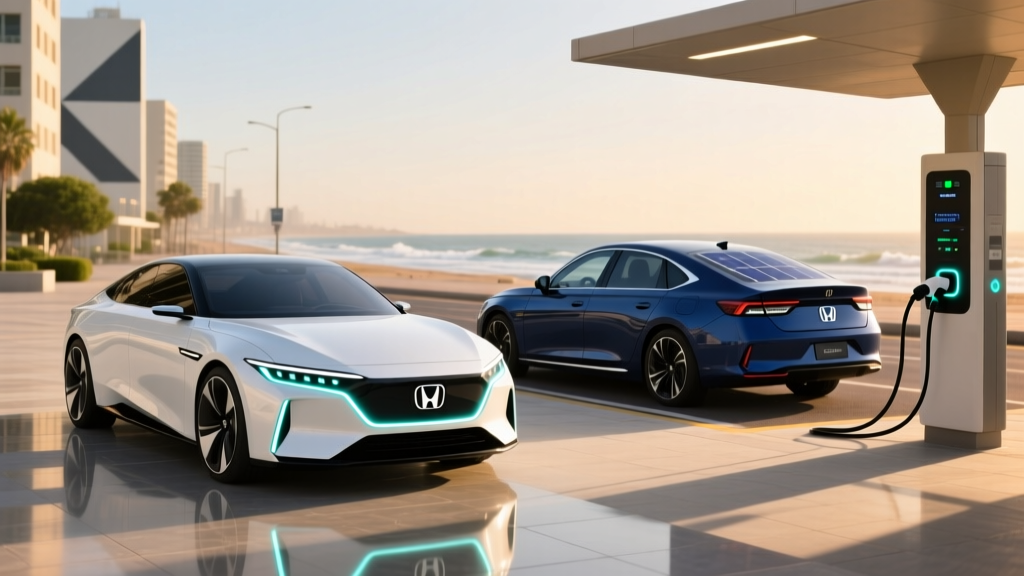
Quick Answer: Honda's only current all-electric vehicle in the U.S. is the Prologue SUV (EPA range up to 296 miles, starting around $47,400). The highly anticipated Honda 0 Series Saloon sedan is expected for the 2027 model year on Honda's new dedicated EV platform. If you need a Honda with electric propulsion today but aren't ready for full EV ownership, Honda's hybrid lineup (Accord Hybrid, CR-V Hybrid) delivers 40+ MPG combined without charging infrastructure requirements.
Honda's Electric Vehicle Lineup: Where Things Stand in 2026
Honda has been cautious in its EV transition compared to rivals like Hyundai and Tesla, but the strategy is shifting. The Honda Prologue, built on General Motors' Ultium platform, launched as a 2024 model and received updates for 2025 and 2026. It remains Honda's sole battery-electric offering available for purchase in the United States.
The bigger story is Honda's next-generation EV architecture. The Honda 0 Series — announced at CES 2024 — represents Honda's bespoke EV platform, developed in-house rather than borrowed from GM. The first production models, the Saloon sedan and an SUV, are targeted for 2027 model-year availability. Honda has stated these vehicles will feature thinner battery packs, lighter weight, and a new approach to aerodynamics.
For buyers researching "electric Honda" options right now, the decision tree is straightforward: buy the Prologue today, wait for the 0 Series, or opt for a Honda hybrid as a bridge solution.
2026 Honda Prologue: Range, Charging, and Pricing
| Specification | EX (FWD) | Touring (AWD) |
|---|---|---|
| EPA Range | 296 miles | 270 miles |
| Battery Capacity | 85 kWh usable (NMC) | 85 kWh usable (NMC) |
| Peak DC Fast Charge | 150 kW | 150 kW |
| 10–80% DC Charge Time | ~35 minutes | ~35 minutes |
| Level 2 Charge Rate | 11.5 kW | 11.5 kW |
| Horsepower | 212 hp | 288 hp |
| 0–60 mph | ~7.5 sec | ~6.0 sec |
| Base MSRP | $47,400 | $57,900 |
| Battery/Powertrain Warranty | 8 years / 100,000 miles | |
Real-World Range Reality: The Prologue's 296-mile EPA rating applies to the FWD EX trim under mixed driving conditions. Expect 240–265 miles on sustained highway driving at 70+ mph, and 200–230 miles in sub-freezing winter conditions. The AWD Touring's 270-mile EPA figure drops to roughly 220 miles highway in temperate weather. These reductions are typical for EVs but matter for road-trip planning.
The Prologue's 150 kW peak DC fast-charging rate is respectable but trails competitors like the Hyundai Ioniq 5 (240 kW peak) and Tesla Model Y (250 kW). In practice, the Prologue's charge curve tapers noticeably above 80% state of charge — a common NMC battery behavior. If you regularly fast-charge, plan your stops around 10–80% sessions rather than topping to 100%.
At home on a Level 2 charger (240V, 48A), the Prologue adds approximately 30 miles of range per hour of charging, meaning a full overnight session from 20% to 100% takes roughly 8 hours. If you're limited to Level 1 (120V standard outlet), expect about 3–4 miles per hour — adequate only for low-mileage drivers who can leave the car plugged in overnight consistently.
Federal Tax Credit Eligibility
Under current IRS §30D rules, the Prologue may qualify for up to $7,500 in federal tax credits, but eligibility depends on multiple factors:
- MSRP Cap: SUVs must have an MSRP at or below $80,000 — all Prologue trims qualify.
- Buyer Income Cap: Modified AGI must not exceed $150,000 (single) or $300,000 (joint).
- Battery Sourcing: Critical minerals and battery component requirements phase in annually. Because the Prologue uses GM's Ultium battery (North American assembly), it has historically qualified, but verify current-year sourcing compliance at fueleconomy.gov.
- Point-of-Sale Transfer: You can transfer the credit to the dealer at purchase, reducing your out-of-pocket cost immediately rather than waiting for tax filing.
Note: Tax credit rules are subject to change. Consult a tax professional and verify eligibility at the time of purchase.
EV vs. Hybrid Honda: The Cost and Practicality Comparison
For many Honda shoppers, the real question isn't "which electric Honda?" but "EV or hybrid?" Honda's hybrid lineup — particularly the Accord Hybrid (48 MPG combined) and CR-V Hybrid (40 MPG combined) — offers electrified efficiency without charging requirements.
| Factor | Prologue (EV) | CR-V Hybrid (AWD) | CR-V (Gas AWD) |
|---|---|---|---|
| Base MSRP | $47,400 | $36,350 | $32,350 |
| Est. After $7,500 Credit | ~$39,900 | $36,350 | $32,350 |
| EPA Efficiency | 95 MPGe combined | 40 MPG combined | 28 MPG combined |
| Annual Fuel/Energy Cost* | ~$550 (home charging) | ~$1,450 | ~$2,100 |
| Annual Maintenance (est.) | ~$300 | ~$600 | ~$750 |
| 5-Year Fuel + Maintenance | ~$4,250 | ~$10,250 | ~$14,250 |
*Based on 12,000 miles/year, $0.14/kWh average home electricity, $3.50/gallon regular unleaded. Actual costs vary by region and driving pattern. Source: fueleconomy.gov data.
The Prologue's fuel savings are substantial — roughly $1,550/year over the CR-V Hybrid and $1,550/year over the gas CR-V — but the higher purchase price means the break-even point depends on how long you keep the vehicle and how much you drive. At 15,000 miles per year, the Prologue's annual energy cost rises to roughly $690, still far below gas costs, and the payback period shortens.
Real-World Ownership: What First-Time EV Buyers Must Know
Buying the Prologue — or any EV — involves ownership considerations that don't apply to gas or hybrid vehicles. These aren't deal-breakers, but they require honest assessment before purchase.
Home Charging Access
Home Level 2 charging is the backbone of convenient EV ownership. If you have a garage or driveway with access to a 240V circuit (or can install one), daily charging becomes effortless — plug in at night, wake up with a full battery. Installation costs vary widely:
| Item | Typical Cost Range |
|---|---|
| Level 2 Charger (hardware) | $300–$700 |
| Electrician (240V/50A circuit install) | $800–$2,500 |
| Panel upgrade (if needed, 100A→200A) | $1,500–$3,500 |
| Permits & inspection | $100–$400 |
| Total (no panel upgrade) | $1,200–$3,600 |
| Total (with panel upgrade) | $2,700–$7,100 |
If you live in an apartment or lack dedicated parking with electrical access, you'll rely on public charging networks. This is viable but requires planning — apps like PlugShare and the Electrify America or EVgo networks are essential, and public DC fast-charging costs roughly $0.35–$0.55/kWh, making it significantly more expensive than home charging.
Climate and Driving Patterns
Cold weather reduces EV range — typically 20–35% loss at temperatures below 25°F, depending on whether the vehicle uses a heat pump (the Prologue includes one). If you live in northern climates and regularly drive 200+ miles in winter, the Prologue's real-world range may dip to 180–210 miles, requiring mid-trip charging stops.
For predominantly urban and suburban driving under 60 miles per day, the Prologue's range is more than adequate year-round, and home charging handles nearly all energy needs.
Waiting for the Honda 0 Series Saloon?
The Honda 0 Series Saloon, previewed as a concept at CES 2024 and confirmed for production, is expected to arrive as a 2027 model-year vehicle. Honda has stated it will use a new thin-form battery pack, a dedicated EV platform with rear-wheel-drive bias, and advanced aerodynamics targeting over 300 miles of range.
Key announced details (preliminary — final specs not yet confirmed):
- Dedicated Honda EV architecture (not GM Ultium)
- Target range: 300+ miles EPA (estimated)
- Thinner battery pack for lower seating position
- New Honda SENSING 360+ ADAS suite
- Production anticipated at Honda's Ohio EV hub
If the Saloon's design and Honda-engineered platform appeal to you, waiting 12–18 months may be worthwhile. If you need an electric Honda now, the Prologue is a capable, if not class-leading, option.
Common Electric Honda Misconceptions
| Myth | Fact |
|---|---|
| "Honda doesn't make electric cars." | The Prologue is a fully electric SUV available since 2024, with the 0 Series Saloon coming for 2027. |
| "The Prologue is just a rebadged Chevy." | While it shares GM's Ultium platform with the Blazer EV, Honda designed its own body, interior, suspension tuning, and software interface. Driving character and cabin quality differ meaningfully. |
| "EVs cost more to own than gas cars." | Higher purchase price is offset by lower fuel and maintenance costs. Over 5 years at 12,000 miles/year, the Prologue saves ~$6,000–$10,000 in fuel and maintenance vs. a gas CR-V, partially offsetting the higher MSRP. |
| "EV batteries need replacing every few years." | Honda warranties the Prologue battery for 8 years/100,000 miles with a capacity retention threshold of 70%. NMC batteries typically retain 85–90% capacity at 100,000 miles based on industry data. |
| "I can't take an EV on road trips." | The Prologue charges from 10–80% in ~35 minutes at DC fast chargers. With the growing Electrify America and EVgo networks, highway road trips require planning but are routine. |
Decision Framework: Which Electrified Honda Is Right for You?
Choose the Honda Prologue (EV) if:
- You have home Level 2 charging access or can install it
- Your daily driving is under 100 miles round-trip
- You qualify for the federal tax credit, bringing effective price to ~$39,900
- You want zero tailpipe emissions and minimal maintenance
- You take road trips 2–4 times per year and can plan charging stops
Choose a Honda Hybrid (CR-V Hybrid or Accord Hybrid) if:
- You lack reliable home or workplace charging access
- You regularly drive 300+ miles without stopping (rural routes, remote areas)
- You live in an extreme cold climate and don't want range-loss planning
- Your budget is under $38,000 and you want AWD
- You want electrified efficiency without changing your fueling habits
Wait for the Honda 0 Series Saloon if:
- You want a sedan rather than an SUV
- You prefer Honda's in-house engineering over the GM-sourced Prologue
- You can wait until late 2026 or 2027 for availability
- 300+ mile range and next-gen styling are priorities
Frequently Asked Questions
Does Honda have a fully electric car available now?
Yes. The Honda Prologue is a midsize electric SUV currently on sale, offering up to 296 miles of EPA range (FWD EX trim). It is Honda's only all-electric vehicle available in the U.S. as of 2026. The Honda 0 Series Saloon sedan is expected for the 2027 model year.
How much does it cost to charge a Honda Prologue at home?
At the U.S. average residential electricity rate of ~$0.14/kWh, fully charging the Prologue's 85 kWh battery costs approximately $11.90. For a typical driver covering 12,000 miles per year, annual home-charging costs are roughly $550–$650, compared to $1,400–$2,100 for a gas-powered equivalent.
Is the Honda Prologue eligible for the $7,500 tax credit?
The Prologue has historically qualified for the full $7,500 federal clean vehicle credit under IRS §30D, because its GM Ultium battery is assembled in North America. However, eligibility depends on your income (under $150K single / $300K joint), the vehicle's MSRP (under $80K for SUVs — all trims qualify), and current-year battery sourcing requirements. Verify at fueleconomy.gov before purchasing, and consider the point-of-sale transfer option to reduce your purchase price directly.
How does the Prologue compare to the Tesla Model Y or Hyundai Ioniq 5?
The Prologue's 150 kW peak DC charging rate lags the Ioniq 5 (240 kW) and Model Y (250 kW), meaning longer charging stops on road trips. Its 296-mile maximum range is competitive, and its interior quality and ride comfort are strong, but it lacks access to Tesla's Supercharger network (unless using an adapter on newer model years — check Honda's latest NACS compatibility updates). The Prologue is a solid choice for Honda-loyal buyers but doesn't lead the segment in charging speed or tech innovation.
Will the Honda 0 Series Saloon be worth waiting for?
If you want a Honda-engineered electric sedan with next-generation architecture, yes. The 0 Series platform promises thinner batteries, lighter weight, and a more engaging driving experience than the GM-based Prologue. However, production timing (expected 2027 model year), final pricing, and exact range figures are not yet confirmed. If you need an EV within the next 6 months, the Prologue or a competing EV is your practical option.