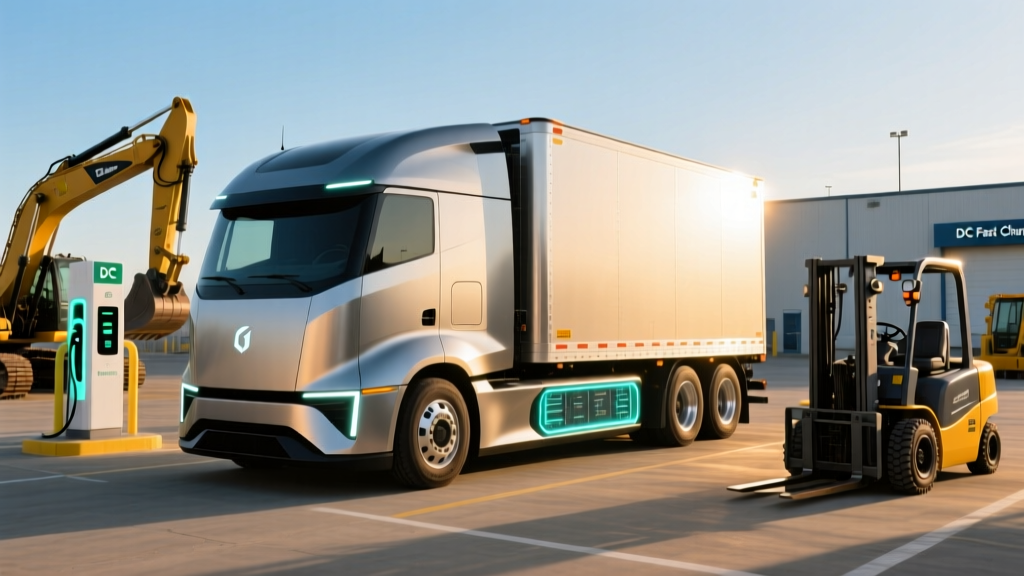
Bottom line for 2026: Electric heavy equipment — including Class 8 semi-trucks, excavators, wheel loaders, and dump trucks — has reached commercial viability for hub-and-spoke operations with depot charging. Expect upfront costs 1.5–2.5× diesel equivalents, but fuel savings of 50–70% and maintenance savings of 30–40% can yield break-even in 3–5 years depending on duty cycle. The critical constraint is charging infrastructure: a single Class 8 electric truck needs 150–350 kW DC fast charging, and depot electrification can cost $50,000–$250,000+ before utility upgrades.
What Electric Heavy Equipment Actually Covers
The term "electric heavy equipment" spans a wide range of battery-electric commercial machines. In 2026, the most commercially available categories include:
- Class 8 electric trucks (semi-tractors): Freightliner eCascadia, Tesla Semi, Volvo VNR Electric, Peterbilt 579EV
- Electric excavators: Volvo ECR25 Electric, Caterpillar 301.9 Electric (announced), JCB 19C-1E
- Electric wheel loaders: Volvo L25 Electric, JCB 525-60E telehandler
- Electric dump trucks: Mack MD Electric, BYD Class 8 refuse trucks
- Electric yard tractors/terminal tractors: Orange EV, Kalmar Ottawa EV
This guide focuses primarily on the most mature segment — Class 8 electric trucks and vocational heavy trucks — where real-world fleet data, pricing, and charging infrastructure are most established. Compact electric construction equipment (mini excavators, small loaders) follows similar economics at smaller scale.
Electric vs Diesel Heavy Equipment: The Cost Comparison
The purchase-price gap between electric and diesel heavy equipment remains substantial, but total cost of ownership (TCO) tells a different story when you factor in fuel, maintenance, and incentives.
| Cost Factor | Electric (e.g., Freightliner eCascadia) | Diesel (e.g., Freightliner Cascadia) |
|---|---|---|
| Base MSRP | $250,000–$350,000 | $130,000–$170,000 |
| Federal incentive (§30D / 45W commercial credit) | Up to $40,000 (weight-based) | $0 |
| State/utility incentives (varies) | $25,000–$120,000 (e.g., CARB HVIP, NYSERDA) | $0 |
| Effective purchase price (with incentives) | $150,000–$275,000 | $130,000–$170,000 |
| Fuel cost per mile | $0.20–$0.40 (electricity at $0.10–$0.18/kWh) | $0.60–$0.85 (diesel at $4.00–$5.00/gal, 6.5 MPG) |
| Annual fuel cost (60,000 mi/yr) | $12,000–$24,000 | $36,000–$51,000 |
| Maintenance cost per mile | $0.08–$0.12 | $0.15–$0.22 |
| Annual maintenance (60,000 mi/yr) | $4,800–$7,200 | $9,000–$13,200 |
| Estimated annual insurance | $12,000–$18,000 (higher due to replacement cost) | $8,000–$12,000 |
| 5-year total operating cost (fuel + maint + insurance) | $144,000–$246,000 | $265,000–$381,000 |
Key takeaway: At 60,000 miles/year with depot charging at commercial electricity rates, an electric Class 8 truck can save $15,000–$25,000 per year in operating costs. Break-even on the higher purchase price typically occurs in years 3–5, heavily dependent on your local utility rates, available incentives, and annual mileage.
Note: The IRS §45W Commercial Clean Vehicle Credit provides up to $40,000 for qualified commercial electric vehicles over 14,000 lbs GVWR. Unlike the consumer §30D credit, §45W has no MSRP cap or income limit, but it requires the vehicle to be used in a trade or business and meet battery-sourcing requirements. Always consult a tax professional for your specific situation.
Range, Battery, and Charging Specs for Electric Heavy Trucks
Range and charging remain the most scrutinized specs for electric heavy equipment buyers. Here's how the leading 2026 Class 8 electric trucks stack up:
| Model | Battery (kWh usable) | EPA Est. Range | Peak DC Charge Rate | 10–80% Charge Time | GCWR |
|---|---|---|---|---|---|
| Freightliner eCascadia | 291–438 kWh (NMC) | 150–230 mi | 250 kW | ~60–90 min | 82,000 lbs |
| Tesla Semi (dual motor) | ~500–900 kWh (est.) | 300–500 mi (mfr) | ~1,000 kW (Megacharger) | ~30 min (est.) | 82,000 lbs |
| Volvo VNR Electric | 264–375 kWh (NMC) | 150–275 mi | 250 kW | ~60–90 min | 82,000 lbs |
| Peterbilt 579EV | 282–396 kWh (NMC) | 150–200 mi | 150–250 kW | ~75–120 min | 82,000 lbs |
Real-world range reality: EPA or manufacturer range estimates for electric heavy trucks assume moderate loads and flat terrain. In practice, expect 30–50% range reduction when operating at full 80,000 lb GCW, in mountainous terrain, or in cold weather below 30°F. A truck rated at 230 miles may deliver only 120–150 miles fully loaded on a hilly route in winter. Plan routes accordingly — most electric heavy trucks today serve regional haul (under 200 mi round-trip), drayage, and last-mile delivery where depot charging between shifts is feasible.
Charging infrastructure is the bottleneck. Unlike passenger EVs that can use public networks, electric heavy equipment almost exclusively relies on depot charging. Here's what that involves:
| Component | Per-Charger Cost Range | Notes |
|---|---|---|
| 150 kW DC fast charger (single) | $50,000–$85,000 | Sufficient for overnight charging of 1–2 trucks |
| 350 kW DC fast charger (single) | $90,000–$150,000 | Needed for opportunity charging / mid-shift top-ups |
| Electrical service upgrade (transformer, switchgear) | $30,000–$200,000+ | Varies wildly by existing panel capacity and utility distance |
| Trenching, conduit, concrete pads | $10,000–$40,000 | Per charger run |
| Utility demand charges / interconnection fees | $5,000–$50,000 | Some utilities offer make-ready programs to offset |
| Software / fleet management integration | $2,000–$10,000/yr | Charge scheduling, load management |
| Total per-charger installed | $100,000–$400,000+ | Multi-charger depots benefit from shared infrastructure |
Many utilities offer make-ready programs that cover 50–100% of infrastructure costs on their side of the meter. Check with your local utility — programs from PG&E, SCE, Con Edison, and others have funded significant commercial EV depot buildouts. The Alternative Fuel Vehicle Refueling Property Credit (§30C) also provides up to $100,000 per item of qualified charging equipment placed in service, subject to prevailing-wage and census-tract requirements.
Real-World Ownership: What Fleet Operators Actually Face
Specs and cost tables only tell part of the story. Here's what electric heavy equipment ownership looks like day-to-day based on fleet operator reports and industry data:
Maintenance Savings Are Real — But Different
Electric heavy trucks eliminate diesel particulate filter (DPF) regenerations, exhaust aftertreatment systems, oil changes, and transmission fluid services. Regenerative braking extends brake life significantly — some fleets report brake replacements at 300,000+ miles vs. 100,000–150,000 miles on diesel. However, electric trucks introduce new maintenance considerations:
- Battery thermal management systems require coolant service and monitoring
- High-voltage cable inspections are mandatory per most OEM maintenance schedules
- Charging connector/handle wear — CCS and proprietary connectors need periodic replacement at $1,500–$4,000
- Battery degradation: expect 10–20% capacity loss over 5–7 years at typical commercial duty cycles. Most OEMs warrant 70% capacity retention at 5 years / 300,000–600,000 miles
Cold Weather Is the Great Equalizer
For fleets operating in northern climates, cold weather remains the single biggest operational challenge for electric heavy equipment. Battery chemistry (typically NMC in heavy trucks) loses efficiency below freezing, and cab/battery heating draws significant energy from the traction pack. Fleets in Minnesota, Canada, and the Northeast report:
- 25–40% range reduction at temperatures below 20°F
- Longer charge times due to cold battery preconditioning requirements
- Need for heated depot parking or opportunity charging to maintain schedules
If your operation runs in sub-freezing climates for 3+ months per year, plan for the reduced range in route scheduling and consider depot heating infrastructure.
Driver Acceptance and Training
Fleet operators consistently report that drivers adapt to electric heavy trucks faster than expected. The instant torque, quiet operation, and one-pedal driving (via aggressive regen) are popular. However, drivers need training on:
- State-of-charge (SoC) management and route planning around charge stops
- Preconditioning the battery before fast-charging stops
- Understanding the charge curve — peak kW rates only apply at low SoC and taper significantly above 80%
- Regen braking behavior when the truck is empty vs. loaded
Common Misconceptions About Electric Heavy Equipment
| Myth | Fact |
|---|---|
| "Electric trucks can't pull heavy loads" | Electric motors produce peak torque from 0 RPM. The Freightliner eCascadia is rated for 82,000 lb GCWR — identical to its diesel counterpart. The limitation is range at full load, not pulling power. |
| "Batteries won't last and replacement is $200K+" | Current NMC packs in Class 8 trucks are warrantied for 70%+ capacity at 300,000–600,000 miles. Replacement costs are declining — estimated at $80,000–$150,000 in 2026 for a full pack, but most operators will sell or repurpose the truck before needing a full replacement. Second-life battery applications (stationary storage) add residual value. |
| "Charging takes too long for commercial operations" | For depot-based operations (drayage, regional delivery), overnight charging at 150 kW fully replenishes most trucks in 3–6 hours. For higher-utilization routes, 350 kW opportunity chargers can add 100+ miles in 30–40 minutes. The constraint is infrastructure, not the truck. |
| "Electric heavy equipment isn't really zero-emission" | Tailpipe emissions are zero. Grid emissions depend on your electricity source — but even on coal-heavy grids, lifecycle emissions per ton-mile are typically 40–60% lower than diesel (per EPA analysis). As grids decarbonize, the advantage grows. |
| "There are no incentives for commercial electric trucks" | The §45W Commercial Clean Vehicle Credit offers up to $40,000. State programs like California's HVIP (up to $120,000+), New York's NYTVIP, and various utility make-ready programs can stack to cover 50–80% of the price premium. These programs are competitive and funding-limited — apply early. |
Electric Heavy Equipment Decision Framework
Should Your Operation Go Electric?
Choose electric heavy equipment if:
- Your trucks run under 200 miles per day on predictable routes (drayage, regional delivery, refuse, construction site hauling)
- You have depot or yard space where chargers can be installed with overnight dwell time of 8+ hours
- Your utility offers commercial EV rates or make-ready infrastructure programs
- You operate in a state with stackable incentives (CA, NY, NJ, WA, CO, MA)
- Your fleet faces emissions regulations (e.g., CARB Advanced Clean Fleets rule, port clean-truck mandates)
- You run high annual mileage (50,000+ mi/yr) where fuel savings compound fastest
Stick with diesel (or wait) if:
- Your trucks run long-haul routes exceeding 300 miles between depots with no mid-route charging available
- Your depot has no feasible electrical service upgrade (utility transformer maxed out, 2+ year interconnection queue)
- You operate in extreme cold climates with no heated parking and cannot tolerate 30–40% range loss
- Your trucks run under 15,000 miles/year — the fuel savings won't justify the purchase premium within a reasonable payback period
- Your application requires continuous PTO (power take-off) operation that drains the traction battery faster than route plans allow
Compact Electric Construction Equipment: A Quick Primer
Beyond Class 8 trucks, compact electric construction equipment is maturing rapidly. The economics differ because these machines are often trailer-transported to job sites and charged from portable generators or temporary site power:
- Volvo ECR25 Electric (mini excavator): 20 kWh LFP battery, ~4–6 hours runtime, ~$60,000 MSRP. Ideal for indoor demolition, utility work in noise-restricted zones.
- JCB 19C-1E (mini excavator): 19 kWh battery, similar runtime, competitive pricing. Zero emissions enable work in enclosed spaces without ventilation.
- Electric wheel loaders (Volvo L25 Electric, etc.): 40–60 kWh packs, 6–8 hour shifts, but require 22–40 kW Level 2 charging on-site.
For compact equipment, the value proposition often centers on regulatory access (indoor work, noise ordinances, urban emissions zones) rather than pure fuel-cost savings. Battery runtime of 4–8 hours covers most single-shift applications, and LFP chemistry in this segment offers excellent cycle life (3,000–5,000+ cycles) with lower energy density trade-offs.
Frequently Asked Questions
What is the typical battery warranty on electric heavy trucks?
Most OEMs (Freightliner, Volvo, Peterbilt) warrant their Class 8 EV battery packs for 5 years / 300,000–600,000 miles with a guaranteed capacity retention of 70–80% of original capacity. This is comparable to the expected first-owner lifecycle of a commercial truck. Always verify exact warranty terms with the dealer, as they vary by model year and configuration.
Can I charge an electric heavy truck from a standard commercial outlet?
Technically, yes — using Level 2 (AC) charging at 19–22 kW, but a full charge of a 300+ kWh battery would take 15–20+ hours. For practical fleet operations, DC fast charging at 150–350 kW is essential, bringing charge times to 2–6 hours depending on charger power and battery size. Plan depot infrastructure accordingly.
How does the §45W commercial EV tax credit work?
The §45W Commercial Clean Vehicle Credit provides 15% of the vehicle's basis (or 30% if no depreciation/tax-exempt financing applies), up to $7,500 for vehicles under 14,000 lbs GVWR and $40,000 for vehicles over 14,000 lbs. The vehicle must be used in a trade or business, meet battery component and critical-mineral sourcing requirements, and be manufactured by a qualified OEM. The credit is non-refundable and cannot exceed the incremental cost over a comparable diesel vehicle. Consult a tax professional — rules are complex and subject to change.
What happens if the battery needs replacement out of warranty?
Full battery pack replacement for a Class 8 electric truck is estimated at $80,000–$150,000 in 2026, depending on pack size and chemistry. However, modular designs (like Volvo's) allow replacing individual battery modules rather than the full pack, reducing costs to $15,000–$40,000 per module. Additionally, degraded packs retain 70–80% capacity and have second-life value in stationary storage applications, offsetting net replacement cost.
Are there electric heavy equipment options for owner-operators, not just fleets?
Currently, electric heavy trucks are primarily sold through fleet channels with dealer support for infrastructure planning. Owner-operators face challenges: higher upfront cost, depot charging requirements, and limited service network for high-voltage systems outside major metro areas. If you're an owner-operator running regional routes under 150 miles with home/yard charging access, it's feasible — but work with a dealer who supports single-unit buyers and verify local service capability before purchasing.