Quick answer: For a typical 2-car garage (400–500 sq ft) where you park and charge an EV, you need a 10,000–15,000 BTU (3–5 kW) electric garage space heater on a dedicated 240V circuit. Budget $200–$600 for the unit and $300–$800 for professional installation. Crucially, your heater and Level 2 EV charger usually cannot share a circuit — plan for separate 240V/30A+ circuits or a smart load-management panel. Running a 4 kW heater 4 hours/day costs roughly $1.80–$2.40 at the U.S. average electricity rate of $0.16/kWh.
Why EV Owners Care About Garage Heating in 2026
Garage heating isn't a luxury when you own an electric vehicle — it directly impacts battery preconditioning, charging speed, and daily range. Lithium-ion batteries (both NMC and LFP chemistries) operate most efficiently between 60–80°F. When a battery pack sits below 40°F, DC fast charging speeds can drop by 30–50% until the thermal management system warms the cells, and regenerative braking may be limited or disabled entirely on cold mornings.
Keeping your garage between 45–55°F in winter accomplishes three things for EV ownership:
- Faster Level 2 charging: A battery starting at 50°F accepts charge more readily than one at 20°F, reducing the time to reach 80% SoC.
- Reduced range loss: Cold-soaked packs lose 20–30% of EPA-estimated range. A tempered garage cuts that penalty significantly on the first few miles.
- Better preconditioning: Many 2025–2026 EVs (Tesla Model Y, Hyundai Ioniq 5, Ford Mustang Mach-E) precondition the battery when you schedule a departure time. A warmer starting point means less energy spent heating the pack before you leave.
The challenge: most EV owners are simultaneously adding a 240V/40A or 48A Level 2 charger and considering an electric garage space heater. Both are high-wattage 240V loads, and most homes don't have unlimited panel capacity.
Types of Electric Garage Space Heaters Compared
Not every heater works in a garage environment. You need units rated for spaces where vehicles are stored, with adequate clearance from combustible materials and protection from dust and moisture. Here's how the main categories compare:
| Heater Type | Typical kW Output | Best For | Unit Cost | Install Complexity |
|---|---|---|---|---|
| Wall-mounted forced-air (240V) | 3–5 kW | 2-car garages, whole-space heating | $250–$600 | Hardwired, dedicated 240V/30A circuit |
| Ceiling-mounted unit heater | 3–7.5 kW | High-ceiling or 3-car garages | $400–$900 | Hardwired, dedicated 240V/30–40A circuit |
| Portable 120V ceramic/radiant | 1.5 kW | Spot heating, workbench area | $40–$120 | Plug-in (standard 120V outlet) |
| Infrared tube heater (240V) | 2–4 kW | Heating objects/people, not air | $300–$700 | Hardwired, ceiling mount |
| Mini-split heat pump | 1.5–3.5 kW (delivers 3–5 kW heat) | Insulated garages, year-round use | $1,200–$3,500 | Professional HVAC install, dedicated 240V |
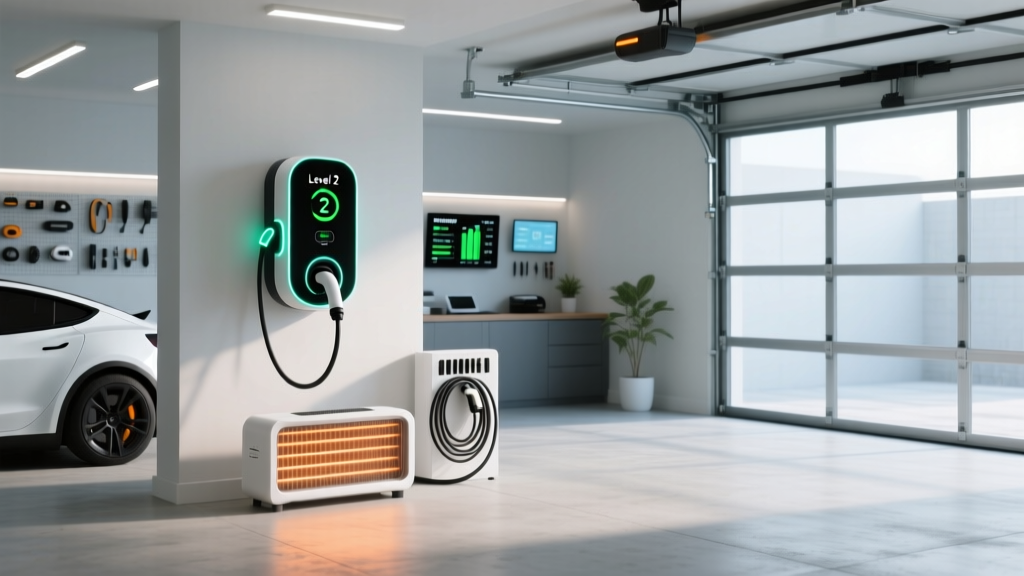
For most EV owners with an attached 2-car garage, a wall-mounted forced-air unit at 4–5 kW on a 240V/30A circuit is the practical sweet spot. It heats the entire space in 15–20 minutes and can be controlled via a built-in thermostat or smart plug.
If your garage is well-insulated (R-13+ walls, insulated door), a mini-split heat pump delivers 2–3× more heat per kWh of electricity consumed (measured as COP — coefficient of performance). A mini-split with a COP of 3.0 produces 3 units of heat for every 1 unit of electricity, compared to 1:1 for resistive heaters. The tradeoff is higher upfront cost and the need for an HVAC contractor.
Circuit Planning: Heater + EV Charger on the Same Panel
This is where most EV owners hit a wall — literally and electrically. Here's the math:
- Level 2 EV charger (40A circuit): Draws up to 32A continuous, or 7.7 kW at 240V
- Wall-mounted garage heater (30A circuit): Draws up to 24A continuous, or 5.76 kW at 240V
- Combined peak load: ~13.5 kW simultaneously
A typical U.S. home has a 100A or 200A main panel. A 200A panel can theoretically supply 48 kW, but your actual available capacity depends on existing loads (electric range, dryer, HVAC, water heater). An electrician will perform a NEC Article 220 load calculation to determine if your panel can handle both additions.
Panel & Circuit Cost Breakdown
| Item | Estimated Cost | Notes |
|---|---|---|
| Dedicated 240V/30A circuit for heater | $300–$600 | If panel has spare capacity; ~30 ft run |
| Dedicated 240V/50A circuit for EV charger | $400–$900 | Standard for 40A chargers (ChargePoint Home Flex, Tesla Wall Connector) |
| Panel upgrade (100A → 200A) | $1,500–$3,500 | Required if load calculation exceeds existing capacity |
| Smart load management (e.g., Emporia, Span panel) | $500–$2,500 | Shares capacity between charger and heater dynamically |
| Permit & inspection | $50–$200 | Required in most jurisdictions for new 240V circuits |
Smart load management is an increasingly practical solution in 2026. Devices like the Emporia Load Controller or a Span smart electrical panel can dynamically share amperage between your EV charger and garage heater. When the car is charging at full power, the heater throttles down; when charging finishes or tapers above 80% SoC, the heater ramps back up. This can avoid a costly panel upgrade entirely.
Operating Cost: Heating Your Garage vs. the EV Range Benefit
Let's quantify whether the electricity spent on a garage heater is offset by reduced cold-weather range loss and faster charging.
| Scenario | Electricity Use | Monthly Cost (at $0.16/kWh) | Benefit |
|---|---|---|---|
| 4 kW heater, 4 hrs/day, 30 days | 480 kWh | $76.80 | Garage maintained at ~50°F |
| 4 kW heater, 8 hrs/day (thermostat-cycled), 30 days | ~360 kWh (cycled ~50%) | $57.60 | Garage maintained at ~50°F |
| Portable 1.5 kW, 4 hrs/day | 180 kWh | $28.80 | Spot heating only, limited garage warming |
| Mini-split (COP 3.0), equivalent to 4 kW heat, 4 hrs/day | ~160 kWh | $25.60 | Same heat output, 60% less electricity |
Now compare this to the cold-weather range penalty. A 2026 EV with a 300-mile EPA range (say, a Tesla Model Y Long Range at 320 miles EPA or a Hyundai Ioniq 5 at 310 miles EPA) can lose 60–90 miles of range when the battery is cold-soaked at 20°F and cabin heating draws 3–5 kW from the pack during the first 30 minutes of driving.
If you drive 40 miles/day round-trip, that range loss rarely strands you — but it does increase charging frequency. A cold battery also charges slower: DC fast charging from 10–80% might take 25 minutes at 70°F but 35–40 minutes at 25°F without preconditioning.
Net assessment: If you pay $57–77/month in winter heating, you save time (faster charging, less preconditioning) and reduce battery stress. For most owners in climates where temperatures regularly drop below 30°F, a thermostat-controlled 240V heater running only when needed is a worthwhile investment.
Safety Requirements for Garages With EVs and Heaters
Garages present unique hazards: flammable vapors from stored fuels or solvents, vehicle exhaust, dust accumulation on heating elements, and proximity to high-voltage EV charging equipment. Follow these rules:
- Minimum clearance: Most 240V forced-air units require 3 feet of clearance from combustible materials. Check the manufacturer's installation manual — this is non-negotiable.
- Mounting height: Wall-mounted units should be installed at least 6 feet above the floor or per manufacturer spec, keeping them above vehicle bumpers and stored items.
- GFCI protection: NEC 2023 and later codes require GFCI protection on 240V circuits in garages. Your electrician will include this in the breaker.
- Dust and lint: Garages accumulate dust that can coat heating elements. Clean or vacuum the heater's intake and element quarterly.
- No extension cords: Never power a space heater through an extension cord or power strip. Hardwired 240V units eliminate this risk.
- Carbon monoxide: Electric heaters produce no CO. If you also run a gas-powered vehicle in the garage, ensure adequate ventilation and install a CO detector.
EV charging equipment has its own safety profile. Level 2 chargers (Tesla Wall Connector, EnelX JuiceBox, ChargePoint Home Flex) are UL-listed and include ground-fault protection, thermal sensors, and automatic shutoff. Keeping your heater and charger on separate circuits with proper breakers ensures neither device interferes with the other's safety systems.
Decision Framework: Which Heater Is Right for Your EV Garage?
If/Then Heater Selection
- If your garage is attached, insulated, and under 500 sq ft → Then choose a 4–5 kW wall-mounted forced-air heater on a dedicated 240V/30A circuit. Budget: ~$500–$1,000 total installed.
- If your garage is detached or poorly insulated → Then prioritize insulation first (garage door kit, $200–$400). A heater in an uninsulated garage is wasted energy. After insulating, size up to 5–7.5 kW.
- If your electrical panel is near capacity and you can't upgrade → Then use a smart load-management device or opt for a 120V portable heater (1.5 kW) for spot heating while you charge.
- If you plan to stay in the home 10+ years and want maximum efficiency → Then install a mini-split heat pump. Higher upfront cost ($1,500–$3,500 installed) but 60% lower operating cost and provides cooling in summer.
- If you only need warmth at a workbench and don't need to heat the whole garage → Then a 120V infrared or ceramic portable heater ($40–$120) on a standard outlet is sufficient.
- If you live in a mild climate (rarely below 40°F) → Then you may not need a dedicated garage heater. Your EV's battery thermal management system handles preconditioning, and an insulated garage door alone may keep temps adequate.
Common Misconceptions About Garage Heaters and EVs
| Myth | Fact |
|---|---|
| "I can plug my heater and EV charger into the same 240V outlet." | Almost never safe or code-compliant. Each requires a dedicated circuit sized to its amperage draw. Sharing circuits risks tripped breakers or overheated wiring. |
| "A bigger heater is always better." | Oversized heaters short-cycle (turn on/off rapidly), wasting energy and wearing out components. Size the heater to your garage's square footage and insulation level: ~10 watts per sq ft for insulated spaces, ~15 watts per sq ft for uninsulated. |
| "Heating the garage wastes electricity that could charge my EV." | A 4 kW heater running 4 hours uses 16 kWh — roughly equivalent to 45–55 miles of EV range. If the heater prevents 60+ miles of cold-weather range loss, the net energy impact can be neutral or positive. |
| "My EV doesn't need a warm garage because it has a heat pump." | EV heat pumps (standard on 2025–2026 Hyundai, Kia, Tesla models) improve cabin heating efficiency, but the battery pack still suffers reduced performance below 40°F. Garage warmth helps the pack, not just the cabin. |
| "I need a 200A panel upgrade to add a heater and EV charger." | Not necessarily. A load calculation may show sufficient capacity. Smart load-sharing devices can also manage both loads on existing panels. Get a licensed electrician's assessment before assuming an upgrade is required. |
Frequently Asked Questions
Can I use a 120V portable heater in my garage while my EV charges?
Yes, as long as the heater is on a different circuit than your EV charger and you don't exceed the circuit's capacity. A 1.5 kW portable heater draws about 12.5A on a 120V circuit — fine on a standard 15A or 20A outlet. Just never use an extension cord, and keep the heater 3+ feet from the vehicle and any stored materials.
Will a garage heater reduce my EV's cold-weather range loss?
Yes, indirectly. A garage kept at 45–55°F means your battery starts warmer, which reduces the energy the vehicle's thermal management system must spend on preconditioning. Real-world data from fueleconomy.gov shows that EVs can lose 20–30% of range at 20°F compared to 77°F. A heated garage mitigates a significant portion of that loss, especially on short trips where the pack doesn't have time to self-warm.
Do I need a permit to install a 240V garage heater?
In most U.S. jurisdictions, yes — any new 240V hardwired circuit requires a permit and inspection. Permit costs typically range from $50 to $200. This protects you: the inspector verifies wire gauge, breaker sizing, and GFCI protection meet NEC code. Always hire a licensed electrician for this work and verify the permit is pulled.
What's the most efficient electric garage heater for an EV owner?
A mini-split heat pump is the most efficient option, delivering a COP of 3.0–4.5 (meaning 3–4.5 units of heat per unit of electricity). However, it costs $1,500–$3,500 installed. For budget-conscious EV owners, a 240V forced-air resistive heater with a programmable thermostat is the most practical balance of cost ($500–$1,000 installed) and performance. Set the thermostat to 45–50°F and use a timer to run only during the hours before you drive or charge.
How does garage heating affect my home electricity bill vs. gas heating?
Electric resistive heat costs roughly $0.16/kWh × 4 kW × 4 hours = $2.56/day. A comparable natural gas garage heater (if gas is available) costs about $1.00–$1.50/day at current gas prices. However, electric heaters require no venting, no gas line, and no combustion air — making them simpler and safer in a garage with an EV. If you have rooftop solar, the effective cost of electric heating drops further.
Sources: U.S. Department of Energy / fueleconomy.gov — EV technology and cold-weather effects; NFPA 70 National Electrical Code (NEC); IRS §30D clean vehicle credit rules (for EV ownership context).