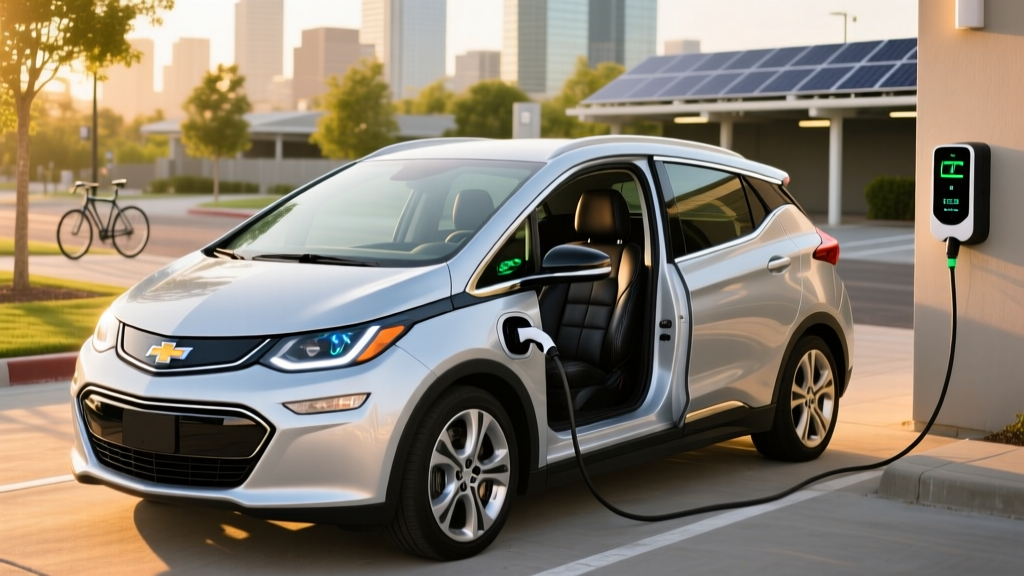
The 2017 Chevrolet Bolt EV LT arrived as a watershed moment in electric vehicles: the first mass-market, non-Tesla BEV to clear 200 miles of EPA range at a price point under $40,000. Nearly a decade later, it remains one of the most popular used EVs on the market. With Chevrolet ending Bolt production after the 2023 model year, the 2017 Bolt EV LT now trades on the used market at a fraction of its original sticker — making it an intriguing entry point for budget-conscious EV buyers. But how does this pioneering hatchback hold up in 2026? We break down every spec that matters.
2017 Bolt EV LT at a Glance: Key Specifications
| Spec | 2017 Chevrolet Bolt EV LT |
|---|---|
| EPA Range | 238 miles |
| Battery (Usable) | 60 kWh (LG Chem NMC) |
| Motor Output | 200 hp / 266 lb-ft torque |
| Drivetrain | FWD (single motor, front) |
| 0–60 mph | 6.5 seconds |
| DC Fast Charge (Peak) | 55 kW (CCS1) |
| Level 2 Charge Rate | 7.2 kW (25 mi/hr) |
| Efficiency | 119 MPGe combined / 28 kWh/100 mi |
| Cargo (Behind Rear Seats) | 16.9 cu ft |
| Cargo (Seats Folded) | 56.6 cu ft |
| Battery Warranty (Original) | 8 years / 100,000 miles |
| Original MSRP (LT Trim) | $37,495 (before incentives) |
| Typical Used Price (2026) | $8,500–$14,000 |
Sources: EPA Fueleconomy.gov, Chevrolet historical press materials.
Real-World Range: What 238 EPA Miles Actually Means
Real-World Expectation: 200–230 miles (mixed driving); 160–190 miles (sustained 70+ mph highway in winter)
The 2017 Bolt EV LT's 238-mile EPA rating was genuinely impressive at launch and still holds up for daily commuting. The 60 kWh LG Chem lithium-ion battery pack uses NMC (nickel-manganese-cobalt) chemistry, which offers strong energy density but is more sensitive to extreme temperatures than the LFP packs now common in newer EVs.
In city and suburban driving with regenerative braking set to maximum, owners routinely report achieving or even exceeding the EPA figure thanks to the Bolt's excellent low-speed efficiency. Highway driving at 70–75 mph, however, drops range to roughly 200–210 miles in moderate temperatures. The Bolt's relatively upright hatchback shape creates more aerodynamic drag than sleeker competitors like the Tesla Model 3, and that penalty shows at speed.
Cold weather is the Bolt's Achilles' heel. Without a dedicated battery heat pump (the 2017 model uses resistive cabin heating and a basic thermal management system), expect a 25–40% range reduction when temperatures drop below freezing. A 238-mile sticker becomes roughly 145–180 miles in sub-30°F highway driving. If your commute is under 80 miles round-trip and you can charge at home, this is manageable. If you're planning 200-mile winter road trips, you'll need to plan charging stops carefully.
Charging Speed: The Bolt's Biggest 2026 Limitation
| Charging Level | Power / Rate | Time / Range Added |
|---|---|---|
| Level 1 (120V household) | ~1.2 kW | ~4 miles per hour |
| Level 2 (240V home/public) | 7.2 kW | ~25 miles per hour; full charge in ~9 hours |
| DC Fast Charge (CCS1) | 55 kW peak | 10–80% in ~55 minutes; ~90 miles in 30 min |
Here's where the 2017 Bolt EV LT shows its age most clearly. The 55 kW peak DC fast-charging rate was modest even at launch and feels decidedly slow in 2026, when competitors routinely charge at 150–250 kW. The Bolt's charge curve is relatively flat — it sustains close to 50 kW from roughly 10% to 55% state of charge, then tapers gradually. A 10–80% session takes approximately 55 minutes at a capable CCS1 station.
For context, a Hyundai Ioniq 5 with its 800V architecture completes the same 10–80% session in about 18 minutes at a 350 kW charger. The Bolt's DC charging speed makes it viable for road trips, but you'll be spending noticeably more time at charging stations than drivers of newer EVs.
Home Level 2 charging at 7.2 kW is more than adequate. Plug in overnight on a standard 240V/32A Level 2 home charger, and you'll add roughly 25 miles of range per hour — easily replenishing a full day's commute in just a few hours. The Bolt uses the CCS1 connector standard (with J1772 for Level 1/2 AC charging), which remains widely compatible at public stations, though the industry is shifting toward Tesla's NACS connector through 2025 and beyond. Adapters are available for Tesla Supercharger access on older CCS-equipped vehicles.
Performance and Driving Impressions
The 2017 Bolt EV LT's single front-mounted permanent-magnet motor produces 200 horsepower and 266 lb-ft of torque. That torque is available instantly from zero RPM, giving the Bolt a punchy, eager feel around town that belies its economy-car origins. The 0–60 mph sprint clocks in at 6.5 seconds — quick enough to merge confidently onto any highway and genuinely fun in stop-and-go traffic.
The front-wheel-drive layout means torque steer is noticeable under hard acceleration, and the eco-focused tires prioritize low rolling resistance over grip. In rain and light snow, the FWD setup combined with the Bolt's relatively heavy battery pack (the car weighs 3,563 lbs) provides adequate traction, but it's no substitute for AWD in severe winter conditions.
Regenerative braking is adjustable through two modes: standard (mild regen, behaves like a conventional car) and "L" mode with the steering-wheel paddle engaged (aggressive one-pedal driving that can bring the car to a complete stop without touching the brake pedal). The one-pedal implementation is excellent and one of the Bolt's most praised features among owners.
Interior, Tech, and Practicality
The Bolt EV LT's cabin is functional rather than luxurious — a reminder that this was designed as an affordable commuter, not a premium EV. The 8-inch diagonal touchscreen runs Chevrolet's MyLink infotainment system with Apple CarPlay and Android Auto as standard. A 4G LTE Wi-Fi hotspot was included. The interface is dated by 2026 standards but remains usable, and phone integration handles most navigation and media needs.
Driver-assistance technology on the LT trim includes a rear-vision camera, Teen Driver settings, and OnStar. Notably absent compared to the Premier trim: blind-spot monitoring, rear cross-traffic alert, and the surround-view camera. Forward collision alert and lane-keep assist were optional packages on the LT.
Practicality is a strong suit. The 16.9 cu ft of cargo space behind the rear seats beats most compact crossovers, and folding the 60/40 split rear seats opens up 56.6 cu ft — enough for a full Costco run or a week's worth of camping gear. Rear legroom measures 36.5 inches, which is adequate for adults on shorter trips. The flat floor (thanks to the battery pack placement) creates a surprisingly spacious feel for a subcompact hatchback.
Battery Health, Degradation, and Warranty
Chevrolet backs the 2017 Bolt's battery pack with an 8-year/100,000-mile warranty guaranteeing at least 60% capacity retention. California and other CARB-adopting states extend this to 10 years/150,000 miles. For a 2017 model in 2026, most examples are at or just past the 8-year mark, meaning many are nearing warranty expiration unless they fall under the CARB extension.
Real-world battery degradation data from Bolt owners has been generally encouraging. Most 2017 Bolts with 60,000–100,000 miles show between 5–12% capacity loss, translating to roughly 210–225 miles of remaining range on a full charge. However, degradation is not linear — it tends to accelerate slightly after the first few years. The NMC chemistry in the Bolt is proven but less robust over very high cycle counts compared to LFP batteries now used in vehicles like the Tesla Model 3 RWD.
Recall note: The 2017–2019 Bolt EV was subject to a major battery recall (GM recall N212277230) due to fire risk from manufacturing defects in certain battery cells. GM replaced defective battery modules in affected vehicles. Before purchasing any used 2017 Bolt, verify the recall repair was completed by checking the VIN at NHTSA.gov. Vehicles with the recall repair received a new battery module, which effectively resets the degradation clock on the replaced cells.
A full battery replacement outside of warranty costs between $14,000 and $16,000 at a Chevrolet dealer — a significant expense relative to the vehicle's current used value. However, outright battery failure is rare; gradual capacity loss is the more realistic concern.
Pricing, Tax Credits, and Ownership Costs
| Item | Amount |
|---|---|
| Original 2017 MSRP (LT) | $37,495 |
| Typical 2026 Used Price | $8,500–$14,000 |
| Used EV Federal Tax Credit (§25E) | Up to $4,000 (30% of sale price, max $4,000) |
| Effective Price After Credit | As low as $4,500–$10,000 |
The original $7,500 federal tax credit under §30D is no longer available for new Bolt purchases (production ended in 2023). However, the used EV credit under IRS §25E is a major advantage for 2026 buyers. This credit provides 30% of the sale price, up to a maximum of $4,000, for qualified used EVs sold for $25,000 or less through a licensed dealer.
Eligibility requirements for the §25E used EV credit include:
- Vehicle must be purchased from a licensed dealer (private sales excluded)
- Sale price must be $25,000 or less
- Buyer income caps: $75,000 (single), $112,500 (head of household), $150,000 (joint)
- Vehicle must be at least two model years old (2017 qualifies)
- Credit can only be claimed once per vehicle (check if a prior owner already used it)
- The credit is non-refundable — it can reduce your tax liability to zero but won't generate a refund
For a $12,000 used 2017 Bolt EV LT, the §25E credit would be $3,600 (30% of $12,000), bringing the effective cost to $8,400. At this price point, the Bolt is one of the most affordable ways to access a 200+ mile range EV. Always verify current eligibility with a tax professional and consult the IRS §25E guidance before purchasing.
Running costs are extremely low. At the national average electricity rate of ~$0.16/kWh, fully charging the 60 kWh battery costs about $9.60 — equivalent to roughly $0.04 per mile. A comparable gasoline hatchback at 30 MPG and $3.40/gallon costs about $0.11 per mile. Over 12,000 miles annually, the Bolt saves approximately $840 in fuel costs. Maintenance is minimal: no oil changes, no transmission fluid, and regenerative braking extends brake pad life significantly.
Pros, Cons, and Who Should Buy the 2017 Bolt EV LT
Pros
- 238-mile EPA range remains practical for most commutes
- Extremely low used pricing, especially with the §25E tax credit
- Excellent cargo space for a subcompact (56.6 cu ft max)
- Punchy 200 hp motor with instant torque
- Strong one-pedal driving implementation
- Low operating costs (~$0.04/mile on electricity)
- Apple CarPlay and Android Auto standard
Cons
- Slow DC fast charging (55 kW peak, ~55 min 10–80%)
- No battery heat pump — significant cold-weather range loss
- FWD only; limited traction in severe winter conditions
- Dated infotainment and driver-assist technology
- Battery warranty expiring or expired on most 2017 examples
- Battery recall history — must verify repair completion
- CCS1 connector in an industry shifting to NACS
Best for: Budget-conscious commuters with home charging access, a daily round-trip under 80 miles, and mild-to-moderate climates. The Bolt EV LT is an outstanding second car, a perfect first EV for someone testing the waters, or a low-cost fleet commuter. It is not ideal for frequent long-distance road trippers (the 55 kW charging is a bottleneck), buyers in extreme-cold regions (range loss is severe), or those who prioritize the latest ADAS and infotainment tech.
Frequently Asked Questions
What is the real-world range of the 2017 Chevrolet Bolt EV LT?
Expect 200–230 miles in mixed driving at moderate temperatures. Highway driving at 70+ mph drops this to roughly 200–210 miles. In freezing temperatures, range can fall to 145–180 miles due to the lack of a battery heat pump and resistive cabin heating.
How fast does the 2017 Bolt EV LT charge?
On DC fast charging, the Bolt peaks at 55 kW via CCS1, taking approximately 55 minutes for a 10–80% charge. At home on a Level 2 (240V) charger, it charges at 7.2 kW, adding about 25 miles of range per hour and reaching a full charge in roughly 9 hours. Level 1 (120V) trickle charging adds about 4 miles per hour.
Does the 2017 Bolt EV LT qualify for any federal tax credit in 2026?
Not the new-vehicle §30D credit (production ended in 2023). However, it qualifies for the used EV credit under §25E: up to $4,000 (30% of sale price) when purchased from a licensed dealer for $25,000 or less, subject to buyer income limits ($75K single / $150K joint). Verify eligibility at IRS.gov and with a tax professional.
Is the 2017 Bolt EV LT worth buying over competitors?
At $8,500–$14,000 used (potentially $4,500–$10,000 after the §25E credit), the Bolt offers the best range-per-dollar of any used EV in its price class. The 2017 Nissan LEAF (original 30 kWh battery) offers only 107 EPA miles. A used 2017 Tesla Model 3 was not yet in production. The 2017 VW e-Golf manages just 125 miles. The Bolt's main trade-offs versus newer used EVs are its slow DC charging and lack of a battery heat pump. If road trips and cold weather aren't primary concerns, the value proposition is hard to beat.
How long will the 2017 Bolt's battery last?
Most 2017 Bolts show 5–12% degradation at 60,000–100,000 miles, leaving 210–225 miles of real-world range. The original battery warranty (8 years/100,000 miles, 60% minimum capacity) is expiring or expired for most examples. If the battery recall repair was performed, the replaced modules may show less degradation. A full out-of-warranty battery replacement costs $14,000–$16,000, which is a significant factor given the vehicle's current market value.
Can I charge a 2017 Bolt EV LT at Tesla Superchargers?
The 2017 Bolt uses the CCS1 connector. As of 2026, Tesla has opened select Supercharger stations to non-Tesla EVs via the Magic Dock adapter (built into some stalls) or through a purchased CCS-to-NACS adapter. Availability varies by station, and charging will be limited to the Bolt's 55 kW peak rate regardless of the Supercharger's capability.