Quick Answer: Freightliner's electric lineup — the Class 8 eCascadia and the Class 6/7 eM2 106 — is designed for regional haul and last-mile delivery, not long-haul trucking. The eCascadia offers an EPA-estimated range of up to 230 miles with a 315 kWh battery pack, while the eM2 106 delivers up to 250 miles with a 315 kWh option. Expect base pricing in the $250,000–$300,000+ range before incentives, with DC fast charging from 10–80% in roughly 90 minutes at 180 kW. For fleets running predictable sub-200-mile daily routes with depot charging access, the total cost of ownership can beat diesel within 3–5 years. For long-haul or routes without reliable charging infrastructure, diesel remains the practical choice in 2026.
What Is an Electric Freightliner? The 2026 Lineup
Freightliner, a Daimler Truck North America brand, offers two battery-electric commercial trucks as of the 2026 model year:
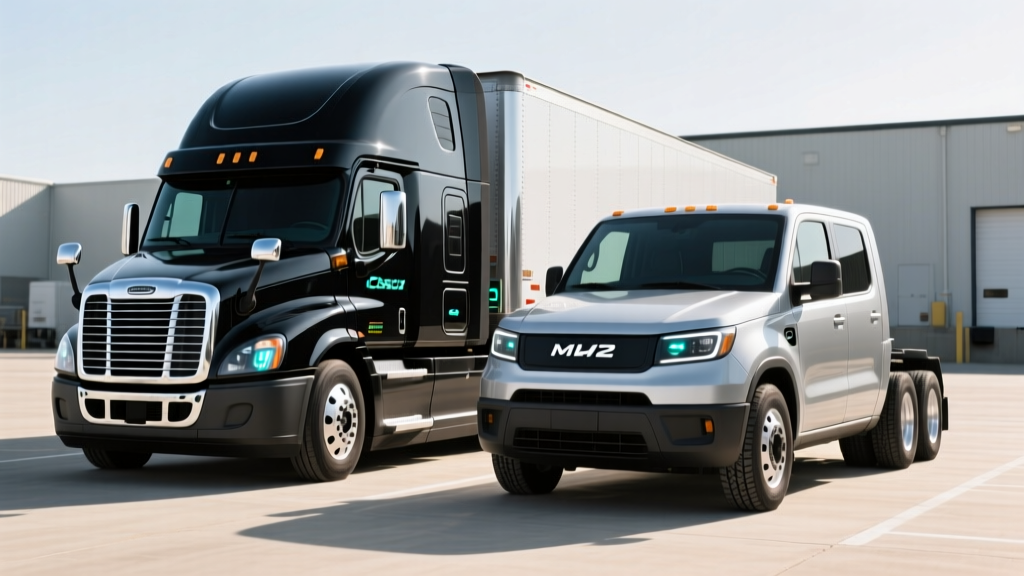
Freightliner eCascadia (Class 8): The heavy-duty workhorse aimed at regional freight, drayage, and distribution. Built on the proven Cascadia platform, it replaces the diesel engine with electric motors and a large battery pack mounted on the frame rails.
Freightliner eM2 106 (Class 6/7): A medium-duty box truck and delivery vehicle targeting last-mile logistics, food/beverage distribution, and municipal fleets. It's the electric variant of the popular M2 106.
Neither truck is designed for over-the-road long-haul. Both are built around a hub-and-spoke model: trucks leave a depot, complete a route, and return to charge. If your operation fits that pattern, the numbers start to make sense.
| Spec | eCascadia (Class 8) | eM2 106 (Class 6/7) |
|---|---|---|
| GVWR | 82,000 lbs (GCWR) | 26,000–33,000 lbs |
| Battery Capacity | 194 kWh / 315 kWh (usable) | 194 kWh / 315 kWh (usable) |
| Battery Chemistry | NMC (nickel manganese cobalt) | NMC |
| EPA Est. Range | Up to 230 miles (315 kWh) | Up to 250 miles (315 kWh) |
| Electric Motors | Dual e-axle, up to 470 hp | Single e-axle, up to 363 hp |
| Peak Torque | ~1,750 lb-ft | ~1,475 lb-ft |
| Max DC Fast Charge | ~180 kW (CCS1) | ~180 kW (CCS1) |
| 10–80% DC Charge | ~90 minutes (315 kWh pack) | ~90 minutes (315 kWh pack) |
| Level 2 AC Charging | ~19.2 kW | ~19.2 kW |
| Battery Warranty | 5 years / 600,000 miles | 5 years / 600,000 miles |
| Base MSRP (est.) | ~$280,000–$320,000 | ~$250,000–$290,000 |
Electric Freightliner vs. Diesel: Real Cost Comparison
The sticker price of an electric Freightliner is roughly 2–3× that of a comparable diesel model. A new diesel Cascadia typically runs $120,000–$160,000 depending on spec. The eCascadia lands in the $280,000–$320,000 range before incentives. That upfront gap is the single biggest barrier — and the reason total cost of ownership (TCO) analysis is essential.
| Cost Category | eCascadia (Electric) | Diesel Cascadia |
|---|---|---|
| Purchase Price (base) | $300,000 | $140,000 |
| Federal/State Incentives | −$40,000 to −$100,000* | $0 |
| Fuel / Energy (5 yr) | $75,000–$95,000** | $175,000–$210,000 |
| Maintenance (5 yr) | $18,000–$25,000 | $40,000–$55,000 |
| DEF / Emissions Systems | $0 | $5,000–$8,000 |
| Depot Charger Install (amortized) | $25,000–$50,000 | $0 |
| Estimated 5-Yr TCO | $378,000–$430,000 | $360,000–$413,000 |
*Incentives vary widely. The federal IRC §45W Commercial Clean Vehicle Credit offers up to $40,000 for qualifying Class 8 trucks. States like California (HVIP), New York (NYTVIP), and others add $50,000–$120,000+ in voucher incentives. Consult a tax professional and check current program availability.
**Electricity costs assume $0.12–$0.18/kWh blended depot rate. Diesel assumes $4.50–$5.20/gallon at 6.5 mpg average. Actual costs depend heavily on utility rates, route terrain, and payload.
The TCO gap narrows significantly — and can flip in the electric truck's favor — when state incentives are stacked, when depot electricity rates are below $0.12/kWh, and when diesel prices rise above $5/gallon. Fleets in California with HVIP vouchers have reported TCO parity within 3 years.
Range Reality: EPA Sticker vs. Real-World Miles
EPA vs. Real World: The eCascadia's 230-mile EPA estimate assumes a mix of urban and highway driving at moderate loads. In real-world regional haul operation:
- Loaded highway (80,000 lb GCWR, 65 mph): Expect 150–180 miles
- Urban delivery cycle (stop-start, lower speeds): Expect 190–220 miles
- Cold weather (below 32°F, loaded): Expect 120–160 miles
- Mountainous terrain (loaded): Expect 130–170 miles
Regenerative braking recovers significant energy on downhill grades and in stop-and-go traffic, partially offsetting the efficiency penalty of heavy payloads in urban duty cycles.
This is why route analysis is non-negotiable before ordering. Freightliner's eConsulting team works with fleets to model specific routes — elevation profiles, ambient temperatures, payload weights, and duty cycles — to predict actual energy consumption in kWh/mile. Most fleets find that routes under 175 miles round-trip are reliable year-round with the 315 kWh pack, even in northern climates.
The smaller 194 kWh pack reduces range by roughly 35–40% and is best suited to lighter-duty urban routes under 120 miles.
Charging Infrastructure: What Depot Charging Actually Costs
Unlike passenger EVs, commercial electric trucks don't rely on public charging networks. Fleet depot charging is the standard model, and it represents a significant capital investment.
| Component | Level 2 (19.2 kW AC) | DC Fast Charger (180 kW) |
|---|---|---|
| Charger Hardware | $8,000–$15,000 | $80,000–$150,000 |
| Electrical Installation | $5,000–$20,000 | $30,000–$80,000 |
| Utility Service Upgrade | $0–$15,000 | $20,000–$150,000+ |
| Permitting & Engineering | $2,000–$5,000 | $10,000–$30,000 |
| Total Per Stall | $15,000–$55,000 | $140,000–$410,000 |
Most fleet operators install a mix: DC fast chargers for mid-day top-ups and quick turnaround, plus Level 2 chargers for overnight charging. Overnight Level 2 charging at 19.2 kW adds roughly 25–30 miles of range per hour — enough to fully replenish a 315 kWh pack in 14–16 hours, which works for single-shift operations.
Critical consideration: Utility service upgrades are the wildcard. A depot adding 10 DC fast chargers may need a new transformer, switchgear, and medium-voltage service — a 12–18 month lead time in some utility territories. Start utility engagement 18–24 months before your target truck delivery date.
Public DC fast charging for commercial trucks is extremely limited in 2026. While networks like WattEV and TeraWatt Infrastructure are building truck-specific charging plazas along major freight corridors, coverage is concentrated in California and a handful of other states. Plan your operation around depot charging, not public infrastructure.
Myths vs. Facts: Common Misconceptions About Electric Freightliners
| Myth | Fact |
|---|---|
| "Electric semis can't pull heavy loads." | The eCascadia is rated for 82,000 lbs GCWR and delivers peak torque of ~1,750 lb-ft from zero RPM. Gradeability meets or exceeds comparable diesel at typical highway grades. The trade-off is range reduction under max payload, not capability. |
| "Batteries won't last and replacement costs a fortune." | Freightliner warranties the battery for 5 years / 600,000 miles with a capacity retention threshold (typically 70–80% SoH). NMC packs in commercial service are showing degradation of ~2–3% per year in moderate climates. Full pack replacement is estimated at $50,000–$80,000 — significant, but offset by years of fuel and maintenance savings. |
| "Charging takes too long for commercial use." | At 180 kW DC, a 10–80% charge takes ~90 minutes. For overnight depot operations on Level 2, charging happens while trucks are parked — zero downtime impact. The constraint is route planning, not charging speed per se. |
| "The grid can't handle fleet electrification." | Individual depot loads are manageable with utility coordination. Smart charging software staggers charge sessions to avoid peak demand charges. The challenge is real but solvable with 18–24 months of advance planning. |
| "Electric trucks are zero-emission everywhere." | Tailpipe emissions are zero. Upstream emissions depend on your utility's generation mix. A depot in a coal-heavy grid region has a larger carbon footprint than one on a grid with high renewables penetration. That said, even on dirtier grids, lifecycle emissions are typically 40–60% lower than diesel. |
Who Should Buy an Electric Freightliner (and Who Shouldn't)
Decision Framework: Is an Electric Freightliner Right for Your Fleet?
Choose the eCascadia (Class 8) if:
- Your routes are predictable and under 175 miles round-trip (loaded)
- You operate drayage, regional distribution, or dedicated lane freight
- You have (or can build) depot charging infrastructure
- You're in a state with significant commercial EV incentives (CA, NY, NJ, WA, OR, CO)
- Your fleet runs single-shift or has predictable mid-day layovers for top-up charging
- You're under regulatory pressure (e.g., CARB's Advanced Clean Fleets rule in California)
Choose the eM2 106 (Class 6/7) if:
- You run last-mile delivery, food/beverage distribution, or parcel routes
- Daily routes are under 200 miles with frequent stops (regen-friendly)
- You operate in urban areas with noise restrictions or zero-emission zones
- You want lower operating costs and reduced driver fatigue (no shifting, quieter cab)
Stick with diesel (or wait) if:
- Your routes regularly exceed 250 miles or are unpredictable
- You run long-haul, OTR freight without access to en-route truck charging
- Your depot is in a utility territory with long upgrade lead times and high demand charges
- You operate in extreme cold climates (northern MN, MT, AK) where range loss exceeds 35%
- Your capital budget can't absorb the upfront premium even with incentives
What First-Time Electric Truck Buyers Must Know
If your fleet is transitioning from diesel to electric for the first time, these are the operational realities that catch buyers off guard:
1. Order lead times are long. Electric Freightliners are built to order, and production slots are limited. Expect 12–18 months from order to delivery, sometimes longer for high-volume fleet orders. Plan ahead.
2. The charging infrastructure timeline is longer than the truck timeline. Utility service upgrades, permitting, and charger installation can take 18–24 months. Engage your utility and an electrical contractor before you place your truck order.
3. Driver training is essential but different. Drivers need to understand regenerative braking behavior, range-efficient driving techniques, charge connector handling (CCS1 connectors on heavy-duty trucks are large and require two hands), and state-of-charge management. Most drivers adapt within 1–2 weeks and prefer the quieter, vibration-free cab.
4. Demand charges can wreck your electricity budget. Commercial electricity billing includes demand charges based on your peak kW draw. Simultaneously charging 10 trucks at 180 kW each creates a 1.8 MW peak — which can trigger demand charges of $10–$25/kW/month in some utility territories. Smart charging software (e.g., Enel X JuiceNet, Amply Power) is not optional; it's essential to stagger charging and manage peak load.
5. Maintenance savings are real. No oil changes, no DPF regenerations, no DEF refills, no transmission fluid, no exhaust system repairs. Brake wear is dramatically reduced thanks to regenerative braking — some fleets report brake pad life extending 3–5× vs. diesel. The primary maintenance items become tire rotation, cabin air filters, coolant system checks, and software updates.
Federal and State Incentives: What's Available in 2026
The federal IRC §45W Commercial Clean Vehicle Credit provides up to $40,000 for qualifying Class 8 electric trucks (15% of basis for property subject to depreciation, up to $40,000 for vehicles over 14,000 lbs GVWR). This is a business tax credit — it reduces your federal tax liability and is not subject to the same MSRP or buyer income caps as the consumer §30D credit, but the vehicle must meet domestic content and battery sourcing requirements.
State-level incentives are where the real money is for commercial fleets:
- California HVIP: Vouchers of $60,000–$120,000+ per Class 8 electric truck, depending on fleet size and type. Subject to funding availability and application cycles.
- New York NYTVIP: Up to $185,000 for Class 8 electric trucks, with higher vouchers for disadvantaged communities.
- New Jersey, Washington, Oregon, Colorado: Various voucher and rebate programs ranging from $25,000–$75,000 per vehicle.
- Utility rebates: Many utilities offer make-ready infrastructure rebates covering 50–100% of charger installation costs.
Incentive programs change frequently — check current availability with your state energy office and a qualified tax professional before basing purchase decisions on specific amounts.
Frequently Asked Questions
Can the Freightliner eCascadia do long-haul routes?
Not practically in 2026. With a maximum real-world loaded range of ~180 highway miles and limited en-route truck charging infrastructure, the eCascadia is designed for regional haul, drayage, and dedicated lanes under 200 miles. Long-haul electric trucking will require either megawatt charging infrastructure (MCS at 1,000+ kW) or hydrogen fuel cells — both are years away from broad deployment.
How long does the eCascadia battery last before replacement?
Freightliner warranties the battery pack for 5 years / 600,000 miles with a guaranteed minimum state of health (typically 70–80% capacity retention). Based on current NMC degradation data from commercial fleets, expect 8–12 years of usable service before capacity drops below practical thresholds. A full pack replacement is estimated at $50,000–$80,000, though prices are expected to decline as battery manufacturing scales.
What happens if a truck runs out of charge on route?
Unlike a diesel truck that can be refueled in 15 minutes from a jerry can or a nearby truck stop, a depleted electric truck requires a tow or a mobile charger — both of which mean significant downtime and cost. This is why conservative route planning with a 20–30% range buffer is standard practice. Fleet telematics systems monitor real-time SoC and alert dispatchers before a truck is at risk.
Is an electric Freightliner cheaper to insure?
Not typically, at least not yet. Commercial insurance premiums for electric trucks are generally 10–25% higher than equivalent diesel models, reflecting higher replacement values, limited repair network familiarity with high-voltage systems, and battery replacement cost exposure. As the repair ecosystem matures and actuarial data accumulates, this gap is expected to narrow.
What connector does the eCascadia use?
The eCascadia and eM2 106 use the CCS1 (Combined Charging System Type 1) connector for DC fast charging, which is the North American standard for commercial and passenger EVs. The CCS1 connector on a Class 8 truck handles up to 500A and is physically larger than the passenger-car version. The future Megawatt Charging System (MCS) connector, designed for 1,000+ kW truck charging, is in development but not yet deployed on production Freightliners.